Fri, Nov 20 2026
Advocate Rajkumar
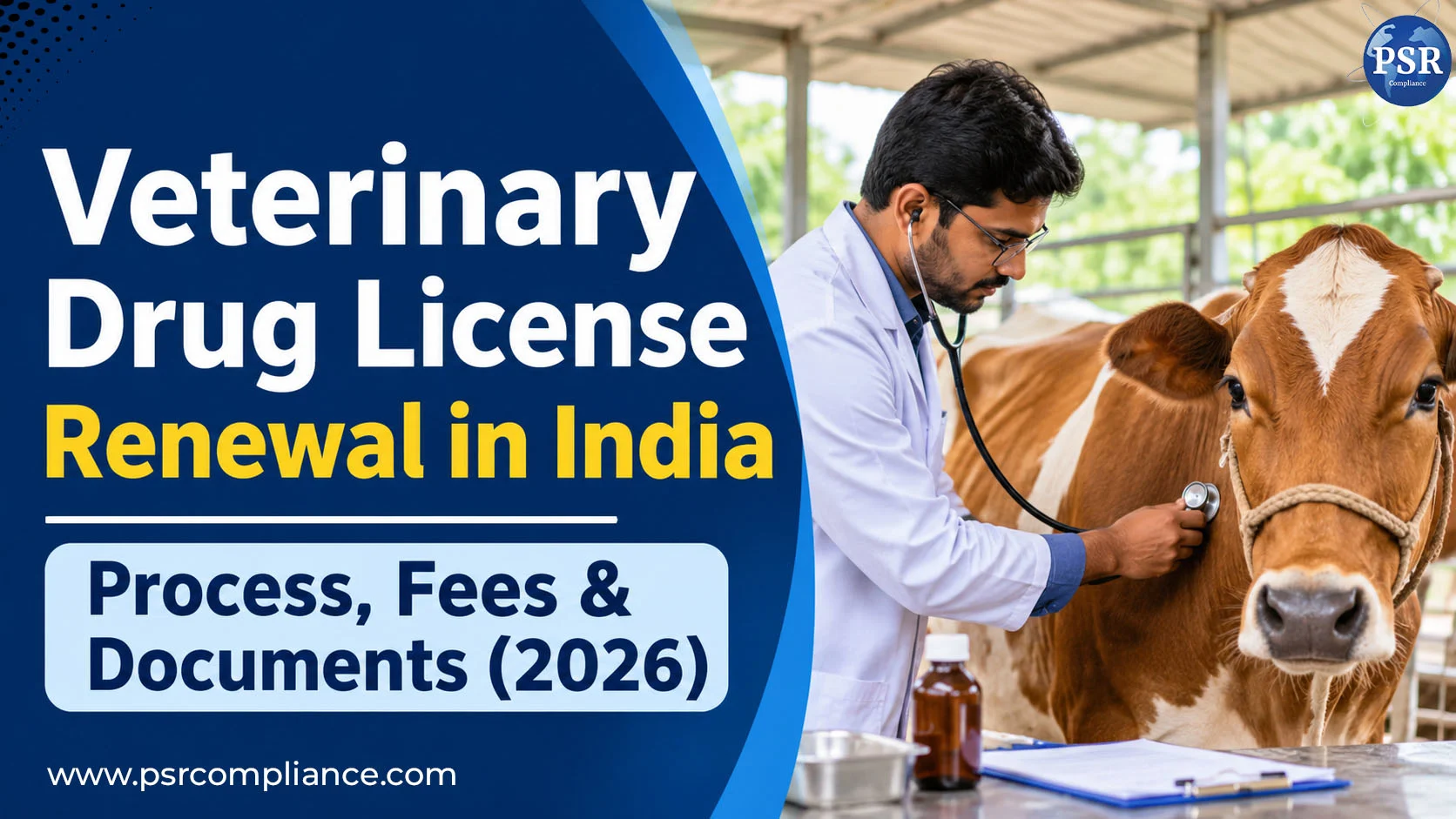
Veterinary Drug License Renewal in India: Process, Fees & Documents (2026)
Running a medical store for animals is a steady and respected business. Farmers, pet owners, dairy units and poultry farms all depend on you for safe medicines. But many veterinary shop owners get confused about one thing: The renewal of their license.
Do you still have to renew it every few years? How much do you pay? What if you miss the date? Because of this confusion, many shop owners pay late fees, or lose their license without knowing it.
This guide explains veterinary drug license renewal in simple words. You will learn what has changed, the process, the fees, the documents and the mistakes to avoid, so your shop keeps running smoothly.
What Is a Veterinary Drug License?
A Veterinary Drug License is official permission to sell, stock or distribute medicines for animals. It is issued by the State Drugs Control Department under the Drugs and Cosmetics Act, 1940 and the Drugs and Cosmetics Rules, 1945.
Veterinary medicines include antibiotics, vaccines, dewormers, vitamins, painkillers and other treatments for cattle, buffaloes, goats, poultry, dogs, cats and other animals.
In most states, a veterinary shop gets its license in the same forms as a normal medical store:
Form 20 and Form 21 for retail sale
Form 20B and Form 21B for wholesale
Without a valid license, selling veterinary medicines is illegal. You can read more in our guide on How To Apply For A Medical Store License
Veterinary Medical Store License: Who Needs It?
- You need a veterinary medical store license if you:
- Run a shop selling medicines for pets, cattle or poultry
- Operate a pharmacy inside an animal clinic or hospital
- Supply veterinary medicines to farms, dairies or other shops
- Distribute veterinary medicines in bulk (wholesale)
Even if you only sell a few products, the moment you sell medicines, a license is a must.
Big Change: Drug License Renewal Is Now "Retention"
This is the most important point in this blog, and many shop owners still miss it.
Earlier, a drug license had to be renewed every few years.
Now, since the Drugs and Cosmetics (Tenth Amendment) Rules, 2017, retail and wholesale drug licenses (including veterinary ones) are valid permanently, as long as you pay a license retention fee before the end of every five-year period from the date of issue. The license stays valid unless the authority suspends or cancels it.
So when people search for drug license renewal, what they really need to do today is pay the retention fee on time.
| Old System | New System |
|---|---|
| Renewal every few years | Retention fee every 5 years |
| New application each time | Simple payment and filing |
| Renewal certificate issued | License remains valid |
This saves time and paperwork. But it also means one thing: if you forget the date, penalties apply.
Veterinary Drug License Renewal: When Is It Due?
Your due date is before the end of each five-year period from the date your license was first issued.
Example: If your license was issued on 10 June 2021, your first retention fee is due before 10 June 2026. The next one is due before 10 June 2031, and so on.
Tip: Look at the issue date on your license, count five years forward, and set a reminder at least two months earlier.
Benefits of Veterinary Drug License in India
Obtaining a Veterinary Drug License in India offers several benefits to businesses involved in the sale, distribution, and supply of veterinary medicines.
- Legal Authorization: Allows businesses to sell and distribute veterinary medicines in compliance with applicable drug regulations.
- Business Credibility: Builds trust among customers, veterinary doctors, suppliers, and distributors.
- Business Opportunities: Helps businesses enter the veterinary pharmaceutical and animal healthcare market.
- Quality & Safety: Promotes proper storage, handling, and distribution of veterinary medicines.
- Avoids Legal Issues: Helps prevent regulatory action arising from operating without the required license.
- Supplier Partnerships: Makes it easier to establish relationships with authorized manufacturers and distributors.
- Business Expansion: Supports growth into veterinary pharmacies, wholesale distribution, and animal healthcare supplies.
- Conclusion: A veterinary drug license helps businesses operate legally, build credibility, and explore growth opportunities in India's veterinary pharmaceutical sector.
Documents for Veterinary Drug License Renewal
Here are the usual documents for veterinary drug license renewal (retention). Requirements vary slightly by state.
Basic Documents
- Copy of your existing drug license (Form 20/21 or 20B/21B)
- Application for retention of license
- Fee payment challan or receipt
- ID proof of the owner, partners or directors
- Updated proof of business constitution (partnership deed, company papers, etc.)
Premises Documents
- Rent agreement or ownership papers (still valid)
- Latest electricity or utility bill
- Premises layout, if any change was made
Technical Person Documents
- Registration certificate of the registered pharmacist (for retail) or details of the competent person (for wholesale)
- Appointment letter and consent, if the person has changed
Other Documents
- GST registration certificate
- Self-declaration that there is no change, or details of changes made
If anything changed after the license was issued, such as a new pharmacist, new address or new partner, you may need to apply for that change as well.
How to Renew Veterinary Drug License: Step by Step
Here is how to renew a Veterinary Drug License in simple steps. The exact portal differs from state to state, but the steps are almost the same.
Step 1: Check Your Due Date
Find your license issue date and note when the five-year period ends.
Step 2: Check Your Details
Make sure your shop name, address, pharmacist details and constitution are up to date. If anything changes (like a new pharmacist or a new address), update it first.
Step 3: Collect Documents
Keep scans of the required papers ready (list below).
Step 4: Log In to Your State Portal
Most states use an online system. Many use the state drug control portal or the national ONDLS system. Log in with your account.
Step 5: Select Retention of License
Choose the retention option for your license type (retail or wholesale).
Step 6: Fill Details and Upload Documents
Check each detail carefully, then upload your documents in the right format.
Step 7: Pay the Retention Fee
Pay the fee online and save the receipt.
Step 8: Download the Updated License or Acknowledgement
Once accepted, keep a copy for your records and display your license at the shop.
For more help, see our blog on Pharmacy License Registration And Renewal.
Veterinary Drug License Fees: What Will You Pay?
Many owners ask about Veterinary Drug License fees. Here is the simple view.
Retention fee: It is equal to the fee you paid to get the license in the first place (not counting the inspection fee).
As a rough guide, the government fee for a retail license is about ₹3,000 for Forms 20 and 21 together, and about ₹3,000 for a wholesale license. States may have small differences, so always check the latest amount on your state portal.
Late fee: If you pay after the due date, you must pay the retention fee plus a late fee of 2% of the license fee for every month or part of a month, up to six months.
After six months: If the fee is still not paid, the license is deemed cancelled. You would then have to apply for a fresh license.
| Situation | What Happens |
|---|---|
| Pay on or before due date | Only the retention fee |
| Pay within 6 months after due date | Retention fee + 2% late fee per month |
| Pay after 6 months | License is deemed cancelled |
Who Can Run a Veterinary Shop? Pharmacist and Staff Rules
Many people ask about the veterinary medication clerk license. In India, there is no separate license with that exact name. Instead, the rules focus on the license of the shop and the qualified person who runs it.
- For a retail veterinary shop: A registered pharmacist is usually required to supervise the sale of medicines. The owner does not have to be a pharmacist, but the pharmacist must work at the shop.
- For a wholesale business: A competent person, as per the rules (such as a registered pharmacist or a graduate with the required experience), must supervise.
Rules about who can run a veterinary store can differ by state, so confirm with your State Drugs Controller before you hire staff.
Your sales staff may help customers, but they should not sell prescription medicines without proper supervision.
License Requirements for Veterinary Drug Manufacturing in India
If you plan to make veterinary medicines instead of selling them, the rules are stricter. Here are the main license requirements for veterinary drug manufacturing in India:
- A manufacturing license from the State Licensing Authority (commonly in Forms 25 and 28 for many categories)
- A factory building that follows Good Manufacturing Practices (Schedule M)
- Proper machines, clean rooms, water systems and testing facilities
- Qualified technical staff, such as a competent person in manufacturing and testing
- Standard operating procedures and quality control records
- Compliance with the Drugs and Cosmetics Act and Rules
- A retention fee every five years to keep the license valid
- Veterinary vaccines and biologicals may need extra approvals from central authorities, so check before starting.
A wholesale license is also needed if you want to sell your products to shops and distributors. See our Wholesale Drug License page for details.
Why the Veterinary Drug License Matters: Real-Life Example
Veterinary medicines are closely watched because misuse harms animals and also people. In July 2019, the Indian government banned the use of the antibiotic colistin in food-producing animals, poultry and aquaculture. The reason was worry about drug-resistant germs spreading to humans.
Such rules show why authorities keep a close eye on veterinary shops and distributors. A licensed, well-run shop that follows the rules is safe from action. A shop that sells banned or unapproved products, or runs without a valid license, risks fines, seizure and closure.
What Happens If You Do Not Pay the Retention Fee?
Missing the date can cost you more than money.
- Late fee: 2% of the license fee for every month of delay, for up to six months
- Deemed cancellation: After six months, the license is treated as cancelled
- Illegal sale: Selling medicines without a valid license is an offence under the Drugs and Cosmetics Act
- Legal action: Fines, stock seizure, sealing of the shop and even imprisonment in serious cases
- Loss of business: Suppliers stop supplying to unlicensed shops
Paying on time is far cheaper than fixing the damage later.
Common Mistakes During Veterinary Drug License Renewal
From what we see, these are the most common errors:
- Thinking the license is "permanent" with no payment needed
- Forgetting the five-year due date
- Not updating a changed pharmacist, address or partner
- Using an expired rent agreement
- Uploading unclear or incomplete documents
- Mismatched names across papers
- Paying the wrong fee amount
- Ignoring queries from the drug control office
- Each mistake can cause delay, penalty or even cancellation.
Practical Tips for a Smooth Renewal
- Mark your due date on your calendar and set reminders two months early
- Keep your documents updated all year
- Renew your rent agreement before it expires
- Report any change in pharmacist or premises quickly
- Pay early, not at the last minute
- Keep a soft and printed copy of your license and fee receipt
- Take expert help if you are unsure
Why Choose PSR Compliance for Veterinary Drug License Renewal?
Renewing a veterinary drug license requires proper documentation and compliance with applicable drug regulations. PSR Compliance provides professional assistance to make the renewal process easier and more efficient.
- Timely Renewal Support: Helps track renewal and retention deadlines to avoid delays.
- Document Verification: Checks the required documents before application submission.
- Change Management: Assists with updates related to business address, pharmacist, and other license details.
- Fee & Payment Assistance: Guides you through applicable retention fees and outstanding dues.
- Application Filing: Provides assistance with accurate application preparation and submission.
- Department Coordination: Helps address regulatory queries and documentation requirements.
Choose PSR Compliance for reliable guidance and hassle-free assistance with veterinary drug license renewal.
If you are also starting a new shop, explore our Drug License Registration service, or read our guide on Retail Drug License Fees And Documents.
Conclusion
Timely Veterinary Drug License Renewal is essential to maintain legal compliance and ensure uninterrupted veterinary medicine business operations. Proper documentation, fee payment, and timely submission help avoid unnecessary delays and regulatory complications. PSR Compliance assists businesses with veterinary drug license renewal, documentation, application filing, and regulatory guidance for a smooth renewal process.
FAQs
1. What is a veterinary drug license?
It is official permission to sell or distribute medicines for animals, issued by the State Drugs Control Department.
2. Does a veterinary drug license need renewal?
Not in the old way. The license stays valid if you pay a retention fee before the end of every five-year period.
3. How do I renew a veterinary drug license?
Log in to your state licensing portal, choose retention of license, upload documents, pay the retention fee and keep the receipt.
4. What is the veterinary drug license fee for retention?
The retention fee equals the fee paid to grant the license, excluding the inspection fee. For a retail license, it is about ₹3,000, but check your state portal for the latest amount.
5. What if I miss the due date?
You can pay the fee with a late fee of 2% for every month of delay, up to six months. After that, the license is deemed cancelled.
6. What documents are needed for veterinary drug license renewal?
Existing license copy, fee receipt, ID proof, constitution proof, premises proof, pharmacist or competent person details, and GST certificate.
7. Is a pharmacist required for a veterinary shop?
Usually yes, a registered pharmacist is needed for retail. Wholesale needs a competent person. Rules can differ by state.
8. Is there a separate veterinary medication clerk license?
No separate license with that name exists. The rules focus on the shop license and the qualified person supervising it.
9. Can I sell veterinary medicines without a license?
No. It is illegal and may lead to fines, seizure and legal action.
10. What licenses are needed to manufacture veterinary drugs?
A manufacturing license from the State Licensing Authority, a GMP-compliant factory, qualified technical staff and other approvals, depending on the product.