Thu, Nov 19 2026
Advocate Rajkumar
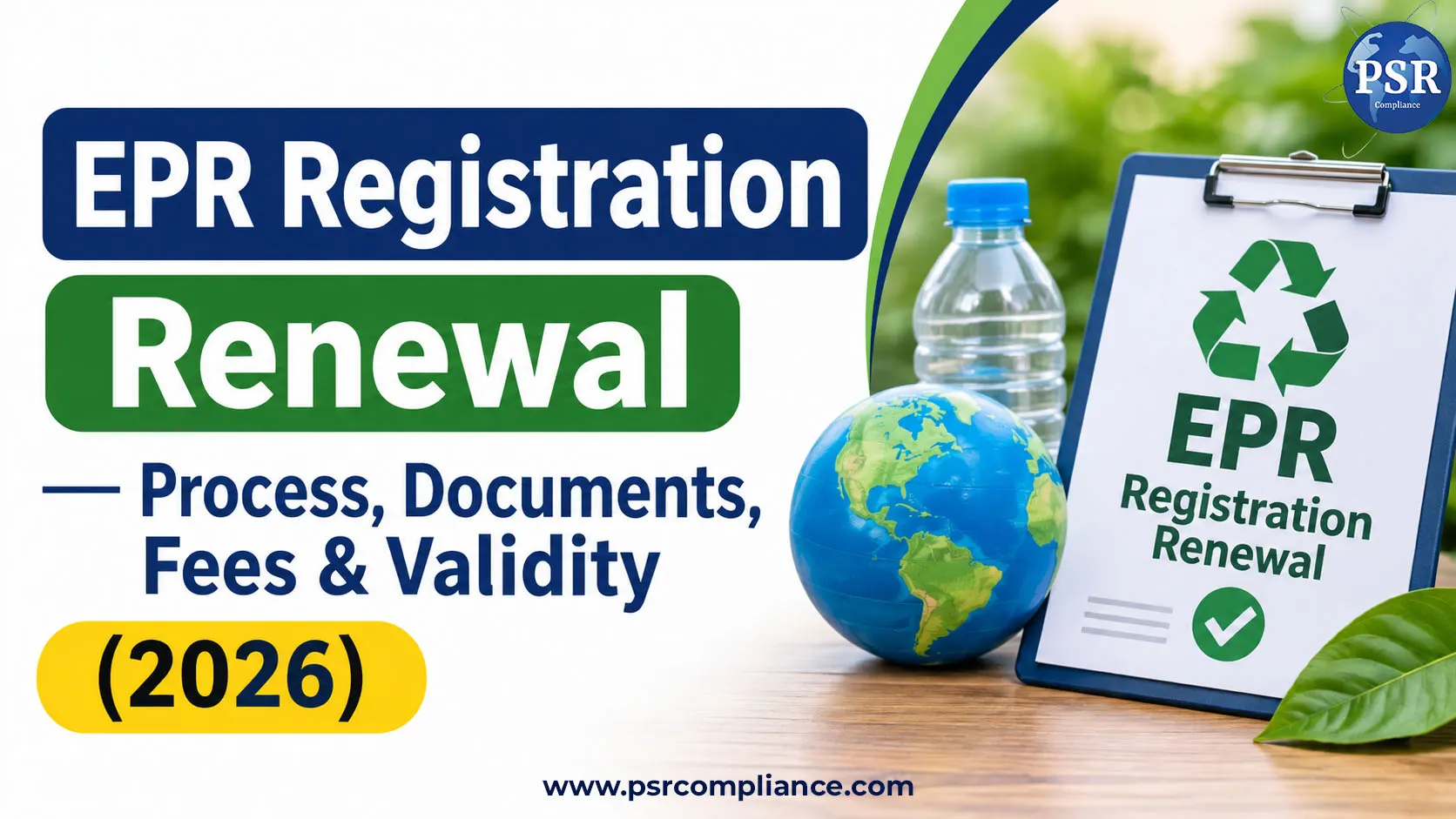
EPR Registration Renewal – Process, Documents, Fees & Validity (2026)
Getting your initial EPR Registration is a great first step for your business, but many business owners make a costly mistake thinking it is a one-time approval. In reality, every EPR Certificate comes with an expiry date, and keeping it active through timely EPR Registration Renewal is mandatory under Indian environmental laws. Because of changing Central Pollution Control Board (CPCB) portal rules, missing recycling targets, or confusion around EPR Annual Return Filing, hundreds of renewal applications get delayed or rejected every year.
This guide is written in simple, easy-to-understand language to walk you through the complete EPR License Renewal Process. It will show you what steps to follow, the exact Documents Required for EPR Renewal, the CPCB EPR Renewal Fees, what mistakes to avoid, and how you can renew your certificate without stress so your business keeps running smoothly.
What Is EPR Registration and an EPR Certificate?
EPR stands for Extended Producer Responsibility. It is an environmental policy made by the Government of India and managed by the Central Pollution Control Board (CPCB) and State Pollution Control Boards (SPCBs). Under this rule, any company that introduces products or packaging into the Indian market is responsible for collecting, recycling, or safely disposing of the waste left behind after customers use those products.
What Is EPR Registration Renewal and Why Does Your Business Need It?
EPR Registration Renewal is the official process of extending the validity of your existing EPR Certificate before it expires on the CPCB or SPCB portal. When you first apply for EPR Registration For Plastic Waste, your initial certificate is valid for only 1 year (while E-Waste and Battery registrations are valid for up to 5 years). Once that period is about to end, you must apply for EPR Renewal Online to continue selling, manufacturing, or importing your products legally.
Who Needs EPR Renewal in India?
- Producers (P): Businesses that manufacture plastic packaging, electronic goods, batteries, or tyres in India.
- Importers (I): Companies importing packaged goods, raw plastic, electronics, batteries, or tyres through Indian ports.
- Brand Owners (BO): Companies, FMCG brands, and e-commerce sellers selling products under their own brand name or trademark.
- Waste Processors and Recyclers (PWPs): Registered recycling plants and waste processors whose facility authorization is nearing its expiry date.
Different businesses fall under different waste rules, and your EPR Registration Renewal schedule depends on your specific category.
Here Is How EPR Categories Work for Renewal:
- EPR Registration for Plastic Waste: Governed by the Plastic Waste Management Rules. It covers four main categories, rigid plastic (Category I), flexible single-layer or multi-layer plastic (Category II), multilayered plastic packaging (Category III), and plastic sheets or compostable plastics (Category IV). First-time registration is valid for 1 year, and after EPR Registration Renewal, it is granted for 3 years.
- EPR for E-Waste: Applies to manufacturers, importers, and brand owners of IT equipment, consumer electronics, solar panels, and household appliances under E-Waste (Management) Rules. Renewal is granted for 5 years.
- EPR for Battery Waste: Applies to businesses dealing in electric vehicle (EV) batteries, inverter batteries, and portable cells under Battery Waste Management Rules.
- EPR for Tyre Waste & Used Oil: Applies to tyre manufacturers, importers, retreaders, and base oil/lubricant producers, where renewed certificates are valid for 2 years.
Why Is Timely EPR Renewal Online So Important?
If you operate with an expired EPR Certificate, you may face:
- Heavy Environmental Compensation (EC) fines and late fee penalties.
- Freezing of your CPCB portal account, blocking EPR credit transfers.
- Hold-ups and shipment seizures at Customs ports during import clearance.
- Delisting of your products from major e-commerce marketplaces and retail chains.
On the other hand, completing your EPR Registration Renewal on time gives you:
- Continuous legal permission to manufacture, import, and sell across India.
- Longer validity (such as 3 years of uninterrupted validity for plastic waste PIBOs).
- Strong trust from corporate buyers, customs officials, and e-commerce platforms.
EPR Annual Return Filing and EPR Annual Return Due Date (Mandatory Before Renewal)
You cannot get your EPR Registration Renewal approved if your past compliance records are incomplete. Before CPCB approves any renewal request, officials check whether your company has met its recycling targets and completed its EPR Annual Return Filing.
- What Is EPR Annual Return Filing: Every registered PIBO and recycler must submit an annual report on the CPCB portal showing the exact quantity of plastic, e-waste, batteries, or tyres placed in the market during the financial year (April 1 to March 31) and the EPR recycling certificates purchased against that target.
- What Is the EPR Annual Return Due Date: Under standard CPCB guidelines, the EPR Annual Return Due Date for Plastic Waste, E-Waste, and Battery Waste PIBOs is June 30 following the end of the financial year (unless officially extended by CPCB notification, such as periodic extensions granted for portal migration).
- Why It Matters for Renewal: If you miss the EPR Annual Return Due Date, the portal charges late filing penalties starting from ₹5,000 up to ₹20,000 or more, and your EPR Renewal Online application will remain stuck until all pending quarterly and annual returns are cleared.
Documents Required for EPR Renewal
- Existing EPR Certificate copy and CPCB registration number.
- Company PAN Card, GST Registration Certificate, and CIN (Certificate of Incorporation).
- Import Export Code (IEC) issued by DGFT (mandatory for Importers).
- PAN Card and Government ID proof of the Authorized Signatory along with a Board Resolution or Authorization Letter.
- Proof of EPR Annual Return Filing and quarterly return submissions for the previous compliance period.
- EPR Credit Certificate transfer proofs from CPCB-registered recyclers or co-processors.
- CA-certified sales, procurement, and plastic/product consumption data for the past 1 to 2 financial years.
- Updated EPR Action Plan covering state-wise waste collection and target projections.
- Valid SPCB Consent to Operate (CTO) and geo-tagged plant photos (for Producers and Recyclers).
Step-by-Step EPR License Renewal Process (EPR Renewal Online)
Step 1: Complete Pending EPR Annual Return Filing and Target Fulfillment
Before clicking the renewal button, check your CPCB portal dashboard. Ensure you have purchased enough recycling credits from registered recyclers to meet your previous year's obligation and completed your EPR Annual Return Filing.
Step 2: Log in to the CPCB Portal for EPR Renewal Online
Visit the official CPCB Common EPR Portal (or the dedicated portal for Plastic, E-Waste, Battery, or Tyre waste). Log in using your existing credentials and select the "Renew EPR Registration" option on your dashboard.
While Starting the Form, the Portal Will:
- Auto-fetch your existing EPR Registration details.
- Ask you to confirm whether there are any changes in company address, GST, or authorized signatory.
- Open the renewal schedule form (such as Form-I for Plastic PIBOs or Form 1(A) for Battery/Tyre Producers).
Step 3: Update Business Data and Upload Documents Required for EPR Renewal
Enter your updated year-wise sales, manufacturing, or import figures in Metric Tonnes (MT) or Tonnes Per Annum (TPA). Next, upload all the Documents Required for EPR Renewal in clear PDF format.
Step 4: Pay CPCB EPR Renewal Fees Online
Once your application and documents are uploaded, proceed to the integrated online payment gateway to pay the CPCB EPR Renewal Fees. Keep the payment receipt downloaded for your compliance file.
Step 5: CPCB Verification and Renewed EPR Certificate Issuance
After submission, CPCB or SPCB officials review your application, verify your past annual returns, and cross-check your uploaded documents.
CPCB EPR Renewal Fees and Annual Processing Charges
The CPCB EPR renewal fee depends on the annual plastic waste generation capacity of the Producer, Importer or Brand Owner (PIBO). Businesses must pay the applicable government fee to maintain their EPR registration and continue meeting environmental compliance requirements.
Plastic Waste EPR Renewal Fee Structure
| Annual Plastic Waste Generation | Government Renewal Fee | Annual Processing Fee (25%) |
|---|---|---|
| Below 1,000 TPA | ₹10,000 | ₹2,500 |
| 1,000–10,000 TPA | ₹20,000 | ₹5,000 |
| Above 10,000 TPA | ₹50,000 | ₹12,500 |
Important Points to Remember
- Renewal Charges: The applicable renewal fee depends on the annual plastic waste generation category.
- Annual Processing Fee: An additional processing charge of 25% of the applicable registration fee may apply.
- Online Payment: Payments are made through the official CPCB Common EPR Portal.
- Additional Expenses: Recycling certificates, consultancy charges and applicable late penalties are separate expenses.
- Fee Verification: Always check the latest fee structure before submitting your renewal application.
Note: The above fee structure is for Plastic Waste EPR registration of PIBOs. Actual payable charges may vary depending on the applicable CPCB rules and portal requirements. Verify the current fee before payment through the CPCB EPR Portal
Timeline and Validity for EPR Registration Renewal
- When to Apply: You must submit your EPR Renewal Online application at least 120 days (4 months) before expiry for Plastic Waste and E-Waste, and at least 60 days before expiry for Battery Waste.
- Document & Return Preparation: 5–7 working days.
- CPCB Portal Review: 15–30 working days (if no queries are raised).
- Validity After Renewal: Renewed EPR Registration for Plastic Waste is valid for 3 years, E-Waste and Battery Waste renewals are valid for 5 years, and Tyre Waste renewals are valid for 2 years.
Common Mistakes People Make During EPR Renewal
- Waiting until the final week before expiry instead of applying 120 days in advance.
- Missing the EPR Annual Return Due Date and trying to renew with pending returns.
- Uploading incorrect plastic packaging thickness or wrong category weights (Cat I, II, III, IV).
- Using mismatched PAN details when migrating to the CPCB Common EPR Portal.
- Not responding to CPCB portal queries within the stipulated resubmission window.
Real-Life Example: How an FMCG Packaging Brand in Delhi NCR Got Their EPR Registration Renewal Smoothly
A Noida-based food and beverage company held an EPR Registration for Plastic Waste for its packaged snack products. Because their team was busy with seasonal sales, they missed the 120-day advance renewal window and struggled to reconcile their Category II and Category III flexible plastic packaging data on the new CPCB Common EPR Portal. Their initial EPR Renewal Online attempt was flagged with a CPCB query due to a mismatch in their EPR Annual Return Filing, putting their upcoming retail shipments at risk.
They immediately reached out to compliance experts, audited their plastic procurement invoices, arranged verified recycling credits from CPCB-registered recyclers, cleared their pending return discrepancies, and resubmitted the complete Documents Required for EPR Renewal. Within 20 working days, their renewed EPR Certificate was approved for the next 3 years, saving them from hefty penalties and keeping their supply chain running without interruption.
Why Choose PSR Compliance for EPR Registration Renewal?
- Expert assistance with EPR registration and renewal.
- Support with CPCB portal applications and documentation.
- Assistance with annual return filing and EPR compliance.
- Guidance on recycling targets and certificate requirements.
- Support in resolving CPCB queries and application errors.
- End-to-end assistance until renewal approval.
Conclusion
Timely EPR Registration Renewal helps businesses maintain environmental compliance and avoid unnecessary penalties or registration delays. Whether you are a Producer, Importer or Brand Owner, PSR Compliance provides professional assistance with documentation, annual returns and the complete CPCB renewal process. Contact PSR Compliance to get your EPR registration renewed smoothly and on time.
Frequently Asked Questions
1. What Is EPR Registration Renewal and Why Is It Mandatory?
EPR Registration Renewal is the process of extending the validity of your EPR Certificate on the CPCB portal before it expires. It is mandatory to continue manufacturing, importing, or selling products using plastic packaging, electronics, batteries, or tyres legally in India.
2. When Should I Apply for EPR Renewal Online?
For EPR Registration for Plastic Waste and E-Waste, you must apply for EPR Renewal Online at least 120 days (4 months) before your current certificate expires. For Battery Waste, the renewal application must be filed at least 60 days before expiry.
3. What Is the Validity of an EPR Certificate After Renewal?
For Plastic Waste PIBOs, the initial EPR Registration is valid for 1 year, and after EPR Registration Renewal, it is valid for 3 years. For E-Waste and Battery Waste, the renewed certificate is valid for 5 years, and for Tyre Waste, it is valid for 2 years.
4. What Are the Documents Required for EPR Renewal?
The main Documents Required for EPR Renewal include your existing EPR Certificate, Company PAN, GST, CIN, IEC (for importers), Authorized Signatory PAN and ID proof, CA-certified sales/import data, proof of EPR Annual Return Filing, and EPR recycling credit certificates.
5. What Are the CPCB EPR Renewal Fees for Plastic Waste?
The CPCB EPR Renewal Fees for plastic waste PIBOs depend on annual plastic waste generation: ₹10,000 for less than 1,000 TPA, ₹20,000 for 1,000 to 10,000 TPA, and ₹50,000 for more than 10,000 TPA, along with an annual processing fee of 25% of the application fee.
6. Is EPR Annual Return Filing Mandatory Before Applying for EPR Renewal?
Yes, completing your EPR Annual Return Filing and fulfilling 100% of your previous year’s recycling targets through registered recycler credits is compulsory before CPCB approves your EPR Registration Renewal.
7. What Is the EPR Annual Return Due Date in India?
The standard EPR Annual Return Due Date for Producers, Importers, and Brand Owners (PIBOs) is June 30 following the end of each financial year (April–March), unless extended by an official CPCB notice.
8. Can PSR Compliance Help If My EPR Renewal Application Has a CPCB Query or Late Penalty?
Yes, PSR Compliance provides end-to-end support for resolving CPCB portal queries, calculating targets, sourcing affordable EPR recycling credits, completing pending EPR Annual Return Filing, and getting your EPR Registration Renewal approved quickly.