Thu, Nov 19 2026
Advocate Rajkumar
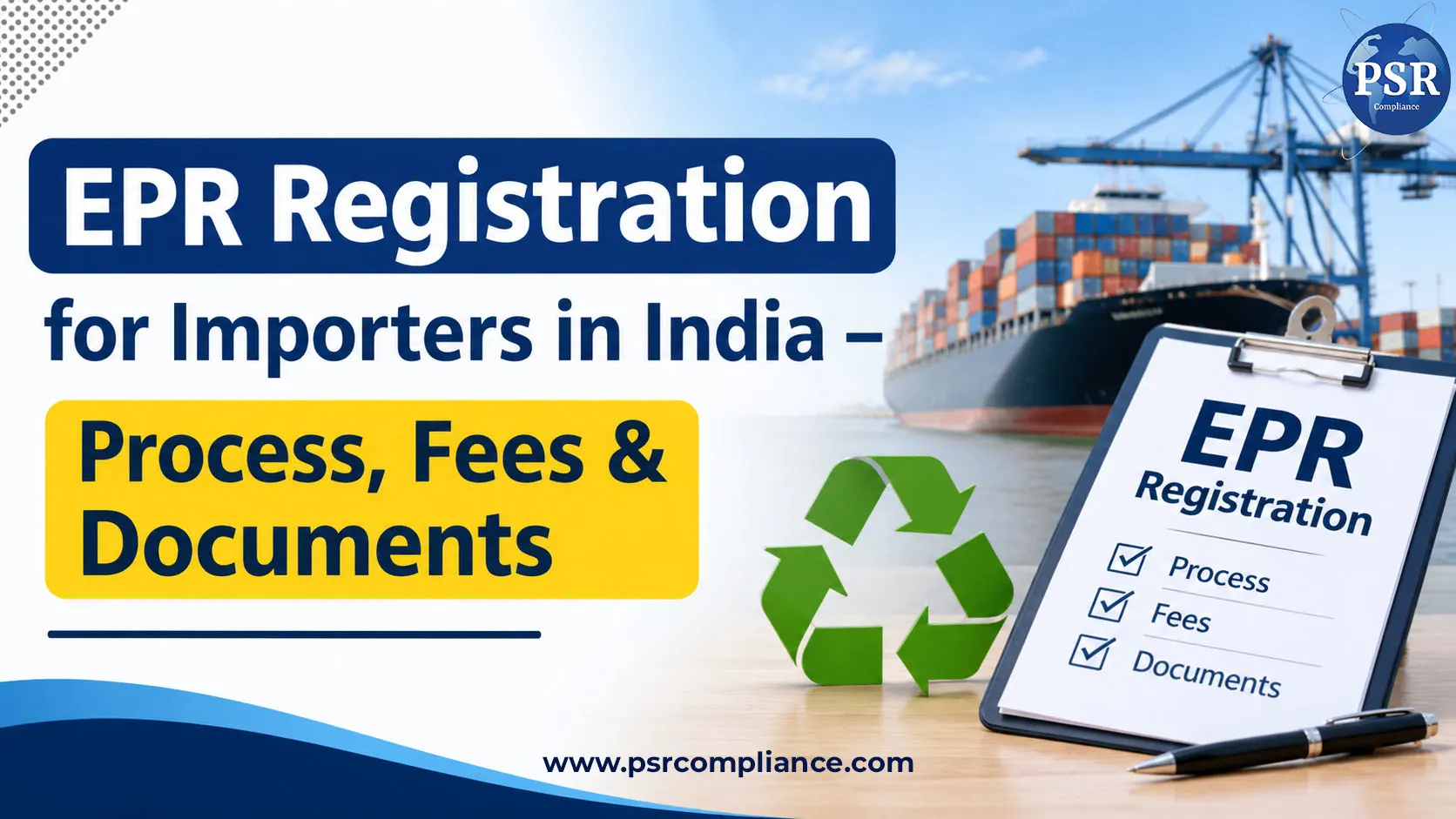
EPR Registration for Importers in India – Process, Fees & Documents
The importing of goods into India includes not just ensuring customs clearance, product quality, and taxes, but also knowing about one’s environmental obligations, especially if the imported goods or products come under the scope of Extended Producer Responsibility. The Government of India has made EPR rules that will ensure producers, importers, and brands are responsible for the waste management of products at the end of their lives.
If one imports goods that are subject to EPR rules, one must get EPR Registration for Importer if his business activities come under the ambit of these EPR rules. Based on the goods one is importing, one may need to register with the CPCB or the appropriate PCC/SPCB.
There are many different types of waste categories that fall under the ambit of EPR rules, some of which are plastic packaging, electronic and electrical equipment, batteries, and waste tyres.
Knowledge of the EPR Registration Procedure can help the importers to steer clear of any regulatory problems, handle the waste in an environmentally responsible manner, and conduct their business operations without disruptions.
What Is EPR Registration for Importers?
The Extended Producer Responsibility (EPR) is a policy that ensures that companies are accountable for the waste produced through products and packages introduced to the Indian market.
As per EPR regulations, importers have to take care of collecting, recycling, refurbishing, or ensuring proper disposal of the waste related to their products. The requirement of Extended Producer Responsibility Registration depends on the nature of imported products.
The major waste categories covered under EPR regulations include:
- Plastic Packaging Waste: Plastic packaging waste importers, products imported with plastic packaging, and specified plastic waste material.
- E-Waste: Importers of Electrical & Electronic Equipment regulated under the E-Waste (Management) Rules, 2022.
- Battery Waste: Battery producers and eligible battery importers and manufacturers of equipment containing batteries under the Battery Waste Management Rules, 2022.
- Tyre Waste: Tyre importers, vehicles with new tyres and waste tyres under the relevant rules.
- Used Oil: Used oil producers under the provisions of extended producer responsibility for used oil.
The above categories are governed by different rules and have different online registration processes. Hence, the appropriate category must be selected prior to application for CPCB EPR Registration.
Who Needs EPR Registration in India?
Not every importer is required to have the same kind of EPR Registration. It depends on the nature of the product, packaging, business activity, and definition under applicable regulations.
The following kinds of businesses must consider whether they need EPR registration:
1. Importers of Plastic-Packaged Products
Importers that bring in products in plastic packaging for any commercial activity may fall under the Plastic Waste Management Rules, 2016, and applicable EPR guidelines. This will include import of goods in plastic packaging as well as relevant plastic packaging materials.
2. Importers of Electronic Products
Importers of computers, laptops, mobile phones, televisions, refrigerators, and any other electrical and electronic products may qualify as producers under the E-Waste (Management) Rules, 2022.
3. Importers of Batteries
Businesses that import batteries or products with batteries should consider their EPR obligations under the Battery Waste Management Rules, 2022.
4. Importers of Tyres
Importers of new tyres, vehicles with new tyres, or waste tyres must consider their EPR obligations under the applicable rules for waste tyres.
5. Importers of Plastic Raw Materials
It should be noted that companies importing plastic raw materials, including certain resins, pellets, and intermediate products used to produce plastic packaging, may be required to register according to the appropriate plastic waste rules.
Documents Required for EPR Registration for Importers
Before initiating the EPR Registration Process, it is essential to gather all the necessary documents. Although the document checklist may vary depending on the type of waste, the following documents are usually required.
| Document | Purpose |
|---|---|
| PAN Card | Establishes the legal identity of the business |
| GST Registration Certificate | Verifies business and tax registration details |
| Import Export Code (IEC) | Establishes import-related business credentials |
| Certificate of Incorporation | Confirms company registration, where applicable |
| CIN Details | Identifies companies registered under the Companies Act |
| Authorised Person's PAN | Verifies the authorised representative |
| Authorisation Letter | Establishes the applicant's authority to submit the application |
| Registered Office Address Proof | Confirms the business address |
| Product Details | Identifies imported products and applicable categories |
| Import and Sales Data | Helps calculate applicable EPR obligations |
| Product or Packaging Details | Provides information about materials, quantities, and packaging |
How to Get EPR Registration for Importers in India: Step-by-Step Process
The EPR Registration Process is mainly done online using various portals designed for particular types of waste. It is vital to choose an appropriate portal for submission.
Here is a step-by-step explanation.
Step 1: Identify the Applicable EPR Category
For example, if you are importing electronic equipment, you can take a look at the E-Waste (Management) Rules, 2022. If your business is involved in the importation of products in plastic packaging, then you can see what the Plastic Waste Management Rules and their amendments contain.
Sometimes there can be an overlap whereby some firms might fall under two or more EPR regulations. For example, if you are importing electronic appliances in plastic packaging, you may need to consider two categories of regulations.
Step 2: Select the Relevant EPR Portal
After identifying the applicable category, visit the corresponding government portal.
The major online portals include:
- Plastic Packaging EPR Portal: CPCB Plastic EPR Portal
- E-Waste EPR Portal: CPCB E-Waste Management Portal
- Battery Waste EPR Portal: CPCB Battery EPR Portal
- Waste Tyre EPR Portal: CPCB Waste Tyre Portal
There are provisions within the portals for registrations, information submissions, and EPR obligations.
Step 3: Create an Account on the Portal
The following step is to register as an applicant in the chosen portal.
Usually, the applicant should provide business-related information such as:
- Name of the legal business
- Type of business
- Details of PAN
- GST number
- Import Export Code
- Address of registered office
- Name of authorised person
- Email address
- Mobile number
Other kinds of OTP verification processes may be asked.
Step 4: Complete the EPR Application Form
Once the account creation process is completed, log in to the portal and fill out the necessary application form. Typically, the application requests information about the business, the type of imported products, quantity, and waste categories applicable to the company.
The portal can also require you to provide the following information:
- Details of imported products
- Categories and description of the products
- Quantity of annual imports
- Domestic sales details
- Packaging material and quantity
- Information regarding batteries or electronic products
- Historical import information if necessary
- Waste management arrangements proposed
- Be sure to provide correct and well-supported information.
Incorrect product data and inaccurate information about the quantities imported might cause more questions in the process of CPCB EPR Registration.
Step 5: Upload the Required Documents
Having filled out the application, upload the supporting documents. Check if the uploaded document is readable and matches the information entered in the application.
Companies that apply for the EPR Certificate for Importer should have supporting documentation related to quantities and packaging of their products.
Step 6: Pay the Applicable Registration Fee
In certain cases, EPR portals demand application or processing fees based on the category and prescribed guidelines. The fee system is not the same for all the categories of EPR. This can vary according to the business classification, the type of registration, and certain other prescribed parameters. Before paying, importers must review the current fee schedule from the related portal.
Step 7: Application Verification and Approval
Upon submission, the application will be reviewed by the related regulatory authority along with the required documents. Based on the category, the application will be processed either by the Central Pollution Control Board or the related State Pollution Control Board/Parastatal Councils. In case of any shortfall of information, the related authority may ask for any clarification. The importer will have to provide the required information or correct documents in return.
When the application fulfills all the required criteria, the authority may approve the application through the online portal. It must be remembered that the EPR Registration Online process is not only filling out a form but much more than that.
EPR Compliance Responsibilities After Registration
Registration is just the first step for an importer’s environmental compliance obligations. Companies have to comply with their obligations under the concerned waste management regulations as well.
The following are some of the crucial obligations:
1. Meet Annual EPR Targets
It is obligatory for importers to achieve the respective Extended Producer Responsibility goals. This includes meeting obligations related to collecting, recycling, refurbishing, or utilizing recycled material depending on the type of waste and relevant rules.
For instance, importers of electrical/electronic equipment must achieve their obligations regarding recycling as stipulated in the E-Waste (Management) Rules, 2022.
2. Work With Registered Recyclers
Importers might have to collaborate with registered recyclers, refurbishers, or other authorized waste processors to meet their EPR obligations.
According to the concerned framework, the EPR certificates are issued through the respective portal by registered recyclers/processors.
It is imperative that companies keep proper records of their transactions and certificates.
3. File Annual Returns
Businesses registered under EPR shall submit annual returns and compliance information within specified time periods.
The returns may contain information on quantity of imports, products that have been introduced in the market, waste management processes undertaken, and achievement of the EPR objectives.
4. Maintain Business and Import Records
Importers shall keep invoices, import data, sales records, product data, and waste management data.
These records will assist the importer in showing their compliance status.
5. Monitor Changes in EPR Regulations
The EPR laws are updated from time to time in order to enhance waste collection and recycling.
Importers should be in touch with CPCB notifications to ensure that their registration and compliance activities stay in tune with these updates.
The government has provided online systems for major waste categories for the purpose of registration, obligations, certificates, and annual returns.
What Is the Difference Between EPR Registration and an EPR Certificate?
Importers often use the terms EPR registration and EPR certificate interchangeably. However, they refer to different aspects of environmental compliance.
| EPR Registration | EPR Certificate |
|---|---|
| It is the registration granted to an eligible business under the applicable EPR rules. | It is a certificate generated through the applicable system to demonstrate eligible recycling or other prescribed compliance. |
| It establishes the business's status as a registered entity. | It helps fulfil applicable EPR obligations. |
| It is obtained by submitting an application to the relevant authority. | It is generally generated by eligible registered recyclers or processors. |
| It involves business and product-related information. | It involves eligible waste processing and compliance-related information. |
It is imperative that an EPR Registration Certificate for Importers is not to be taken as the registration certificate given to the importer. First, the importer needs to get registration, and then he needs to fulfill his responsibilities under the relevant compliance mechanism.
What Are the Fees for EPR Registration in India?
The cost involved for EPR Registration for India will vary depending on the category of waste, relevant rules, classification of the applicant, and the requirements of the portal.
There is no uniform registration fee for all importers.
Some of the costs may include:
- Applicable government fee for application or processing, if any.
- Professional fees for filling out the applications.
- Documentation or compliance costs.
- Applicable cost of fulfilling the EPR responsibility.
- Other professional costs, if any.
A professional EPR Registration Agency can help you know the cost involved.
What Happens If an Importer Does Not Obtain EPR Registration?
Not getting mandatory EPR registration can pose various problems for the importer. All importers whose products fall under the scope of the pertinent waste management legislation need to meet all registration and compliance obligations required under the legislation.
Consequences of non-compliance can take the following forms:
1. Environmental Compensation
The authorities can impose environmental compensation on the violations as per the rules and guidelines applicable under the legislation.
2. Regulatory Action
Companies can receive notices/directions or any such other regulatory actions from the authorities.
3. Import and Business Difficulties
Non-availability of registration documentation can pose compliance-related problems such as problems with regulatory checks/clearance at the customs end, if any.
4. Audit and Inspection Issues
Companies can be asked to provide documentary evidence that they have complied with their environmental obligations.
5. Financial and Reputational Losses
Not complying with the regulation can raise the cost of doing business and damage relations with the distributors/clients/any other stakeholder.
Hence, all importers need to go for EPR Registration Online and keep their compliance records instead of facing any regulatory consequences.
Why Should Importers Hire an EPR Registration Consultant?
Collaboration with an expert in the field of EPR registration will help you to systematize the whole process. The following is a list of advantages of using professional services.
- Identification of the Right EPR Category: An expert will help you to analyze your products and to find out what category should be selected for this case and which regulatory body should control this process.
- Assistance in Creating Documentation: Professional assistance will come in handy while preparing documents like PAN, GST, IEC, registration certificate, product description, etc.
- Application Help: An expert in EPR registration will help you to complete the application form, to upload necessary documents, and to avoid any application-related problems.
- Compliance Assistance: It is important not only to register but to perform all compliance obligations in relation to recycling and other requirements.
- Regulatory Updates: It is always better to get help from an expert EPR Compliance Consultant to stay updated regarding amendments, notifications, and changes in the procedure on the portal.
**Selection of appropriate EPR Registration Services can help save a lot of time and minimize chances of mistakes during the application procedure. Regulatory decisions and approvals always lie with the concerned authority.
How PSR Compliance Can Help With EPR Registration for Importers
Our PSR Compliance offers professional regulatory and compliance assistance to organizations requiring help with EPR Registration for Importers. We can help you in complying with the environmental regulations. Our EPR Registration Services can help businesses with identification and organization of EPR requirements.
Whether it's the matter of importing electronics, plastic packaged goods, batteries, or tyres, we can help you with that.
PSR Compliance can support your business with:
- EPR category identification
- Document preparation for registration
- Online application assistance
- Understanding EPR compliance obligations
- Assistance in understanding annual return obligations
- Providing information about regulatory updates
If you need assistance with your EPR Registration in India, contact PSR Compliance to know more about the EPR Registration process in India.
Conclusion
There is growing significance of being compliant with the EPR regulations in India, especially when it comes to importing any product that is subject to waste management rules. This could involve electronic equipment, batteries, packaging material, or tyres.
PSR Compliance will be able to assist you with the EPR Registration Services. If you are looking for professional guidance in this regard, PSR Compliance can help you out.
Frequently Asked Questions (FAQs)
1. Is EPR Registration mandatory for importers in India?
EPR registration is mandatory for importers falling under the definition and scope of the applicable waste management rules. Such importers include importers of plastic packaging, electronic equipment, batteries, and tyres, depending on their category and respective rule.
2. Which authority provides EPR Registration in India?
EPR registration in India is provided by CPCB through several centralized EPR registration portals. Depending on the rule and category, EPR registration can be obtained from CPCB or the respective State Pollution Control Board or Pollution Control Committee.
3. What is the validity of an EPR Registration Certificate?
Validity will depend upon the waste management regulations and registration category. For instance, registration of plastic packaging material will be based on once-off registration under the concerned regulations. It is advisable that importers make sure about the validity and other requirements of continuous compliance for their respective category.
4. Can importers apply for EPR Registration online?
Yes. Importers can get themselves registered through the concerned CPCB EPR website for their respective waste category. The process of EPR Registration Online consists of creating an account and submitting the business details and other information.
5. What documents are required for EPR Registration for Importers?
Importers generally need a PAN card, GST registration certificate, Import Export Code (IEC), Certificate of Incorporation (where applicable), authorised person's details, registered office address proof, product details, and import or sales data. Requirements may vary depending on the EPR category.
6. How much does EPR Registration cost in India?
The cost of EPR Registration depends on the applicable waste category, type of business, government processing fees, and professional assistance charges. There is no single fixed registration fee for all importers.
7. Is EPR Registration mandatory for importing electronic products?
Yes, eligible importers of electrical and electronic equipment must obtain registration under the E-Waste (Management) Rules, 2022, and fulfil the applicable EPR obligations through the CPCB portal.
8. Can an importer apply for multiple EPR registrations?
Yes. If an importer deals with products covered under multiple EPR categories, such as electronic equipment with plastic packaging or products containing batteries, separate registrations or category-specific compliance may be required.
9. What is the role of CPCB in EPR Registration?
The Central Pollution Control Board (CPCB) regulates and administers EPR registration through designated online portals for applicable waste categories. It also oversees compliance requirements, EPR targets, and reporting under the relevant regulations.
10. Do importers need to file annual returns after EPR Registration?
Yes. Eligible registered importers must submit annual returns and compliance information within the prescribed deadlines. These returns generally include import quantities, products introduced into the market, and details of waste management and EPR target fulfilment.