Fri, Nov 20 2026
Advocate Rajkumar
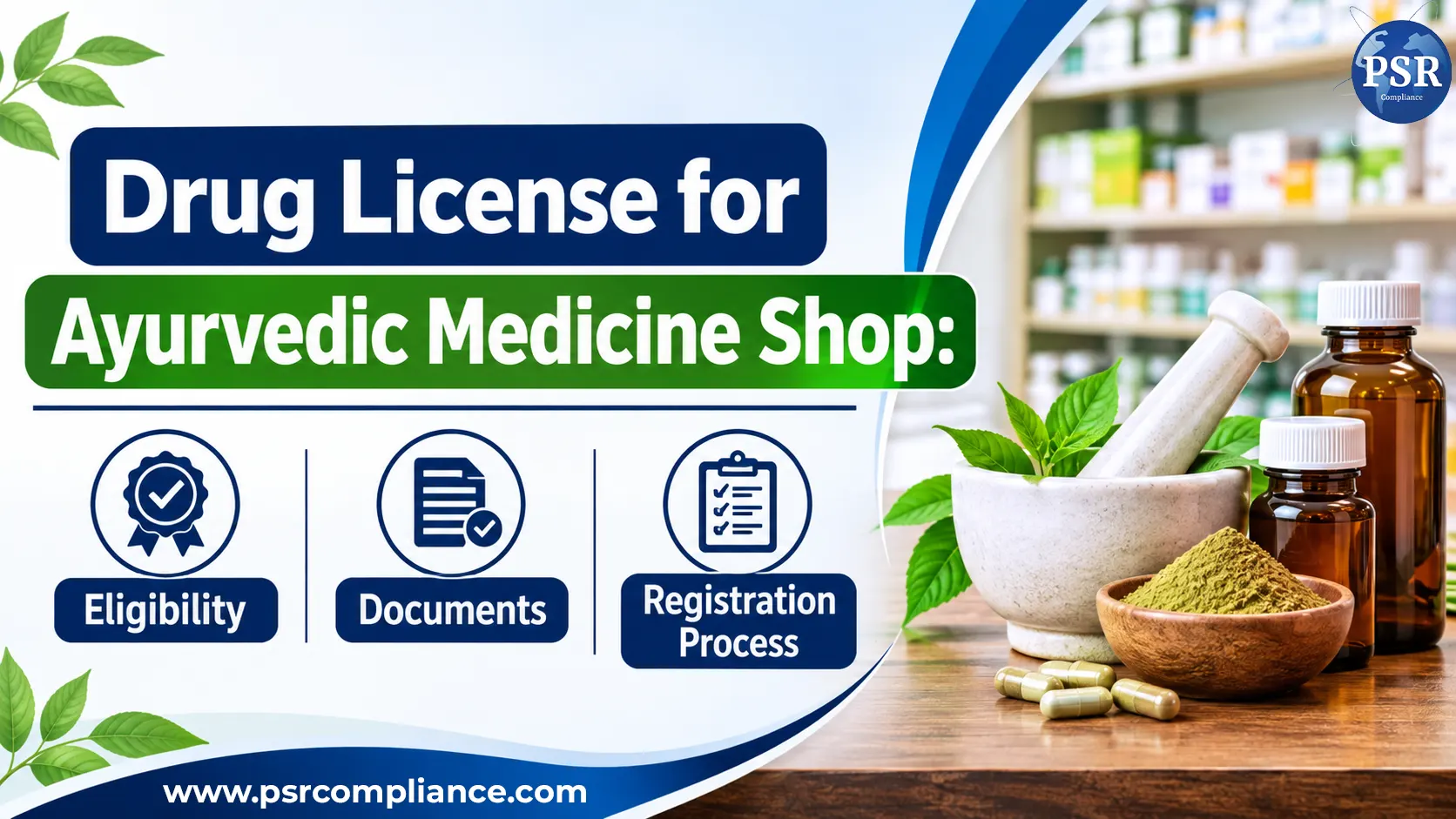
Drug License for Ayurvedic Medicine Shop: Eligibility, Documents & Registration Process
Starting an Ayurvedic medicine shop in India requires compliance with applicable drug regulations and business registration requirements. Ayurvedic medicines are regulated under the Drugs and Cosmetics Act, 1940.
Retail sale of genuine Ayurvedic medicines generally does not require a separate retail drug licence under central rules. However, state-specific requirements and local permissions should be checked. If you also sell allopathic medicines, a retail drug licence is required.
Proper medicine storage, authorised suppliers and product compliance are essential for running an Ayurvedic medicine shop legally.
What Is a Drug License for an Ayurvedic Medicine Shop?
Ayurvedic Medicine Shop Drug License is one of the phrases often used by businessmen who would like to get authorization to set up and conduct the business of selling these kinds of medicines that they are looking to be authorized for, which differs from the licensing of the manufacturer of Ayurvedic medicines and the selling thereof.
Under the provisions of the Drugs and Cosmetics Act of 1940, the Ayurvedic medicines fall into the classification of traditional medicine, and these Ayurvedic medicines are formulated according to the provisions laid down in the law.
From the information provided by the Indian government, it is clear that there is no requirement for any particular sales license for the sale of Ayurvedic, Siddha, and Unani medicines. But there is a requirement for manufacturing these kinds of Ayurvedic, Siddha, and Unani medicines under the manufacturing license.
Hence, it is essential for any aspiring entrepreneur to determine what products he wants to deal in, along with determining what type of licensing agreements he should have.
The licensing of Ayurvedic drugs is not the same as the licensing of allopathic drugs, as both of these come under different regulations.
For example, in case the shop sells only the registered Ayurvedic drugs, the licensing regulations are different from those for pharmacies selling prescription drugs. Also, in case the shop deals with allopathic drugs too, it becomes imperative to get a retail drug license as well.
Is an Ayurvedic Medicine Shop License Mandatory in India?
It definitely stands out to be one of the most crucial aspects that have to be considered in the event of any individual who is planning to venture into business in Ayurvedic medicines.
Normally, there is no need for any special permission to sell Ayurvedic, Siddha, and Unani medicines in the absence of such special permission. However, it does not imply that the Ayurvedic shop will run on a legal footing without having any prerequisites whatsoever.
In this regard, the owner of the business will have to acquire the required permits as well as registrations depending upon the nature of the business.
Some of these aspects are:
- Business Registration: The business shall get properly registered, whether in the name of a sole proprietorship, partnership, LLP, or Pvt. Ltd. Company.
- Shop and Establishment Registration: A proprietor needs to be acquainted with the rules and regulations for registration of shops and establishments of all states.
- Trade License: It is also a requirement for the business as per the municipal laws.
- GST Registration: Whether the registration under GST is necessary or not depends upon the turnover and nature of the business, etc.
- Product Certification: It is mandatory that the product should be procured from an authorized manufacturer and must have proper labeling.
- Drugs License: In case you are going to sell allopathic medicines, then it becomes necessary for you to obtain a drug license.
Therefore, it is recommended that you should first analyze your entire business model instead of applying for unnecessary licenses.
Benefits of Running an Ayurvedic Medicine Shop
- Growing demand for Ayurvedic and herbal healthcare products.
- Opportunity to serve customers seeking traditional medicines.
- Wide range of Ayurvedic products to sell.
- Scope to build relationships with trusted manufacturers and suppliers.
- Opportunity to expand into herbal wellness and healthcare products.
- Builds customer trust through proper regulatory compliance.
Documents Required to Open an Ayurvedic Medicine Shop
However, a license for the sale of Ayurvedic drugs separately may not be required for retail sale. Entrepreneurs need to organize the necessary paperwork for the registration of their business and other required permissions.
The commonly required documents include:
| Document | Purpose |
|---|---|
| PAN Card | Identity and tax-related verification |
| Aadhaar Card | Identity and address verification, where applicable |
| Passport-size photographs | Business owner identification |
| Address proof | Verification of the business premises |
| Rent agreement or ownership proof | Evidence of premises possession |
| Electricity bill | Supporting address documentation |
| Business registration documents | Proof of legal business constitution |
| Bank account details | Business financial transactions |
| GST registration | Where registration is applicable |
| Shop and Establishment registration | Compliance with applicable state requirements |
| Trade licence | Where required by the local authority |
Step-by-Step Process to Start an Ayurvedic Medicine Shop
Setting up a business selling Ayurvedic medicines requires proper planning and consideration of all legal aspects that need to be taken into account in the process of setting up the business. The following guide can be helpful to a businessman setting up his business.
Step 1: Decide the Business Structure
The first step in the process includes choosing the appropriate business structure. One can set up an Ayurvedic medicine shop as a proprietorship, Partnership, LLP, or Private Limited Company.
Step 2: Select Suitable Business Premises
Choose a commercial space that is easily reachable to consumers as well as one where Ayurvedic products can be stored safely.
This should be a place with proper storage facilities, adequate ventilation, and no signs of dampness or heat.
Follow the guidelines and laws that the municipality and state government prescribe before selecting the place.
Step 3: Obtain Applicable Business Registrations
Do all the necessary registrations like those of Shop & Establishment, trading license, and GST registration if needed.
Searching for “Ayurvedic Medicine Shop Licence Online” may bring up different portals, but the businessman should find out if that license is needed for his business or not.
Step 4: Identify Authorised Manufacturers and Suppliers
Use only the authorized manufacturers and suppliers to buy Ayurvedic medicines.
This means that you should have information on the name of the manufacturer, manufacturing license, label on the medicine, batch number, manufacturing date, and expiry date.
Step 5: Maintain Proper Storage and Records
Medicines may be classified according to the category and storage requirements of the products.
Maintain documentation of invoices, suppliers, and inventory. Make sure that medicines that have passed their expiry date are removed from sales.
Step 6: Review Product-Specific Compliance
There are certain Ayurvedic medicines containing certain components that require special handling and expert advice.
For example, the medicines that contain the ingredients listed under Schedule E(1) would be required to be properly labelled. While selling traditional medicines, the retailer must not ignore such requirements.
Step 7: Start Retail Operations
After completing all the above procedures, one can begin his/her retail business.
Make sure that the customer is supplied with genuine medicine along with its correct information. Avoid making any false medicinal claims.
Entrepreneurs may seek guidance on all the above steps from an AYUSH License Consultant.
Cost of Drug License for Ayurvedic Medicine Shop
Selling only Ayurvedic medicines generally does not require a separate retail drug licence under central drug rules. Therefore, there is no standard government fee for such a retail drug licence.
However, business registration, local permissions and other applicable compliance costs may vary depending on the state and business structure.
| Particulars | Estimated Cost |
|---|---|
| Ayurvedic Retail Drug Licence | Not Required under central rules |
| Business Registration | ₹1,000–₹5,000 |
| Shop & Establishment Registration | ₹500–₹2,000 |
| Local Trade Licence (if applicable) | ₹500–₹3,000 |
| Professional Consultancy | Depends on service provider |
Note: The above costs are indicative, not fixed government fees. Actual charges vary by state and business requirements. A separate retail drug licence may be required if you also sell allopathic medicines.
Timeline for Ayurvedic Medicine Shop Registration
| Registration / Process | Estimated Timeline |
|---|---|
| Business Registration | 3–7 Working Days |
| Shop & Establishment Registration | 3–10 Working Days |
| Local Trade Licence (if applicable) | 7–15 Working Days |
| Overall Setup & Compliance | 7–15 Working Days |
Note: The timeline may vary depending on the state, local authority and completeness of documents.
Difference Between an Ayurvedic Drug Licence and an Allopathic Drug Licence
There is often confusion among entrepreneurs in understanding the Ayurvedic Drug License and the allopathic retail drug licence. These two licenses are not the same, though the drugs they cover are similar.
The following table explains the key differences:
| Basis | Ayurvedic Medicines | Allopathic Medicines |
|---|---|---|
| Regulatory framework | Drugs and Cosmetics Act, 1940 | Drugs and Cosmetics Act, 1940 |
| Product category | Ayurveda, Siddha and Unani medicines | Modern pharmaceutical medicines |
| Retail sale licence | Generally not required for ordinary ASU medicine sales | Required under applicable provisions |
| Manufacturing licence | Required for manufacturing for sale | Required for manufacturing for sale |
| Manufacturing authority | State Licensing Authority | State Drug Licensing Authority |
| Product standards | Applicable ASU standards and requirements | Applicable pharmacopoeial and drug standards |
| Special labelling | Rules 161, 161A and 161B | Applicable drug labelling rules |
Special Compliance Requirements for Selling Ayurvedic Medicines
It is essential to keep in mind that even if a separate retail sale license is not needed, there are some essential requirements which must be fulfilled by the retailers of Ayurvedic medicine.
1. Purchase Medicines from Licensed Manufacturers
The medicines that are sold need to be produced by authorized manufacturers.
2. Follow Labelling Requirements
The labeling and packaging of Ayurvedic medicines are required to conform to the relevant provisions of the Drugs and Cosmetics Rules, 1945.
The labels of products need to include the necessary particulars, such as particulars of the manufacturer, batch particulars, manufacturing and expiry particulars, and other such particulars.
3. Exercise Caution with Schedule E(1) Medicines
Some of the Ayurvedic medicines have ingredients which are included in Schedule E(1). Rule 161(2) states that for any medicinal product used internally having such ingredients, the necessary caution needs to be provided on the labels.
The Central Consumer Protection Authority has also asked the e-commerce operators to ensure that the prescriptions are maintained for the ASU medicines having Schedule E(1) ingredients.
4. Avoid Misleading Advertisements
It is advisable that retailers should not advertise Ayurvedic medicines with misleading claims such as guarantees of cure, permanent cure, or freedom from side effects.
5. Maintain Purchase and Stock Records
Invoices and inventory records can help retailers to prove the source of their medicines along with the management of expiration requirements.
What If You Want to Manufacture Ayurvedic Medicines?
There is a distinction between opening an Ayurvedic medicine shop and setting up an Ayurvedic medicine manufacturing unit. If the activity involves just buying and selling ready-made Ayurvedic medicines, then the exemption from a general retail sale licence as mentioned above shall apply.
But if the plan is to manufacture Ayurvedic medicines for sale, then the proper manufacturing licence needs to be obtained from the State Licensing Authority.
Under the Drugs and Cosmetics Rules, 1945, the relevant application and licence forms include:
| Form | Purpose |
|---|---|
| Form 24-D | Application for a manufacturing licence |
| Form 25-D | Manufacturing licence |
| Form 24-E | Application for a loan manufacturing licence |
| Form 25-E | Loan manufacturing licence |
The manufacturers also need to comply with the requirements of GMP as specified in Schedule T of Drugs and Cosmetics Rules, 1945.
In case there is an intention of expansion from retail to manufacture, professional help with Ayurvedic Drug License Registration may be sought.
Why Should You Hire an Ayurvedic Drug License Consultant?
A skilled consultant for an Ayurvedic Drug License will guide you on the relevant laws and regulations. Here are some advantages of availing consultancy services:
- Regulations: Understanding the differences between Ayurvedic retail sale and manufacture licenses.
- Documentation: Helping in the documentation process related to business registrations.
- Registration: Assistance with Shop and Establishment registrations and trade licenses, among others.
- Compliance Guidance: Knowledge of sourcing, labeling, and documentation rules.
- Industry-Specific Guidance: Determine any additional licenses needed, if the store also distributes allopathic medicines or other such regulated products.
Professional Ayurvedic Drugs License Services may prove especially helpful for first-time entrepreneurs who have no knowledge of the relevant laws.
An AYUSH License Consultant can also assist in determining whether the enterprise would require a manufacturing license, loan license, or some other kind of license instead of the regular retail license. If you plan on opening up your own Ayurvedic medicine shop, then selecting the proper Ayurvedic Drugs License Consultant will definitely be of great use.
How PSR Compliance Can Help
PSR Compliance offers professional compliance and business registration services to entrepreneurs, retailers, and corporations. PSR Compliance is ready to assist you in understanding the requirements for the Ayurvedic Medicine Shop License, determining the relevant registrations, and organizing the documents required for your business.
Through professional Ayurvedic Drug License Services, the entrepreneur can have clarity on the regulatory requirements before establishing the business.
Contact PSR Compliance for discussion of your business requirements and appropriate business registrations and compliance processes.
Frequently Asked Questions (FAQs)
1. Is a Drug License for Ayurvedic Medicine Shop mandatory in India?
In most cases, the licence to sell drugs is not necessary to operate the sale of Ayurvedic, Siddha, and Unani drugs that have been produced with the appropriate manufacturing license. However, the shop owner needs to adhere to the necessary business registrations and other regulations concerning the product.
2. How can I apply for an Ayurvedic Medicine Shop License Online?
Before applying for an Ayurvedic Medicine Shop License Online, first find out which permission you need to obtain for your business. Ordinary retail of ASU medicines that have a valid manufacturing licence generally does not need a separate drug sale licence. You may register for other necessary documents via your state/local government portal.
3. What is the difference between an Ayurvedic Drug License and an AYUSH manufacturing licence?
The term Ayurvedic Drug License is widely used by people to search for permission to use their product. AYUSH manufacturing license is granted to eligible businesses that want to produce Ayurvedic medicines for sale.
4. Can I sell Ayurvedic and allopathic medicines in the same shop?
Yes, provided you fulfill all the required licensing criteria. Even though there is no need for a sale license to sell ordinary Ayurvedic medicines through regular sale, the sale of allopathic medicines requires the respective retail drug license.
5. What documents are required for Ayurvedic Pharmacy Registration?
Commonly used documents are PAN, ID Proof, Address Proof, Rent Agreement/Ownership Documents, Photographs, Business Constitution Documents and any other documents required by the respective registration authority. Other documents may be needed based on the kind of business activity.