Mon, Nov 16 2026
Advocate Rajkumar
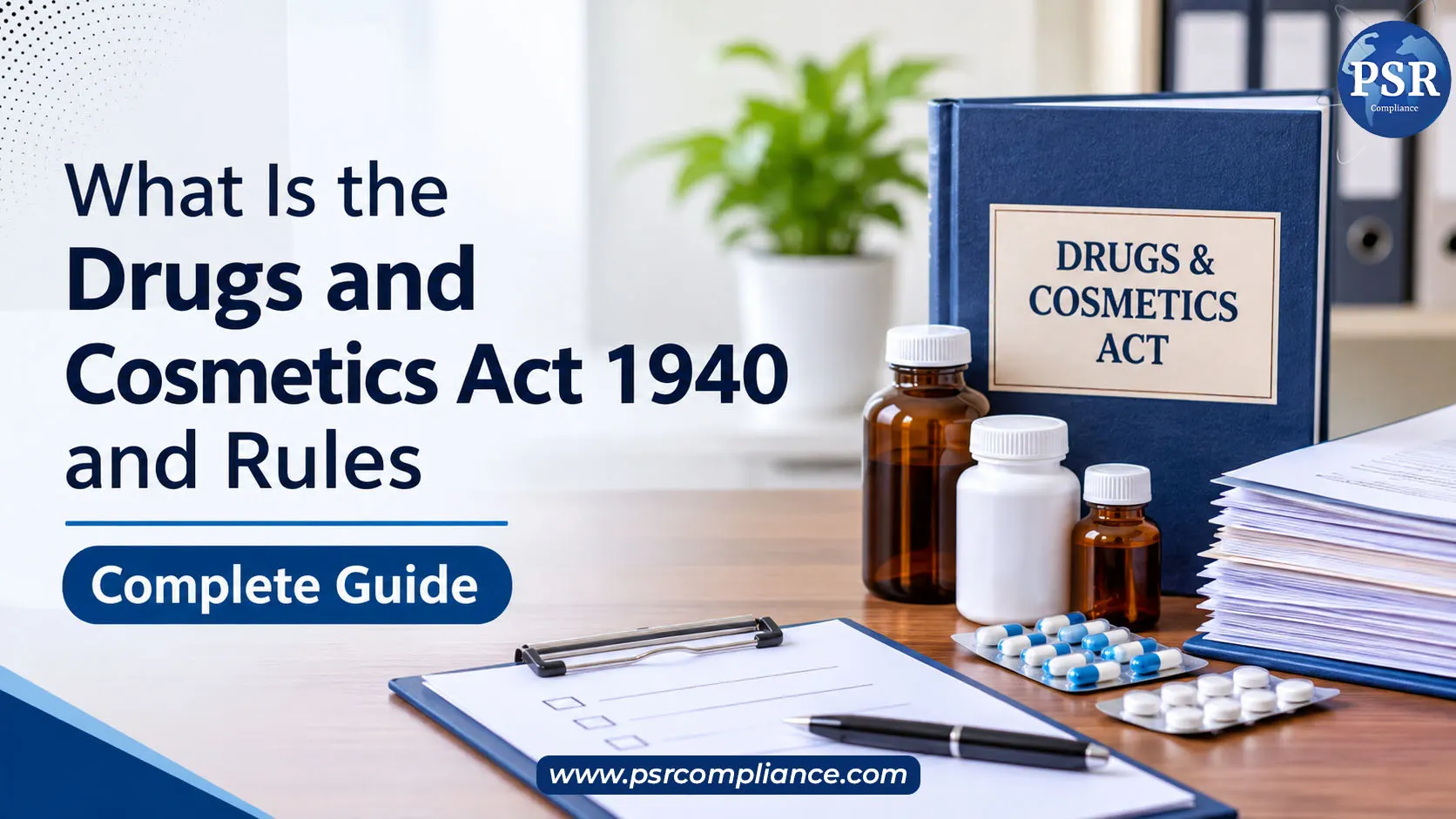
What Is the Drugs and Cosmetics Act 1940 and Rules | Complete Guide
There are very strong laws and regulations needed in the pharmaceutical industry in order to regulate the safety, efficiency, and quality of medicines and cosmetics sold in the Indian market. In order to control their manufacturing, supply, importation, and sales, there has been an enactment of the Drugs and Cosmetics Act 1940 by the Indian Government.
It is a law that regulates the drug and cosmetic industry in India with a view to regulating the quality of drugs and cosmetics. The law is complemented by the Drugs and Cosmetics Rules, 1945, which detail the procedures, licensing, standards, and conditions of businesses in this industry.
If you intend to start a pharmaceutical production company, retail medicine outlets, pharmaceutical products, or import, then it is important that you understand the Drug Regulatory Act of India.
What Is the Drugs and Cosmetics Act, 1940?
The Drugs and Cosmetics Act 1940 is a law passed in India to control the importation, manufacturing, distribution, and sale of drugs and cosmetics. The main objective of the law is to promote public health and ensure that the items conform to standards of safety and quality.
The law makes it illegal to manufacture and sell any defective, substandard, adulterated, or spurious drugs and cosmetics. There are various agencies that ensure compliance with the provisions of the law.
There are the Drugs and Cosmetics Rules 1945, which provide details on how the Act shall be applied in practice. To pharmaceutical manufacturers, wholesalers, retailers, and importers, the Act provides the basis for Drug License Registration.
What Are the Drugs and Cosmetics Rules, 1945?
The Drugs and Cosmetics Rules, 1945 have been made to give detailed rules for the implementation of the parent act. Though the parent act provides the legal framework, the Rules give practical guidelines for companies and regulatory authorities.
Some of the important aspects that are covered by these Rules are:
- Licensing for manufacture and sale of drugs.
- Drug standards and testing.
- Conditions for importing drugs.
- Packaging requirements.
- Storage and distribution requirements.
- Record-keeping requirements.
- Procedure for licensing and inspection.
The Drugs and Cosmetics Rules, 1945 also provide different forms of licences depending upon the kind of pharmaceutical business. It is essential to find out the right licence before starting the business.
Key Objectives of the Drugs and Cosmetics Act, 1940
The Act is concerned with protecting consumers and ensuring accountability in the drug and cosmetic industry. Objectives of the Act include:
1. Quality of goods: The Act ensures that all drugs and cosmetics conform to prescribed quality standards before their release to the consumer.
2. No hazardous goods: It prevents the production, importation, and marketing of any adulterated, misbranded, and spurious goods.
3. Licensing of drug business firms: The Act regulates manufacturing, wholesaling, retailing, and importing firms within the drug and cosmetic industry.
4. Import of drugs: The Act regulates the import of drugs and cosmetics to ensure that hazardous and substandard products are not brought into the Indian market.
5. Protection of consumers' health: It provides a legal regime of inspection, testing, and prosecution of firms contravening relevant regulations.
This makes the Drug Regulatory Act an essential part of the Indian healthcare regulatory system.
Major Provisions of the Drugs and Cosmetics Act, 1940
There are many clauses contained in the Drugs and Cosmetics Act 1940, which need to be understood by a business before venturing into pharmaceuticals or cosmetology.
Some important provisions include:
- Section 16: Deals with standards of quality for drugs.
- Section 17: Defines misbranded drugs.
- Section 17A: Covers adulterated drugs.
- Section 17B: Addresses spurious drugs.
- Section 18: Prohibits the manufacture and sale of certain non-compliant drugs and cosmetics.
- Section 18A: Requires disclosure of the source from which a drug or cosmetic was acquired.
- Section 27: Provides penalties for violations relating to the manufacture and sale of certain drugs.
The clauses will enable the relevant authorities to detect violations and take necessary action against the businesses failing to comply with the law.
Important Schedules Under the Drugs and Cosmetics Rules, 1945
There are schedules in the Drugs and Cosmetics Rules, 1945 which lay down certain requirements for different classes of drugs and pharmaceuticals.
| Schedule | Purpose |
|---|---|
| Schedule C and C(1) | Biological and special products, including specified categories of drugs |
| Schedule G | Drugs requiring medical supervision |
| Schedule H | Prescription drugs that cannot be sold without a registered medical practitioner's prescription |
| Schedule H1 | Specified prescription drugs subject to additional sale and record-keeping requirements |
| Schedule X | Certain controlled prescription drugs subject to stricter requirements |
| Schedule M | Good Manufacturing Practices and requirements for pharmaceutical manufacturing premises |
| Schedule P | Life period and storage requirements for specified drugs |
| Schedule N | Minimum equipment requirements for a pharmacy |
The business has to go through the relevant schedule before engaging in the manufacture, storage, distribution and sale of drugs. There may be additional conditions set out in the Drugs and Cosmetics Rules, 1945 depending on the class of drug and business activity.
Types of Licences Required Under the Drugs and Cosmetics Act
The business handling pharmaceutical products generally needs a proper license from the relevant authorities.
The following are some common licensing categories:
1. Drug Manufacturing License
Businesses engaged in the manufacturing of pharmaceutical products should get the appropriate Drug Manufacturing License. They should follow all the necessary manufacturing standards, infrastructure, quality control, and other such requirements.
2. Drug Sale License
Pharmacies retailing medicines and wholesale businesses of medicines need to get the appropriate Drug Sale License to sell the medicines. Pharmacies also need to follow all the necessary requirements for pharmacists and premises.
3. Drug Import License
Businesses importing drugs into India need to get the appropriate import license and registration approval. This will depend on the type of drug and other regulatory requirements.
4. Drug License Registration
It is mandatory for businesses to complete the Drug License Registration procedure before commencing any regulated activities. Businesses have to submit all the necessary applications and other related documentation to the licensing authorities.
Getting an appropriate license is essential for doing business in the pharmaceutical sector. Businesses can also consider hiring professional Drug License Consultant Services.
Who Regulates Drugs and Cosmetics in India?
The Indian regulatory system consists of central and state agencies.
The Central Drugs Standard Control Organisation (CDSCO) operates as India's regulatory agency under the Director General of Health Services at the Ministry of Health & Family Welfare.
These agencies are responsible for:
- Approval of new drugs and clinical trials.
- Control of drugs coming from other countries.
- Working with State Drug Control Agencies.
- Setting up standards for drugs.
- Regulating certain categories of pharmaceutical products.
- Ensuring the quality and safety of drugs.
State Drug Control Departments are responsible for different types of licensing and control functions such as manufacturing licenses and sales licenses.
Thus, organizations that are applying for Drug License Registration need to determine the licensing authority according to their activities and regulations.
Documents Required for Drug License Registration
The list of documents will differ according to whether the application is made for a manufacturing, retail, wholesale, or import license.
Some of the frequently asked documents include:
Proof of identity and address of the applicant.
Documents related to business registration.
Ownership and rent agreement document for the premises.
Site plan and layout of the premises, wherever applicable.
Information about the registered pharmacist/competent person, whichever is applicable.
Storage facility information.
Application form as per prescription.
Fee payment receipt from the Government, wherever applicable.
For a hassle-free Drug License Apply Online procedure, the applicant needs to be sure about the accuracy of documents.
Penalties for Non-Compliance
Failure to abide by the Drugs and Cosmetics Act of 1940 could lead to significant legal ramifications. Depending upon the nature and gravity of the offense, companies could be subjected to:
- Financial sanctions and prosecutions.
- Temporary or permanent suspension of licenses.
- Confiscation of non-compliant goods.
- Imprisonment for designated offenses.
- Limitations on manufacture, distribution, and sale.
The manufacture or sale of spurious or misbranded drugs is liable for heavy sanctions.
Therefore, companies should take the services of professional Drug License Compliance Services.
How Can a Drug License Consultant Help?
Understanding pharmaceutical regulations and going through the process of licensing could be difficult, especially for new entrepreneurs. One can seek the services of a Drug License Consultant who will assist in identifying the appropriate license and preparing the required documents.
Professional Drug License Registration Services normally include:
- Identification of the appropriate type of license.
- Preparation and checking of application documents.
- Guiding the applicant through the Drug License Apply Online procedure.
- Coordination with the appropriate licensing authority.
- Knowledge of license conditions and post-approval requirements.
Selection of the appropriate Drug License Registration Services will help pharmaceutical companies from making mistakes in preparing documents and delaying the process.
An expert Drug License Consultant will also assist in the renewal and amendment of the license. Companies in search of Drug License Compliance Services must make sure that their consultant knows the provisions of the Drugs and Cosmetics Act 1940 and rules.
Companies which plan to venture into the pharmaceutical industry can greatly benefit from the professional help in Drug License Registration.
Conclusion
The Drugs and Cosmetics Act of 1940 is of great significance in ensuring the safety and efficacy of medicines and cosmetics in India. Together with the Drugs and Cosmetics Rules of 1945, the Act creates a regulatory framework for the manufacture, importation, distribution, and sale of these goods.
It is important for pharmaceutical manufacturers, retailers, wholesalers, and importers to know about the Drug Regulatory Act in India. This way, you will be able to acquire the necessary license in accordance with the regulations.
If you want to open a pharmaceutical company or need help in obtaining the necessary licenses, then PSR Compliance will provide you with detailed information about the requirements and the Drug License Registration process.
📞 Call Us: +91 87961 04190
📧 Email Us: support@psrcompliance.com
Frequently Asked Questions (FAQs)
1. What is the Drugs and Cosmetics Act, 1940?
The Drugs and Cosmetics Act, 1940 is an Indian Act that controls the import, manufacture, sale, and distribution of drugs and cosmetics. It is designed to ensure the safety, quality, and compliance with standard norms of products.
2. What are the Drugs and Cosmetics Rules, 1945?
The Drugs and Cosmetics Rules, 1945 are supplementary rules to the parent Act, providing detailed regulations on licensing, manufacturing, labelling, storage, sale, etc.
3. Is a drug licence mandatory for opening a medical store?
Yes. To establish a medical store, one needs to have the required retail drug sale license from the concerned State Drug Control Department.
4. Who issues drug licences in India?
The licenses for drugs are granted by the concerned Central or State Licensing Authority, depending on the kind of products and the nature of the activity undertaken by the entity.
5. What happens if a business violates the Drugs and Cosmetics Act?
Penalties may be imposed, prosecution may follow, the goods may be seized, and the license itself may be suspended or revoked, depending upon the nature of the violation.
6. Can a consultant help with drug licence registration?
Yes. An expert in licensing of drugs can provide consultancy services.