Just send us your questions or concerns by starting a new case &
we will give you the help you need. Start Here...
BIS Certification
Thu, Oct 01 2026
Raju Karn
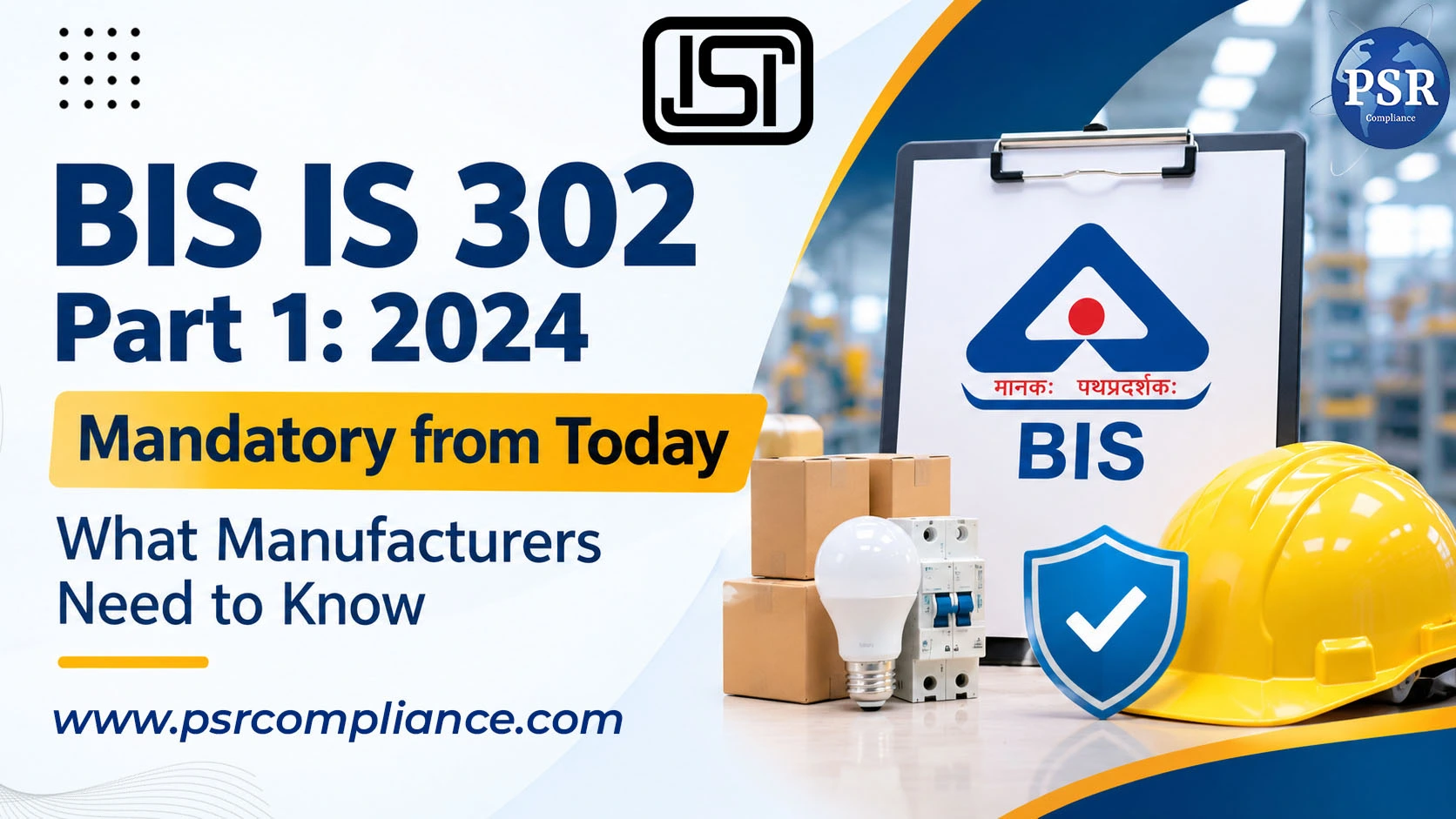
BIS IS 302 Part 1:2024 Mandatory from October 1, 2026
From October 1, 2026, the Safety of Household, Commercial and Similar Electrical Appliances (Quality Control) Order, 2026 comes into force for covered electrical appliances under IS 302 (Part 1):2024. The new requirement applies to electrical appliances intended for household, commercial or similar applications that fall within the scope of the order.
The 2026 QCO requires covered products to conform to the applicable Indian Standard and bear the BIS Standard Mark under a BIS licence through Scheme-I. However, the implementation dates are different for general, small and micro enterprises.
For manufacturers, importers and businesses dealing in covered electrical appliances, understanding the product scope, applicable deadline, testing requirements and BIS certification process is important before manufacturing, importing or selling products in India.
What Is IS 302 (Part 1):2024?
IS 302 (Part 1):2024 is the Indian Standard titled Household and Similar Electrical Appliances – Safety, Part 1: General Requirements. It is aligned with IEC 60335-1:2020 and establishes general safety requirements for covered electrical appliances.
BIS has included IS 302 (Part 1):2024 under its compulsory certification framework. The standard covers general safety requirements, while applicable product-specific requirements may also need to be considered depending on the appliance.
Is IS 302 Part 1 Mandatory from October 1, 2026?
Yes, the Safety of Household, Commercial and Similar Electrical Appliances (Quality Control) Order, 2026 states that the order comes into force on October 1, 2026.
The QCO applies to electrical appliances intended for household, commercial or similar applications with rated voltage not exceeding 250 V for single-phase appliances and 480 V for other appliances, including direct-current supplied and battery-operated appliances, subject to the exclusions and scope specified in the order.
However, businesses should not interpret this as meaning that every electrical appliance automatically falls under this particular QCO. Appliances already covered by another applicable Quality Control Order or mandatory BIS certification requirement are excluded from the scope of this order.
IS 302 Part 1:2024 Implementation Dates
The 2026 QCO provides different implementation dates based on enterprise category.
| Enterprise Category | Implementation Date |
|---|---|
| General enterprises | October 1, 2026 |
| Small enterprises | January 1, 2027 |
| Micro enterprises | April 1, 2027 |
Therefore, manufacturers should first determine their enterprise category before assessing the applicable compliance deadline.
Which Products Are Covered Under IS 302 Part 1?
The BIS list includes a wide range of household, commercial and similar electrical appliances. Some representative examples are:
| Category | Products Covered |
|---|---|
| Cleaning Appliances | Vacuum cleaners and water suction cleaning appliances |
| Laundry Appliances | Spin extractors, tumbler dryers |
| Cooking Appliances | Cooking ranges, hobs, ovens, frying pans, deep-fat fryers |
| Personal Care | Electric shavers, hair clippers, skin beauty-care appliances |
| Heating Appliances | Warming plates, appliances for heating liquids, electric heating tools |
| Kitchen Appliances | Electric steam cookers, commercial electric boiling pans, commercial electric kitchen machines |
| Commercial Cooking | Commercial electric grillers and toasters, commercial electric food-warming appliances |
| Commercial Cleaning | Commercial electric dishwashing machines |
| Air Treatment | Air-cleaning appliances, humidifiers, vaporizers, battery-operated air purifiers |
| Fabric Care | Fabric steamers |
| Pest Control | Insect killers |
| Commercial Appliances | Commercial electric hoods, commercial vacuum packaging appliances |
| Outdoor Appliances | Outdoor barbecues |
| Heating & Comfort | Foot warmers and heating mats, massage appliances |
| Personal Transport | Personal e-transporters |
| Motorized Furniture | Furniture with electrically motorized parts |
| Battery-Operated Cleaning | Battery-operated vacuum cleaners |
| Battery-Operated Personal Care | Battery-operated shavers, trimmers and clippers |
| Battery-Operated Kitchen | Battery-operated blenders and juicers |
| Battery-Operated Oral Care | Battery-operated toothbrushes and oral-hygiene appliances |
Note: This is a representative list, not an exhaustive product list. Manufacturers should check the official QCO and applicable product requirements to determine whether their specific appliance is covered under IS 302 (Part 1):2024.
Who Needs BIS Certification Under the New QCO?
Manufacturers of electrical appliances covered by the QCO need to comply with the applicable BIS requirements.
For covered products, the QCO requires conformity to the relevant Indian Standard and use of the Standard Mark under a BIS licence according to Scheme-I.
Importers and businesses bringing covered appliances into India should also verify whether the product and manufacturer have the required BIS certification before importing or placing the product on the Indian market.
Businesses should also check whether their product is already regulated under another QCO because products covered by another mandatory certification order are outside the scope of this particular QCO.
What Is the BIS Certification Process for IS 302 Part 1?
Manufacturers generally need to complete the applicable BIS certification requirements before using the Standard Mark for covered products.
The process can involve the following steps:
1. Identify the Applicable Product Standard
First, identify the exact product and determine whether IS 302 (Part 1):2024 applies to it. Depending on the product, applicable product-specific requirements may also need to be considered.
2. Check the QCO Applicability
Confirm that the product falls within the scope of the 2026 QCO and is not already covered by another applicable Quality Control Order.
3. Arrange Product Testing
The product needs to meet the applicable requirements of the Indian Standard. Testing should be carried out through the appropriate BIS-recognized laboratory route as applicable.
BIS's laboratory system currently lists IS 302 (Part 1):2024 / IEC 60335-1:2020 within its testing scope.
4. Prepare Technical and Manufacturing Documents
Depending on the certification route and product, manufacturers may need to prepare documents relating to the manufacturing facility, product specifications, test reports, quality-control arrangements, machinery, raw materials and other applicable information.
5. Apply for BIS Certification
The manufacturer can proceed with the applicable BIS certification application under Scheme-I.
6. Factory Assessment and Compliance
Where required, BIS assesses the manufacturing facility and evaluates whether the manufacturer can consistently produce products conforming to the applicable standard.
7. Obtain the BIS Licence
After the applicable requirements are fulfilled, the manufacturer can obtain the BIS licence and use the Standard Mark according to the conditions of the licence.
What Is the Difference Between IS 302 Part 1:2008 and IS 302 Part 1:2024?
The earlier standard was IS 302 (Part 1):2008. BIS subsequently revised the standard as IS 302 (Part 1):2024, aligned with IEC 60335-1:2020.
BIS had provided a concurrent-running period for IS 302 (Part 1):2008 and IS 302 (Part 1):2024, which was scheduled through February 23, 2026.
Manufacturers should therefore avoid assuming that compliance with the older version automatically satisfies the current requirements. They should verify their current licence, product testing and applicable certification requirements against IS 302 (Part 1):2024.
What Should Manufacturers Do After October 1, 2026?
Manufacturers dealing in covered electrical appliances should take the following steps:
- Identify every electrical appliance manufactured or imported.
- Check whether each product falls under the 2026 QCO.
- Confirm whether another QCO already covers the product.
- Determine the applicable enterprise category.
- Check the applicable implementation date.
- Review compliance with IS 302 (Part 1):2024.
- Arrange the required product testing.
- Prepare BIS certification documents.
- Apply for the applicable BIS licence.
- Review labelling and Standard Mark requirements before placing the product on the market.
Starting this review early can help manufacturers identify testing, documentation or certification gaps before they affect production and market supply.
Is There Any Exemption Under the 2026 QCO?
Yes. The QCO contains specific provisions and exemptions.
For example, the order does not apply to goods manufactured domestically for export. It also provides an exemption for up to 200 units per year imported for research and development by manufacturers of household and similar electrical appliances, subject to the conditions stated in the order.
The QCO also contains provisions concerning certain stock manufactured or imported before the applicable implementation date. Such stock may be sold, displayed or offered for sale for up to six months from the applicable implementation date, subject to the conditions and declaration requirements specified in the order.
Businesses should review the exact conditions rather than treating these provisions as a general exemption from BIS certification.
Why Is IS 302 Part 1 Compliance Important for Manufacturers?
The new requirement makes product safety compliance an important part of market access for covered electrical appliances.
Manufacturers need to consider:
- Product safety requirements
- Applicable Indian Standards
- Laboratory testing
- Factory quality-control arrangements
- BIS licensing
- Product marking and labelling
- Enterprise-specific implementation dates
- Import and domestic market requirements
BIS explains that products covered by compulsory certification are required to comply with the applicable requirements through the relevant QCO and certification framework.
What Manufacturers Should Check Today
As the general implementation date is October 1, 2026, manufacturers of covered electrical appliances should review their compliance status now.
A practical checklist is:
Product → QCO applicability → Enterprise category → Applicable date → IS 302 Part 1:2024 requirements → Testing → Documentation → BIS application → Factory compliance → Licence → Standard Mark
If your product is covered, the next step is to determine the exact certification requirements for that product rather than assuming that all appliances follow the same testing or certification route.
Get Help With BIS IS 302 Part 1:2024 Certification
If you manufacture or import electrical appliances covered under the new QCO, professional support can help you identify the applicable standard, prepare documentation, coordinate testing and understand the BIS certification process.
PSR Compliance provides support for BIS certification and compliance requirements for covered products. Contact our compliance team to check whether your product falls under IS 302 (Part 1):2024 and understand the applicable certification requirements.
Need Help With BIS QCO Compliance?
Check whether your product is covered under the latest BIS QCO and get expert support for certification, documentation, testing, and application.
📞 Call PSR Compliance: +91 8796104190
Conclusion
IS 302 (Part 1):2024 is now an important BIS compliance requirement for covered household, commercial and similar electrical appliances under the 2026 Quality Control Order. The general implementation date is October 1, 2026, while small and micro enterprises have later implementation dates of January 1, 2027 and April 1, 2027 respectively.
Manufacturers should identify their covered products, verify the applicable enterprise category, review the IS 302 (Part 1):2024 requirements and complete the required BIS certification steps before placing covered products on the Indian market.
FAQs
Is IS 302 Part 1:2024 mandatory from October 1, 2026?
The Safety of Household, Commercial and Similar Electrical Appliances (Quality Control) Order, 2026 comes into force on October 1, 2026. It requires covered products to conform to the applicable Indian Standard and bear the BIS Standard Mark under a BIS licence through Scheme-I, subject to the enterprise-specific dates and conditions in the order.
What is IS 302 Part 1:2024?
IS 302 (Part 1):2024 is the Indian Standard for safety of household and similar electrical appliances, Part 1 covering general requirements. It is aligned with IEC 60335-1:2020.
Which products are covered under IS 302 Part 1:2024?
The QCO covers a broad range of household, commercial and similar electrical appliances, including various cleaning, cooking, heating, personal-care and commercial appliances, as well as certain DC and battery-operated appliances. The official product list should be checked for the specific appliance.
What is the BIS deadline for small enterprises?
For small enterprises covered by the QCO, the implementation date is January 1, 2027.
What is the BIS deadline for micro enterprises?
For micro enterprises covered by the QCO, the implementation date is April 1, 2027.
Is BIS certification required for imported electrical appliances?
Where an imported electrical appliance falls within the scope of the applicable mandatory certification requirements, the required BIS compliance must be considered before placing the product on the Indian market. The exact applicability depends on the product and applicable QCO.
Is IS 302 Part 1:2008 still applicable?
The revised IS 302 (Part 1):2024 replaced the older version following the transition period. BIS's implementation guidance provided concurrent running of the 2008 and 2024 standards until February 23, 2026.
How can I obtain BIS certification for IS 302 Part 1:2024?
The applicable process can involve identifying the product standard, product testing, preparing technical and manufacturing documents, submitting the BIS application, completing applicable factory assessment and obtaining the BIS licence under the relevant certification scheme.
Do all electrical appliances require certification under this QCO?
No. The 2026 QCO specifically excludes electrical appliances that fall under another applicable Quality Control Order or mandatory BIS certification requirement under another Act. Product-specific applicability should therefore be checked before determining the certification route.