

Just send us your questions or concerns by starting a new case &
we will give you the help you need. Start Here...
BIS Hallmark
Mon, Aug 24 2026
Raju Karn
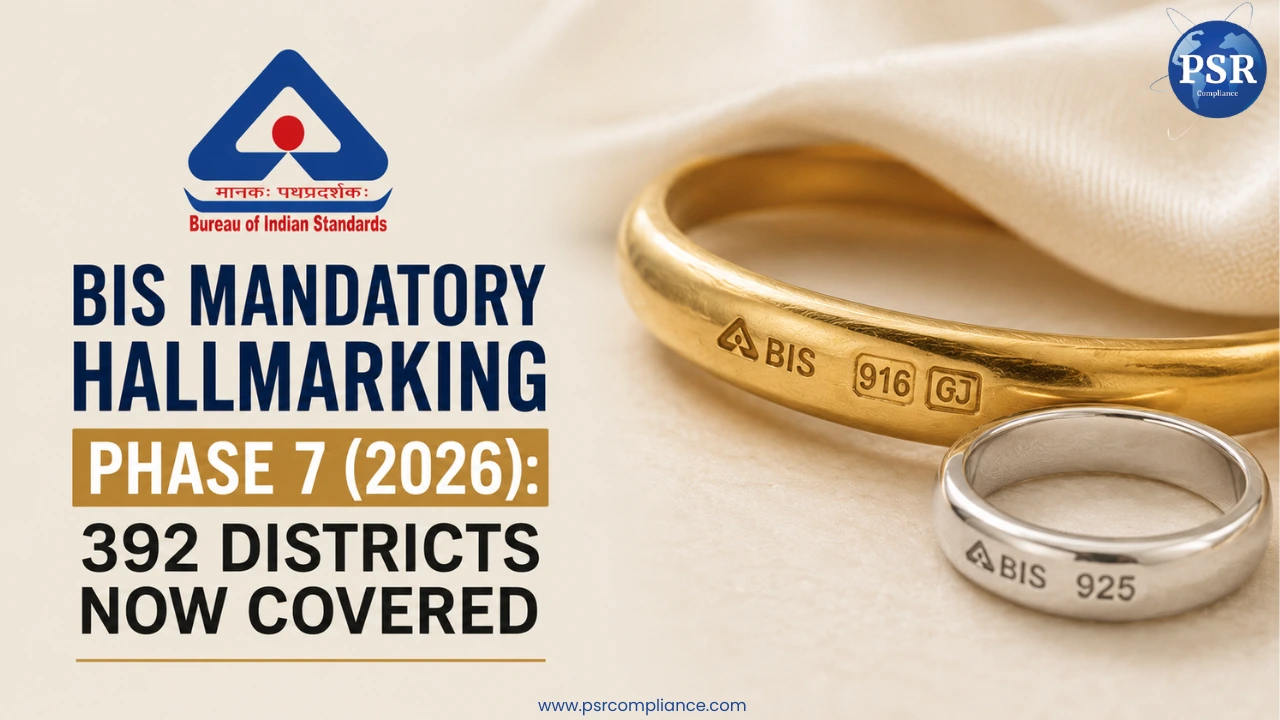
BIS Mandatory Hallmarking Phase 7 (2026): 392 Districts Now Covered
Gold hallmarking in India just expanded again. With the seventh phase of mandatory hallmarking now in force, 392 districts across 26 States and Union Territories are covered under the Bureau of Indian Standards hallmarking framework. If you are a jeweller, a manufacturer, or simply someone planning to buy gold soon, this update affects you directly, and it is worth understanding in full.
In this guide, we explain what changed, why it matters, and how you can stay compliant, using simple language throughout.
What Is Mandatory Hallmarking
BIS Hallmarking is a government backed certification that confirms the purity of gold jewellery and gold artefacts sold across India. It is issued under the Bureau of Indian Standards Act, 2016, and once a district is declared mandatory, jewellers operating there cannot legally sell gold jewellery without a valid hallmark.
Put simply, hallmarking protects buyers from impure gold and protects honest jewellers from unfair competition posed by sellers who skip certification altogether.
What Changed In Phase 7
On August 3, 2026, the Ministry of Consumer Affairs, Food and Public Distribution issued the Hallmarking of Gold Jewellery and Gold Artefacts Third Amendment Order, 2026, acting on the advice of BIS. This order added 12 new districts to the mandatory list, taking the total from 380 to 392.
The newly added districts span nine states:
- Assam, including Kokrajhar and Lakhimpur
- Haryana, including Panipat
- Madhya Pradesh
- Maharashtra
- Odisha, including Angul
- Rajasthan
- Tamil Nadu
- Uttarakhand, including Udham Singh Nagar
- West Bengal
If your jewellery business operates in any of these locations, mandatory hallmarking now applies to you, and skipping compliance can lead to penalties, seizure of stock, or legal action against your business.
How We Got to 392 Districts
BIS has expanded mandatory hallmarking gradually since 2021, widening coverage each time more Assaying and Hallmarking Centres, commonly called AHCs, become operational in a region.
| Phase | Effective Date | Districts Added | Total Districts Covered |
|---|---|---|---|
| Phase 1 | June 23, 2021 | 256 | 256 |
| Phase 2 | April 4, 2022 | 32 | 288 |
| Phase 3 | September 8, 2023 | 55 | 343 |
| Phase 4 | November 5, 2024 | 18 | 361 |
| Phase 5 | — | 12 | 373 |
| Phase 6 | March 2, 2026 | 7 | 380 |
| Phase 7 | August 3, 2026 | 12 | 392 |
Each phase generally targets districts where a hallmarking centre has since been established, making local compliance operationally realistic for jewellers in that area.
Why This Matters For Jewellers
If your district was newly added under Phase 7, here is what you should do without delay.
First, register with BIS if you have not already done so. No jeweller can legally sell hallmarked gold without valid registration. Second, get your existing stock hallmarked through a BIS recognized Assaying and Hallmarking Centre. This step cannot be skipped once your district becomes mandatory. Third, clear or convert old non hallmarked stock according to applicable norms, or have it hallmarked at the next lower eligible purity grade where required. Fourth, update your marking practices so every article carries all three required marks, meaning the BIS logo, the purity grade, and the HUID number.
Compliance is not optional once a district turns mandatory, and BIS enforcement has become noticeably stricter. More than 30 enforcement actions were carried out against jewellers during the financial year 2025 to 2026 alone, related specifically to hallmarking violations. Businesses that delay registration risk losing customer trust, facing inspection related disruptions, and dealing with legal complications that could have been avoided with timely action.
PSR Compliance can support you through the entire BIS Hallmark Registration process, including documentation, coordination with recognized hallmarking centres, and ongoing compliance guidance, so your business does not lose time or revenue due to a missed deadline.
Why This Matters For Buyers
For everyday consumers, more districts under mandatory hallmarking means fewer places where unhallmarked gold can be legally sold at all. Even so, the responsibility to verify still rests with the buyer at the point of purchase. Always check for three essential marks before paying for any gold jewellery. The first is the BIS Standard Mark, which is the triangular BIS logo confirming that the item has gone through certification. The second is the purity indication expressed in carats and fineness. For example, a mark reading 22K916 means the item is 22 karat gold with 91.6 percent purity. The third is the HUID, short for Hallmark Unique Identification. This is a unique alphanumeric code assigned to that individual piece of jewellery, and it is what allows buyers to trace an item back to its certification record.
You can verify any HUID instantly using the Verify HUID feature inside the BIS Care App. Simply enter the code shown on your jewellery, and the app will display the jeweller's name, the purity of the item, and the date it was hallmarked. If the details returned do not match what you were told at the point of sale, that is a clear signal to raise a concern before completing the purchase.
The Bigger Picture
Since mandatory hallmarking began in 2021, more than 60 crore gold items have been hallmarked nationwide with a unique HUID, and the number of registered jewellers has grown roughly fivefold over the same period. The steady expansion from 256 districts to 392 districts reflects both growing infrastructure, in the form of new hallmarking centres, and a clear policy direction toward nationwide coverage over time.
For jewellers, the message is straightforward. Compliance requirements will keep expanding into new districts, and businesses that prepare early avoid last minute scrambling once their district is formally added to the mandatory list.
For buyers, the message is equally simple. As more of the country comes under mandatory hallmarking, checking for the three essential marks should become a routine habit rather than an occasional precaution, regardless of which city or district you are purchasing gold in.
Need Help With BIS Hallmark Registration
Whether your district was just added under Phase 7 or you are planning to expand your jewellery business into a new region altogether, staying compliant with BIS hallmarking rules is not something to postpone. PSR Compliance helps jewellers, manufacturers, and traders across India secure BIS Hallmark Registration efficiently, with complete documentation support, coordination with recognized hallmarking centres, and expert guidance at every stage of the process.
Call us at +91 8796104190 or write to us at support@psrcompliance.com to book a free consultation and keep your jewellery business fully compliant as coverage continues to expand.
Frequently Asked Questions
Is hallmarking mandatory in my district?
Mandatory hallmarking currently applies to 392 districts nationwide. If your district is not yet on this list, hallmarking may still be available on a voluntary basis in your area. It is worth checking the official BIS website or speaking with a compliance expert to confirm your district's current status.
What gold purity grades fall under mandatory hallmarking?
The caratages currently covered are 14K, 18K, 20K, 22K, 23K, and 24K. Additionally, 9K gold was brought under the mandatory hallmarking framework starting July 2025, expanding coverage to more affordable gold categories such as entry price jewellery and fashion accessories.
What happens if a jeweller sells non hallmarked gold in a mandatory district?
This is treated as a violation under the Bureau of Indian Standards Act, 2016, and can result in financial penalties, seizure of unhallmarked stock, or further legal proceedings depending on the severity and frequency of the violation.
How can I check whether my gold jewellery is genuine?
Look for all three marks together on the item, namely the BIS logo, the purity and fineness code, and the HUID. Then use the BIS Care App to verify the HUID directly and confirm the details match what you were told by the seller.
Does hallmarking apply to old or inherited jewellery?
Older or heirloom jewellery that predates mandatory hallmarking rules can generally continue to be held or sold privately, but once such jewellery enters the retail chain again for resale in a mandatory district, applicable hallmarking rules typically come into play, subject to conditions around melting or altering the piece.