Wed, Oct 28 2026
Advocate Rajkumar
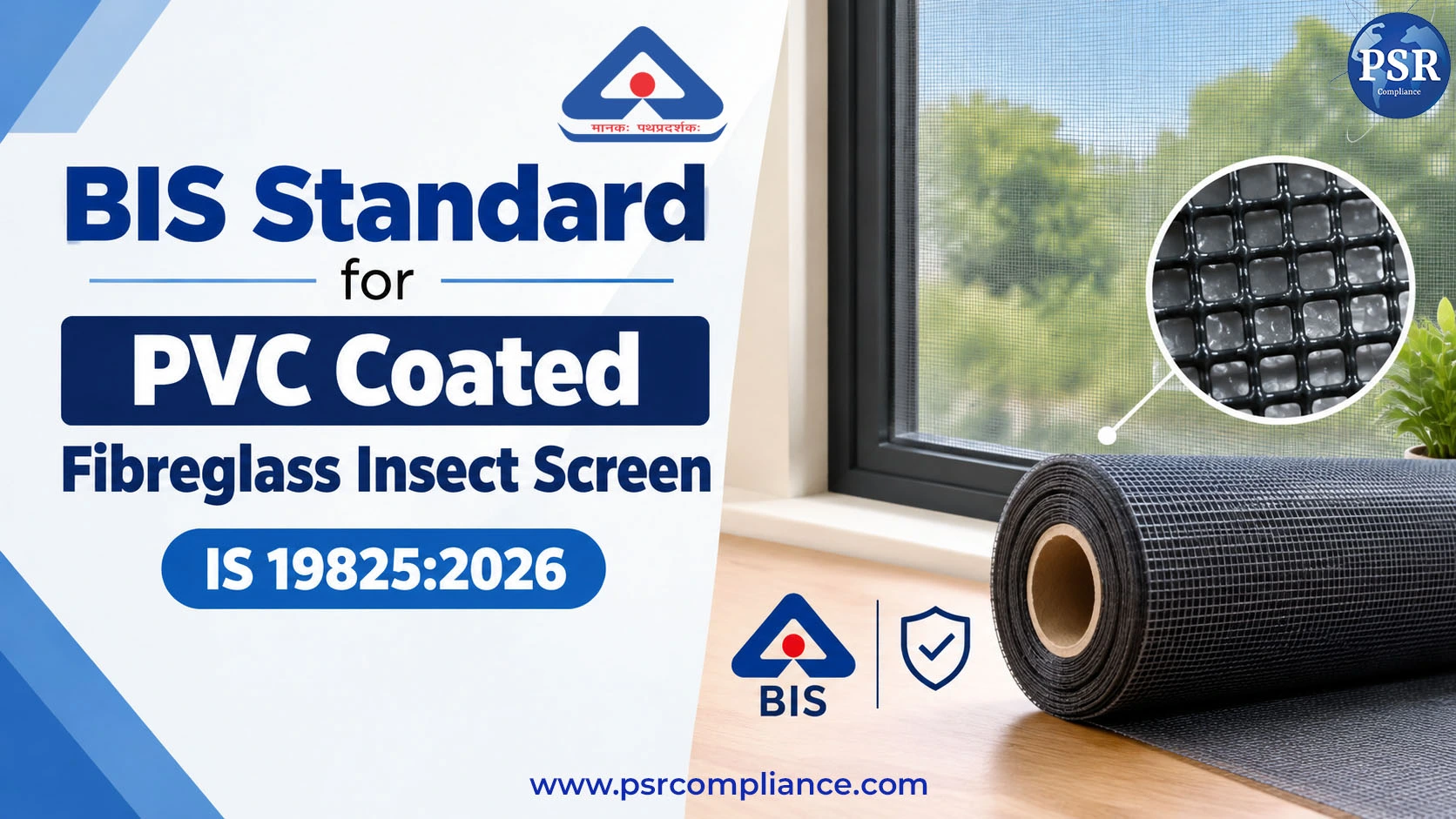
BIS Standard for PVC Coated Fiberglass Insect Screen Under IS 19825:2026
PVC coated fibreglass insect screens are widely used in residential and commercial buildings to prevent insects from entering through windows, doors and other openings while allowing natural ventilation. Product quality matters because these screens face regular handling, sunlight, and varied environmental conditions.
For manufacturers, importers, and businesses dealing in fibreglass insect screens, understanding this new Indian Standard is an important step towards product quality and regulatory preparedness. This guide explains the standard, its key technical focus areas, the potential BIS certification process, and the documents businesses should prepare.
The Bureau of Indian Standards (BIS) formulated IS 19825:2026 - Textiles: PVC Coated Fibreglass Insect Screen - Specification on 14th October, 2026, as a way of formulating a quality standard for this particular product. The requirements of this standard were formulated to cater for the critical features of this product. This guide explains the standard, its key technical focus areas, the potential BIS certification process, and the documents businesses should prepare.
What Is a PVC Coated Fiberglass Insect Screen?
A Fiberglass window mesh with a PVC coating is a type of mesh material that is made using fiberglass yarns that are then coated with PVC to enhance their performance. The coated yarns are woven together to make a mesh that can be fitted in windows, doors, ventilation openings, among other places where there is a need for controlling insects.
The fiberglass gives the mesh its strength, whereas the PVC coating protects the yarns from moisture, friction, and environmental exposure. These features make it ideal for everyday use.
Unlike window panes, these fiberglass screens are meant to keep rooms open while still providing a barrier against insects.
There are a number of sizes, colors, and even rolls depending on the purpose for which the screen is to be used.
According to IS 19825:2026 – Textiles: PVC Coated Fibreglass Insect Screen Specification, the product should conform to certain quality standards.
Key Product Requirements Under IS 19825:2026
Businesses should study the complete standard before making changes to production or applying for certification. The principal performance areas identified in the published announcement are outlined below.
| Performance area | What manufacturers should review |
|---|---|
| Mesh strength | Relevant strength characteristics and prescribed test methods |
| UV degradation resistance | Performance after the specified UV exposure test |
| Flame propagation resistance | Compliance with the prescribed fire-related test criteria |
| Structural durability | Ability of the screen to meet the applicable durability requirements |
| Product specification | Applicable construction, dimensions, workmanship and other requirements stated in the complete standard |
The table provides a high-level overview, not a substitute for the complete Indian Standard. Exact numerical limits, specimen preparation procedures, and test conditions should be taken directly from the official document.
BIS Certification for PVC Coated Fibreglass Insect Screens
BIS operates product certification schemes under the BIS Act, 2016, and the applicable conformity assessment regulations. Certification requirements vary according to the product and the scheme under which it is covered.
Before starting an application for BIS certification for PVC coated fibreglass insect screens, a manufacturer should confirm three things:
- Whether certification against IS 19825:2026 is currently available under an applicable BIS scheme.
- Whether a QCO or another notification makes certification compulsory, and the relevant implementation date.
- What product-specific testing, manufacturing controls, marking conditions, and documentation BIS requires.
If certification is available and appropriate for the product, the general Scheme I product-certification route may involve assessment of manufacturing facilities, quality controls and product conformity. The actual procedure must follow the scheme and product-specific directions applicable to the application.
The official BIS website explains the product certification process and the requirements for products under compulsory certification.
Why Is IS 19825:2026 Important for Manufacturers?
The introduction of a dedicated Indian Standard gives manufacturers a defined technical reference for evaluating their products.
Its practical importance includes the following:
- Improved product consistency: Specified requirements help manufacturers assess whether their products maintain consistent construction and performance.
- Quality control: Relevant testing and inspection can help identify product defects and variations during manufacturing.
- Better product evaluation: A common technical reference helps businesses understand the characteristics that need to be assessed.
- Market readiness: Manufacturers can review their products and quality-control procedures against the standard before responding to applicable regulatory or customer requirements.
- Informed sourcing: Importers and buyers can use the relevant technical requirements when evaluating suppliers and product specifications.
Does IS 19825:2026 Make BIS Certification Mandatory?
The establishment of a new Indian Standard does not, by itself, establish that BIS certification is compulsory for every product covered by that standard. Whether certification is mandatory depends on the applicable government notifications, Quality Control Orders (QCOs), product scope and other relevant regulatory provisions.
Manufacturers and importers should therefore verify whether PVC coated fibreglass insect screens are covered by an applicable mandatory certification requirement and whether any implementation date or transition period has been notified. Businesses should not assume that an ISI mark is mandatory solely because IS 19825:2026 has been established.
BIS Certification Process for PVC Coated Fibreglass Insect Screens
The general BIS Certification preparation and application process is explained below. They should not be interpreted as an indication of a certification scheme that is in place for IS 19825:2026.
Step 1: Identify the Applicable Standard and Scheme
The first step is to understand the scope of the product and, where applicable, IS 19825 is an Indian Standard. Please refer to the BIS document on the official BIS portal for the latest status of the documents, product-specific guidelines, and applicable QCO. When there is no product-specific certification procedure/marking requirement published, please ask for clarification from BIS before proceeding.
Step 2: Conduct a Product Gap Assessment
Match the current product specifications and manufacturing processes with the requirements of IS 19825:2026. Check out the fibreglass yarn, PVC coating, mesh construction, finished dimensions and other applicable attributes. Determine if there are any deficiencies in product performance, testing or production control. Creating a corrective-action plan to meet the gaps in the application before submitting.
Step 3: Establish Manufacturing and Quality Controls
Manufacturers should record their production process and set up controls to guarantee uniformity of product. They can include incoming raw materials, coating, weaving, finishing, dimensional checks, inspection, product identification and batch traceability, depending on the manufacturing process. The actual controls should be based upon the needs of the appropriate standard and certification scheme.
Step 4: Organize Product Testing
Identify tests to be conducted under the full standard and select suitable testing facility / testing arrangements accepted by BIS. Tests can include resistance to UV degradation, resistance to flame propagation, mesh strength and other standard properties.
Keep test reports, sample identification information and records of the production batch or product variant evaluated. Only use test reports and laboratories that are acceptable in accordance with the applicable BIS procedure.
Step 5: Prepare and submit the Application
If relevant, complete the application form on the BIS online application system and pay the fee and submit the necessary supporting documents.
Make sure the legal name for the manufacturing unit, factory address, product information and scope of the proposed project are consistent throughout the application and supporting documents.
Step 6: Factory Assessment and Sample Evaluation
BIS can examine the manufacturing facilities, manufacturing infrastructure, testing facilities, and quality-control systems depending on the certification process involved. Product samples may be tested in the manufacturer's laboratory, in an approved external laboratory or be tested using a mixture of testing arrangements, depending on the scheme.
If deficiencies are found during the assessment process, corrective action and evidence of the corrective action should be taken.
Step 7: Certification Decision and Ongoing Compliance
BIS decision will be based on the requirements that apply and assessment results. If a licence or certificate is issued, the manufacturer is obliged to comply with the scope of the licence/certificate, its validity, marking requirements and continuing compliance responsibilities.
BIS Standard Mark should not be used in a business or claimed as being BIS certified until a business receives the required authorisation.
Documents Required for BIS Certification
The final checklist depends on the applicable certification scheme and any product-specific instructions. Manufacturers should prepare the following categories of documents for review.
| Document | Purpose |
|---|---|
| Business registration documents | Establish the legal identity of the applicant |
| Factory address proof | Verify the manufacturing premises |
| Authorised signatory documents | Establish the authority of the person submitting the application |
| Manufacturing process flowchart | Explain the main production and finishing stages |
| Product specification sheet | Identify the product, variants, dimensions and construction details |
| Raw material specifications | Record the characteristics of fibreglass yarn, PVC coating materials and other relevant inputs |
| Quality-control plan | Describe incoming, in-process and finished-product inspections |
| Testing equipment list | Identify available equipment and testing capabilities, where applicable |
| Calibration records | Demonstrate the status of relevant measuring and testing equipment |
| Product test reports | Provide evidence of conformity with applicable requirements |
| Brand or trademark documents | Support brand identification and ownership or authorised use, where applicable |
| Factory layout and machinery details | Help demonstrate manufacturing capability |
| Previous certification records | Provide relevant history, where applicable |
| Application forms and fee records | Complete the formal submission requirements |
How PSR Compliance Can Help
PSR Compliance assists businesses with regulatory compliance and product certification-related requirements.
For businesses manufacturing or importing PVC coated fibreglass insect screens, professional assistance can help with:
- Understanding the scope of IS 19825:2026.
- Reviewing applicable BIS certification requirements.
- Identifying relevant product testing and documentation needs.
- Organising compliance documents.
- Understanding the applicable certification process, where required.
The certification route, timelines, government fees and professional fees should be confirmed after reviewing the product and applicable regulatory requirements.
Conclusion
IS 19825:2026 is a quality requirement standard for PVC Coated Fiberglass Insect Screens. Manufacturers need to study the standard, document themselves accordingly, undergo the necessary tests, and confirm BIS certification requirements. PSR Compliance can help organizations with documentation and compliance assistance to achieve BIS certification requirements efficiently.
📞 Call: +91 8796104190
📧 Email: support@psrcompliance.com
Frequently Asked Questions
1. What is IS 19825:2026?
IS 19825:2026 is known as the Indian Standard "Textiles – PVC Coated Fibreglass Insect Screen – Specification" that was developed on 14 October 2026. Performance aspects covered by the standard include mesh strength, resistance to UV degradation, resistance to flame propagation, and structural durability.
2. Is BIS certification necessary for PVC coated fibreglass insect screens?
It is important to remember that the establishment of an Indian Standard does not necessarily mean that certification is obligatory. You have to consult the latest BIS compulsory certification lists, QCOs, and other notifications to see if the licence is required.
3. Which test methods are associated with IS 19825:2026?
Mesh strength, resistance to UV degradation, resistance to flame propagation, and structural durability are mentioned in the standard announcement as the most important performance characteristics. You have to look through the standard itself for details of test procedures, test limits, specimens, etc.
4. Which products are covered by IS 19825:2026?
The standard concerns PVC coated fibreglass insect screens. Businesses should consult the official standard to confirm the precise scope and applicable product specifications.
5. Who should review IS 19825:2026?
Manufacturers, importers, suppliers and other businesses involved in PVC coated fibreglass insect screens should review the standard to understand its technical requirements and determine whether any applicable compliance obligations affect their products.
6. What tests are relevant to PVC coated fibreglass insect screens?
Relevant areas identified in the standard include mesh construction, dimensional accuracy, strength, UV resistance and fire performance. The precise test procedures and acceptance limits should be obtained from the official standard.
7. What documents may be needed for BIS certification?
Depending on the applicable certification scheme, documents may include business details, product specifications, manufacturing information, quality-control records and testing reports. The final list depends on the applicable requirements.
8. How can PSR Compliance assist with IS 19825:2026?
PSR Compliance can help businesses review the standard's applicability, understand relevant BIS requirements, organise supporting documentation and identify the appropriate next steps for product compliance.