Mon, Oct 26 2026
Advocate Rajkumar
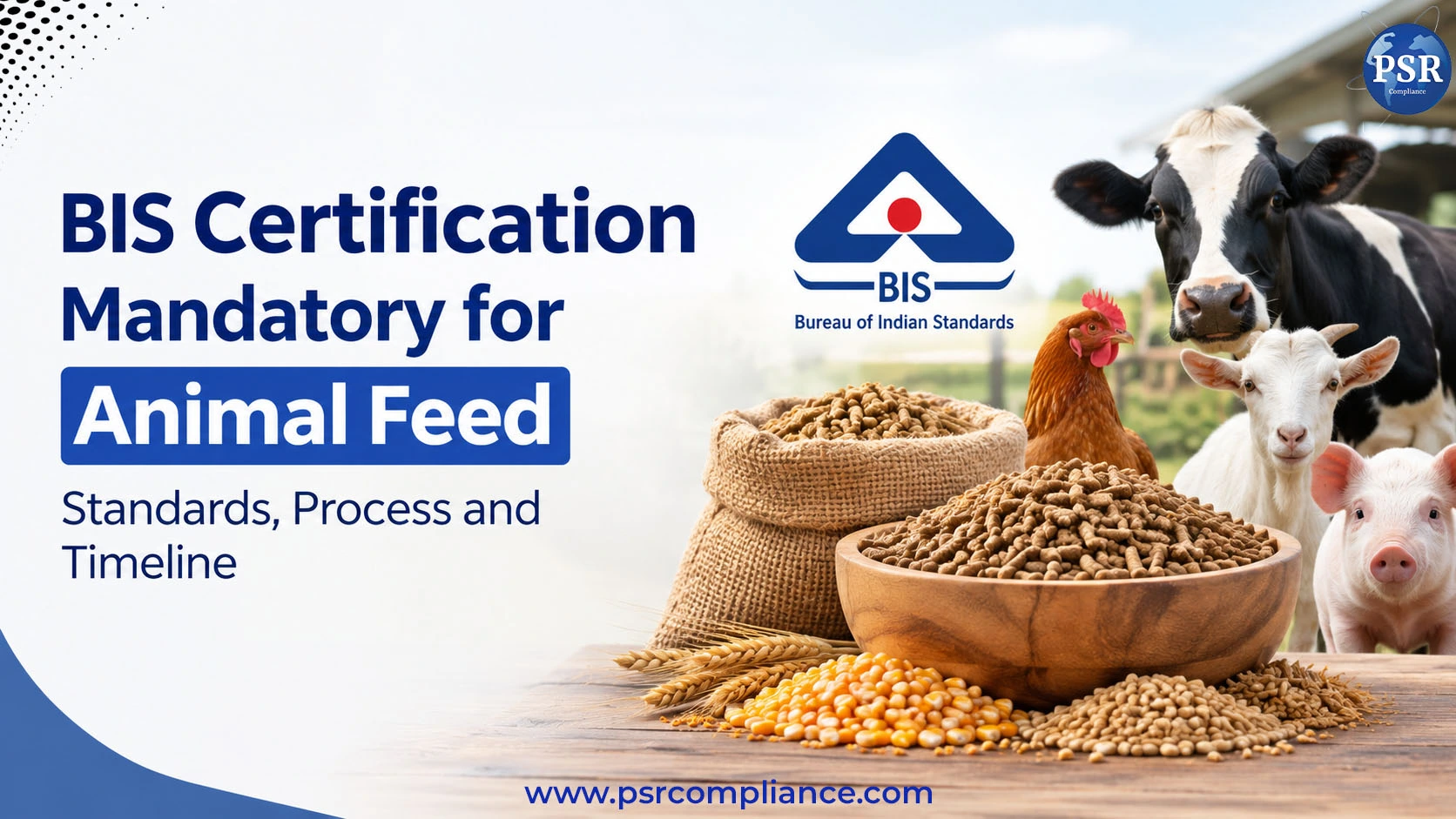
BIS Certification Mandatory for Animal Feed: Standards, Process and Timeline
Animal feeds play an important role in the well-being of livestock, milk, poultry, and aquaculture. The nutritional value, productivity, and safety of food products produced by food-producing animals are determined by the quality of the ingredients used in the process. Knowledge of the Indian Standards and the related regulations is necessary for maintaining the quality of the product.
With the implementation of the Animal Feeds and Feed Ingredients (Quality Control) Order, 2026, the BIS Certification for Animal Feed has returned to the agenda. Under the Bureau of Indian Standards Act, 2016, the Order stipulates compulsory compliance with the animal feed ingredients conforming to the Indian Standards and the use of the BIS Standard Mark.
Not all animal feed products require Mandatory BIS certification for cattle feed under the Order. Prior to production or marketing of the product, the manufacturer should establish the standards applicable to the particular product, the category of the product, and the date from which the standard will become mandatory.
Is BIS Certification compulsory for Animal Feed in India?
Yes, certain animal feed products and ingredients (as specified) under relevant government directions and the Quality Control Orders (QCOs) must be BIS certified.
The Animal Feeds and Feed Ingredients (Quality Control) Order, 2026 (S.O. 5576(E)), sets out the standards for three product groups, which are to be met with their respective Indian Standards and are subject to the BIS Standard Mark if the product has been registered under a BIS licence for animal feed.
These include:
- Mineral Mixtures for the Supplements of Cattle Feeds – IS 1664.
- Animal feed grade Dicalcium phosphate, as per IS 5470.
- Use of common salt and cattle licks for animals, under IS 920.
The order specifies a time frame for implementation for general enterprises, micro enterprises, and small enterprises. It also exempts goods/ articles intended for export.
Key BIS Standards Applicable to Animal Feed
Different animal feed products have different composition, quality, and Animal feed testing requirements. The following standards are particularly relevant to manufacturers and suppliers.
| Indian Standard | Product category | Compliance consideration |
|---|---|---|
| IS 1664 | Mineral mixtures for supplementing cattle feeds | Mandatory under the 2026 QCO according to the applicable implementation date |
| IS 5470 | Dicalcium phosphate, animal feed grade | Listed under the 2026 QCO |
| IS 920 | Common salt and cattle licks for animal consumption | Listed under the 2026 QCO |
| IS 2052:2023 | Compounded feeds for cattle | Check applicable FSSAI directions and the current mandatory status |
| IS 5560:2024 | Compounded feeds for young stock | Verify applicable regulatory requirements |
| IS 1374:2024 | Chicken feeds | Verify the product-specific standard and applicable certification requirements |
Important Compliance Dates Under the Animal Feeds and Feed Ingredients QCO, 2026
The 2026 order establishes a phased compliance schedule for mineral mixtures for supplementing cattle feeds under IS 1664.
| Enterprise category | Compliance date for IS 1664 |
|---|---|
| Enterprises other than micro and small enterprises | 1 April 2027 |
| Small enterprises | 1 July 2027 |
| Micro enterprises | 1 October 2027 |
Why Animal Feed Manufacturers Need BIS Certification?
1. Consistent product quality
The ingredients used for animal feed should conform to the requirements applicable to them in terms of composition, purity, and other quality parameters. Adopting the relevant Indian Standard facilitates BIS certification for animal feed manufacturers to have the same production specifications.
2. Regulatory compliance
If a manufacturer is required to certify, it must adhere to the instructions in the applicable QCO or other regulatory requirements that are binding. Failure to comply with the relevant legislation may result in enforcement action and penalties.
3. Better buyer confidence
Documented quality compliance can be used as a basis for choosing suppliers by dairy cooperatives, livestock farms, feed distributors and institutional buyers. A valid BIS licence, if applicable, is evidence of compliance with the applicable certification conditions.
4. Stronger quality-control systems
The certification process will allow for the retention of testing arrangements, production controls, and records by the manufacturers. These systems are used to pinpoint deviations before products are delivered to customers.
5. Readiness to expand into market
Planning and preparing for certification requirements can be advantageous for manufacturers who are new to a buyer or new certification requirements in a region. This lessens the chance of delays due to the lack of approvals or insufficient quality documentation.
Documents Required for BIS Certification for Animal Feed
Commonly required documents include:
- Certificate of incorporation, business registration or other applicable proof of business identity.
- PAN and GST registration details, where applicable.
- Factory address and manufacturing unit details.
- Product specifications and applicable Indian Standards.
- Manufacturing process and quality-control plan.
- Details of testing equipment and laboratory facilities.
- Raw material specifications and supplier information.
- Product test reports and declarations required under the applicable scheme.
- Authorisation letter and supporting documents, where required.
BIS Certification Process for Animal Feed
The procedure for certification shall be subject to the product, applicable Indian Standard, and conformity assessment requirements. In the case of a product covered by 2026 QCO, the order refers to Scheme I of BIS (Conformity Assessment) Regulations, 2018.
The general process is provided below.
Step 1: Identify the appropriate Indian Standard
Firstly, identify the exact product category & Indian Standard. A supplier of mineral mixtures for cattle feed should look into IS 1664, for instance, or a supplier of animal-feed-grade dicalcium phosphate should take a look at IS 5470.
Step 2: Review manufacturing and testing arrangements
The manufacturer needs to determine if its manufacturing facilities, equipment, raw materials, quality control, and testing arrangements will be able to meet the standard.
Step 3: Develop the application and supporting documents
Gather necessary business, manufacturing, and technical data. It will vary depending on the BIS procedure applied, but may contain:
- Registration of business and manufacturing unit information.
- Address / Contact information of the factory.
- A product description and the applicable Indian Standard.
- Manufacturing process flowchart.
- Specifications for raw materials and finished products.
- Quality-control and testing procedures.
- Information on the test equipment and qualified staff.
- Reports of test results, if applicable.
- Documents and declarations to be submitted for authorisation to BIS.
The precise list can vary. The requirements for applying for BIS are as per the current application guidelines for the relevant product/certification scheme.
Step 4: Application for BIS is submitted
Present application on BIS prescribed channel along with the required documents and fees. Keep product descriptions, manufacturing information, or test information the same throughout the application.
Step 5: Product testing and factory assessment
The manufacturing facility, the quality-control system, and the production capability can be evaluated by BIS under the current certification process. Product samples can be sent to a recognised laboratory or a BIS-approved laboratory as stipulated by the scheme.
Step 6: Licence grant and use of the Standard Mark
Once the application has fulfilled the requirements and the BIS has assessed the application, the licence may be issued if it fulfils the conditions as agreed to by BIS.
Step 7: Maintain compliance after certification
Continuous monitoring of product quality, manufacturing controls, records, and appropriate surveillance requirements are required for certification.
BIS Certification Timeline for Animal Feed
The following is a practical planning estimate, not an official BIS service guarantee.
| Certification stage | Indicative time |
|---|---|
| Standard identification and initial gap assessment | 3–7 working days |
| Document preparation and application readiness | 1–2 weeks |
| Application review and clarification, if required | 1–3 weeks |
| Factory assessment and sample testing | 2–6 weeks |
| Corrective action or additional testing, if needed | 1–4 weeks or more |
| Final review and licence decision | Depends on the case |
Conclusion
The company needs to find out which Indian Standard is applicable, evaluate their manufacturing and testing facilities, and make plans for their certification at least one month before the due date.
With proper planning and adequate professional help, companies can ensure that they are ready for BIS certification of animal feed and minimize unnecessary delays in applying for this purpose.
Frequently Asked Questions
1. Is BIS certification required for all types of animal feed products in India?
No, BIS certification is required for specific products mentioned in the applicable Quality Control Order, such as mineral mixtures (IS 1664), animal feed grade dicalcium phosphate (IS 5470), and common salt and cattle licks (IS 920).
2. What is the deadline for implementation of BIS certification of cattle feed ingredients?
For mineral mixtures according to IS 1664, the deadlines are 1 April 2027 for general enterprises, 1 July 2027 for small enterprises, and 1 October 2027 for micro enterprises.
3. How long will it take to get BIS certification for animal feed?
The BIS certification process may take around 6 to 12 weeks, or more depending on documentation, testing of the product, plant inspection, and rectification, if necessary.
4. Which Indian Standards are applicable to BIS certification for animal feed?
The relevant Indian Standards include IS 1664 for mineral mixtures for supplementing cattle feeds, IS 5470 for animal feed-grade dicalcium phosphate, and IS 920 for common salt and cattle licks. Manufacturers should verify the applicable standard for their specific product.
5. What documents are required for BIS certification for animal feed manufacturers?
Common documents include business registration proof, PAN and GST details where applicable, factory address, product specifications, manufacturing process details, quality-control plans, testing equipment information, and applicable test reports and declarations.
6. What is the process for obtaining a BIS licence for animal feed?
The process generally involves identifying the applicable Indian Standard, reviewing manufacturing and testing facilities, preparing the application and supporting documents, submitting the application to BIS, completing applicable product testing and factory assessment, and obtaining the licence after meeting the requirements.
7. Is product testing mandatory for BIS certification for animal feed?
Product testing may be required under the applicable BIS certification scheme to verify compliance with the relevant Indian Standard. The testing requirements depend on the product category, applicable standard, and certification procedure.
8. Can animal feed manufacturers apply for BIS certification before the mandatory compliance date?
Manufacturers can prepare for certification in advance and should check the applicable BIS application procedure and the implementation schedule under the relevant Quality Control Order. Early preparation can help identify documentation, testing, and manufacturing compliance gaps before the deadline.