Tue, Oct 27 2026
Advocate Rajkumar
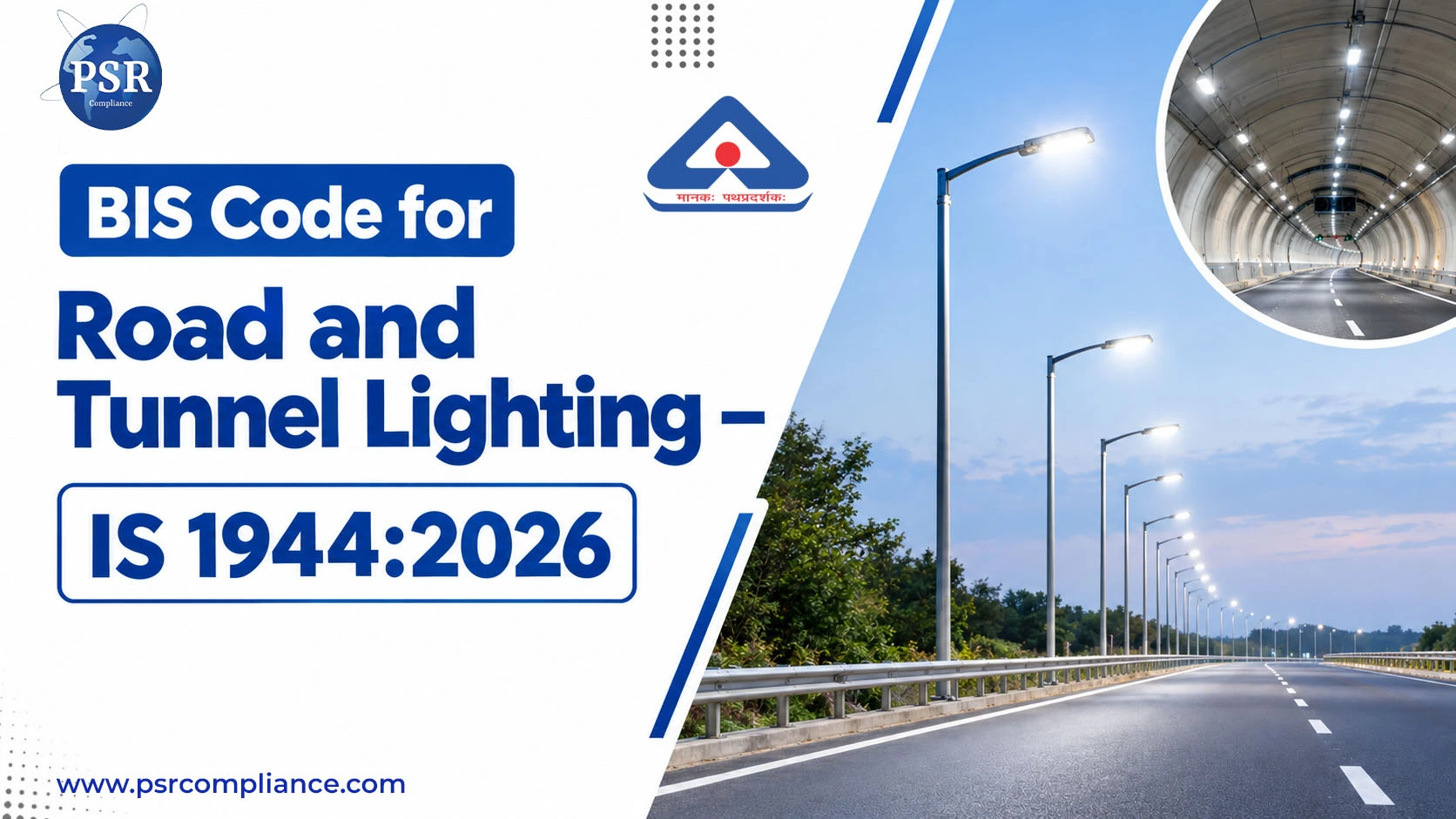
BIS Code for Road and Tunnel Lighting – IS 1944:2026
Good lighting saves lives. A dark highway curve, a patchy stretch of road or a badly lit tunnel entrance can cause accidents within seconds. At the same time, cities spend huge amounts of money on electricity for public lights.
India has now updated its rulebook for this work. The Bureau of Indian Standards (BIS) has published IS 1944: 2026, the new code for road and tunnel lighting. If you design, build, supply or bid for lighting projects, this change affects you directly.
This guide explains the new IS 1944 Code of Practice in simple words. You will learn what has changed, how it affects smart street lighting and tunnel lighting, and what lighting companies and contractors should do next.
What Is IS 1944: 2026? The New IS 1944 Code of Practice for Road and Tunnel Lighting
IS 1944: 2026 is titled Road and Tunnel Lighting: Code of Practice (Second Revision). It is issued by the Bureau of Indian Standards, Civil and Electrotechnical Division, Government of India.
It replaces and combines the older multi-part standard IS 1944 (Parts 1 to 7), which was first drafted between 1970 and 1981.
In simple words, it is the main design guide for road and tunnel lighting in India. It tells engineers how bright a road should be, how evenly the light should spread and how to light a tunnel safely.
Why Was the Old IS 1944 Code of Practice Replaced?
1. Old Lamps vs LED and Smart Street Lighting
The 1970 to 1981 rules were written for older lamps, such as high-pressure sodium, mercury vapor and low-pressure sodium lamps. Today, most public lighting uses LED lights and smart, internet-connected controls.
2. Growth of Expressways Needs Better Tunnel Lighting
India is building expressways, mountain highways, coastal corridors and metro underpasses. Examples include the Atal Tunnel in Himachal Pradesh, the Zojila project and the Mumbai Coastal Road. Long tunnels need clear, safety-focused lighting rules.
3. Global Alignment
The new code follows modern international practice, mainly the European standard EN 13201 and guidelines from the International Commission on Illumination (CIE).
BIS Street Lighting Standards: Key Points in IS 1944:2026
A. Tunnel Lighting Design
A tunnel is not lit the same way from start to end. The standard divides it into zones.
- Access and Threshold Zone: Needs strong daytime light so that the entrance does not look like a dark hole. This avoids the "Black Hole Effect".
- Transition Zone: Light is lowered step by step so that the driver's eyes can adjust.
- Interior Zone: Steady, glare-free light for normal driving speed.
- Exit Zone: Light is raised before the exit to reduce the "White Hole Effect", when a driver comes out into bright sunlight.
- Emergency and Evacuation Lighting: Backup lighting must work during a power cut, smoke or fire.
B. Road Lighting Measures
The code sets clear measures based on road speed, traffic and pedestrian use.
- Average road surface luminance: Even brightness on asphalt and concrete roads.
- Overall and longitudinal uniformity (Uo and Ul): Avoids dark and bright patches, often called "zebra" effect on highways.
- Glare control (Threshold Increment, TI): Limits harmful glare from pole-mounted and high-mast LED lights.
- Surround Ratio (SR): Keeps footpaths, verges and curbs properly lit for pedestrians.
C. Smart and Adaptive Lighting
This is where smart road lighting gets formal support. The code gives guidance on:
- Centralized Control and Monitoring Systems (CCMS) for remote control.
- Astronomical timers that switch lights on and off by sunrise and sunset.
- Ambient light sensors.
- Dimming based on traffic density to save power.
Smart Street Lighting: What Does It Mean?
Smart street lighting means street lights that are connected, monitored and controlled from a central point.
A smart or intelligent street lighting system can:
- Switch on at dusk and off at dawn automatically.
- Dim the lights when traffic is low.
- Send alerts when a light fails.
- Track power use for each pole or feeder.
- Reduce maintenance trips and delays.
India already has a large base of connected LED street lights. The Street Lighting National Programme (SLNP) was launched on 5 January 2015, and by May 2022 the government's implementing agency, EESL, had installed over 1.27 crore LED street lights across the country, saving more than 8,500 million units of electricity. Many of these use CCMS for remote monitoring.
Real-World Example: Smart Road Lighting in Ara, Bihar
In March 2018, 4,611 smart LED street lights were dedicated to the people of Ara in Bihar under SLNP. They were installed in about three weeks. The Ara Municipal Corporation was expected to save around 27 lakh kWh of energy each year. The project also used CCMS panels with GIS mapping for remote control and monitoring.
This shows what a smart road lighting project can deliver: quick installation, lower power bills and easier fault tracking.
With IS 1944: 2026, designs for such projects now have a modern code behind them.
LED Tunnel Light: What Changes for Suppliers?
An LED tunnel light must do more than just shine. In a tunnel, light levels change from zone to zone, and the system must work in dust, smoke, vibration and moisture.
A smart tunnel lighting system under the new code is expected to include:
- Zone-wise brightness control.
- Daylight sensors at entrance and exit.
- Dimming based on traffic and outside light.
- Emergency backup with standby supply.
- Remote monitoring of faults.
For manufacturers, this means that product details such as light distribution, glare control and ingress protection become even more important.
Code of Practice vs BIS Product Certification: Do Not Mix Them Up
| Point | IS 1944: 2026 | Product Standards (for example IS 10322 Part 5 / Sec 3) |
|---|---|---|
| Type | Code of Practice (design, installation, planning) | Product specification (manufacturing and safety) |
| Used by | Highway engineers, urban planners, EPC contractors, NHAI, PWDs | LED luminaire makers, fixture assemblers, importers |
| Focus | Lux levels, pole spacing, beam angles, tunnel safety | Electrical safety, IP ratings (IP66), surge protection, thermal design |
| Compliance | Needed in government tenders and project reports | BIS ISI or CRS licence needed to sell the luminaire |
Simple rule: IS 1944: 2026 decides how the lighting should be designed. Product standards decide whether the light fitting itself is safe and approved to be sold.
A project needs both to pass.
Government and highway tenders often ask bidders to follow BIS codes. With the new code, you may see:
- Design reports based on IS 1944: 2026 rather than the older parts.
- Photometric files in .IES or .LDT format, to check light distribution.
- Calculations for luminance, uniformity, glare and surround ratio.
- Smart control and CCMS details.
- Tunnel zone-wise design for road tunnels.
- BIS-certified luminaires with valid test reports.
BIS Registration Process for Road and Tunnel Lighting Products
Step 1: Identify Product Certification Requirements
Determine the category of your road lighting or tunnel lighting product and identify the Indian Standard applicable to its manufacture and safety requirements.
Step 2: Verify BIS Applicability
Check whether the product is covered under a mandatory BIS certification scheme or Quality Control Order (QCO). The applicable requirements depend on the product type and relevant regulations.
Step 3: Arrange Technical Documentation
Prepare product specifications, manufacturer details, factory information, quality-control documents and other technical records required for the applicable certification scheme.
Step 4: Complete Product Testing
Arrange testing against the applicable product standard through a laboratory accepted under the relevant BIS scheme. Ensure the test results correspond to the exact product model.
Step 5: File the BIS Application
Submit the application through the relevant BIS portal with the required documents, test reports and applicable fees.
Step 6: Respond to BIS Assessment
Address any questions raised during application review. If required under the applicable scheme, facilitate factory inspection, sample evaluation or additional testing.
Step 7: Obtain the Applicable Approval
After the requirements are fulfilled, obtain the relevant BIS licence or registration, where applicable, and follow the conditions for product marking and sale.
Step 8: Maintain Ongoing Compliance
Maintain quality-control records, product traceability and testing documentation, and comply with the conditions of the applicable certification scheme.
Important: IS 1944:2026 addresses road and tunnel lighting design practices. It does not automatically require a separate BIS product licence under that standard. Verify the applicable product standard and certification requirements before applying.
Who Should Act Now on BIS Street Lighting Standards?
- Lighting OEMs and LED fixture makers: Check that your test reports and files meet tender needs.
- EPC contractors and bidders: Update design methods to the new code.
- Highway consultants and DPR preparers: Use the new parameters in design reports.
- Importers of LED street lights and tunnel lights: Confirm BIS certification for the products you bring in.
- Municipal bodies and PWDs: Update tender documents and checking methods.
Common Mistakes to Avoid
- Using the old IS 1944 parts in a new design.
- Treating a BIS code of practice as a product licence.
- Submitting a bid without photometric files.
- Ignoring glare control and uniformity values.
- Skipping emergency lighting in tunnel designs.
- Selling LED street lights without valid BIS certification.
- Using test reports that do not match the product model.
- These mistakes can lead to tender rejection, project delays or legal trouble.
Practical Advice for Road and Tunnel Lighting Bidders
- Read the tender line by line. Check which parts of the code are asked for.
- Match your test reports. Make sure your product reports under IS 10322 and IS 16107 are valid and cover the exact model.
- Prepare photometric files. Keep .IES and .LDT files ready and correct.
- Plan for smart features. CCMS, sensors and dimming are now part of the conversation.
- Use safe margins. Do not design only to the minimum value.
- Check tunnel details. Zone-wise lighting and emergency backup need special planning.
- Take expert help early. It saves time at the bid stage.
How PSR Compliance Can Help
We support lighting manufacturers, importers, EPC bidders and project teams with BIS-related work:
- Review of your product test reports against tender needs.
- Checking of photometric files (.IES / .LDT) for tender parameters.
- Guidance on BIS ISI Certification and CRS certification for LED luminaires.
- Gap check between your product data and IS 1944: 2026 based designs.
- Documents and filing support for BIS licences.
- Support for importers of LED lighting products.
- Tender document review for compliance points.
Get tender-ready without last-minute stress.
Conclusion
Bidding for a road or tunnel lighting project requires proper documentation and compliance with the applicable BIS standards and technical requirements. Before submitting your tender, ensure that your product reports, test documents, and certification requirements are in order.
PSR Compliance helps you review your documents, identify compliance gaps, and get professional guidance for the certification process. Get your documentation ready and approach your next tender with confidence.
FAQs
1. What is IS 1944: 2026?
It is the new Indian Standard code of practice for road and tunnel lighting. It is the second revision and replaces the older IS 1944 Parts 1 to 7.
2. Who issues IS 1944: 2026?
The Bureau of Indian Standards (BIS), Civil and Electrotechnical Division, Government of India.
3. Why was the old standard replaced?
The older rules were made for discharge lamps. Today, LED and smart lighting are common, and India is building many highways and tunnels.
4. What is the difference between IS 1944 and IS 10322?
IS 1944 is a design and installation code. IS 10322 (for example Part 5 / Sec 3) covers product requirements for luminaires.
5. Does IS 1944: 2026 cover tunnel lighting?
Yes. It gives guidance for access, threshold, transition, interior and exit zones, as well as emergency lighting.
6. What is the Black Hole Effect?
It happens when a tunnel entrance looks very dark to a driver in bright daylight. Strong lighting at the entrance reduces this effect.
7. What is the White Hole Effect?
It is the temporary glare that a driver faces when leaving a tunnel into bright sunlight. Step-up lighting at the exit helps.