Tue, Oct 27 2026
Advocate Rajkumar
BIS Certification for Flexible Plywood Under IS 19952:2026 – Process, Specifications & Documents
Curved reception desks, round pillars, spiral arches and designer ceilings are now common in homes, offices and hotels. They are all made with flexible plywood, also called flexi-ply. Until recently, India had no dedicated standard for it. That has now changed. The Bureau of Indian Standards (BIS) has published IS 19952 : 2026, the first Indian Standard made only for flexible plywood. If you make, import or sell this product, you need to understand it now. Once it comes under a mandatory order, BIS certification for flexible plywood will be a must to sell in India.
This blog explains the new standard, the key flexible plywood specifications, the ISI mark process and what you should do next. It is written in simple words so that you can act without confusion.
What Is Flexible Plywood?
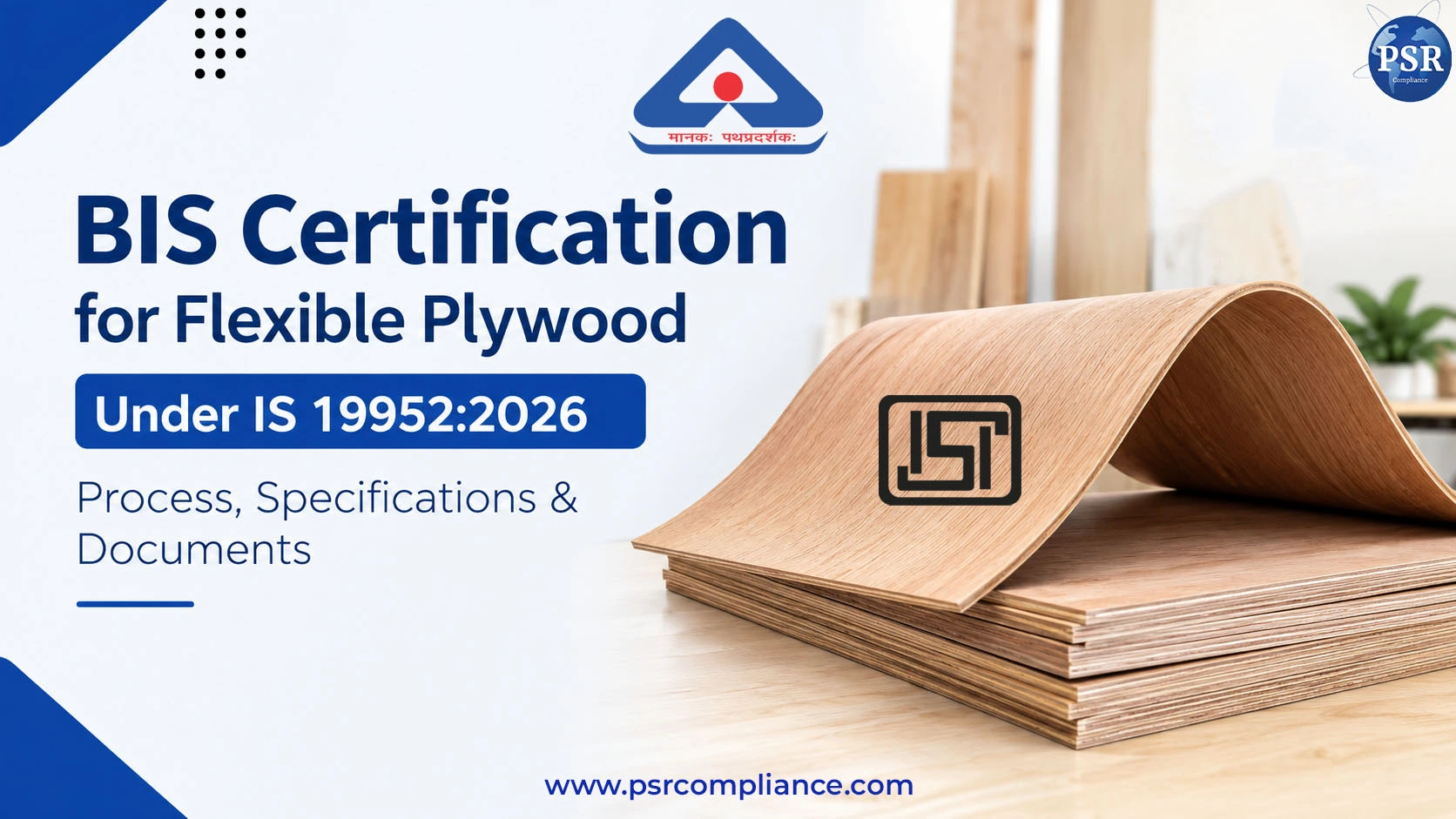
Flexible plywood is a bendable board made from thin veneers. Its layers and grain direction are arranged so that the sheet can curve smoothly without cracking.
It is commonly used for :
- Curved columns and pillars
- Round reception desks and counters
- Spiral arches and curved walls
- Designer false ceilings
- Curved furniture and modular interiors
- Shop displays and exhibition stands
Normal plywood is stiff. If you bend it too much, it snaps. Flexible plywood is built to bend without breaking.
What Is IS 19952 : 2026?
IS 19952 : 2026 is titled Flexible Plywood : Specification. It is issued by the Bureau of Indian Standards (BIS), under the Ministry of Consumer Affairs, Food and Public Distribution, Government of India.
Flexible Plywood Specifications Under IS 19952 : 2026
The standard sets requirements for both product quality and performance. Here are the main points.
| Parameter | What IS 19952 : 2026 Requires |
|---|---|
| Bending radius | Curve smoothly without cracking |
| Veneer layout | Flexible core for multi-directional bending |
| Glue strength | No layer separation under bending |
| Grades | Available in MR (Moisture Resistant) and BWP/BWR (Boiling Water Proof / Resistant) grades. |
| Emissions | Strict formaldehyde limits |
| Tolerances | Precise thickness and dimensions |
IS 303 vs IS 19952 : 2026 : What Is the Difference?
| Feature | Plywood under IS 303 | Flexible Plywood under IS 19952 : 2026 |
|---|---|---|
| Main strength | High stiffness and load-bearing | High flexibility and curve ability |
| Typical use | Partitions, wardrobes, beds, flat paneling | Curved columns, round desks, spiral arches, designer ceilings |
| How it fails | Snaps when bent too far | Built to curve without fibre breakage |
| Testing focus | Static bending strength and modulus of elasticity | Bending flexibility index and glue shear after curving |
This is why a flexi-ply board cannot be judged by old plywood tests. It needs its own standard.
Please note : Until a QCO is notified, certification for this product may be voluntary. Once it is notified, it becomes compulsory, and a transition period is usually given. Businesses that prepare early will not face a rush.
ISI Mark for Plywood : What Does It Give You?
The ISI mark certificaftion for plywood tells buyers that the product meets the Indian Standard and that the factory is checked by BIS.
Benefits for manufacturers :
- Legal right to sell once the QCO applies
- Higher trust from architects, interior designers and contractors
- Better chances with large projects and tenders
- A clear edge over uncertified grey-market products
- Lower risk of complaints over cracking and peeling
- Stronger brand value in a growing market
Large plywood brands already work with BIS on standards. For example, in a BIS committee meeting (CED 20) held on 20 July 2020, Greenply Industries Limited asked BIS to review the plywood standard so that it matches modern materials. This shows that standards change with the market, and that companies that follow them early stay ahead.
BIS ISI Mark Certification for Plywood : Who Needs It?
- Domestic manufacturers of plywood and plywood-based boards
- Plywood mills in clusters such as Yamunanagar, Perumbavoor and others
- Importers and foreign mills that send plywood to India
- Traders and brands who sell under their own label (the license holder must be the manufacturer, so label arrangements need care)
For flexible plywood, two groups need to act :
- Domestic manufacturers must upgrade their testing setup and apply for an ISI license.
- Importers and foreign mills must obtain certification under the Foreign Manufacturers Certification Scheme (FMCS) before shipping flexible plywood to India, once the product is notified.
BIS Certification for Flexible Plywood: Step-by-Step Process
The certification route is Scheme-I (ISI Mark) under IS 19952 : 2026.
Step 1 : Set Up an In-House Lab
You need your own testing facility. It should be able to run :
- Bend radius tests
- Glue shear tests
- Moisture content checks
- Size and thickness checks
Equipment must be calibrated, and trained staff must run the tests.
Step 2 : File the Application Online
Apply on the BIS Manakonline portal with Form V. You will submit :
- Plant layout
- Machinery details
- Raw material details
- Test records
- Authorized person details
Take care here. Missing or wrong details are a common cause of delay.
Step 3 : Factory Audit and Inspection
A BIS auditor visits your plant. The auditor checks :
- Production controls
- Raw material handling
- Process records
- Testing equipment and how tests are done
The auditor may also witness your in-house tests.
Step 4 : Independent Lab Testing
Samples are drawn during the inspection, sealed and sent to a BIS-approved third-party lab. The lab checks them against IS 19952 : 2026.
Step 5 : Grant of License
If the audit and the lab tests are satisfactory, BIS grants the license. You receive a CM/L number. This allows you to print the ISI mark on each sheet.
Documents You Should Keep Ready
- Business registration and ownership papers
- Factory address proof and plant layout
- Machinery and equipment list
- Raw material and supplier details (veneer, adhesive, resin)
- In-house lab details and calibration records
- Test records for bend radius, glue shear and moisture
- Quality control manual
- Authorized signatory and contact person details
For foreign mills under FMCS, the papers also include the mill's details, an authorized Indian representative, and the required local approvals.
How Long Does It Take?
Timelines depend on how ready your factory is and how quickly BIS schedules the audit and lab results.
| Stage | Typical Time |
|---|---|
| In-house lab setup and documents | Several days to weeks |
| Online application review | A few weeks |
| Factory inspection | Based on BIS scheduling |
| Lab testing | A few weeks |
| License grant | After successful test results |
If everything is correct, the process runs smoothly. Most delays come from gaps in lab setup, missing records or wrong details in Form V.
Common Mistakes to Avoid
- Waiting for the QCO and starting late
- Using old plywood test methods for flexible boards
- Setting up a lab without bend radius testing equipment
- Using glue that fails after repeated bending
- Ignoring formaldehyde limits
- Incomplete or wrong details in Form V
- No trained staff for in-house testing
- Selling under a brand name without clarity on who holds the license
These mistakes can delay your license by weeks or even months, and can block your sales.
Real-World Example : Why Early Preparation Pays Off
When plywood for general purposes (IS 303) came under strict control, many mills in plywood clusters had to upgrade machines, labs and records in a short time. Mills that had already built testing systems moved faster, while others faced stock holding and delays at the start.
Flexible plywood is now at the same point. The standard is published, the product has a clear test method, and the QCO is expected to follow. Mills in clusters such as Yamunanagar, Perumbavoor and Kandla, along with interior board importers and architectural panel suppliers, can use this window to get certified first.
How PSR Compliance Can Help
We support plywood mills, importers and panel suppliers with the full BIS process for IS 19952 : 2026 :
- Gap check of your factory against the standard
- In-house lab equipment list and setup guidance
- Document and quality manual preparation
- Form V filing on the Manakonline portal
- Audit preparation and mock inspection
- Follow-up with BIS and the lab until license grant
- FMCS support for foreign manufacturers
- ISI mark use guidance and renewal support
Planning to get BIS certification for flexible plywood but unsure where to start?
PSR Compliance can handle everything for you, from lab setup guidance to final license. Get your ISI license faster and avoid last-minute stress.
FAQs
1. What is IS 19952 : 2026?
It is the Indian Standard for flexible plywood. It sets requirements for bending, veneer layout, glue strength, formaldehyde emission and size tolerance.
2. Is BIS certification for flexible plywood mandatory?
The standard is published. Flexible plywood is expected to be added to the mandatory Quality Control Order list. Once notified, the ISI mark will be compulsory.
3. What is flexible plywood used for?
It is used for curved columns, round reception desks, spiral arches, designer ceilings and curved furniture.
4. How is IS 19952 different from IS 303?
IS 303 covers general-purpose plywood that is stiff and strong. IS 19952 covers flexible plywood that must bend without cracking.
5. What grades are covered under IS 19952 : 2026?
MR (Moisture Resistant) and BWP/BWR (Boiling Water Proof/Resistant) grades.
6. What tests are done for flexible plywood?
Tests include bend radius, glue shear after curving, moisture content, formaldehyde emission and dimensional checks.
7. How can PSR Compliance help?
We assist with lab setup guidance, documents, Form V filing, audit preparation and follow-up until the license is granted.