
Just send us your questions or concerns by starting a new case &
we will give you the help you need. Start Here...
Spice Board Registration
Fri, May 29 2026
Raju Karn
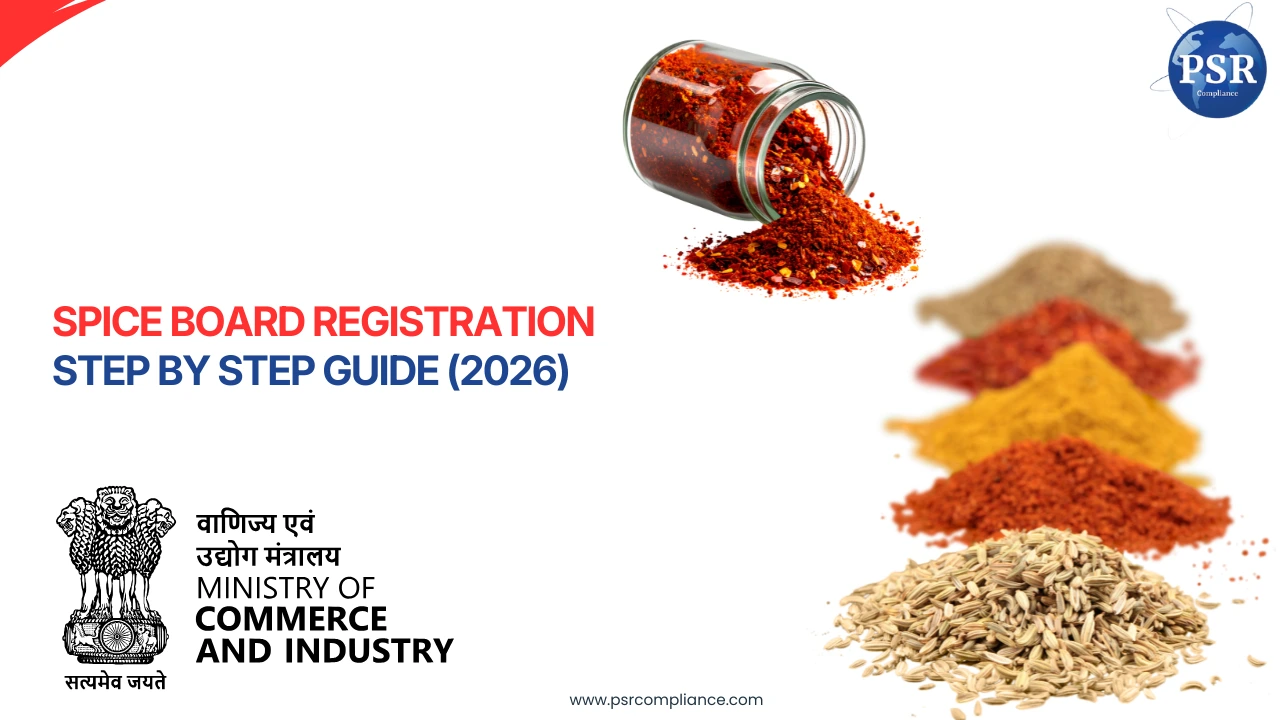
Spice Board Registration in India : Step by Step Guide (2026)
India’s spices are world famous-think cardamom, turmeric, black pepper. But to legally export or trade many of these spices, you need registration under the Spice Board of India. With PSR Compliance, we make Spice Board registration (2026 edition) easy and accurate.
In this guide, we'll walk you through what Spice Board registration means, who needs it, what documents are required, and how PSR Compliance can assist so you don’t run into surprises or delays.
Spice Board of India and Its Functions
The Spice Board of India, established under the Spices Board Act of 1986, is a regulatory body under the Ministry of Commerce and Industry. Its primary functions include promoting Indian spices globally, ensuring quality control and standardization, regulating spice exports, supporting research and development in the spice industry, and providing market intelligence to stakeholders.
Who Needs Spice Board Registration?
Spice Board registration in India is mandatory for the following categories of businesses and individuals involved in the spice industry:
- Spice exporters who are engaged in exporting spices from India to international markets
- Spice manufacturers involved in processing, production, or packaging of spices
- Traders dealing with the 52 specified spices listed under the Spice Board Act
- Cardamom growers who cultivate and supply cardamom for commercial purposes
- Cardamom traders involved in buying, selling, or distributing cardamom in domestic or export markets
- Merchant exporters who source spices from suppliers and export under their own name
- Small and medium spice businesses planning to enter the export market
- Contract manufacturers producing spices for export-oriented companies
- Spice processing units involved in cleaning, grading, or value addition before export
- Startups entering the spice export industry and dealing with regulated spice products
Eligibility Criteria for Spice Board Registration
To be eligible for Spice Board registration in India, applicants must meet the following criteria:
- Be a registered entity under the Companies Act or Partnership Act
- Possess a valid Import-Export (IE) Code
- Have a minimum turnover of ₹2.5 lakhs in the previous financial year
- Maintain a permanent business location and adequate storage facilities
- Possess necessary infrastructure and technical expertise
- Comply with food safety and quality standards
- Agree to follow Spice Board guidelines and procedures
Step-by-Step Spice Board Registration Process in India (2026)
Step 1: Online Registration
The first step in the Spice Board registration process is to visit the official Spice Board portal. Applicants are required to create an account using their Import-Export (IE) Code, mobile number, and email address. Once the registration is completed successfully, the applicant gains access to the online application form and dashboard for further processing.
Step 2: Fill Application Form
After logging in, the applicant must carefully fill out the application form with complete business details. This includes export-related information, ownership structure, and other essential declarations. Accuracy is very important at this stage because any incorrect or incomplete information may lead to delays or rejection of the application.
Step 3: Document Submission
In this step, all required documents must be uploaded through the online portal. These typically include the Import-Export Code certificate, GST registration certificate, PAN card, recent bank statement, and proof of business premises. Proper and clear documentation helps ensure smooth verification and faster processing.
Step 4: Fee Payment
Once the application form and documents are submitted, the applicant must pay the prescribed registration fee online using the official payment gateway. The application will only move forward after successful payment confirmation.
Step 5: Application Review
After submission and payment, the Spice Board reviews the application along with all uploaded documents. During this stage, the authorities may also request additional information or clarification if any discrepancies are found in the application.
Step 6: Verification
In certain cases, the Spice Board may conduct a physical verification of the applicant’s business premises. This step is carried out to confirm the authenticity of the business operations and ensure compliance with regulatory requirements.
Step 7: Certificate Issuance
Once the application is approved and all checks are completed, the Certificate of Registration as Exporter of Spices (CRES) is issued. The certificate can be downloaded directly from the official Spice Board portal and serves as proof of legal authorization for spice export activities.
State-Wise Spice Export Registration Usage
| State | Export Activity Level | Key Spice Activity |
|---|---|---|
| Kerala | Very High | Pepper, cardamom, clove exports |
| Tamil Nadu | High | Turmeric, chili processing |
| Karnataka | High | Coffee-spice trade, pepper |
| Andhra Pradesh | High | Chili, turmeric exports |
| Telangana | High | Spice processing industries |
| Maharashtra | Very High | Export houses, trading hubs |
| Gujarat | High | Bulk spice trading, packaging |
| Rajasthan | Medium | Dry spices, cumin exports |
| Uttar Pradesh | High | Processing units, trading |
| Madhya Pradesh | Medium | Raw spice sourcing |
| West Bengal | High | Mustard, spice trading |
| Punjab | Medium | Processing and milling |
| Haryana | Medium | Trade and logistics hubs |
| Delhi NCR | Very High | Export companies, HQ offices |
| Assam | Medium | Organic spices, ginger |
| Odisha | Medium | Regional spice trade |
| Bihar | Medium | Local spice processing |
| Jharkhand | Low-Medium | Small-scale trade |
| Chhattisgarh | Low-Medium | Emerging spice sector |
| Himachal Pradesh | Low | Herbal and organic spices |
| Uttarakhand | Low | Organic spice farming |
| Goa | Medium | Tourism-based spice trade |
| Manipur | Low | Organic niche spices |
| Meghalaya | Low | Herbal spice exports |
| Nagaland | Low | Organic farming exports |
| Mizoram | Low | Local spice cultivation |
| Tripura | Low | Small-scale trade |
| Arunachal Pradesh | Low | Organic niche production |
| Sikkim | Low | Organic spice exports |
Benefits of Spice Board Registration in India
Spice Board registration offers legal compliance, credibility in international trade, access to exporter databases, global networking opportunities, support in trade inquiries, participation in exhibitions, access to market intelligence, and eligibility for government incentives.
Compliance After Registration
After registration, exporters must submit quarterly returns using Form B, renew registration on time, report any changes in business details, and maintain active export operations.
Spice Board Renewal Process
Spice Board registration is valid for three years. Renewal requires online application, updated documents, fee payment, and verification if required.
Penalties for Non-Compliance
Non-compliance may result in fines, suspension or cancellation of registration, blacklisting from export activities, or legal action in serious cases.
Tips for Smooth Registration
Start early, verify all documents carefully, maintain updated records, follow Spice Board guidelines, and seek professional assistance if needed.
Wrapping Up
Registration with the Spice Board is an important requirement for businesses who wish to trade spices in India. The registration process ensures compliance with national standards and smooth export operations. With proper documentation and adherence to guidelines, exporters can build a strong presence in both domestic and international markets.
Need Help with Spice Board Registration (2026)?
Get expert assistance with Spice Board registration for exporting spices from India. Our compliance specialists handle the entire process—from documentation to approval—so your business stays fully compliant with the requirements of the Spice Board of India.
📞 Call: 8796104190
📧 Email: support@psrcompliance.com
Spice Board Registration FAQs (2026)
Q. What is Spice Board registration?
It is a mandatory certification for exporters dealing in specified spices under the Spice Board of India.
Q. Who needs Spice Board registration?
Exporters, manufacturers, traders, and cardamom growers dealing in notified spices require it.
Q. Is Spice Board registration mandatory for export?
Yes, it is required for exporting spices legally from India.
Q. How long is Spice Board registration valid?
It is generally valid for three years.
Q. What is the certificate called?
It is called Certificate of Registration as Exporter of Spices (CRES).
Q. Can I apply online?
Yes, the entire process is done through the official online portal.
Q. Is physical verification required?
Yes, in some cases the Spice Board may inspect business premises.
Q. What happens if I don’t register?
You cannot legally export spices listed under the Spice Board regulations.
Q. Can small traders apply?
Yes, if they meet eligibility criteria like IE code and business registration.
Q. Can PSR Compliance help with registration?
Yes, professional assistance helps in faster and error-free approval.