Mon, Nov 23 2026
Advocate Rajkumar
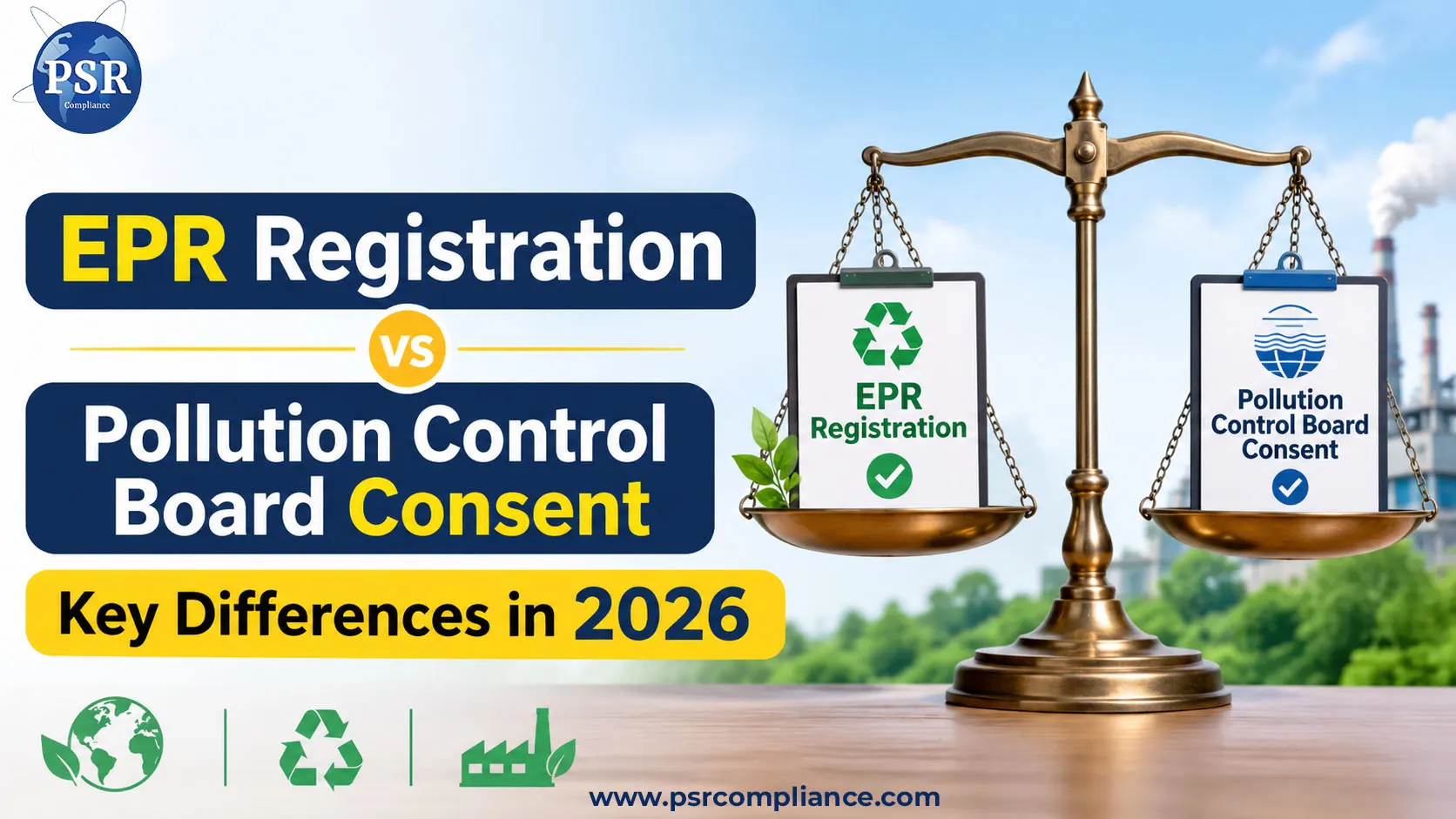
EPR Registration vs Pollution Control Board Consent – Key Differences in 2026
Many business owners ask the same question: "I already have a Pollution NOC. Do I still need EPR registration?" The short answer is yes, most of the time. These are two different approvals from two different authorities, and having one does not replace the other.
This confusion is a big reason why applications get delayed, returns get missed, and notices arrive. This guide explains EPR Registration vs Pollution Control Board Consent in simple words, so you know what you need, who issues it, and what to do next.
What Is EPR Registration?
EPR stands for Extended Producer Responsibility. The idea is simple: if your business puts plastic packaging in the market, you are responsible for what happens to it after use.
EPR Registration is a mandatory sign-up on the centralised portal of the Central Pollution Control Board (CPCB). It comes under the Plastic Waste Management Rules, 2016, and the EPR Guidelines added in February 2022. Similar EPR rules also exist for e-waste, batteries, used oil, and waste tyres.
EPR Registration for Plastic Waste: Who Needs It?
You need EPR Registration for Plastic Waste if you are a:
- Producer who makes plastic packaging or products
- Importer who brings plastic packaging or packaged goods into India
- Brand Owner who sells goods in plastic packaging under your own name
- Plastic Waste Processor (PWP) such as a recycler
- Together, producers, importers, and brand owners are called PIBOs.
Here is what you get after registration:
- You can legally place plastic packaging in the market
- You get a registration certificate through the CPCB portal
- You can buy or sell EPR certificates to meet your yearly targets
- You can file your yearly return on the portal
What Is Pollution Control Board Consent?
Pollution Control Board Consent is a permission from your State Pollution Control Board (SPCB) or Pollution Control Committee. It is issued under the Water Act, 1974 and the Air Act, 1981.
It checks one thing: will your factory, plant, or workshop pollute the air or water more than the allowed limits?
People often call this approval a Pollution NOC. Strictly speaking, the correct name is "consent," and it comes in two stages.
Consent to Establish and Consent to Operate
- Consent to Establish (CTE): You must take this before you build your unit or install machines. The board checks your site, plans, and pollution control setup.
- Consent to Operate (CTO): You must take this before you start production. The board checks that your pollution control systems are really in place and working.
CTO needs to be renewed from time to time. The validity and fees depend on your industry category and state, so always check with your SPCB.
EPR Registration Vs Pollution Control Board Consent: Key Differences
| Point | EPR Registration | Pollution Control Board Consent |
|---|---|---|
| Main purpose | Manage waste after your product is used | Control pollution from your factory |
| Authority | CPCB (central portal) | State Pollution Control Board |
| Law | Plastic Waste Management Rules, 2016 (and other EPR rules) | Water Act, 1974 and Air Act, 1981 |
| Who needs it | Producers, importers, brand owners, recyclers | Industries and units that can pollute |
| Focus | Packaging waste, recycling targets | Emissions, effluent, and noise |
| Need a factory? | No. Even a trading brand needs it | Yes. It is linked to a physical unit |
| Yearly work | Annual return and certificates | Renewal and monitoring reports |
| Stages | One registration plus yearly compliance | Two stages: CTE and CTO |
Difference Between EPR and CTO in Simple Words
Imagine a company that makes packaged snacks in a factory.
Its factory makes smoke, wastewater, and noise. The SPCB checks this and gives CTO.
Its snack packets are made of plastic. After customers eat the snacks, those packets become waste. The company must make sure that an equal amount of plastic waste is collected and recycled. This is EPR.
Do You Need Both?
- Manufacturer of plastic packaging: You usually need both. SPCB consent for your plant, and EPR registration as a producer.
- Recycler or Plastic Waste Processor: You need both. In fact, a valid CTO from the SPCB is needed before you apply for EPR registration.
- Brand owner with outsourced manufacturing: You usually need EPR registration. Consent belongs to the factory that makes the goods.
- Importer or trader of packaged goods: You need EPR registration. A Pollution NOC is usually not needed unless you run a polluting unit.
- E-commerce seller using plastic packaging: You are usually covered under EPR as a brand owner or producer.
What Is an EPR Certificate?
- EPR Registration Certificate: This is your proof of registration on the CPCB portal.
- EPR Certificates for targets: These are generated by registered recyclers and processors when they recycle plastic. PIBOs buy these certificates to prove they met their yearly recycling targets.
EPR Annual Return Filing: What You Must Know
EPR Annual Return Filing is the yearly report where you tell CPCB how much plastic packaging you placed in the market and how you met your targets. You file it on the same portal.
Your return usually includes:
- Plastic packaging quantity by category
- Recycling, reuse, and recycled-content targets
- EPR certificates used
- Supporting records and invoices
Targets are getting stricter. From FY 2025-26, recycled content rules also apply, so planning ahead matters.
EPR Annual Return Due Date
The normal EPR Annual Return Due Date is 30 June after the financial year ends. But the government has often extended it because of portal issues.
For FY 2025-26, the extended dates are:
- PIBOs: 31 December 2026
- Plastic Waste Processors: 31 October 2026
As of today, the PIBO deadline is still open, so there is time, but it is closing. Dates can change, so always confirm on the CPCB portal. Do not assume another extension.
Missing the deadline can lead to environmental compensation and other action under the rules.
Documents Usually Needed
For EPR registration:
- Company registration proof, PAN, and GST
- Details of plastic packaging by category
- Authorisation letter
- Valid CTO or consent details (for manufacturers and recyclers)
- Udyam certificate, if you claim a small business benefit
For Pollution Control Board consent:
- Site and layout plan
- Land or lease papers
- Process flow chart and raw material list
- Pollution control system details
- Water and power details
Real-Life Example: When Registration Was Ignored
In October 2020, CPCB told the National Green Tribunal that it had issued show-cause notices to Flipkart and Patanjali Peya. The reason was alleged non-compliance with the Plastic Waste Management Rules. The notices asked why their operations should not be closed and why environmental compensation should not be charged. This came out of a case filed by a teenager against the use of excess plastic in e-commerce packaging. CPCB also said that other big names, such as Amazon Seller Services and Coca-Cola India, had recently been granted registration as brand owners.
The lesson: Even large, well-known brands can face serious notices when EPR obligations are not met. A small business has even less room for error.
Common Mistakes to Avoid
- Thinking a Pollution NOC covers EPR. It does not.
- Applying for EPR before sorting consent (for recyclers and manufacturers).
- Choosing the wrong packaging category. This changes your targets and can cause trouble later.
- Mismatched details between your consent, GST, and portal data.
- Missing the annual return or assuming another extension.
- Buying EPR certificates from unverified sources. Always buy through the official portal.
- Claiming the small business exemption without a valid Udyam certificate.
How PSR Can Help
- A free check to find out whether you need EPR, consent, or both
- EPR Registration on the CPCB portal, in the correct category
- Consent to Establish and Consent to Operate applications with your State Pollution Control Board
- EPR Annual Return Filing and target planning
- Help with EPR certificates and compliance records
- Renewals, reminders, and notice replies
- Not sure what applies to your business? Call us today for a free consultation. We will tell you exactly what you need, how long it takes, and what it costs, before you pay anything.
Frequently Asked Questions
1. Is EPR registration the same as a Pollution NOC?
No. EPR registration is issued through the CPCB portal and covers product waste. A Pollution NOC, or consent, is issued by the State Pollution Control Board and covers pollution from your unit.
2. What is the difference between EPR and CTO?
EPR makes you responsible for the waste your products create after use. CTO is permission to run your factory without crossing pollution limits.
3. What are Consent to Establish and Consent to Operate?
CTE is needed before you build or set up a unit. CTO is needed before you start production.
4. Who needs EPR registration for plastic waste?
Producers, importers, brand owners, and plastic waste processors need it.
5. Do traders or online sellers need EPR registration?
If you sell goods in plastic packaging under your own brand, or import them, you usually need it. Check your exact role with an expert.
6. What is the EPR annual return due date?
It is normally 30 June. For FY 2025-26, PIBOs have been given time until 31 December 2026. Always confirm on the portal.
7. Does a recycler need consent before EPR registration?
Yes. A valid Consent to Operate from the SPCB is needed before applying for EPR registration as a Plastic Waste Processor.
8. What happens if I skip EPR registration?
You may face environmental compensation, notices, and even closure action under the rules.
9. Who issues an EPR certificate?
EPR certificates are generated on the CPCB portal by registered recyclers and processors, not by state boards.