Fri, Nov 27 2026
Utkarsh Sharma
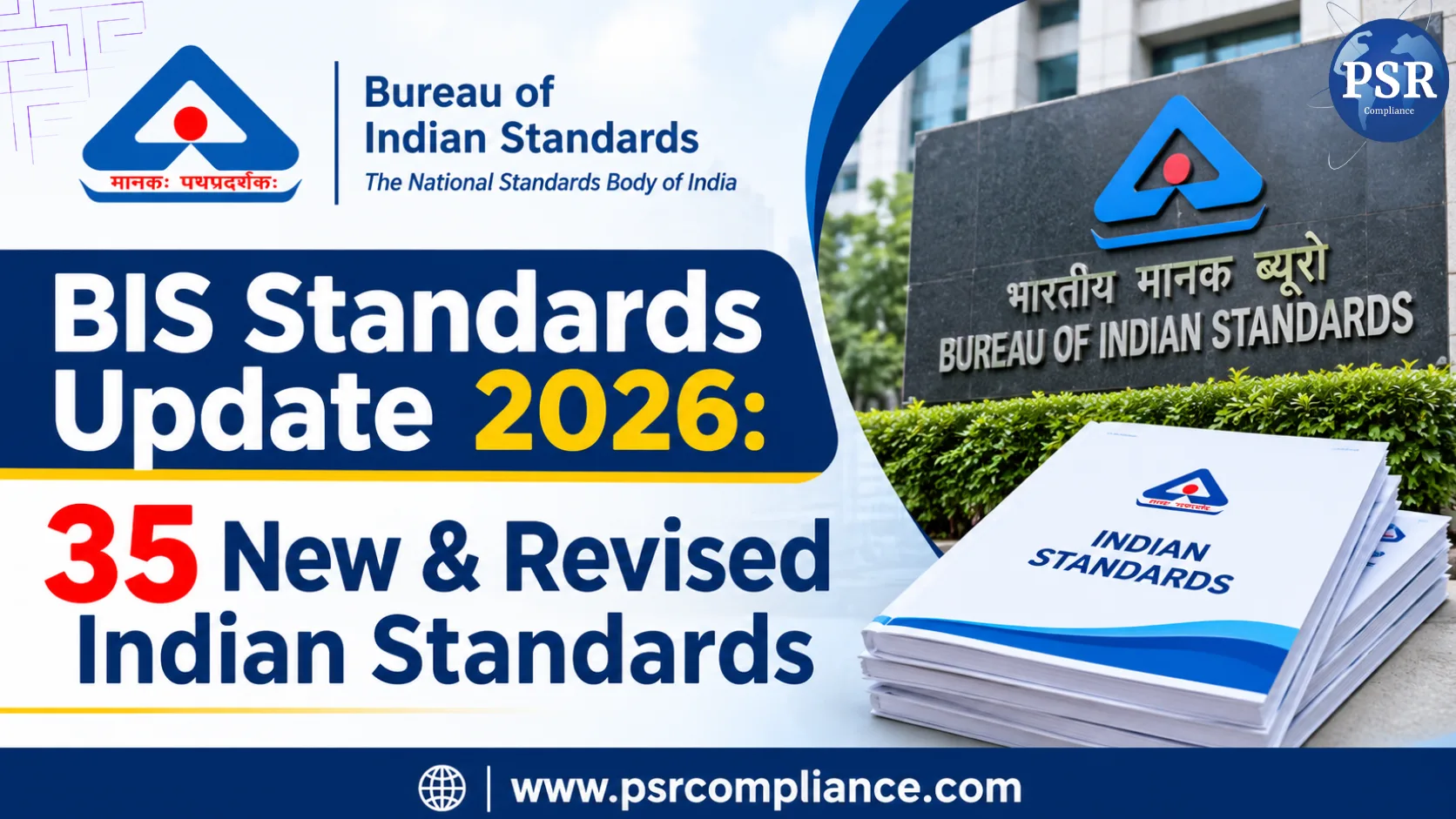
BIS Standards Update 2026: 35 New & Revised Indian Standards
The Bureau of Indian Standards (BIS) has notified 35 new and revised Indian Standards through Gazette Notification No. 665, published on 6 November 2026. All 35 were established on 28 October 2026. Of these, 25 are revisions of standards, including IS 800:2026 for steel construction, and 10 are completely new. The old versions stay valid until 28 April 2027. These standards are not automatically mandatory. BIS certification becomes compulsory when a Quality Control Order covers the product.
Have you seen posts in the media that say BIS makes 35 new standards mandatory? That is a mistake, but it is not true.
BIS did issue 35 new and revised Indian Standards in November 2026. However, issuing a standard is not the same as requiring BIS certification. This guide explains, in words, what BIS announced, which standards changed, what IS 800:2026 means for steel construction and what manufacturers should do before April 2027.
What Did BIS Announce in November 2026?
BIS issued a notice under Rule 15(1) of the Bureau of Indian Standards Rules, 2018. It lists 35 Indian Standards that have been established and also indicates versions that will be withdrawn later.
- Issued by: Bureau of Indian Standards (Department of Consumer Affairs)
- Notification date: Nov 3, 2026
- Gazette publication: Nov 6, 2026 (Notification No. 665)
- Reference number: HQPUB013/1/2020PUBBIS (1632)
- Standards established on: Oct 28, 2026
- Total standards: 35
- Revised standards: 25
- Completely new standards: 10
- Old versions withdrawn on: Apr 28, 2027
Real-life context: This is not a one-off. BIS has been updating standards in batches all autumn.
Is BIS Making These 35 Standards Mandatory?
No. This is the important point in this article. The notice only says these standards have been "established". It does not make BIS certification compulsory for any of the 35 products.
| Establishing a Standard | Making Certification Mandatory |
|---|---|
| BIS publishes or updates the technical rules for a product. | The government requires a BIS licence and the Standard Mark before sale. |
| Done through a BIS Gazette notification like this one. | Done through a separate BIS Quality Control Order (QCO). |
| Businesses can choose to follow it. | Businesses must follow it by law. |
What Is a BIS Quality Control Order?
A BIS Quality Control Order is a government order that lists specific products and the Indian Standards they must meet. Once a QCO applies, nobody can make, import or sell that product in India without a Bureau of Indian Standards certificate and the Standard Mark.
What this means for you: If your product is already covered by a QCO and its standard was revised in this notice, you must follow the version once the transition ends. If your product is not under any QCO, the new standard is voluntary, unless your buyer's contract or tender asks for it.
IS 800:2026: The Biggest Change in This BIS Standards List
The headline update in this notification is IS 800:2026 – General Construction in Steel – Code of Practice (Fourth Revision).
IS 800 is the code that engineers in India use to design steel structures, such as factory sheds, bridges, towers, warehouses and multi-storey steel buildings. The new version replaces IS 800:2007, which was in use for 19 years.
Who should pay attention:
- Engineers and design consultants
- Steel fabricators and construction companies
- Architects and project managers
- Government departments and builders that write tender specifications
- Engineering colleges and students
- IS 800:2007 will remain valid until 28 April 2027.
Take advantage of this period to acquire the IS 800:2026 document, compare it with the 2007 edition and update your design software, drawings and tender documents.
Complete BIS Standards List: 25 Revised Indian Standards
These new Indian Standards replace older ones. The older versions will stay valid until 28 April 2027.
Chemicals, Oils and Industrial Materials
| New Standard | Subject | Replaces |
|---|---|---|
| IS 327:2026 | Oil of lemongrass | IS 327:1991 |
| IS 869:2026 | Ethylene dichloride | IS 869:2020 |
| IS 1758:2026 | Jute batching oil | IS 1758:1986 |
| IS 2252:2026 | Diacetone alcohol | IS 2252:2018 |
| IS 3398:2026 | Oil of patchouli | IS 3398:2003 |
| IS 7297:2026 | Olivine sand and flour for steel foundries | IS 7297:1974 |
| IS 7437:2026 | Sampling and test methods for vegetable adhesives | IS 7437:1974 |
Construction and Engineering
| New Standard | Subject | Replaces |
|---|---|---|
| IS 800:2026 | General construction in steel – code of practice | IS 800:2007 |
| IS 2115:2026 | Mud phuska flat roof finish – code of practice | IS 2115:1980 |
| IS 8632:2026 | Test specimen axes for metallic materials | IS 8632:2023 |
| IS 14962 (Part 4):2026 | Metric screw threads – dip galvanized threads | IS 14962 (Part 4):2023 |
| IS 15277:2026 | Test methods for hydraulic tube connections | IS 15277:2002 |
Plastics, Packaging and Agriculture
| New Standard | Subject | Replaces |
|---|---|---|
| IS 7019:2026 | Glossary of plastics and flexible packaging terms | IS 7019:1998 |
| IS 8688:2026 | Bottles for drinking water | IS 8688:2004 |
| IS 10951:2026 | Polypropylene materials for moulding and extrusion | IS 10951:2020, IS 10910:1984 |
| IS 12395:2026 | Disposable polyethylene trash bags | IS 12395:1988 |
| IS 14434:2026 | Moulding and extrusion materials | IS 14434:2023, IS 14971:2001 |
| IS 15827:2026 | Cladding films for greenhouses and polyhouses | IS 15827:2019 |
| IS 15830:2026 | Plastic mulch laying machines | IS 15830:2009 |
Note: IS 10951:2026 and IS 14434:2026 each replace two older standards. This includes the food-contact standards for polypropylene (IS 10910) and polycarbonate (IS 14971). Makers of food containers and water bottles should check this carefully.
Food, Fuel and Nuclear Technology
| New Standard | Subject | Replaces |
|---|---|---|
| IS 8895:2026 | Handling slaughterhouse by-products | IS 8895:2015 |
| IS 13401:2026 | TBARS test method for meat and meat products | IS 13401:1992 |
| IS 16731:2026 | Marine fuels specification | IS 16731:2019 |
| IS 17328 (Part 1):2026 | Determination of uranium | IS 17328 (Part 1):2021 |
| IS 17329:2026 | Measurement of plutonium | IS 17329:2021 |
| IS 17653:2026 | Ash content in solid biofuels | IS 17653:2021 |
10 Completely New IS Standards
These IS standards are brand new, with no older version to replace:
| Standard | Subject |
|---|---|
| IS 19941 (Part 4):2026 | Inch screw threads – allowances and tolerances |
| IS 19970:2026 | Medical textiles – tampons |
| IS 19972:2026 | Measuring beta radioactivity |
| IS 19973:2026 | Radiation dose assessment for workers |
Key Differences: Revised Indian Standards vs. BIS Amendments
A standout addition for consumers in this update is IS 19970:2026. As India's official standard for disposable tampons, it establishes essential benchmark criteria for an everyday personal hygiene product used by many.
Among these, IS 19970:2026 is particularly notable for consumers as India's new standard for disposable tampons, defining essential quality benchmarks for a widely used personal care product.
Understanding the Distinction: Revised Indian Standards vs. BIS Amendments
IS 19970:2026 stands out for consumers. It is India's standard for disposable tampons, setting quality rules for a product many women use.
Revised Indian Standards vs. BIS Amendment: What's the Difference?
| Type | What It Means | Example |
|---|---|---|
| Revision | A new edition that replaces the standard | IS 800:2026 replaces IS 800:2007 |
| BIS Amendment | A small change to some parts of an existing standard | IS 6528:2024 Amendment No. 1 |
| New Standard | A standard for a subject that had none before | IS 19970:2026 for tampons |
All thirty-five standards mentioned in this notice are either brand-new or revised. They are not amendments. BIS issues amendments on a list. For example, BIS updated four standards covering stainless steel wire, roller bearings, performance sports footwear and nonwoven fabric for medical wipes, effective 28 October 2026, the same day the thirty-five standards were issued.
What Happens on 28 April 2027?
The old copies of the revised standards will be withdrawn on 28 April 2027. Until that date, both the old and new copies can be used together. After that date:
- Only the new 2026 versions will remain Indian Standards.
- Licence holders regulated by a QCO must ensure their products comply with the new versions.
- Contracts and tenders that refer to old versions should be updated.
- This six-month window gives you time to prepare. Do not wait until April.
How Do These Changes Affect Your Bureau of Indian Standards Certificate?
If you already hold a Bureau of Indian Standards certificate for a product whose standard has been revised:
Your licence does not end. You do not need a licence automatically.
Your product must satisfy the version after the transition if BIS requires it under your certification scheme.
Check BIS circulars for guidance on switching to the new edition.
Use BIS Manakonline, the BIS portal for product certification, to apply for a licence or update your licence details when your product scope changes.
What Manufacturers Should Do
- Check the list: Find out if any of the thirty-five standards apply to your products, tests or projects.
- Get the BIS standard PDF: Obtain the document for each standard that applies.
- Compare the new versions: Review the new versions and note every change.
- Check for a BIS Quality Control Order: Confirm if your product requires certification.
- Update documents: Revise specifications, drawings, test methods, quality manuals and tender documents.
- Talk to suppliers and buyers: Discuss the applicable standard versions.
- Plan before 28 April 2027: Make sure you are ready when the old versions are withdrawn.
How PSR Compliance Can Help
PSR Compliance helps manufacturers, importers and engineering firms keep up with BIS changes. We can:
- Check whether a QCO covers your product.
- Explain what changed in your revised standard.
- Help update your licence on BIS Manakonline.
Support new applications for BIS Certification, ISI Mark Certification and BIS CRS Registration.
FAQs on the BIS Standards Update 2026
1. Did BIS make thirty-five new standards mandatory?
No. BIS established thirty-five revised Indian Standards. Certification becomes mandatory only if a separate Quality Control Order covers the product.
2. When were the thirty-five Indian Standards established?
On 28 October 2026. The notification was published in the Gazette on 6 November 2026.
3. What is IS 800:2026?
It is the revision of India's code of practice for general construction in steel. It replaces IS 800:2007.
4. Till when can I use the standards?
The old versions remain valid until 28 April 2027.
5. Do I need a Bureau of Indian Standards certificate?
No, usually you do not need a Bureau of Indian Standards certificate. Existing licence holders should follow the instructions from the Bureau of Indian Standards to move to the revised standard.
6. How many of the 35 standards are new?
Ten of the 35 standards are completely new. The remaining twenty-five are revisions of standards.
7. Where can I find the BIS standards list?
You can find the list on the Bureau of Indian Standards website. Look under the sections called New Standards, Revised Standards and Know Your Standard.
8. What is the difference between a BIS amendment and a revision?
An amendment changes a part of a standard. A revision is an edition that replaces the old version of a standard.