Wed, Nov 04 2026
Advocate Rajkumar
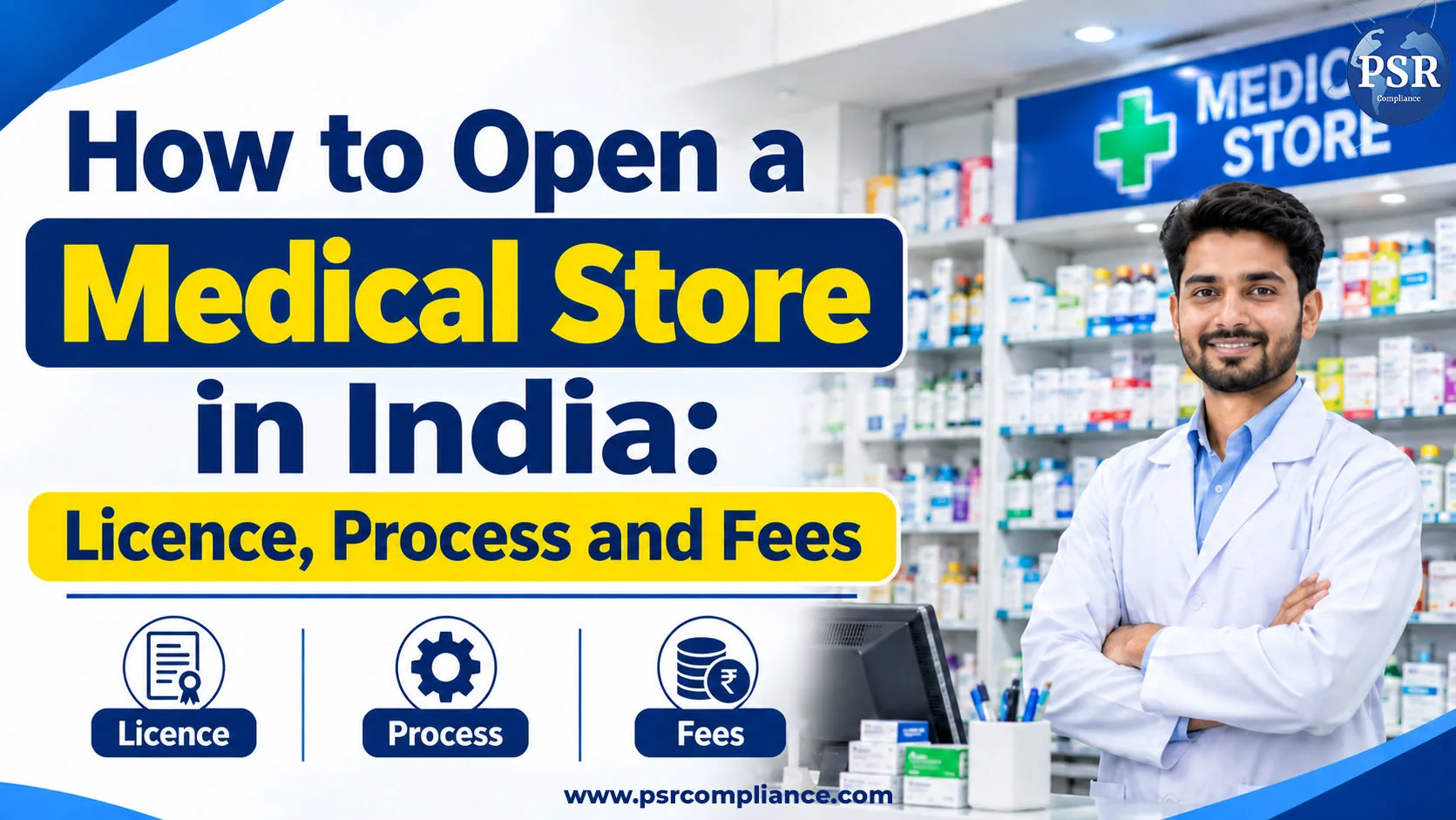
How to Open a Medical Store in India: License, Process and Fees
Opening a medical store in India requires more than just investment and a suitable location. You must obtain the appropriate drug license, meet pharmacy infrastructure requirements, appoint a registered pharmacist where required, and comply with the Drugs and Cosmetics Act, 1940. Understanding the eligibility criteria, registration process, required documents, government fees and other costs is essential before starting your pharmacy business. This guide explains how to open a medical store in India, apply for a drug license, and meet the necessary legal requirements.
Understand the Medical Store Licence Requirements in India
It is mandatory to get a Medical Store Licence in India from the State Drugs Control Department or State Licensing Authority before opening a pharmacy. The retail drug license is issued according to the Drugs and Cosmetics Act 1940 and Drugs and Cosmetics Rules 1945.
The nature of the licence varies according to the type of medicine one wishes to deal with.
| Licence Form | Purpose |
|---|---|
| Form 20 | Retail sale of drugs other than Schedule C, C(1) and X drugs |
| Form 21 | Retail sale of Schedule C and C(1) drugs, excluding Schedule X |
| Form 20F | Retail sale of Schedule X drugs |
| Form 20B | Wholesale sale of drugs other than Schedule C, C(1) and X |
| Form 21B | Wholesale sale of Schedule C and C(1) drugs |
Generally, Forms 20 and 21 are applicable for a regular pharmacy. More licences can be required for some medicines that you wish to sell.
The licence for a medical store in India varies according to place. One licence is needed for each shop that you have.
Eligibility Criteria to Open a Medical Store
One need not be a pharmacist in order to open a medical store. However, a qualified pharmacist should be employed to oversee the retail sale of medicines.
The basic criteria for opening a retail pharmacy are:
- Registered Pharmacist: A person who holds a diploma in pharmacy (D.Pharm) or a bachelor’s degree in pharmacy (B.Pharm) and is registered under the concerned state pharmacy council.
- Minimum Shop Size: 10 sq. meters for a retail pharmacy.
- Combined Retail and Wholesale Pharmacy: 15 sq. meters.
- Storage Facilities: Adequate shelves, adequate ventilation, and refrigeration facilities for temperature-sensitive medicines.
- Business Setup: The pharmacy may be opened in the form of a proprietorship, partnership, LLP, or a private limited firm.
The pharmacist needs to be present during the working hours and oversee dispensation of medicines. Thus, a registered pharmacist is one of the most crucial criteria for a retail drug license.
Documents Required for a Medical Store Licence
Preparation of these documents beforehand will help to simplify the application procedure. While there may be minor variations from state to state in the list of documents, the general list of documents that are often required includes:
- PAN card and Aadhaar card of the applicant.
- Passport-sized photographs of the owner or partner/directors.
- Documents related to registration of the firm or partnership deed.
- Ownership papers for the shop or rental papers duly registered.
- Layout of the premises.
- Educational qualification papers of the pharmacist.
- Registration papers of the State Pharmacy Council.
- Appointment paper of the pharmacist.
- Electricity bill or any other proof of address.
Affidavit/declaration related to compliance with drug regulations.
Step-by-Step Process to Open a Medical Store in India
Medical Store Registration Process gives you an understanding of how to apply without making any mistakes.
Step 1: Select a Suitable Location
Pick a commercial location that is highly visible and has enough demand. Make sure that the property meets the minimum area criteria and is appropriate for running a pharmacy.
Step 2: Register Your Business
Select the business format and get yourself registered accordingly. In addition to this, depending on the type of your business, you may have to get GST registration and other business registrations done.
Step 3: Appoint a Registered Pharmacist
You will need to appoint a pharmacist who is registered with the State Pharmacy Council. Gather all the educational qualification certificates, registration certificate, and letter of appointment required for the application.
Step 4: Arrange the Shop Infrastructure
Set up medicine rack storage, billing system, refrigerators, and other required facilities. Ensure that temperature-sensitive medicines are stored at the prescribed temperature.
Step 5: Apply for a Retail Drug Licence
Apply for a prescribed license in Form 19 of a normal retail drug license via the state licensing portal/ Online National Drug License System (ONDLS).
Step 6: Complete the Inspection
Drug Inspector shall inspect the premises for Infrastructure, Storage facilities, Documentation, and availability of a pharmacist.
Step 7: Receive Your Licence
On satisfactory inspection and issuance of license by the concerned authority, an applicable retail drug license is granted. Now you can sell medicines on the basis of the license issued.
Medical Store Licence Fees in India
Fees for obtaining a license to operate a medical store vary depending on the state, type of licence, and government fee schedule. The application may have to pay some extra fees related to other formalities.
For instance, in certain states, the government application fee is fixed at around ₹3,000 for a standard retail drugs licence. But this should not be taken as a common fee across India.
The table below gives a budget idea:
| Drug License Type | Government Fee |
|---|---|
| Retail Drug License | ₹3,000 |
| Wholesale Drug License | ₹3,000 |
| Retail + Wholesale Drug License | ₹6,000 |
Please note that these are indicative costs for setting up a business. Actual costs may differ depending on your region and the size of your store, among other factors. Please visit your state’s drug license fees website for the latest fee structure.
How Much Investment Is Required to Start a Medical Store?
The capital investment needed to start a pharmacy will depend upon the city, location of the shop, its size, and the stock of medicines.
On average, you may be able to start with a capital investment of about ₹2-6 lakh in case of a small medical store without any property acquisition.
You will need working capital to take care of your monthly expenses, including salaries of employees, rental expenses, and medicines.
Before starting the business, you must compare medicine suppliers, get good supply agreements from suppliers, and purchase suitable billing software to keep track of your purchases and sales.
Important Rules to Follow After Getting a Drug Licence
But this is just the beginning of things for medical store licensing in India. There are many other aspects to be followed by the pharmacy owner as part of the compliance procedures.
The following points must be adhered to:
- Selling prescription drugs only on prescription.
- Maintaining invoices for purchases and sales.
- Taking care of the expiry dates of the medicines and ensuring that expired items are not sold.
- Storing the medicines in accordance with the recommended temperatures.
- Making sure that the pharmacist registered with the shop oversees the sale.
- Following any regulations relating to Schedule H, H1, and X drugs.
Having the drug license displayed at the place of business.
Why Choose PSR Compliance for Medical Store Licence Consultant?
The licensing process consists of required documents, application, verification of infrastructure, and communication with the concerned authority. Mistakes during these stages can cause delay in the approval process.
Using the services of a consultant for the medical store licence will educate business owners on eligibility requirements, assist them in preparing documentation, and complete their application process.
Services offered by drug licence registration firms include:
- Identifying the correct licence category.
- Preparing and verifying the application form.
- Guiding on the requirements to be satisfied by the pharmacist and premises.
- Helping with submission of an application through the web.
- Assisting and guiding through the process of inspection.
- Providing support for compliance with the licensing terms.
If one is uncertain about the process of application, using the services of a medical store licence consultant is a good option; however, in the end, decision about granting a licence is made by the appropriate licensing authority.
Conclusion
Establishing a pharmacy necessitates careful planning, financial investment, and adherence to regulations relating to drug license. Each procedure, including choosing suitable premises and hiring a pharmacist, plays a key role in running a successful enterprise.
Being informed about opening a medical store in India will help you avoid mistakes and get ready for licensing. In case you require expert help, PSR Compliance can assist you with medical store licensing, required documents, and all procedures you need to complete and apply for the license.
📞 Call Us: +91 87961 04190
📧 Email: support@psrcompliance.com
Frequently Asked Questions
Q1. Can I open a medical store without being a pharmacist?
Yes. It is possible to set up a medical store without having a pharmacy degree. However, one needs to hire a qualified and licensed pharmacist to oversee transactions in the shop.
Q2. What is the minimum area required to open a medical store?
According to the law, a pharmacy should have a minimum area of 10 square meters. A pharmacy, which deals both in wholesale and retail, would need around 15 square meters.
Q3. How much does a medical store licence cost in India?
The Government of India charges differ from state to state; therefore, it is difficult to fix a standard cost. The licensing process in some states mentions a fee of about ₹ 3,000 only for ordinary retail license applications.
Q4. How long does it take to obtain a retail drug licence?
The timeline depends on the state of application, checks, verifications, and approvals. Normally, the licenses are issued more quickly for complete applications.
Q5. Is GST registration mandatory for a medical store?
GST registration is necessary only when the business meets the conditions defined for registration under GST.