Just send us your questions or concerns by starting a new case &
we will give you the help you need. Start Here...
BIS Certification
Thu, Jul 16 2026
Raju Karn
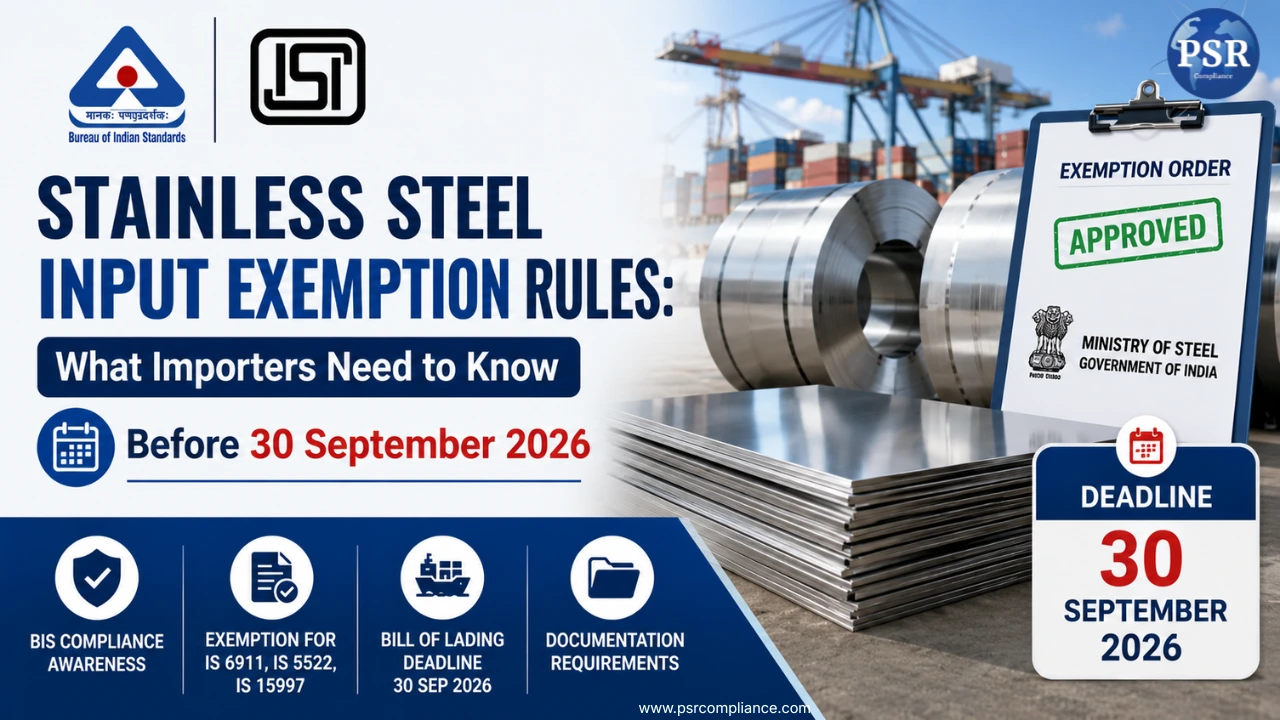
Stainless Steel Input Exemption Rules: What Importers Need to Know Before 30 September 2026
For stainless-steel importers, timing can be just as important as pricing. A government notification may appear to be a simple regulatory update, but it can significantly influence import costs, inventory planning, production schedules, and overall business operations. The Stainless Steel Input Exemption Order dated 31 March 2026 is one such notification that businesses dealing with stainless-steel flat products should understand carefully.
Issued by the Ministry of Steel, Technical Division, this order provides temporary relief from mandatory input adherence requirements for specified stainless-steel flat products. The notification was released in continuation of the earlier order dated 20 November 2025 after considering representations received from stainless-steel importers. While the exemption offers operational flexibility, it is available only for a limited period and under clearly defined conditions. Businesses that fail to understand these conditions may unintentionally lose the benefit.
What Does the Stainless Steel Input Exemption Order Say?
The order grants exemption from mandatory input adherence requirements for stainless-steel flat products covered under the following Indian Standards:
- IS 6911
- IS 5522
- IS 15997
However, this exemption is not permanent. It is applicable only to import consignments where the Bill of Lading carries a shipped-on-board date on or before 30 September 2026. This date is the most important condition under the notification because eligibility depends entirely on it.
Unlike many businesses assume, the exemption is not linked to the arrival date of the shipment, customs clearance date, warehouse entry date, or purchase order date. The only date that determines eligibility is the shipped-on-board date mentioned on the Bill of Lading.
Why This Order Matters
Stainless steel is one of the most widely used industrial materials across India. Manufacturers depend on stainless-steel flat products for producing kitchen equipment, elevators, industrial machinery, automotive components, household appliances, railway equipment, construction materials, fabrication products, utensils, and engineering goods. Any disruption in the supply of these products can affect manufacturing operations across multiple industries.
The exemption allows businesses to continue importing eligible stainless-steel flat products without mandatory input adherence for a limited period. This gives importers additional flexibility to plan procurement, maintain production continuity, and meet customer commitments while preparing for future compliance requirements.
For manufacturers relying on imported stainless steel, proper planning under this exemption can help avoid production delays, inventory shortages, and unexpected procurement challenges.
Why the Bill of Lading Date Is So Important
Many businesses mistakenly believe that the purchase order date or expected delivery date determines eligibility under the exemption. The notification makes it very clear that the deciding factor is the shipped-on-board date recorded on the Bill of Lading.
This means a shipment ordered well before September may still become ineligible if the vessel sails after 30 September 2026. Similarly, a shipment arriving in India after September can still qualify if its Bill of Lading confirms that the goods were shipped on board on or before the prescribed deadline.
Because of this condition, importers should closely coordinate with overseas suppliers, freight forwarders, and shipping companies to ensure that shipments are loaded within the eligible period rather than relying only on estimated dispatch schedules.
Industries That Should Pay Attention
Although the order primarily targets stainless-steel importers, its commercial impact extends throughout the manufacturing supply chain. Any business using stainless-steel flat products as raw material should evaluate whether this exemption can affect procurement planning or project timelines.
The notification is particularly relevant for:
- Stainless-steel importers
- Steel service centres
- Kitchen equipment manufacturers
- Appliance manufacturers
- Automotive component manufacturers
- Engineering goods manufacturers
- Industrial fabrication companies
- Construction material suppliers
- Railway equipment manufacturers
- Infrastructure companies
- Elevator manufacturers
- Cookware and utensil manufacturers
- Heavy engineering industries
- Project procurement teams
Businesses that import stainless-steel flat products directly or purchase them from importers should review upcoming procurement schedules before the exemption period expires.
This Is Not a Blanket Exemption
One of the biggest misunderstandings surrounding this notification is the belief that it removes all compliance requirements for stainless-steel imports. That is incorrect.
The exemption applies only to mandatory input adherence requirements associated with IS 6911, IS 5522, and IS 15997, and only when the shipment satisfies the Bill of Lading condition. Importers should therefore verify several factors before claiming the benefit.
Businesses should confirm:
- Whether the imported product qualifies as a stainless-steel flat product.
- Whether the applicable Indian Standard is IS 6911, IS 5522, or IS 15997.
- Whether the Bill of Lading shows a shipped-on-board date on or before 30 September 2026.
- Whether supporting import documents clearly establish eligibility.
- Whether internal compliance records are complete and properly maintained.
This notification should therefore be viewed as a time-bound regulatory relief, not as a permanent exemption from quality compliance.
The Business Mistake That Can Cost Importers
Many importers concentrate on negotiating the best prices, selecting reliable suppliers, and arranging timely shipments. While these factors are essential, they are not enough to benefit from this exemption. The biggest mistake businesses can make is assuming that simply placing an order before the deadline guarantees eligibility. In reality, the deciding factor is the Bill of Lading shipped-on-board date, not the purchase order date or expected arrival date.
A shipment that misses the qualifying date by even a single day may lose the benefit of the exemption, potentially increasing compliance costs and affecting landed prices. This makes coordination between purchasing, logistics, compliance, and finance teams extremely important. Procurement teams should schedule orders well in advance, logistics teams should closely monitor shipping schedules, compliance teams should verify documentation before dispatch, and finance teams should understand how missing the exemption window could affect project costs and profitability.
Documents Importers Should Maintain
Strong documentation is one of the best safeguards for businesses claiming this exemption. A well-organized compliance file not only supports customs clearance but also simplifies internal audits, customer verification, and future regulatory inspections. Instead of collecting documents only when required, importers should maintain complete records throughout the import process.
The following documents should be available for every qualifying shipment:
- Purchase Order (PO)
- Commercial Invoice
- Packing List
- Bill of Lading showing the shipped-on-board date
- Product description and material specifications
- Grade and applicable Indian Standard details
- Supplier certificates and supporting documents
- Complete import documentation
- Internal note linking the product to IS 6911, IS 5522, or IS 15997
- Copy of the exemption order dated 31 March 2026
- End-use declaration, where applicable
- Internal compliance approval records
Maintaining these records in an organized manner helps businesses respond quickly to customs authorities, internal audits, customer compliance requests, or financial reconciliations.
How Businesses Can Use This Exemption Strategically
Rather than treating this notification as a routine government update, businesses should use it as a procurement planning tool. Companies expecting future demand for stainless-steel flat products should identify eligible shipments early and coordinate with overseas suppliers to ensure that the shipped-on-board date falls within the exemption period. Proper planning can reduce last-minute procurement pressure while improving inventory availability during critical production cycles.
Manufacturers can also use this exemption to improve customer commitments. If imported stainless steel is a key production input, timely procurement under the exemption window can help maintain uninterrupted manufacturing, reduce supply uncertainties, and strengthen delivery schedules. Businesses that integrate compliance planning into their procurement strategy are more likely to gain a competitive advantage over those that react only after shipment delays occur.
How a Regulatory Consultant Can Help
Understanding the scope of this exemption requires more than simply reading the notification. Businesses must determine whether their imported products qualify under the specified Indian Standards, verify documentation, and ensure that every shipment satisfies the conditions mentioned in the order. Errors in product classification or incomplete documentation can create avoidable compliance issues.
A regulatory consultant can assist with product applicability assessment, import documentation review, Indian Standard identification, shipment planning, compliance record preparation, and document verification before customs processing. For businesses importing multiple grades or categories of stainless-steel flat products, professional guidance can simplify compliance while reducing the risk of documentation errors.
Final Takeaway
The Stainless Steel Input Exemption Order dated 31 March 2026 provides valuable temporary relief for importers of stainless-steel flat products covered under IS 6911, IS 5522, and IS 15997. However, the exemption is available only for shipments where the Bill of Lading shows a shipped-on-board date on or before 30 September 2026. Missing this requirement can result in the loss of the exemption, regardless of when the purchase order was placed or when the shipment arrives in India.
Businesses should therefore review their product classifications, coordinate shipping schedules with suppliers, maintain complete import documentation, and monitor every qualifying shipment carefully. In stainless-steel imports, compliance planning is just as important as supply chain planning. Companies that prepare early and manage their documentation properly will be better positioned to use the exemption effectively while avoiding unnecessary compliance challenges.
Need Expert Assistance?
If your business imports stainless-steel flat products or requires guidance on Quality Control Orders (QCOs), BIS compliance, or import documentation, PSR Compliance can help.
Our services include:
- QCO applicability assessment
- Import compliance consultation
- Documentation review
- Product classification support
- BIS and regulatory advisory
- Import planning assistance
- End-to-end compliance guidance
Contact PSR Compliance
📞 +91 8796104190
Frequently Asked Questions (FAQs)
1. What is the Stainless Steel Input Exemption Order dated 31 March 2026?
It is a notification issued by the Ministry of Steel granting temporary exemption from mandatory input adherence requirements for certain stainless-steel flat products covered under IS 6911, IS 5522, and IS 15997, subject to specified conditions.
2. Which products are covered under the exemption?
The exemption applies to eligible stainless-steel flat products associated with IS 6911, IS 5522, and IS 15997, provided all conditions mentioned in the notification are satisfied.
3. What is the last date to claim the exemption?
The exemption is available only for imports where the Bill of Lading carries a shipped-on-board date on or before 30 September 2026.
4. Does the arrival date of the shipment matter?
No. The determining factor is the shipped-on-board date mentioned on the Bill of Lading, not the arrival date, customs clearance date, or warehouse receipt date.
5. What documents should importers maintain?
Businesses should maintain the purchase order, commercial invoice, packing list, Bill of Lading, product specifications, applicable Indian Standard details, supplier documents, complete import records, and a copy of the exemption order for every qualifying shipment.
6. Why is compliance planning important for this exemption?
Proper compliance planning helps businesses meet the notification's conditions, avoid documentation issues, maintain uninterrupted imports, and reduce the risk of losing the exemption due to avoidable administrative errors.