Just send us your questions or concerns by starting a new case &
we will give you the help you need. Start Here...
BIS Certification
Thu, Jul 16 2026
Raju Karn
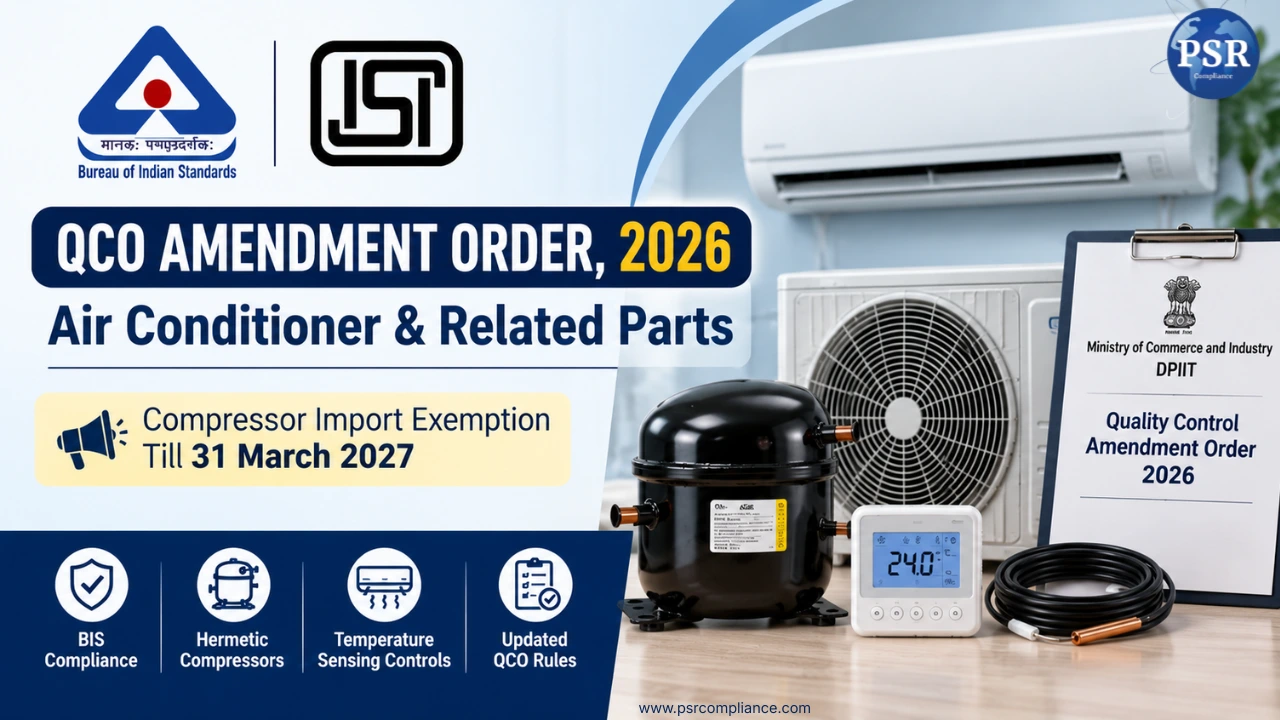
Air Conditioner and Related Parts, Hermetic Compressor and Temperature Sensing Controls (Quality Control) Amendment Order, 2026
India's air-conditioning and refrigeration industry depends heavily on a smooth supply of critical components, especially hermetic compressors. Whether it is an air conditioner, refrigerator, heat pump, or Variable Refrigerant Flow (VRF) system, a shortage of compressors can delay manufacturing, disrupt dealer supplies, and affect seasonal demand. Since compressors are the heart of cooling equipment, even a minor interruption in imports can slow down an entire production line.
Recognizing these practical challenges, the Ministry of Commerce and Industry, Department for Promotion of Industry and Internal Trade (DPIIT) issued the Air Conditioner and its related Parts, Hermetic Compressor and Temperature Sensing Controls (Quality Control) Amendment Order, 2026 on 8 May 2026. The amendment modifies the 2019 Quality Control Order (QCO) by providing a temporary exemption for specified imported hermetic compressors used by manufacturers for their own production. The amendment became effective from the date of its publication in the Official Gazette and provides a limited compliance relief until 31 March 2027, subject to prescribed quantity limits and reporting obligations.
Why This Amendment Matters
This amendment is not merely a regulatory update—it directly affects production planning, procurement strategies, and inventory management across the HVAC and refrigeration industry. Manufacturers often rely on imported compressors while expanding domestic production or transitioning to local sourcing. Without temporary flexibility, production schedules could be disrupted, especially during peak demand seasons.
The amendment creates a controlled window allowing eligible manufacturers to continue importing specified compressor categories without immediate QCO applicability. However, the exemption is not unconditional. It is available only to manufacturers importing compressors for their own manufacturing activities, and the allowable import quantity depends on their actual import volumes during Financial Year 2024–25. Businesses must therefore combine production planning with careful compliance management to fully benefit from the amendment.
What Does the Amendment Allow?
The amendment exempts certain imported hermetic compressors from the Quality Control Order until 31 March 2027, provided the imports are made by manufacturers for use in their own manufacturing facilities. The exemption is linked to the quantity imported during FY 2024–25 and varies according to compressor type and application.
Manufacturers cannot assume unlimited imports. Every compressor category has a separate exemption percentage, making accurate product classification and import calculations essential before planning procurement.
Exemption Limits Under the Amendment
| Compressor Category | Application | Maximum Exemption |
|---|---|---|
| Reciprocating Hermetic Compressors (Fixed Speed & Variable Speed including Inverter Type) below 2 TR | Refrigerators and similar refrigeration appliances | 40% of FY 2024–25 import quantity |
| Rotary Hermetic Compressors (Fixed Speed & Variable Speed including Inverter Type) below 2 TR | Air Conditioners and Heat Pumps | 30% of FY 2024–25 import quantity |
| Scroll & Rotary Hermetic Compressors (Fixed Speed & Variable Speed including Inverter Type) 2 TR and above | Refrigeration, Air Conditioning & Heat Pump Applications | 90% of FY 2024–25 import quantity |
| Rotary Hermetic Compressors 2 TR and above | Variable Refrigerant Flow (VRF) Air Conditioning Systems | 100% of FY 2024–25 import quantity |
These limits are calculated using the total quantity imported during the financial year 2024–25, making historical import records one of the most important documents for compliance planning.
Commercial Impact on Manufacturers
The amendment gives manufacturers an opportunity to maintain uninterrupted production while gradually strengthening domestic sourcing and compliance readiness. Instead of creating sudden supply disruptions, it allows businesses to continue importing specified compressors within approved limits while preparing long-term manufacturing strategies.
For companies involved in air-conditioning and refrigeration equipment, the amendment can influence several business functions, including:
- Production planning
- Compressor sourcing strategy
- Import scheduling
- Dealer inventory management
- Seasonal AC demand planning
- Heat pump manufacturing
- Refrigeration equipment production
- VRF project execution
- Working capital planning
- Supply chain continuity
Manufacturers that calculate their exemption limits correctly can continue production without unnecessary delays, whereas poor planning may lead to shipment interruptions, inventory shortages, or compliance issues.
The Monthly Compliance Requirement Businesses Often Miss
One of the most overlooked aspects of this amendment is that the exemption comes with ongoing compliance obligations. Importing eligible compressors alone is not enough. Manufacturers are also required to maintain monthly records of all specified imported goods and submit those records to the concerned authorities on the company's official letterhead, duly signed by an authorized signatory.
In addition, every eligible manufacturer must submit a formal Indigenisation Plan to the Central Government. This requirement demonstrates the manufacturer's intention to gradually develop or adopt domestic sourcing rather than relying indefinitely on imported compressors. Businesses that focus only on import permissions while ignoring reporting obligations may unintentionally create compliance gaps that could affect future regulatory scrutiny.
The Biggest Compliance Mistake Manufacturers Will Make
Many businesses may assume that this amendment provides a blanket exemption until 31 March 2027, but that is not the case. The relief is available only when every condition mentioned in the amendment is satisfied. It is product-specific, manufacturer-specific, quantity-specific, and time-bound. The exemption is applicable only to manufacturers importing eligible hermetic compressors for their own manufacturing activities, and the maximum permissible quantity depends entirely on the import volumes recorded during FY 2024–25.
Another common mistake is overlooking the compliance obligations that continue after the import. Maintaining monthly records, submitting reports to the concerned authorities, and preparing an indigenisation plan are equally important. A manufacturer may correctly import eligible compressors but still face compliance issues if supporting records are incomplete or reporting requirements are ignored. Businesses should therefore treat this amendment as an ongoing compliance framework rather than a one-time import relaxation.
Documents Manufacturers Should Keep Ready
Manufacturers should begin building a dedicated compliance file instead of waiting for an audit, government query, or shipment issue. Maintaining organized records not only supports regulatory compliance but also simplifies future inspections and internal planning. Since the exemption is based on historical import quantities, proper documentation becomes the foundation of eligibility.
The following documents should be maintained and updated regularly:
- FY 2024–25 import quantity records
- Product-wise compressor classification records
- Current import shipment details
- Monthly import and usage records
- Bills of Entry
- Commercial invoices
- Packing lists
- Technical specifications of compressors
- Rated capacity details
- End-use declarations confirming own manufacturing
- Authorized signatory details
- Copies of monthly submissions made to authorities
- Copy of the indigenisation plan submitted to the Central Government
- Copy of the Amendment Order for reference
Businesses should update these records every month instead of preparing them only when requested by regulatory authorities.
Why Professional Compliance Support Matters
The amendment contains multiple technical conditions involving compressor classification, capacity limits, historical import data, reporting obligations, and future localisation planning. Companies dealing with different compressor categories may find it difficult to interpret exemption percentages accurately without regulatory expertise.
A BIS and regulatory compliance consultant can help manufacturers identify eligible compressor categories, calculate permissible import quantities based on FY 2024–25 data, prepare monthly reporting formats, verify technical documentation, organize import records, prepare authority submissions, and draft the required indigenisation plan. Professional guidance also helps businesses avoid errors in product classification, ensuring they claim only the exemptions that legally apply to their products.
Final Takeaway
The Air Conditioner and its Related Parts, Hermetic Compressor and Temperature Sensing Controls (Quality Control) Amendment Order, 2026 provides valuable short-term relief for manufacturers by allowing specified hermetic compressor imports until 31 March 2027, subject to defined quantity limits and compliance conditions. However, the exemption is not automatic. It applies only to eligible manufacturers importing approved compressor categories for their own production and requires continuous compliance through proper documentation, monthly reporting, and submission of an indigenisation plan.
Manufacturers should use this period to strengthen supply chain planning while preparing for long-term regulatory compliance and increased domestic sourcing. Businesses that accurately calculate eligible import quantities, maintain complete records, and meet reporting obligations will be in a stronger position to avoid production delays and ensure uninterrupted manufacturing operations. In the air-conditioning and refrigeration industry, effective compliance planning is just as important as efficient supply chain management.
Need Help Understanding the QCO Amendment?
If your business imports hermetic compressors, air-conditioner components, refrigeration equipment, or temperature sensing controls, PSR Compliance can help you understand the amendment, calculate eligible import quantities, review compliance obligations, prepare documentation, and support regulatory planning.
Our experts assist with:
- QCO applicability assessment
- Import quantity calculations
- Compliance documentation
- Monthly record preparation
- Indigenisation planning
- Regulatory consultation
- BIS and QCO compliance support
📞 Call: +91 8796104190
📧 Email: support@psrcompliance.com
Frequently Asked Questions (FAQs)
1. What is the Air Conditioner and its Related Parts, Hermetic Compressor and Temperature Sensing Controls (Quality Control) Amendment Order, 2026?
It is an amendment issued by the Ministry of Commerce and Industry on 8 May 2026, providing a temporary exemption for specified imported hermetic compressors used by manufacturers for their own production until 31 March 2027, subject to prescribed conditions.
2. Who can claim the exemption under this amendment?
Only manufacturers importing eligible hermetic compressors for use in their own manufacturing facilities can claim the exemption. Traders and distributors are not covered under this relaxation.
3. How are the exemption limits calculated?
The permissible import quantity is calculated based on the total quantity of eligible compressors imported during Financial Year 2024–25, with different percentages applicable to different compressor categories.
4. Are manufacturers required to maintain records?
Yes. Manufacturers must maintain monthly records of eligible imports, submit reports to the concerned authorities on their official letterhead, and ensure the records are signed by an authorized signatory.
5. Is submitting an indigenisation plan mandatory?
Yes. Eligible manufacturers are required to submit an indigenisation plan to the Central Government as part of the compliance conditions under the amendment.
6. Until when is the exemption available?
The exemption remains available up to 31 March 2027, provided all eligibility conditions, quantity limits, reporting requirements, and documentation obligations are fully complied with.