Just send us your questions or concerns by starting a new case &
we will give you the help you need. Start Here...
BIS Certification
Thu, Jul 16 2026
Raju Karn
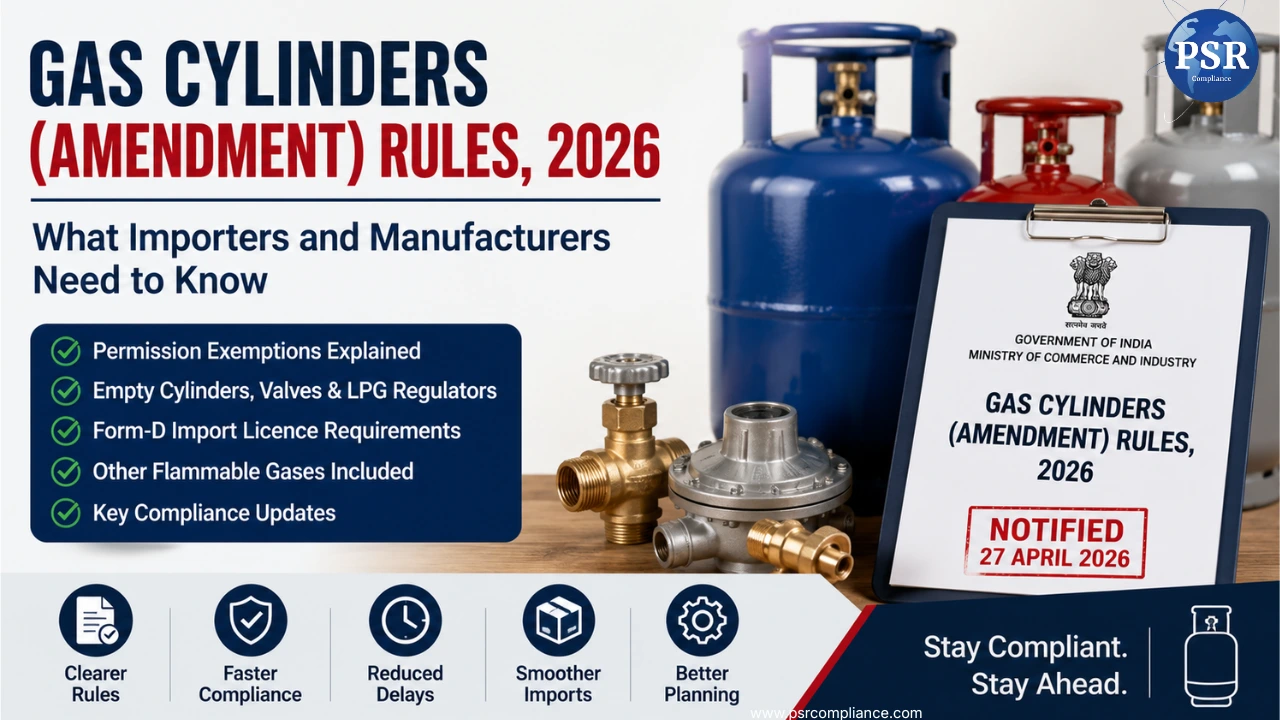
Gas Cylinders (Amendment) Rules, 2026: What Importers and Manufacturers Need to Know
In the gas cylinder industry, smooth operations depend on much more than manufacturing cylinders. Businesses rely on approvals, import licences, plant certifications, safety compliance, customs clearance, and accurate documentation. A single regulatory misunderstanding can delay an entire shipment, affect customer commitments, and increase operational costs.
To address certain compliance issues, the Ministry of Commerce and Industry, Department for Promotion of Industry and Internal Trade (DPIIT) notified the Gas Cylinders (Amendment) Rules, 2026 on 27 April 2026, which were published in the Official Gazette on 28 April 2026. The amendment came into force immediately from the date of publication.
Although the notification is relatively short, its impact is significant for manufacturers, importers, valve suppliers, LPG regulator businesses, defence suppliers, and organizations involved in handling gas equipment. The amendment introduces important clarifications regarding permission requirements for specific imported products and expands the scope of certain provisions relating to flammable gases.
What Changed Under the Gas Cylinders (Amendment) Rules, 2026?
The amendment introduces several practical changes that directly affect import compliance for specific gas cylinder components and related equipment.
One important addition is the inclusion of cylinders and valves imported by establishments under the Ministry of Defence, the Department of Space, and their Public Sector Undertakings (PSUs) for their own use. The amendment also clearly states that permission is no longer required for importing empty cylinders without valves.
Another significant clarification relates to valves and LPG regulators imported from foreign manufacturing plants that have been approved by the Chief Controller. If these products are imported under a valid Form-D Import Licence, separate permission is not required under the amended provisions.
Additionally, the amendment updates the wording relating to Liquefied Petroleum Gas (LPG) by extending the reference to include "other flammable gases." While this appears to be a small textual change, it broadens the applicability of the rule to cover a wider range of gas-related products and industries.
Why This Amendment Matters
Gas cylinder businesses operate within strict delivery schedules and highly regulated supply chains. Delays caused by documentation errors or unnecessary permission requirements can affect manufacturers, distributors, industrial buyers, government agencies, and project contractors alike.
The amendment provides greater clarity regarding situations where prior permission is not required. For businesses importing empty cylinders without valves, the revised rule simplifies compliance by removing an approval requirement that previously created uncertainty.
Similarly, importers dealing with approved foreign-manufactured valves and LPG regulators can benefit from a more straightforward import process when all prescribed conditions are fulfilled. This allows companies to plan imports more efficiently while reducing unnecessary administrative delays.
It is important to understand that the amendment does not relax product safety requirements. Instead, it clarifies the regulatory treatment of specific products under clearly defined conditions.
Businesses That Should Review This Amendment
The amendment affects a broad range of organizations involved in manufacturing, importing, distributing, or supplying gas-related equipment. Businesses should evaluate how these changes apply to their products and supply chains.
The notification is particularly relevant for:
- Gas cylinder manufacturers
- Gas cylinder importers
- LPG regulator importers
- Valve manufacturers and importers
- Industrial gas equipment suppliers
- Defence procurement vendors
- Department of Space suppliers
- Public Sector Undertaking (PSU) vendors
- Gas distribution equipment traders
- Import compliance teams
- Businesses dealing with flammable gas equipment
Even companies that supply only a small component of a gas distribution system should review the amendment carefully to determine whether the revised permission requirements apply to their operations.
Why Businesses Should Understand the Rules Before Importing
Many organizations review regulatory requirements only after a shipment encounters customs issues or documentation queries. By then, delays have already affected delivery schedules, customer commitments, and operational costs.
A better approach is to evaluate the amendment before placing import orders. Businesses should determine whether their products qualify for permission exemptions, confirm whether foreign manufacturing plants hold the required approvals, and verify that Form-D licensing requirements have been satisfied before shipments are dispatched.
Proper planning allows companies to integrate compliance into procurement decisions rather than treating it as a last-minute administrative task. This reduces uncertainty and supports smoother supply chain management.
The Commercial Advantage Most Businesses Overlook
Many businesses only read regulatory amendments after a shipment is delayed or a customs query is raised. By that stage, the opportunity to avoid delays has already passed. The smarter approach is to understand the amendment before placing import orders, allowing compliance to become part of procurement planning rather than a last-minute exercise.
Companies that understand the Gas Cylinders (Amendment) Rules, 2026 can identify products that qualify for permission exemptions, verify whether overseas manufacturing plants have approval from the Chief Controller, and ensure that Form-D import licence requirements are fulfilled before shipment. This proactive approach helps businesses reduce avoidable permission applications, shorten import timelines, improve documentation quality, respond confidently to customer enquiries, and minimise storage or demurrage costs arising from unnecessary delays.
What Businesses Should Verify Before Claiming the Exemption
The amendment provides exemptions only under specific conditions. Businesses should therefore avoid assuming that every imported gas cylinder component automatically qualifies. Before relying on the exemption, importers should carefully examine the exact product category and verify that every regulatory requirement has been met.
Companies should confirm the following before planning imports:
- Whether the product is an empty gas cylinder without a valve.
- Whether the valve or LPG regulator is imported from a foreign manufacturing plant approved by the Chief Controller.
- Whether a valid Form-D Import Licence is available wherever required.
- Whether the imported goods fall within the scope of the amended provisions.
- Whether shipment documents accurately describe the imported products.
- Whether all supporting compliance records are complete and internally verified.
If there is any uncertainty regarding product eligibility, businesses should seek professional guidance rather than relying on assumptions. Incorrect interpretation of the exemption can result in avoidable compliance issues during customs clearance.
Why the Addition of "Other Flammable Gases" Is Important
One of the important textual changes introduced by the amendment is the addition of the words "or other flammable gases" alongside Liquefied Petroleum Gas (LPG) in the relevant provision. Although this may appear to be a minor wording update, it reflects the wider reality of today's gas industry.
Many industries operate with gases beyond LPG, including industrial, laboratory, commercial, and specialised flammable gases. By expanding the wording, the amendment makes the rule more relevant to businesses dealing with different categories of flammable gases rather than limiting its application to LPG alone. Compliance teams should therefore review their product portfolios carefully to determine whether products associated with other flammable gases may also fall within the scope of the amended rules.
Documents Businesses Should Maintain
Strong documentation remains one of the most effective ways to demonstrate compliance during customs clearance, inspections, internal audits, or customer verification. Instead of preparing documents only when requested, businesses should maintain organised compliance records for every import transaction.
Important documents include:
- Product description
- Cylinder specifications
- Valve specifications
- LPG regulator details
- Foreign manufacturing plant approval documents
- Valid Form-D Import Licence (where applicable)
- Commercial invoice
- Bill of Entry
- Purchase Order
- Packing List
- Technical specifications
- End-use declaration
- Customer or project documents
- Internal compliance records
- Import correspondence
Maintaining complete documentation helps businesses establish that the exemption has been applied correctly while reducing the likelihood of regulatory disputes or shipment delays.
How a Regulatory Consultant Can Help
Understanding regulatory amendments often requires more than reading the notification itself. Businesses must determine product applicability, review import documentation, verify approval status of overseas manufacturing plants, and ensure that licensing conditions have been fulfilled before imports take place.
A regulatory consultant can assist with product classification, import documentation review, Chief Controller approval verification, Form-D licence guidance, compliance assessment, shipment planning, document preparation, and regulatory interpretation. For businesses importing multiple product categories, professional support can significantly reduce compliance risks while improving operational efficiency.
Final Takeaway
The Gas Cylinders (Amendment) Rules, 2026 provide important regulatory clarifications for businesses dealing with gas cylinders, valves, LPG regulators, and equipment used with flammable gases. The amendment removes permission requirements for certain imported products, expands the regulatory language to include other flammable gases, and provides greater certainty regarding import compliance under specified conditions.
Manufacturers, importers, industrial gas equipment suppliers, defence vendors, and public sector suppliers should review the amendment carefully and determine whether it affects their product portfolio. Businesses that evaluate their products early, verify documentation, and understand the revised requirements will be better positioned to avoid unnecessary delays while maintaining full regulatory compliance.
In the gas equipment industry, successful imports depend not only on quality products but also on accurate documentation and timely compliance planning.
Need Expert Assistance?
If your business imports or manufactures gas cylinders, valves, LPG regulators, or industrial gas equipment, PSR Compliance can help you understand the latest regulatory amendments and ensure complete import compliance.
Our Services
- Gas Cylinder Rules compliance support
- Import documentation review
- Form-D licence guidance
- Regulatory applicability assessment
- BIS & QCO consultancy
- Product classification support
- End-to-end compliance assistance
Contact PSR Compliance
📞 +91 8796104190
Frequently Asked Questions (FAQs)
1. What is the Gas Cylinders (Amendment) Rules, 2026?
It is a regulatory amendment notified by the Ministry of Commerce and Industry on 27 April 2026, introducing changes relating to permission requirements for specific gas cylinders, valves, LPG regulators, and products associated with flammable gases.
2. Do empty gas cylinders without valves require permission?
Under the amended rules, permission is not required for importing empty cylinders without valves, subject to the provisions of the amendment.
3. When are imported valves and LPG regulators exempt from permission?
Permission is not required when the valves or LPG regulators are imported from a foreign manufacturing plant approved by the Chief Controller and are covered by a valid Form-D Import Licence.
4. Why was the wording changed to include "other flammable gases"?
The amendment broadens the scope of the rule by recognising that many industries work with flammable gases other than LPG, making the regulation more relevant to modern industrial applications.
5. What documents should importers maintain?
Businesses should maintain product specifications, foreign plant approval records, Form-D licences (where applicable), commercial invoices, Bills of Entry, purchase documents, technical specifications, and other supporting compliance records.
6. Why is this amendment important for importers?
The amendment helps businesses understand when permission is required, reduces unnecessary regulatory delays for eligible products, improves import planning, and supports smoother customs clearance when all prescribed conditions are fulfilled.