Mon, Jan 05 2026
Raju Karn
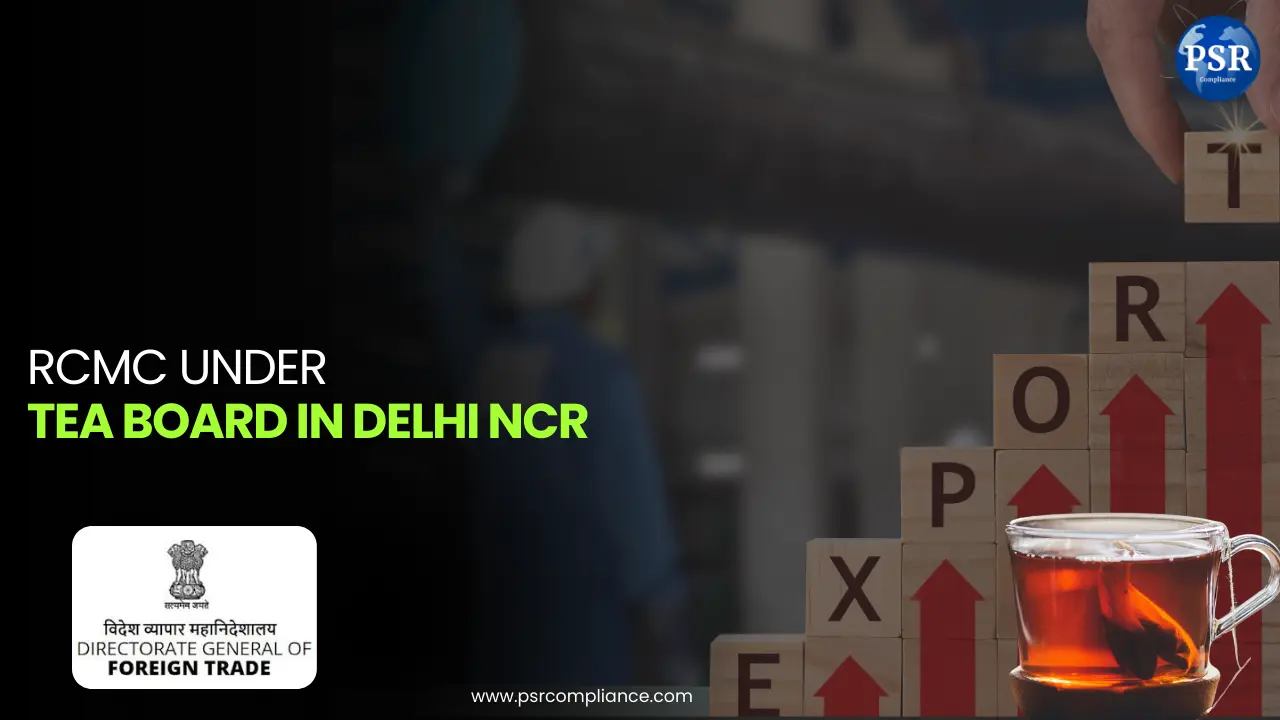
RCMC Under Tea Board in Delhi NCR – Complete Guide for Exporters (2026)
Exporting tea from India, as a manufacturer, trader, or first-time startup, comes with one certificate you can't skip: the RCMC issued by the Tea Board of India. Businesses across Delhi NCR (Delhi, Gurugram, Faridabad, Noida, Ghaziabad, Hisar, and Palwal) often know the name but not the details, what it actually does, who needs it, and how long it realistically takes to get.
Worth knowing upfront: the Tea Board issues RCMC free of charge, unlike many other export promotion councils that charge a fee, and applicants typically need to already hold a Tea Board exporter license and an IEC (Importer-Exporter Code) before they can apply for it.
This guide walks through the process end to end: what RCMC covers, eligibility, documents, fees, timelines, and how it compares to RCMC issued by other export bodies like APEDA and EPCH.
What is RCMC Under Tea Board?
RCMC stands for Registration-cum-Membership Certificate. It's issued by an Export Promotion Council or Commodity Board and confirms that a business is officially recognised to export a specific category of goods. For tea and tea-based products, that authority is the Tea Board of India, functioning under the Ministry of Commerce.
In practical terms, RCMC is what tells customs, ports, and international buyers that your tea export business is legitimate and government-recognised.
Why It Matters
- Confirms your business as a genuine, government-recognised exporter
- Required to claim DGFT export incentives and schemes
- Frequently requested by overseas buyers before they'll finalise a deal
- Used by ports and customs as supporting documentation during shipment clearance
- Legally required to export tea from India in any form
This applies whether you deal in green tea, black tea, CTC, orthodox tea, specialty blends, or premix powders.
Who Needs Tea Board RCMC?
- Manufacturers producing and exporting tea directly
- Merchant exporters who source from factories or farmers and sell internationally
- Tea traders shipping consignments through Indian ports
- E-commerce sellers exporting via Amazon Global, Shopify, or similar platforms
- Startups entering export markets for the first time
- Tea brand owners in Delhi NCR scaling into international markets
Benefits of Holding a Tea Board RCMC
| Benefit | What it Means for You |
|---|---|
| Authorised exporter status | Establishes your business as government-recognised |
| Access to Tea Board schemes | Subsidies and export assistance programs |
| Easier customs clearance | Ports accept RCMC as proof of registration |
| Buyer trust | International buyers prefer verified exporters |
| DGFT eligibility | Required to claim government export incentives |
Documents Required
Identity & Business Basics
- PAN of the business
- Aadhaar of proprietor/partners/directors
- GST registration certificate
- Importer Exporter Code (IEC)
- MSME/Udyam Registration (recommended, not mandatory)
- Cancelled cheque or bank certificate
Entity Documents
- Certificate of Incorporation (for companies/LLPs)
- Partnership Deed, where applicable
- Board resolution authorising a signatory
Tea-Specific Requirements
- List of tea products/varieties exported
- HS codes for the relevant tea commodities
- Factory License or FSSAI license (if you manufacture or process tea)
If any document is missing, most consultants including PSR Compliance - can help arrange a supporting alternative rather than delaying the application.
Step-by-Step RCMC Registration Process
- Gather documents — IEC, GST, PAN, and a finalised list of tea products you plan to export.
- Create an account on the Tea Board of India's online registration portal.
- Fill the application with exporter details, firm name, tea category, HS codes, and contact information. Accuracy here avoids back-and-forth delays later.
- Upload documents — all KYC and business proof required for verification.
- Pay the application fee online. (The Tea Board periodically revises this fee — confirm the current amount directly on the portal before applying, since quoting a fixed number here risks going stale.)
- Application review — the Tea Board may raise queries; responding quickly keeps the timeline on track.
- Certificate issued digitally — valid for five years from the date of issue.
Typical turnaround is 7–15 working days when documents are complete and accurate on first submission; incomplete applications can take significantly longer due to query cycles.
Tea Board RCMC vs Other RCMC Types
| Feature | Tea Board RCMC | APEDA RCMC | EPCH RCMC |
|---|---|---|---|
| Product scope | Tea and tea products (green, black, CTC, orthodox, blends, premix) | Agricultural & processed foods (fruits, vegetables, spices, grains) | Handicrafts, home décor, textiles, artisan goods |
| Issuing authority | Tea Board of India | APEDA | EPCH |
| Validity | 5 years | 5 years | 5 years |
| Key extra document | Tea-specific HS codes & product list | Lab testing certificates (where applicable) | Product photos & design registration |
| DGFT eligibility | Mandatory for tea export incentives | Mandatory for agri-export incentives | Mandatory for handicraft export incentives |
If your product portfolio spans categories — say, tea alongside spices — you may need RCMC from more than one board depending on what you're shipping.
Why This Matters More in Delhi NCR
Delhi NCR has become a meaningful hub for tea trading, private-label packaging, and export logistics, which raises the practical stakes of getting this right:
- Gurugram — home to corporate tea brands and private-label units that need RCMC for both legal export and buyer credibility
- Faridabad — smaller and mid-size export houses where RCMC issues most often stall on paperwork
- Hisar & Rohtak — manufacturing clusters where RCMC supports both export incentive claims and quality verification
- Noida & Ghaziabad — e-commerce tea sellers who need RCMC specifically to fulfil international orders without customs friction
- Delhi — established trading firms relying on RCMC for smooth customs clearance and DGFT claims
A Common Pattern We See
Delays with Tea Board RCMC rarely come from the process itself - they come from incomplete or mismatched documentation triggering repeated query cycles. A mid-size exporter can lose two months or more simply going back and forth on paperwork that could have been right the first time. Getting the document set complete and internally consistent (PAN, GST, and IEC details matching exactly) before submission is the single biggest lever for a fast approval.
How PSR Compliance Helps
We handle Tea Board RCMC registration end to end for exporters across Delhi NCR:
- Document review and preparation
- Application filing on the Tea Board portal
- Direct follow-up on queries raised by the Tea Board
- Certificate download and handover
- Guidance on HS code selection specific to your tea category
Contact us:
Email: support@psrcompliance.com
Phone: 8796104190
Frequently Asked Questions
What is the full form of RCMC?
RCMC stands for Registration-cum-Membership Certificate.
Is RCMC mandatory for tea exporters?
Yes. Tea Board RCMC is required for tea exporters to comply with the applicable export registration requirements.
How long does RCMC registration take?
Tea Board RCMC registration generally takes 7–15 working days, provided the application and documents are complete and accurate.
What is the validity of Tea Board RCMC?
Tea Board RCMC is generally valid for five years from the date of issue, after which renewal is required.
Can I apply for Tea Board RCMC online?
Yes. The Tea Board RCMC application process can be completed online, including application submission, document upload, and payment through the Tea Board's online portal.
What happens if my documents are incomplete?
Incomplete or incorrect documents can lead to queries and delays in processing. Applicants may need to provide additional documents or clarifications before the application can proceed.
Does Tea Board RCMC apply to e-commerce exporters?
Yes. Exporters selling tea through platforms such as Amazon Global, Shopify, or similar e-commerce channels may also need the applicable Tea Board RCMC for their export activities.
Do I need Tea Board RCMC and APEDA RCMC separately?
Yes, where an exporter deals in both tea and agricultural or processed food products covered by different authorities, separate registrations may be required from the respective board or council.