
Just send us your questions or concerns by starting a new case &
we will give you the help you need. Start Here...
Company Registration
Mon, Aug 24 2026
Raju Karn
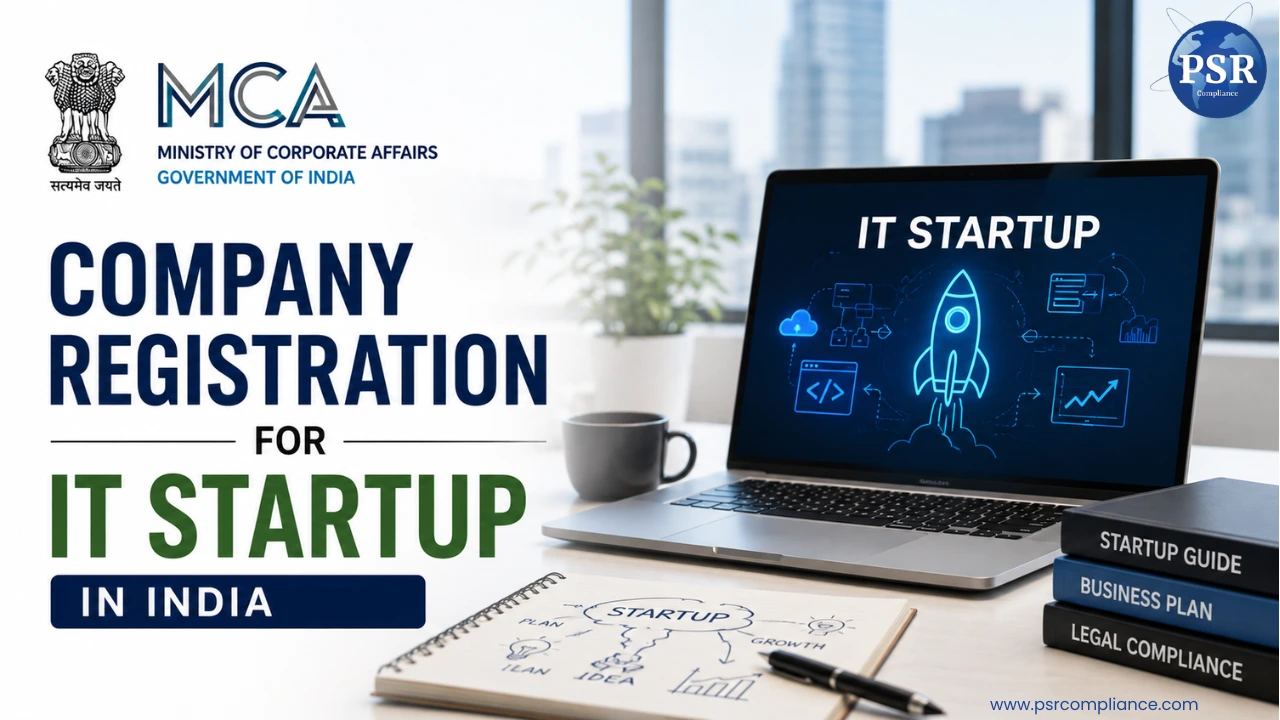
Company Registration for IT Startup in India: Process, Documents & Benefits
Every year, thousands of young developers, engineers, and tech founders in India have a brilliant idea for an app, a SaaS product, or a tech platform. But having a great idea is only the first step. Before you can raise funding, hire a team, or even open a business bank account, you need to make your startup official. That's where Company Registration For IT Startup comes in and getting this step right early can save you months of trouble later.
Many first-time founders assume registration is just paperwork they can handle later, once the product is ready. In reality, most serious clients, investors, and even freelance platforms want to see a registered company before they trust you with real business. Getting this done correctly, right from the start, sets the foundation for everything that follows.
Why IT Startups Specifically Need a Private Limited Company
Not every business structure suits a tech startup. If you ever plan to raise venture funding, issue ESOPs, or sell the company, a private limited company under the Companies Act 2013 is effectively mandatory, since investors do not put equity into proprietorships or ordinary partnerships.
This is especially true for IT startups, which often plan to scale fast, bring in outside investors, and offer stock options to attract good developers. A Private Limited Company is best for raising large amounts of money from investors and growing quickly, and gives you legal identity, liability protection, and market credibility that clients and suppliers trust far more than an informal setup.
IT Company Registration Process: Step by Step
Here's the complete process, explained in simple terms.
Step 1: Get a Digital Signature Certificate (DSC)
This is required for all proposed directors to sign electronic documents during the online registration process.
Step 2: Apply for Director Identification Number (DIN)
Every director of a Private Limited Company needs a DIN, which is applied for through the same incorporation form.
Step 3: Reserve Your Company Name
Your proposed company name must follow MCA naming guidelines and must be unique not already taken by another registered company.
Step 4: File the SPICe+ Form
This is the combined web-based incorporation form used in India, which includes your MOA (Memorandum of Association), AOA (Articles of Association), PAN, TAN, and optional GST, EPFO, and ESIC registration all in one filing.
Step 5: Receive Your Certificate of Incorporation
Once the Registrar of Companies (ROC) verifies everything, your Certificate of Incorporation is issued, and your company is legally established. This full process typically takes between 7 to 14 working days when your documentation is complete and in order.
Documents Required
To register your IT startup, you'll typically need:
- PAN and Aadhaar of all directors
- Address proof (utility bill, bank statement) for directors and registered office
- Passport-size photographs
- Registered office proof (rent agreement or ownership document, plus NOC from the owner)
- Digital Signature Certificates for all directors
- Proposed company name options
Private Limited Company Registration for Tech Startups: What Comes Next
Simply incorporating your company is just the beginning. A key next step is establishing the correct SAC (Services Accounting Code) from your very first invoice. This matters a lot for IT and software companies since it affects how your services get taxed and classified under GST from day one. Getting this wrong early can create tax headaches down the line, so it's worth getting right immediately after incorporation.
Startup India Registration Benefits for IT Company
Once your company is incorporated, the next smart move is applying for DPIIT (Startup India) recognition and for IT startups, this comes with real, practical advantages.
Startup India registration itself is completely free of cost, though standard government fees for company incorporation and document registrations still apply separately. To apply, you first incorporate your business, then visit the official Startup India portal, create an account, fill in your entity and innovation details, upload the required documents, self-certify your eligibility, and submit for DPIIT processing.
What do you actually get once recognised?
Recognition is available for startups working towards innovation or improvement of existing products, services, or processes, with the potential to generate employment or create wealth, and an entity is considered a startup for up to 10 years from incorporation (20 years for DeepTech startups).
Key benefits for IT companies include:
- Discounted trademark filing fees ₹4,500 instead of ₹9,000 per class
- Tax exemptions on profits for eligible years, subject to conditions
- Faster patent examination for tech and software innovations
- Easier compliance with self-certification under various labour and environment laws
- Access to government startup funds and easier procurement opportunities
Special Note for Deep Tech and AI Startups
A February 2026 DPIIT notification introduced specific provisions for deep tech startups working in AI, quantum computing, semiconductors, cybersecurity infrastructure, or advanced robotics. Under this notification, the turnover cap for Deep Tech recognition is raised to ₹200–300 crore, compared to the standard ₹100 crore limit for regular startups. If your IT startup is building genuinely advanced technology rather than a standard app or website, it's worth checking whether you qualify for this expanded category. The benefits last much longer.
Cost of IT Company Registration in India
Understanding the real cost helps you budget correctly from day one.
A standard 2-director Private Limited Company with ₹1–10 lakh authorised capital typically costs between ₹7,000 and ₹25,000 all-inclusive, with the range depending mainly on state stamp duty (₹200 to ₹12,600) and professional fees (₹5,000 to ₹15,000).
Generally, company registration for a private limited company ranges between ₹6,000 and ₹15,000 depending on the service provider and your specific requirements.
A Word of Caution on "Too Good to Be True" Pricing
Ads offering "₹499 company registration" are pure marketing hooks; they exclude DSC charges, stamp duty, and mandatory government charges, all of which are unavoidable parts of the actual process. Always ask for a complete, itemised breakdown before committing to any service provider.
For comparison, an LLP is cheaper to run long-term, with annual compliance costs of roughly ₹5,000 to ₹15,000 versus ₹15,000 to ₹40,000 for a Private Limited Company but an LLP cannot issue shares, which rules it out for most IT startups planning to raise investor funding.
Real-World Example: Why Getting the Structure Right Matters
Few smartphone brands have experienced as dramatic a growth journey as OnePlus, which went from an ambitious startup with no major market presence to a globally recognised technology brand within just over a decade. That kind of scale-up isn't possible without the right corporate structure in place from early on; proper incorporation, investor-friendly share structures, and clean compliance are what allow a company to raise funding rounds, expand teams, and eventually compete globally. The paperwork you handle in your first few weeks as a founder quietly shapes how far your company can grow later.
Build Your IT Startup on a Solid Legal Foundation
Registering your IT startup correctly isn't just a legal checkbox, it's what makes your company fundable, credible, and ready to scale. From choosing the right structure to filing for DPIIT recognition, every step you take early saves you time, money, and stress down the road. If you're serious about building a tech company that can raise funding, hire top talent, and grow fast, get your company registration and Startup India recognition sorted before you scale, not after.
Ready to Register Your IT Startup?
Starting an IT business is easier when your company structure and registration are handled correctly from the beginning. PSR Compliance can help you with Private Limited Company Registration, documentation, incorporation, and Startup India/DPIIT registration support.
📞 Call us: (+91) 8796104190
📧 Write to us: support@psrcompliance.com
Frequently Asked Questions
Is Private Limited Company registration suitable for an IT startup?
Yes. A Private Limited Company is generally suitable for IT startups that plan to raise investment, issue shares, offer ESOPs, build credibility and scale their business.
How do I register an IT company in India?
The process generally involves obtaining DSC, applying for DIN, selecting and reserving a suitable company name, filing the SPICe+ incorporation forms with the required documents, and receiving the Certificate of Incorporation from the ROC.
What documents are required for IT company registration?
Common documents include PAN and Aadhaar of the proposed directors, address proof, photographs, registered office proof, NOC from the property owner where applicable, DSCs and proposed company names.
How long does it take to register an IT company in India?
The timeline depends on documentation, name approval, government processing and whether any resubmission is required. When documents are complete and there are no major issues, incorporation can generally be completed within a few working days.
What is the cost of registering a Private Limited IT company?
The cost depends on factors such as authorised capital, state stamp duty, government fees and professional charges. The final amount can vary based on the company's specific requirements.
Can an IT startup apply for Startup India recognition?
Yes. After incorporation, an eligible IT startup can apply for DPIIT recognition under the Startup India initiative, subject to the applicable eligibility conditions.
What are the benefits of Startup India recognition for an IT startup?
Eligible recognised startups may receive benefits such as intellectual property support, easier patent examination, eligible tax benefits, self-certification benefits and access to certain government schemes and procurement opportunities.
Can an IT startup register as an LLP instead of a Private Limited Company?
Yes. An IT business can choose an LLP if it suits its requirements. However, startups planning to raise equity investment and issue shares often prefer a Private Limited Company.
Is GST registration required for every IT startup?
Not necessarily. GST registration depends on factors such as turnover, nature of services, place of supply and other applicable conditions. An IT startup should evaluate its GST obligations based on its specific business model.
Why should I register my IT startup before launching?
Early registration can help establish a separate legal identity, open a business bank account, enter contracts, build credibility and prepare the company for future funding, hiring and expansion.