Just send us your questions or concerns by starting a new case &
we will give you the help you need. Start Here...
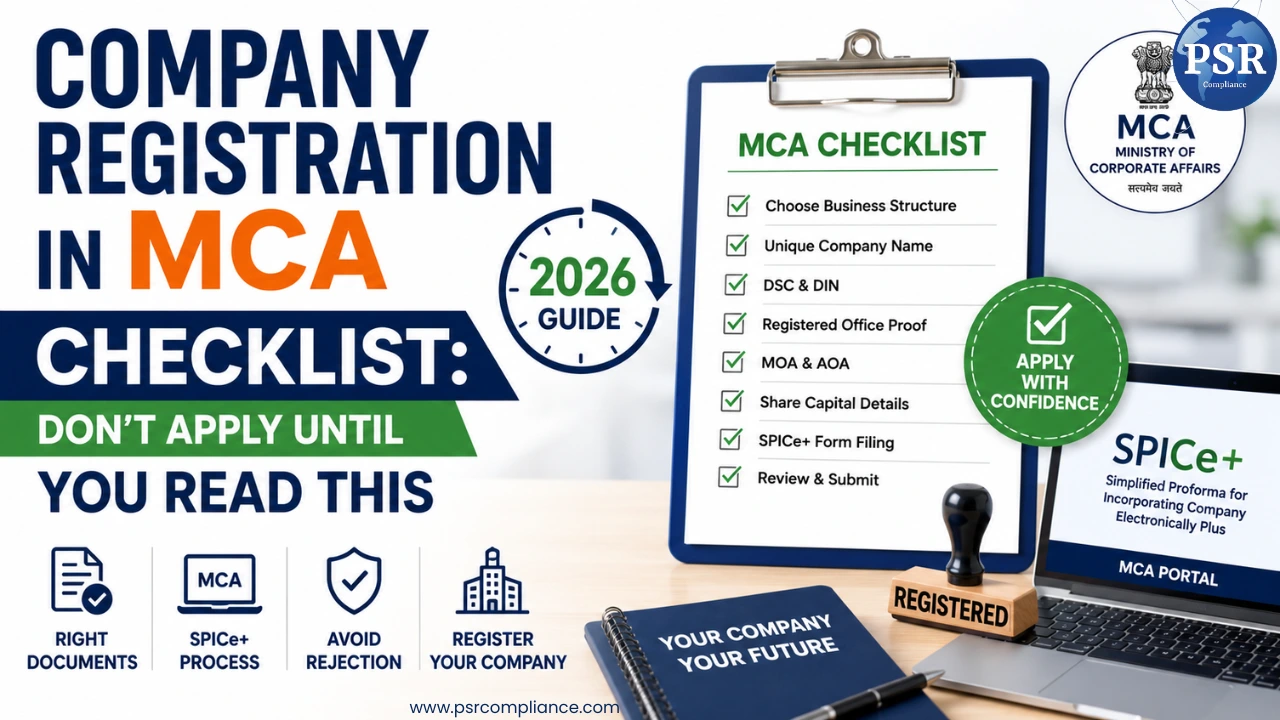
Company Registration
Fri, Jul 24 2026
Raju Karn
Company Registration in MCA Checklist: Don't Apply Until You Read This (2026)
Starting a business is exciting, but many entrepreneurs make mistakes during the company registration in MCA process. A missing document, incorrect company name, or incomplete application can delay your registration or even lead to rejection by the Ministry of Corporate Affairs (MCA).
The good news is that most of these mistakes are avoidable. If you prepare all the required documents and understand the registration process before applying, your company registration can be completed much more smoothly.
In this guide, you'll learn the complete company registration in MCA checklist, required documents, step-by-step registration process, common mistakes to avoid, and practical tips that every first-time business owner should know before filing an application.
What is Company Registration in MCA?
Company registration in MCA is the legal process of incorporating a company under the Ministry of Corporate Affairs (MCA) in India.
When your company is registered, it becomes a separate legal entity that can:
- Conduct business legally.
- Open a current bank account.
- Sign contracts.
- Hire employees.
- Raise investment.
- Apply for government registrations and licenses.
- Build trust with customers and investors.
Today, almost every company is incorporated online through the MCA portal using the SPICe+ (Simplified Proforma for Incorporating Company Electronically Plus) application.
Why is MCA Company Registration Important?
Registering your business with the MCA offers several legal and financial benefits.
Separate Legal Identity
After incorporation, the company becomes a separate legal entity from its owners.
Limited Liability Protection
In a private limited company registration, the personal assets of shareholders are generally protected from business liabilities.
Better Business Credibility
Registered companies are trusted more by customers, suppliers, investors, banks, and government authorities.
Easy Bank Account Opening
Most banks require a Certificate of Incorporation before opening a business current account.
Easier Funding Opportunities
Angel investors, venture capital firms, and financial institutions usually prefer investing in registered companies.
Legal Business Operations
Company registration allows businesses to operate legally while complying with Indian corporate laws.
Who Should Register a Company?
Company registration is suitable for individuals and businesses planning long-term growth.
You should consider company registration in India if you are:
- Starting a startup.
- Launching a technology company.
- Opening a manufacturing business.
- Running an import-export business.
- Providing professional services.
- Planning to raise investment.
- Expanding a family business.
- Building a scalable online business.
If your business plans include expansion, partnerships, or funding, registering a company through MCA is often the right choice.
Complete Company Registration in MCA Checklist
Before you begin the registration process, make sure everything listed below is ready.
This checklist can help you avoid delays and repeated document submissions.
1. Choose the Right Business Structure
The first decision is selecting the appropriate legal structure.
Some common options include:
- Private Limited Company
- One Person Company (OPC)
- Limited Liability Partnership (LLP)
- Public Limited Company
Among these, private limited company registration is one of the most popular choices for startups because it offers limited liability, easier fundraising, and better business credibility.
2. Select a Unique Company Name
Choosing the company name is one of the most important steps.
The proposed name should:
- Be unique.
- Not match an existing company.
- Not violate trademark rights.
- Follow MCA naming guidelines.
- Reflect your business activities.
It is always advisable to prepare two or three alternative names in case your first choice is not approved.
3. Obtain a Digital Signature Certificate (DSC)
Every proposed director must have a Digital Signature Certificate (DSC).
Since the incorporation process is completely online, all forms submitted to MCA must be digitally signed.
Without a DSC, you cannot complete the registration process.
4. Apply for Director Identification Number (DIN)
Every director of the company must possess a Director Identification Number (DIN).
The DIN is a unique identification number issued by the Ministry of Corporate Affairs.
It allows an individual to legally serve as a director in one or more companies.
For first-time directors, the DIN can usually be applied for during the incorporation process.
5. Keep Registered Office Documents Ready
Every company must have a registered office address.
Prepare the following documents:
- Electricity bill.
- Water bill or property tax receipt.
- Rent agreement (if rented).
- No Objection Certificate (NOC) from the property owner.
- Property ownership documents (if owned).
The address proof should generally be recent and clearly mention the registered office location.
6. Prepare Identity and Address Proofs of Directors
All proposed directors and shareholders should keep their identity documents ready.
Commonly accepted documents include:
Identity Proof
- Aadhaar Card
- PAN Card
- Passport
- Voter ID
- Driving Licence
Address Proof
- Bank Statement
- Electricity Bill
- Telephone Bill
- Passport
Ensure that the details in all documents are consistent to avoid verification issues.
7. Draft the Memorandum of Association (MOA)
The Memorandum of Association (MOA) defines:
- The company's objectives.
- Business activities.
- Scope of operations.
- Authorized capital.
It acts as one of the primary legal documents of the company.
8. Prepare the Articles of Association (AOA)
The Articles of Association (AOA) contain the internal rules governing the company's management.
It covers areas such as:
- Appointment of directors.
- Shareholding rules.
- Voting rights.
- Board meetings.
- Company administration.
Preparing both the MOA and AOA correctly helps avoid future legal and operational issues.
9. Decide Your Business Activities
Before filing your incorporation application, clearly identify the business activities your company will undertake.
These activities determine the appropriate NIC (National Industrial Classification) Code, which is selected during the MCA registration process.
Choosing the correct NIC Code is important because it defines the nature of your business and may affect future registrations, licenses, and statutory compliances.
10. Final Pre-Filing Checklist
Before submitting your application, verify that you have:
- Selected the correct business structure.
- Finalized a unique company name.
- Obtained DSC for all directors.
- Prepared DIN details.
- Collected identity and address proofs.
- Arranged registered office documents.
- Drafted the MOA and AOA.
- Selected the correct NIC Code.
- Verified shareholder details.
- Reviewed all information carefully.
Completing this checklist before filing can significantly reduce the chances of objections or delays from the MCA.
Documents Required for Company Registration in MCA
Before starting the company registration in MCA process, keep all the required documents ready. Having complete and accurate documents helps avoid delays during verification.
Documents Required for Directors
- PAN Card
- Aadhaar Card
- Passport (for foreign nationals)
- Passport-size photograph
- Mobile number
- Email ID
- Identity proof
- Address proof
- Digital Signature Certificate (DSC)
Registered Office Documents
- Latest electricity bill or utility bill
- Rent agreement (if the property is rented)
- No Objection Certificate (NOC) from the property owner
- Property ownership proof (if applicable)
Business Documents
- Memorandum of Association (MOA)
- Articles of Association (AOA)
- Details of directors and shareholders
- Proposed company name
- Share capital details
- Business activity details (NIC Code)
Step-by-Step Company Registration in MCA Process
Once all documents are ready, the registration process becomes much easier.
Step 1: Obtain Digital Signature Certificate (DSC)
The first step is obtaining a Digital Signature Certificate (DSC) for all proposed directors. Since MCA applications are filed online, every form must be digitally signed.
Step 2: Reserve Your Company Name
Apply for name approval through the MCA portal.
The proposed company name should:
- Be unique.
- Follow MCA naming guidelines.
- Not conflict with existing trademarks or registered companies.
If the name is approved, you can proceed with incorporation.
Step 3: Prepare Incorporation Documents
Prepare all incorporation documents including:
- MOA
- AOA
- Director details
- Registered office documents
- Shareholding details
Carefully review every document before submission.
Step 4: File the SPICe+ Form
The MCA has simplified incorporation through the SPICe+ (Simplified Proforma for Incorporating Company Electronically Plus) form.
The form allows applicants to apply for:
- Company Incorporation
- DIN allotment
- PAN
- TAN
- GST Registration (where applicable)
- EPFO Registration
- ESIC Registration
- Professional Tax Registration (in applicable states)
- Opening a company bank account through participating banks
Step 5: Verification by MCA
After submission, MCA verifies all the documents and information provided.
If any clarification is required, the registrar may issue a resubmission request.
Providing accurate information at the first attempt helps avoid delays.
Step 6: Receive Certificate of Incorporation
Once the application is approved, MCA issues the Certificate of Incorporation (COI).
This certificate confirms that your company has been legally incorporated under the Companies Act, 2013.
Along with the COI, PAN and TAN are generally issued as part of the incorporation process.
Common Mistakes That Delay Company Registration
Many first-time applicants face delays because of avoidable mistakes.
Some common mistakes include:
- Choosing a company name similar to an existing company.
- Uploading incorrect documents.
- Mismatch between PAN and Aadhaar details.
- Incorrect registered office address.
- Selecting the wrong NIC Code.
- Errors in shareholder details.
- Incorrect spelling of names.
- Incomplete SPICe+ application.
- Missing Digital Signature Certificates.
Reviewing your application carefully before submission can save both time and money.
Company Registration Fees in India
The cost of company registration in India depends on several factors, including:
- Type of company
- Number of directors
- Authorized share capital
- Professional consultancy fees
- Stamp duty applicable in the respective state
Apart from government fees, businesses may also incur professional charges if they seek assistance from company registration experts.
How Long Does Company Registration in MCA Take?
The incorporation timeline depends on document readiness and MCA verification.
In most cases, private limited company registration can be completed within 7 to 15 working days, provided all documents are accurate and no resubmission is required.
Delays usually occur due to incomplete documentation, incorrect details, or objections during name approval.
Final Checklist Before You Click Submit
Before filing your application, make sure you have completed the following:
- ✔ Selected the correct business structure.
- ✔ Finalized a unique company name.
- ✔ Obtained DSC for all directors.
- ✔ Applied for or included DIN details.
- ✔ Verified PAN and Aadhaar information.
- ✔ Collected registered office documents.
- ✔ Prepared MOA and AOA.
- ✔ Selected the correct NIC Code.
- ✔ Checked all shareholder details.
- ✔ Reviewed the SPICe+ form carefully.
Completing this checklist can significantly improve the chances of first-time approval.
Why Choose PSR Compliance?
Starting a company involves multiple legal formalities, document verification, and MCA compliance. Even a small mistake can delay incorporation.
PSR Compliance provides complete assistance with:
- Private Limited Company Registration
- One Person Company (OPC) Registration
- LLP Registration
- Company Name Approval
- DSC & DIN Assistance
- SPICe+ Filing
- MOA & AOA Drafting
- PAN & TAN Registration
- Post-Incorporation Compliance
Our experienced professionals help businesses complete the registration process accurately and efficiently.
Conclusion
Registering a company through the MCA is the first step toward building a legally recognized and credible business. By following a proper company registration in MCA checklist, you can avoid common mistakes, reduce processing delays, and complete the incorporation process with confidence.
Whether you are starting a startup, a manufacturing business, or a service-based company, preparing the right documents and understanding each step will make the registration process much smoother. If you need expert assistance with company registration in MCA, PSR Compliance is ready to guide you from document preparation to successful incorporation.
Frequently Asked Questions (FAQs)
1. What is company registration in MCA?
It is the legal process of incorporating a company with the Ministry of Corporate Affairs (MCA) under the Companies Act, 2013.
2. Who can apply for company registration in India?
Any individual or group of individuals who meet the legal requirements can apply to register a company in India.
3. What documents are required for company registration?
Common documents include PAN, Aadhaar, address proof, DSC, registered office proof, MOA, AOA, and shareholder details.
4. Is DSC mandatory for company registration?
Yes. Every proposed director must have a valid Digital Signature Certificate to file incorporation documents online.
5. How long does company registration take?
Generally, the process takes 7 to 15 working days, depending on document verification and MCA approval.
6. What is the SPICe+ Form?
SPICe+ is the integrated online application used for company incorporation and related registrations through the MCA portal.
7. Can a company be registered completely online?
Yes. The entire company registration process can be completed online through the MCA portal.
8. What is the benefit of a private limited company?
A private limited company provides limited liability, a separate legal identity, better credibility, and easier fundraising opportunities.
9. Can MCA reject a company registration application?
Yes. Applications may be rejected if the documents are incorrect, incomplete, or the proposed company name violates MCA guidelines.
10. Can PSR Compliance help with company registration?
Yes. PSR Compliance offers end-to-end assistance for company registration, including DSC, DIN, name approval, SPICe+ filing, and post-incorporation compliance.