Thu, Jun 25 2026
Utkarsh Sharma
BIS QCO 2026: Relief for AC & Refrigeration Makers
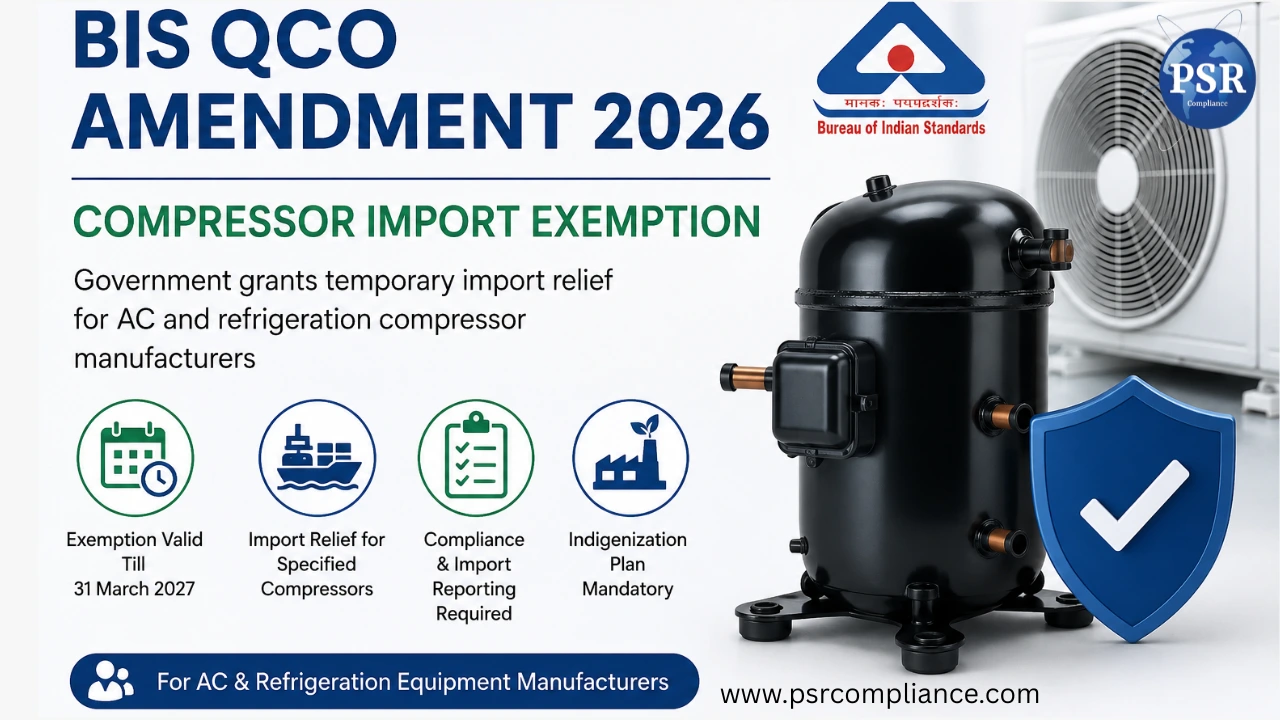
The Government of India has issued an important update under the Air Conditioner and its Related Parts, Hermetic Compressor and Temperature Sensing Controls (Quality Control) Amendment Order, 2026. This amendment provides temporary relief to manufacturers of air conditioning and refrigeration equipment by allowing the import of certain hermetic compressors without the usual Quality Control Order (QCO) restrictions, subject to specific limits and conditions.
The amendment came into effect on 8 May 2026 and will remain applicable until 31 March 2027.
What is the BIS QCO Amendment 2026?
The amendment modifies the existing Quality Control Order (QCO) for air conditioners, refrigeration equipment, hermetic compressors, and related parts. Under this update, manufacturers can continue importing specific categories of compressors for their own manufacturing operations without full QCO applicability, within prescribed limits.
The objective is to support the manufacturing sector while encouraging gradual localization and reducing supply chain disruptions.
Why Was This Amendment Introduced?
India's air conditioning and refrigeration industry relies on various types of compressors that are not always available in sufficient quantities from domestic sources.
The government introduced this amendment to:
- Support uninterrupted manufacturing operations
- Prevent shortages of critical compressor components
- Promote gradual indigenization
- Maintain growth in the HVAC and refrigeration sectors
- Allow manufacturers additional time to strengthen domestic supply chains
Products Covered Under the Exemption
The amendment applies to specific hermetic compressors imported for manufacturing purposes.
1. Reciprocating Hermetic Compressors
These compressors are used in:
- Refrigerators
- Freezers
- Similar refrigeration appliances
The exemption applies to fixed-speed and inverter compressors having a rated capacity below two tons of refrigeration.
2. Rotary Hermetic Compressors for Air Conditioners
These are commonly used in:
- Residential air conditioners
- Commercial air conditioners
- Heat pump systems
The exemption covers fixed-speed and inverter models below two tons of refrigeration capacity.
3. Scroll and Rotary Compressors Above 2 TR
These compressors are widely used in:
- Commercial HVAC systems
- Industrial cooling systems
- Large refrigeration units
- Heat pump applications
The amendment includes both fixed-speed and inverter variants.
4. Compressors for VRF Systems
The exemption also applies to rotary hermetic compressors used in Variable Refrigerant Flow (VRF) air conditioning systems.
Import Limits Allowed Under the Amendment
Manufacturers cannot import unlimited quantities under this exemption. The government has specified import limits based on quantities imported during FY 2024-25.
| Product Category | Permitted Import Quantity |
|---|---|
| Reciprocating Compressors (<2 TR) | Up to 40% of FY 2024-25 imports |
| Rotary Compressors (<2 TR) | Up to 30% of FY 2024-25 imports |
| Scroll & Rotary Compressors (≥2 TR) | Up to 90% of FY 2024-25 imports |
| VRF Rotary Compressors (≥2 TR) | Up to 100% of FY 2024-25 imports |
These limits are applicable during FY 2026-27.
Conditions Manufacturers Must Follow
The exemption is not automatic. Manufacturers must comply with several obligations.
Maintain Monthly Records
Companies must maintain monthly records of all imported compressors covered under the amendment.
Submit Reports to Authorities
The records must be submitted on the company's letterhead and signed by an authorized signatory.
Submit an Indigenization Plan
Manufacturers must also provide a localization or indigenization roadmap to the Central Government showing efforts to reduce import dependence in the future.
Who Will Benefit from This Update?
This amendment is especially beneficial for:
- Air conditioner manufacturers
- Refrigeration equipment manufacturers
- Heat pump manufacturers
- HVAC component suppliers
- Compressor importers supporting OEM manufacturers
The update helps companies maintain production schedules while working toward increased domestic sourcing.
Impact on BIS Compliance
It is important to understand that this amendment does not permanently remove BIS compliance requirements.
Instead, it provides a temporary exemption for specific products and quantities imported by manufacturers for their own production use until 31 March 2027. After that period, businesses may need to comply with applicable Quality Control Orders unless further extensions are announced.
Business Opportunities Created by the Amendment
The amendment creates several opportunities:
Improved Supply Chain Stability
Manufacturers can continue sourcing critical components without immediate disruptions.
Increased Production Capacity
Companies can maintain production targets despite shortages of locally available compressors.
Easier Business Planning
The exemption period allows businesses to plan long-term localization strategies.
Support for Industry Growth
The HVAC and refrigeration sectors can continue expanding without significant compliance-related supply challenges.
How PSR Compliance Can Help
Understanding BIS Quality Control Orders and compliance requirements can be challenging for manufacturers and importers.
PSR Compliance provides professional support for:
✔ BIS Certification
✔ Quality Control Order Compliance
✔ Product Registration
✔ Import Compliance Advisory
✔ Technical Documentation Support
✔ Regulatory Updates and Compliance Management
Our team helps businesses stay compliant while navigating evolving regulatory requirements efficiently.
📞 Call: 8796104190
📧 Email: support@psrcompliance.com
Conclusion
The BIS QCO Amendment Order 2026 is a significant relief measure for India's air conditioning and refrigeration industry. By allowing limited imports of specified hermetic compressors until 31 March 2027, the government has provided manufacturers with additional flexibility while continuing to encourage domestic production and localization.
Businesses involved in compressor imports, HVAC manufacturing, and refrigeration equipment production should carefully review the exemption limits and compliance requirements to make the most of this opportunity while maintaining regulatory compliance.
FAQs for BIS QCO Amendment
1. What is the BIS QCO Amendment Order 2026?
The BIS QCO Amendment Order 2026 provides temporary import exemptions for specific hermetic compressors used in air conditioners, refrigeration equipment, and heat pump systems until 31 March 2027.
2. Which products are covered under the exemption?
The amendment covers reciprocating, rotary, and scroll hermetic compressors used in refrigerators, air conditioners, heat pumps, and VRF air conditioning systems.
3. Who can avail of this import exemption?
The exemption is available to manufacturers of air conditioning and refrigeration equipment who import these compressors for their own manufacturing purposes.
4. What conditions must manufacturers follow under this amendment?
Manufacturers must maintain monthly import records, submit reports to the concerned authorities, and provide an indigenization plan to the Central Government.
5. Until when is the exemption valid?
The exemption remains valid until 31 March 2027, subject to the prescribed import limits and compliance requirements.