Wed, Jul 15 2026
Raju Karn
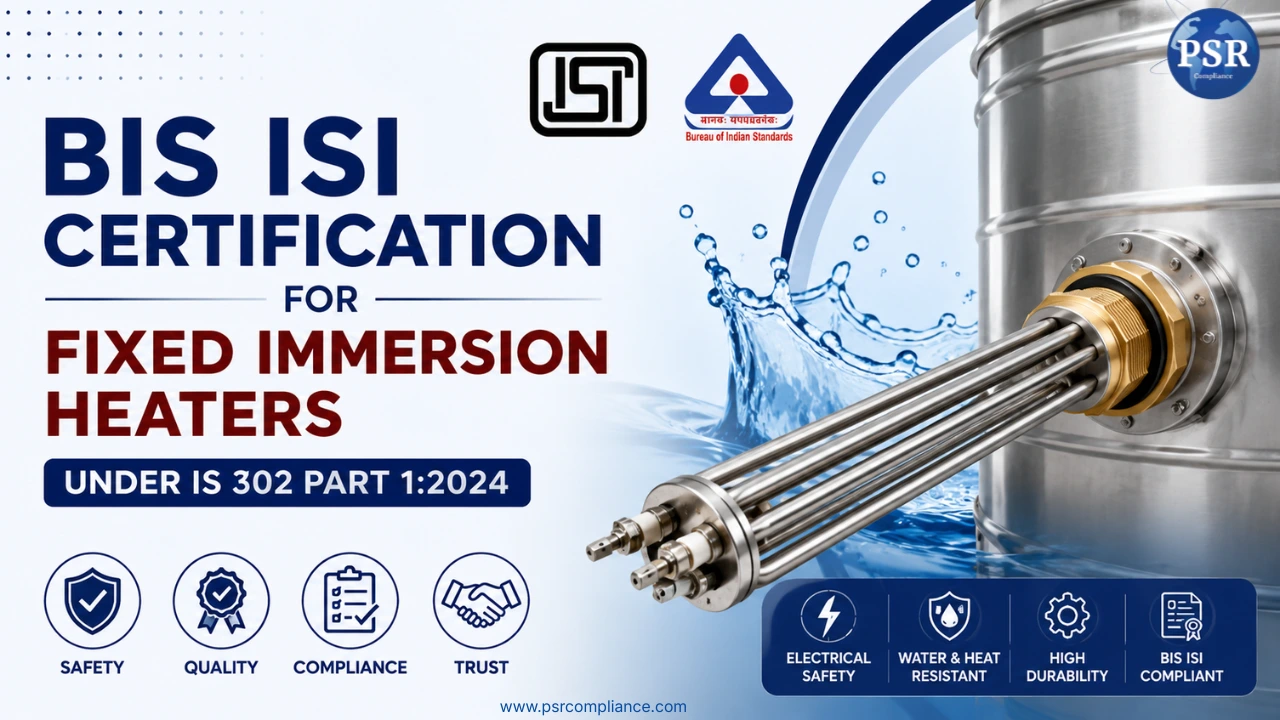
BIS ISI Certification for Fixed Immersion Heaters under IS 302 (Part 1):2024
Fixed immersion heaters may not be visible during everyday use, but they perform one of the most important functions in any water heating system. Installed inside tanks, boilers, vessels, and storage systems, these heaters provide a continuous supply of hot water in homes, hotels, hospitals, hostels, factories, laboratories, commercial kitchens, industrial process units, and institutional facilities. Unlike portable appliances, fixed immersion heaters remain permanently installed and often operate continuously for several hours each day. Since they work directly with both electricity and water, even a small defect can create serious safety hazards. Poor insulation, overheating, faulty wiring, or inadequate earthing may result in electric shock, fire hazards, equipment damage, or complete failure of the heating system.
To improve electrical safety and product quality, the Government of India has included Fixed Immersion Heaters under the Safety of Household, Commercial and Similar Electrical Appliances (Quality Control) Order (QCO). As per the notification, all covered products must comply with IS 302 (Part 1):2024 and carry the BIS Standard Mark (ISI Mark) under a valid BIS licence before they can be manufactured, imported, or sold in India. For general enterprises, the mandatory implementation date is 1 October 2026, while small and micro enterprises have extended compliance timelines. Manufacturers, importers, and suppliers should begin preparing well in advance to complete testing, documentation, factory inspection, and certification before the deadline.
Why Fixed Immersion Heaters Need BIS Certification
A fixed immersion heater performs a simple task—heating water—but it does so under demanding conditions. The heating element remains submerged inside water while continuously drawing electrical power, making electrical safety extremely important. Most users never see the heater because it operates inside sealed tanks or water vessels, yet they rely on it every day for a safe and uninterrupted hot water supply. If the heater is poorly designed or manufactured, faults such as insulation failure, poor earthing, weak thermal protection, or defective wiring can lead to electric shock through the water supply, overheating of the storage tank, short circuits, heating element failure, or even fire. In hotels, hospitals, factories, and hostels, a single faulty heater can interrupt hot water supply for hundreds of users while creating expensive maintenance and safety problems.
This is why BIS certification is much more than a legal formality. It confirms that the product has undergone independent safety testing and complies with Indian electrical safety standards. Buyers such as hotel procurement teams, builders, industrial facility managers, and institutional purchasers increasingly prefer ISI-certified immersion heaters because they reduce operational risks, improve reliability, and demonstrate compliance with government regulations. The BIS Standard Mark gives confidence that the product has been manufactured under a controlled quality system and is suitable for long-term use in demanding environments.
Major Components of a Fixed Immersion Heater
Although a fixed immersion heater appears to be a simple product, it consists of several electrical and mechanical components that work together to heat water safely. A typical immersion heater may include a heating element, metal sheath, thermostat or control connection, electrical terminals, internal wiring, insulation, mounting flange or threaded fitting, temperature safety device, and electrical connection points. Every component plays a critical role in maintaining electrical safety, heat transfer, and long-term durability. If even one component fails, the entire water heating system may become unsafe or stop functioning properly.
Where Fixed Immersion Heaters Are Used
Fixed immersion heaters are installed in a wide variety of residential, commercial, and industrial applications where a reliable hot water supply is essential. They are commonly found in domestic water tanks, hotel hot water systems, hospital water heating units, commercial kitchens, laboratories, industrial storage tanks, process heating equipment, hostels, educational institutions, and manufacturing facilities. Because these heaters are built into larger systems and often operate continuously, businesses expect them to deliver consistent performance with minimal maintenance or downtime.
The widespread use of these products also makes safety a major concern. A failure inside a hotel, hospital, or factory can interrupt operations, increase maintenance costs, and create safety hazards for users. As a result, buyers increasingly prefer BIS-certified immersion heaters that have been tested for electrical safety, durability, and reliable performance under Indian standards.
What Sellers Often Underestimate
Many manufacturers and sellers concentrate on specifications such as wattage, heating speed, sheath material, corrosion resistance, energy efficiency, or product pricing. While these features influence purchasing decisions, they do not guarantee electrical safety. Since a fixed immersion heater operates completely submerged in water, poor insulation or defective wiring may remain unnoticed until a serious failure occurs. By the time a fault becomes visible, it may already have caused equipment damage or created a dangerous situation for users.
For commercial buyers such as hotels, hospitals, industrial plants, and institutional facilities, product safety is often more important than initial purchase price. A BIS-certified immersion heater demonstrates that the product has been independently evaluated against Indian safety standards, helping buyers reduce operational risks and improve long-term reliability. This certification also strengthens a manufacturer's reputation and increases confidence among dealers, distributors, and procurement teams.
Products Covered Under the QCO
Businesses should carefully review every product they manufacture, import, or sell to determine whether it falls within the scope of the Quality Control Order.
| Products to Review | Examples |
|---|---|
| Fixed Immersion Heaters | Standard fixed water heating elements |
| Tank-Mounted Immersion Heaters | Installed directly inside storage tanks |
| Industrial Immersion Heaters | Heavy-duty industrial heating applications |
| Water Heating Elements | Electrical heating elements for water systems |
| Flange-Type Immersion Heaters | Flange-mounted heating assemblies |
| Threaded Immersion Heaters | Screw-type immersion heaters |
| Custom Heating Elements | Specially designed industrial heaters |
| Imported Fixed Heating Appliances | Imported immersion heating products |
| Private-Label Heater Models | OEM and branded heater products |
Every model should be reviewed separately because differences in wattage, voltage, mounting methods, sheath material, dimensions, electrical ratings, or installation design may affect certification planning. Businesses with multiple product variants should complete model mapping before submitting their BIS application to avoid unnecessary delays during testing and approval.
Quick Reference: What You Need to Know
| Detail | Information |
|---|---|
| Product | Fixed Immersion Heaters |
| Applicable Standard | IS 302 (Part 1):2024 |
| Certification Scheme | Product Certification Scheme (Scheme-I) |
| Certification Mark | BIS Standard Mark (ISI Mark) |
| Compliance Status | Mandatory |
| Regulating Authority | Bureau of Indian Standards (BIS) |
| Governing Ministry | Ministry of Commerce and Industry |
| Implementation Date (General Enterprises) | 1 October 2026 |
| Major Import Sources | China, European Union Countries, Japan |
Commercial Benefits of BIS Certification
Obtaining BIS certification offers much more than regulatory compliance. It helps manufacturers and importers build trust, expand market reach, and compete more effectively in both public and private sectors. Buyers are increasingly looking for certified products that reduce operational risks and meet recognized safety standards.
Some of the major commercial benefits include:
- Legal permission to manufacture, import, and sell across India.
- Increased confidence among hotels, hospitals, industries, and institutions.
- Better opportunities in government and corporate procurement.
- Improved dealer and distributor trust.
- Easier acceptance on e-commerce platforms.
- Stronger brand reputation.
- Competitive advantage over uncertified products.
- Better long-term customer confidence and repeat business.
BIS Testing Requirements for Fixed Immersion Heaters
Before a manufacturer receives BIS certification, fixed immersion heaters must successfully pass a series of safety and performance tests specified under IS 302 (Part 1):2024. These tests are designed to verify that the product can operate safely under normal as well as fault conditions. Since the heater works continuously in direct contact with water, BIS places significant emphasis on electrical insulation, earthing, temperature control, and overall construction quality. Testing is carried out in BIS-recognised laboratories before the product can qualify for certification.
The mandatory testing generally includes earth continuity testing, electric strength testing, protection against electric shock, leakage current testing at operating temperature, general leakage current testing, functional performance testing, and verification of proper earthing arrangements. Depending on the product's design, BIS may also require additional evaluations such as resistance to moisture, corrosion protection, terminal strength, overload protection, and resistance to abnormal operating conditions. Successfully passing these tests demonstrates that the heater meets India's prescribed electrical safety standards.
What Can Delay BIS Certification?
Many businesses assume that certification begins with filling out an application form, but in reality, most delays occur because the technical preparation is incomplete. Missing documentation, inconsistent product information, or incorrect model planning can significantly increase approval timelines. These issues become even more challenging for companies handling multiple product variants or imported products from overseas manufacturers.
Some of the most common reasons for certification delays include:
- Incomplete or incorrect electrical ratings.
- Poorly prepared product specification sheets.
- Different heater variants not mapped correctly.
- Missing factory registration documents.
- Weak quality control documentation.
- Incomplete product labels.
- Missing installation or user manuals.
- Imported models without technical drawings.
- Brand authorization documents not ready.
- Inadequate details of testing equipment and manufacturing facilities.
Completing these requirements before filing the BIS application helps businesses avoid unnecessary queries and reduces overall approval time.
Documents Required for BIS ISI Certification
Manufacturers and importers should begin collecting all technical and business documents well before starting the certification process. Proper documentation not only speeds up the BIS review but also helps laboratories and inspection officers verify that the product has been manufactured under a controlled quality system.
The commonly required documents include:
- Company registration certificate
- Factory address proof
- Product specification sheet
- Complete model list
- Electrical rating details
- Brand or trademark registration documents
- Manufacturing process flow chart
- Quality control plan
- List of testing equipment
- Machinery details
- Product label artwork
- User manual
- Installation instructions
- Safety warning labels
For fixed immersion heaters, installation instructions are especially important because improper installation may lead to electrical hazards, water leakage into electrical components, overheating, or reduced product life.
How a BIS Consultant Helps
Managing BIS certification can become challenging, particularly for businesses manufacturing multiple heater models or importing products from foreign suppliers. A professional BIS consultant helps simplify the entire process by ensuring that every stage of certification is completed correctly and on time. Instead of dealing with technical documentation, laboratory coordination, and regulatory queries independently, businesses can focus on manufacturing and sales while the certification process is handled professionally.
A BIS consultant typically assists with product applicability assessment, model grouping, document preparation, technical file review, laboratory testing coordination, factory inspection preparation, product label verification, user manual review, BIS application filing, and response to BIS queries. For OEM manufacturers and importers, consultant support is particularly valuable because products supplied under different brand names often require careful documentation and authorization planning.
Final Takeaway
Fixed immersion heaters may remain hidden inside water tanks and heating systems, but their role in ensuring safe and reliable hot water is extremely important. Since these products continuously operate with electricity and water, even minor manufacturing defects can create significant safety risks. This is why the Government of India has made BIS ISI Certification under IS 302 (Part 1):2024 mandatory for covered products under the Quality Control Order.
Manufacturers, importers, OEM suppliers, distributors, and private-label brands should begin compliance planning well before the implementation deadline. Early preparation allows sufficient time for product testing, factory inspection, documentation, and BIS approval while avoiding project delays and market disruptions. Businesses that complete certification in advance will not only meet legal requirements but also strengthen customer confidence, improve brand credibility, and gain a competitive advantage in India's growing water heating equipment market.
Get Expert Help with BIS ISI Certification for Fixed Immersion Heaters
Need assistance with BIS ISI Certification under IS 302 (Part 1):2024 for Fixed Immersion Heaters? PSR Compliance provides complete end-to-end support—from documentation and application filing to product testing, factory inspection, and final BIS licence approval.
👉 Ensure faster approvals and stress-free compliance with expert guidance.
📞 +91 8796104190
Frequently Asked Questions (FAQs)
1. Is BIS certification mandatory for Fixed Immersion Heaters?
Yes. Fixed Immersion Heaters covered under the Quality Control Order must comply with IS 302 (Part 1):2024 and obtain a valid BIS ISI licence before being manufactured, imported, or sold in India.
2. Which BIS standard applies to Fixed Immersion Heaters?
These products must comply with IS 302 (Part 1):2024, which specifies safety requirements for household, commercial, and similar electrical appliances.
3. Who needs BIS certification for Fixed Immersion Heaters?
Indian manufacturers, foreign manufacturers exporting to India, importers, OEM suppliers, private-label brands, distributors, and e-commerce sellers dealing with Fixed Immersion Heaters require BIS certification.
4. What documents are required for BIS certification?
Typical documents include company registration, factory address proof, product specifications, model list, electrical ratings, trademark documents, quality control plan, manufacturing process, machinery details, testing equipment list, labels, user manuals, and installation instructions.
5. Can imported Fixed Immersion Heaters be sold without BIS certification?
No. Imported Fixed Immersion Heaters covered under the Quality Control Order cannot be legally imported or sold in India without obtaining a valid BIS licence.
6. Why should manufacturers start BIS certification early?
Starting early provides enough time for testing, documentation, factory inspection, and BIS approval while avoiding delays in production, imports, project execution, and product launches.