Sat, Jun 13 2026
Raju Karn
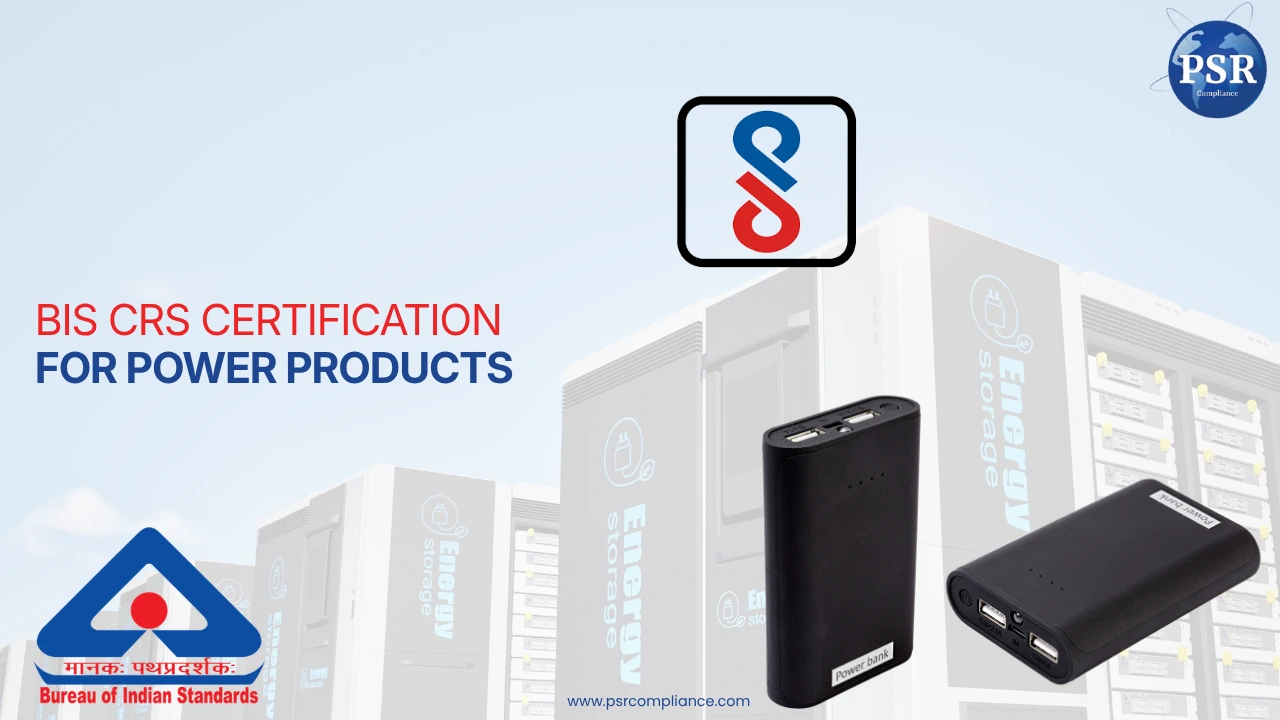
BIS CRS Certification for Power Products
If you sell, import, or manufacture power banks, laptop chargers, or power adapters in India you need to know about BIS CRS registration. Without it, your product cannot legally enter the Indian market.
In simple words: BIS (Bureau of Indian Standards) is the government body that checks whether electronic products are safe and reliable. CRS stands for Compulsory Registration Scheme. Under this scheme, power products must be tested and registered before they can be sold anywhere in India.
This blog covers everything, who needs it, which products require it, how to apply, what happens after approval, and what penalties apply for non-compliance.
What Is BIS CRS Certification For Power Preoducts?
BIS CRS (Compulsory Registration Scheme) was introduced in 2012 by the Ministry of Electronics and Information Technology (MeitY), in consultation with the Bureau of Indian Standards. The scheme makes it mandatory for manufacturers and importers to get their products registered before selling them in India.
Think of it like a quality stamp. When a product carries the BIS CRS mark, it means :
• It has been tested in a certified lab.
• It meets the Indian safety standard.
• It is safe for consumers to use.
For power products specifically, this is very important because devices like power banks contain lithium-ion batteries that can explode, overheat, or cause fires if they are of poor quality.
Which Products Require BIS CRS Registration?
| Product Category | Applicable Standard | Key Details |
|---|---|---|
| Power Banks | IS 13252 (Part 1): 2010 | Portable battery packs used to charge phones, earbuds, and USB devices. Contains lithium-ion batteries which can be hazardous if not properly tested. Effective since 13 May 2015. |
| Power Adapters / Chargers | IS 13252 (Part 1): 2010 | AC/DC wall adapters used for phones, tablets, and electronic devices. Both branded and third-party chargers require BIS CRS compliance. |
| Laptop Chargers | IS 13252 (Part 1): 2010 | Laptop power adapters and AC power supplies. Applicable to all brands selling in India, whether domestic or foreign. |
| Storage Batteries (Solar/Electric) | IS 16270:2014 | Rechargeable batteries used in solar systems, electric vehicles, UPS systems, and similar applications. |
Who Needs BIS CRS Certification?
BIS CRS registration is required for :
A) Indian Manufacturers
Any company or individual manufacturing power products within India and planning to sell them in the domestic market.
B) Foreign Manufacturers
Any company based outside India that wants to sell power products in India. Foreign manufacturers must appoint an Authorised Indian Representative (AIR) : a person or company based in India : to manage the registration process on their behalf.
- Rules for appointing an AIR :
If the foreign manufacturer has a liaison office in India → that office becomes the AIR.
If there is no liaison office, but the trademark owner is an Indian entity → the trademark owner acts as the AIR.
If neither applies a separate Indian entity must be appointed as the AIR.
C) Importers
Any Indian importer bringing in power products from abroad.
D) Brand Owners / Resellers
Even if you don't manufacture yourself, if your brand name appears on the product, you are responsible for BIS compliance.
- Sectors that are most affected include :
Consumer Electronics (phones, tablets, laptops)
E-Commerce Sellers
Solar Energy (batteries, inverters)
Electric Vehicle Industry
IT Hardware Distributors
Retailers selling chargers and power accessories
Benefits of BIS CRS Registration
Legal Permission to Sell in India
Without BIS CRS, your product cannot enter the Indian market. Registration is your gateway to one of the world's largest consumer markets.
Consumer Trust
The BIS mark tells buyers that your product has passed safety checks. It builds confidence, especially in competitive categories like chargers and power banks where low-quality products are common.
Competitive Advantage
A BIS-certified product stands out from non-certified alternatives. Retailers, e-commerce platforms, and procurement agencies prefer certified products.
No Legal Trouble
Selling non-certified products can lead to heavy penalties, product seizure, and even criminal charges. Registration protects you from all of this.
Brand Credibility
Certification signals that your company takes quality seriously. This matters a lot for long-term brand building in India.
Access to Government Tenders
Government departments and PSUs often require BIS-certified products for procurement. Without certification, you miss out on this segment entirely.
Better Export Prospects
BIS compliance can also make it easier to get certifications in other countries, as it demonstrates a commitment to global quality standards.
Step-by-Step Process to Get BIS CRS Certification
Step 1: Prepare Documents
The first step in BIS CRS certification is collecting and preparing all required documents in a proper format. These documents include company registration proof, product technical details, user manuals, trademark certificates, and test-related declarations. All documents must be signed, stamped, and notarised wherever required, especially in the case of foreign manufacturers. This step is important because incomplete or incorrect documentation can lead to delays or rejection at later stages.
Step 2: Register on BIS CRS Portal
After documents are ready, the applicant must create an account on the official BIS CRS portal (crsbis.in). This is where the entire application process is managed online. The applicant fills in company details, product category, manufacturing information, and uploads all supporting documents. Accuracy is very important here because any mismatch in details can create issues during verification and testing.
Step 3: Product Testing
Once the application is initiated, product samples must be sent to a BIS-recognised laboratory for testing. These labs are officially approved by BIS to ensure that products meet Indian safety standards such as IS 13252 (Part 1): 2010 for power banks, chargers, and laptop adapters. The lab tests electrical safety, performance, and quality parameters to ensure the product is safe for consumer use, especially since lithium-ion batteries and power devices can pose serious risks if poorly manufactured.
Step 4: Test Report Submission
After successful testing, the laboratory issues a detailed test report. This report is a critical document in the BIS CRS process and is valid only for 90 days. The applicant must submit this report to BIS within the validity period, along with the application file. If the report expires before submission, the testing process must be repeated, which increases time and cost.
Step 5: Factory Inspection (for Indian Manufacturers)
For Indian manufacturers, BIS may conduct a physical inspection of the manufacturing unit. During this visit, BIS officials verify production facilities, quality control systems, testing equipment, and manufacturing processes. They may also collect additional samples for independent verification. The purpose of this inspection is to ensure that the factory is capable of consistently producing products that meet BIS standards, not just a one-time compliant sample.
Step 6: BIS Review
After receiving the application, test report, and inspection results (if applicable), BIS performs a detailed review. They verify all documents, technical specifications, and compliance with Indian standards. If everything is in order, the application is approved. In normal cases, approval may take around 15 days, but if additional clarifications or verifications are needed, the process can extend up to 30–60 days.
Step 7: Registration Certificate Issued
Once the application is approved, BIS issues a CRS Registration Certificate with a unique registration number. This number is extremely important because it must be printed on the product, packaging, and marketing materials. Only after receiving this registration number can the product be legally sold, imported, or distributed in India. This mark acts as proof that the product has passed all safety and compliance requirements under BIS CRS.
Documents Required for BIS CRS Registration
For All Applicants:
- → Duly filled BIS CRS Application Form
- → Constructional Data Form (CDF)
- → Critical Component List (CCL)
- → Technical Specification Sheet
- → User Manual
- → Marking Label
- → Business/Trade License
- → ISO Certification (if available)
- → Trademark Certificate
- → Trademark Authorisation Letter
- → Authorisation Letter
- → Test Report
For Foreign Manufacturers (Additional):
- → AIR company registration proof
- → Photo ID of AIR
- Notarised and stamped documents
Post-Approval Requirements
1. Display Registration Number
Must be printed on product, packaging, and marketing materials.
2. Maintain Product Quality
No change in design/components without BIS approval.
3. Renew Registration
Must be renewed before expiry.
4. Record Keeping
Maintain production and testing records.
5. Surveillance Testing
BIS may test market samples anytime.
6. Notify BIS of Changes
Any modification must be informed.
7. Use Approved Labs Only
Testing must be done only in BIS-recognised labs.
Penalties for Non-Compliance with BIS CRS
⚠️ Monetary Fines: First offence ₹25,000 or twice product value; repeat offence up to ₹5 lakh or five times value.
⚠️ Imprisonment: Up to 2 years in serious cases.
⚠️ Product Seizure: Non-certified goods can be confiscated or destroyed.
⚠️ Import Ban: Goods can be stopped, returned, or destroyed at ports.
⚠️ Blacklisting: Repeat violators may be blacklisted by authorities.
⚠️ E-Commerce Delistment: Listings can be removed from platforms like Amazon and Flipkart.
Conclusion
BIS CRS certification for power products : whether it is a power bank, power adapter, laptop charger, or storage battery : is not optional. It is the law. Beyond compliance, it is a smart business decision. Products with BIS certification are trusted more by retailers, buyers, and e-commerce platforms. In a market flooded with cheap and unsafe charging accessories, BIS certification helps genuine manufacturers stand out.
If you are a manufacturer, importer, or brand owner dealing in power products in India, start the BIS CRS registration process as early as possible. The process takes time : typically 30 to 60 days : so planning ahead avoids costly delays.
Getting certified shows your commitment to quality and safety. And in India's growing electronics market, that commitment pays off.
Get Expert Help for BIS CRS Certification
Need help with BIS CRS Certification for power banks, chargers, or adapters? PSR Compliance provides complete support for documentation, product testing, and registration approval.
👉 Get your BIS CRS certification done quickly and correctly
📞 8796104190
📧 support@psrcompliance.com
FAQs on BIS CRS Certification for Power Products
Which power products require BIS CRS certification?
Power banks, power adapters/chargers, laptop chargers, UPS/inverters, and lithium-ion or secondary batteries used in portable devices require BIS CRS certification in India.
Can foreign manufacturers apply for BIS CRS?
Yes, but they must appoint an Authorized Indian Representative (AIR) to apply and manage compliance in India.
Is factory inspection required for BIS CRS?
No, BIS CRS certification is mainly based on product testing in BIS-recognized labs and document verification. Factory inspection is not mandatory.
What is a BIS R-Number?
It is a unique registration number issued after approval. It must be printed on the product and packaging for legal sale in India.
How long is BIS CRS valid?
The registration is valid for 2 years and must be renewed before expiry.
Can multiple models be covered in one registration?
Yes, if they have the same specifications, components, and fall under the same Indian Standard.
What documents are required?
Test report (within 90 days), CCL/BOM, ISO certificate, business license, and AIR documents (if applicable).
Where to apply for BIS CRS?
Applications are submitted online through the official ManakOnline BIS portal.