Fri, Jan 02 2026
Raju Karn
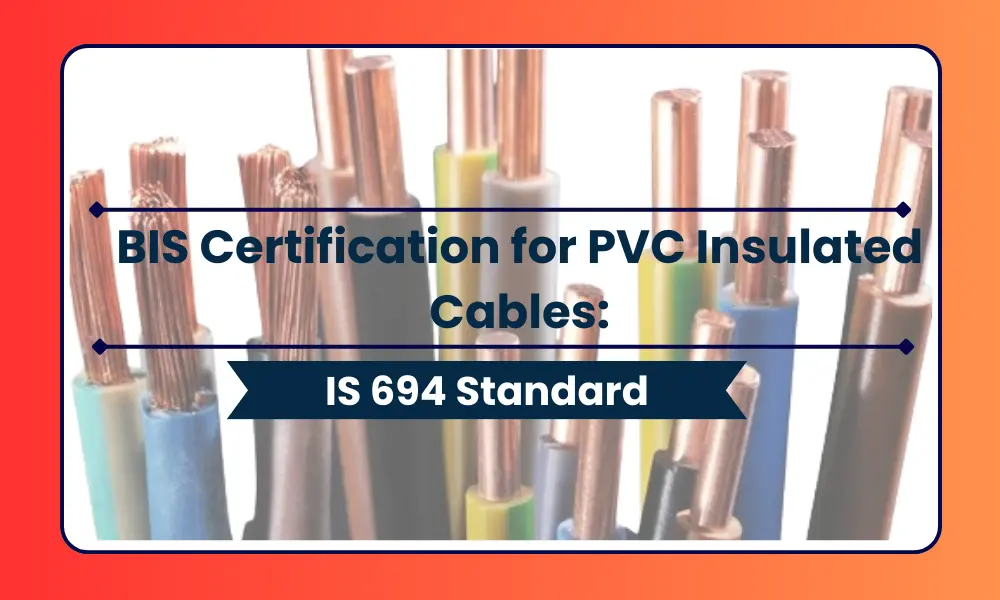
BIS Certification for PVC insulated cables: IS 694 Standard
Many electrical equipment components and devices, particularly PVC-insulated cables, require careful attention to safety during their application. It's because PVC-insulated cables are strong, durable, and reliable. These cables must be tested and certified under BIS, a mandatory quality standard that manufacturers must meet before they can legally sell in the Indian market. The ISI mark that certified manufacturers place on their products shows that the cables comply with India's safety and performance standards, which are designed to protect consumers and ensure the product is of the right quality.
This post will explain everything you need to know about this certification. Read on.
PVC Insulated Cables and BIS Certification
A number of electrical setups use PVC insulated cables due to their good resistance to chemicals, heat, and water. These cables have high dielectric strength and can therefore be relied upon in high-voltage applications.
In India, manufacturers of PVC insulated cables have to acquire a BIS certificate to sell their products. This ensures that the cables conform to the safety and performance guidelines stated in IS 694:2010. Without such certification, no manufacturer is allowed to market his or her products in India.
What is BIS Certification for PVC Insulated Cables?
The Bureau of Indian Standards (BIS) is the national body established to confirm the superiority of products in India. To ensure that these standards are met, suppliers are authorized by BIS to have their goods certified. For instance, in regard to PVC insulated cables, BIS certifies that the cables meet safety standards thus they are fit for use by consumers.
The process of certification is all-encompassing; it ranges from production through packaging guaranteeing compliance with IS 694:2010 guidelines.
Benefits of BIS Certification for PVC Insulated Cables
There are several advantages of a BIS Certificate in India:
Manufacturers can sell their products all over India without any legal restrictions.
If they buy products with ISI marks, customers can be confident about their safety and quality.
BIS-certified cable offers high performance and leads to better customer satisfaction.
If you are producing wire insulators without BIS certifications then you can be fined or go to jail or even both.
Basic Requirements for BIS Certification for PVC Insulated Cables There are certain demands that manufacturers must fulfil to acquire BIS Certification:
The cables are required to comply with IS 694:2010 which is an Indian Standard specification document.
Certified to manufacturers only. So, retailers and distributors are not eligible for this certification.
The factory must have all production facilities including testing machines inside the premises.
Multiple production sites require unique applications: different plants mean other requests for permission with BIS.
In their product manuals, producers should adhere to technical testing and sampling guidelines recommended by BIS.
Testing Requirements for PVC Insulated Cables
PVC insulated cables have to go through several tests to comply with the set standards:
♦ Test Flame spread for determining fire resistance,
♦ Flex test that determines the flexibility of the cables,
♦ The objective of the insulation resistance test is to evaluate insulating properties,
♦ Heat Resistance measurement test also called shrinkage test shows how much material decreases under heat,
♦ The oxygen index measures how much something can support combustion without it getting worse
♦ The conductor resistance test helps check whether a wire has good conductivity.
The tests are carried out at well-equipped laboratories, according to BIS guidelines for quality assurance purposes
Packaging and Labelling Requirements for BIS Certified Cables The labelling of PVC insulated cables by manufacturers includes specific guidelines that should adhere to:
♦ The Brand Name or Manufacturer’s Trademark should be clearly indicated.
♦ Core Number, Voltage Grade and Cable Type – should be given in terms of the number of cores, voltage grade and type of cable.
♦ Finally but most importantly, the winding direction for reels; flame retardant labels and lengths should never be missed on packets.
Documents Required for BIS Certification
Manufacturers must submit the following documents for BIS Registration Online:
♦ Proof that the manufacturing facility is operational at that particular location.
♦ Proof that they are residents of India.
♦ Product drawings and factory layout plans
♦ Information concerning the testing facilities present at their premises.
♦ Manufacturing flowcharts.
♦ Certificate of Incorporation.
♦ Certified product test reports from BIS-authorized labs.
These documents not only signify their compliance with such standards but also facilitate the approval stage.
The BIS Certification Process for PVC Insulated Cables
The BIS certification process consists of several important steps:
1. Selection of the Product Code
Initially, manufacturers are asked to ascertain the applicable product code as per the BIS standards. It ensures that the cables comply with the necessary specifications.
2. Submission of the Application
Here, the manufacturers file for the right Product Certification application. Every item should be filled correctly, and the required payments (i.e., audit and registration fees) must be made.
3. Inspection of Factory
After these steps, the BIS officers are likely to inspect the company for quality checks and make sure that their manufacturing unit accords with BIS standards. Tests will also be conducted on the PVC-insulated cables.
4. Product Tests
After the sample is collected, these will be prepared for dispatch to labs which are contracted by BIS. It is necessary that these results are established selectively and, if not approved they fail the appreciable BIS requirements of the product.
5. Rewarding BIS Certification
After successful testing and inspection, manufacturers will get a BIS license, and they can use the ISI mark on their PVC insulated cables.
Conclusion
The process of acquiring BIS certification in India is mandatory for PVC-insulated wire manufacturers. This is because of the strict requirements and checks products must undergo to get the certificate which protects consumers and allows the manufacturers to have an advantage in the market. It is worth noting that complying with these standards is important for every manufacturer to sell their products in the Indian market. If you need help getting your BIS Certificate in India, contact PSR Compliance today for expert assistance.
Get Expert Help with BIS Certification for PVC Insulated Cables
Need BIS Certification for PVC insulated cables under IS 694:2010? Our experts can help with the complete certification process, from document preparation and application filing to BIS coordination and compliance support.
📞 Call: +91 8796104190
📧 Email: support@psrcompliance.com
FAQs on BIS Certification for PVC Insulated Cables
What is BIS Certification for PVC insulated cables?
BIS Certification confirms that PVC insulated cables meet the applicable quality and safety requirements under IS 694:2010.
Is BIS Certification mandatory for PVC insulated cables?
Yes, PVC insulated cables covered under the applicable Quality Control Order must comply with the relevant BIS certification requirements before being manufactured, imported, or sold in India.
Which Indian Standard applies to PVC insulated cables?
The applicable standard is IS 694:2010, which covers PVC insulated cables and cords for working voltages up to and including 1100 V.
What documents are required for BIS Certification of PVC cables?
Common documents include company registration details, manufacturing process information, product specifications, test reports, quality control details, machinery details, and other documents required by BIS.
How long does BIS Certification for PVC cables take?
The timeline depends on document readiness, product testing, factory inspection, and BIS processing. Delays can occur if testing or documentation requirements are not completed properly.
Can imported PVC insulated cables get BIS Certification?
Yes, eligible foreign manufacturers can apply for BIS certification subject to the applicable BIS requirements, factory assessment, testing, and regulatory conditions.
What happens if PVC cables are sold without required BIS Certification?
If BIS certification is mandatory for the product under an applicable QCO, selling non-compliant products can lead to regulatory action, including restrictions on market access and penalties.
Can a consultant help with BIS Certification for PVC insulated cables?
Yes. A BIS consultant can assist with documentation, application filing, testing coordination, factory inspection preparation, and communication with BIS throughout the certification process.