Mon, Jul 20 2026
Raju Karn
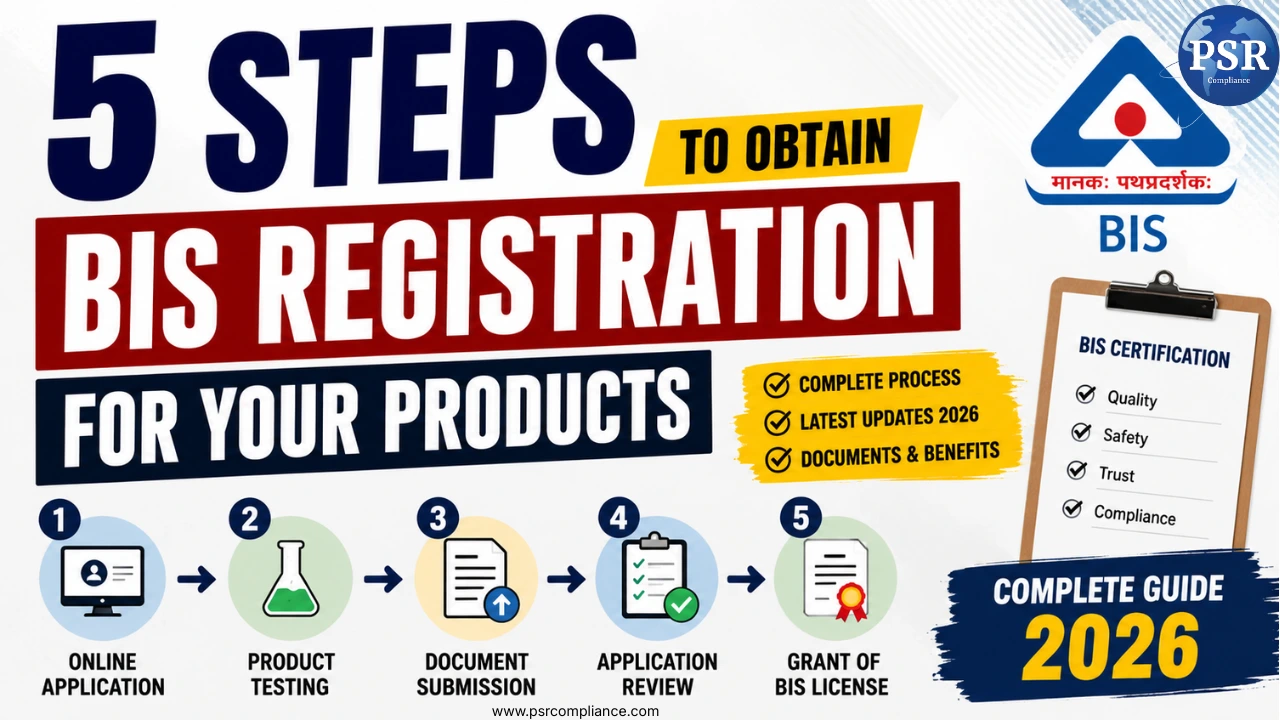
5 Steps to Obtain BIS Registration for Your Products
As India continues to strengthen product quality and safety regulations, BIS Registration has become an essential requirement for manufacturers and importers. Whether you manufacture electronic products, electrical appliances, steel products, chemicals, toys, or IT equipment, obtaining BIS certification ensures your products comply with the Indian Standards prescribed by the Bureau of Indian Standards (BIS).
For many products covered under Quality Control Orders (QCOs), BIS Registration is mandatory before they can be manufactured, imported, distributed, or sold in the Indian market. Apart from legal compliance, BIS Certification helps businesses build customer trust, improve brand reputation, and expand their market opportunities across India.
If you are planning to apply for BIS Registration in 2026, understanding the registration process is the first step toward successful approval. This guide explains the 5 Steps to Obtain BIS Registration for Your Products, along with the required documents, latest 2026 updates, and practical tips to help you complete the certification process smoothly.
What is BIS Registration?
BIS Registration is the process through which the Bureau of Indian Standards (BIS) certifies that a product complies with the applicable Indian Standard (IS).
After successful approval, the manufacturer receives a BIS Registration Number or License, allowing the use of the applicable Standard Mark, such as the ISI Mark or CRS Registration Number, depending on the certification scheme.
The main objective of BIS Registration is to ensure that products sold in India meet prescribed quality, performance, and safety standards, thereby protecting consumers and promoting fair trade practices.
2026 Updates on BIS Registration
In 2026, the Government of India has expanded mandatory BIS compliance for several new product categories through various Quality Control Orders (QCOs).
Some important updates include:
- More electrical and electronic products now require mandatory BIS Certification.
- BIS has strengthened market surveillance to prevent the sale of non-certified products.
- Manufacturers and importers must ensure compliance with the latest Indian Standards before launching products.
- Non-compliance may lead to penalties, product recalls, seizure of goods, cancellation of licenses, and legal action.
Businesses should regularly monitor BIS notifications to remain compliant with the latest regulatory changes.
Who Needs BIS Registration?
BIS Registration is generally required for businesses involved in manufacturing or importing products covered under mandatory BIS schemes.
These include:
- Indian Manufacturers
- Foreign Manufacturers
- Importers
- Brand Owners
- Electronics Manufacturers
- Electrical Appliance Manufacturers
- LED Lighting Manufacturers
- IT Equipment Manufacturers
- Household Appliance Manufacturers
- Steel Product Manufacturers
- Chemical Manufacturers
If your product falls under a mandatory Quality Control Order, obtaining BIS Registration is compulsory before selling it in India.
Documents Required for BIS Registration
Before starting the application process, applicants should keep the required documents ready.
Some commonly required documents include:
- Business Registration Certificate
- PAN Card
- GST Registration Certificate
- Factory Address Proof
- Manufacturing Process Details
- Product Specifications
- Authorized Signatory Documents
- Trademark Certificate (if applicable)
- Product Labels and Markings
- Test Report from a BIS-Approved Laboratory
Depending on the certification scheme and product category, BIS may request additional documents during the verification process.
Step 1: Create an Account on the BIS Portal
The first step in obtaining BIS Registration is creating an account on the official BIS portal under the applicable certification scheme, such as the Compulsory Registration Scheme (CRS).
Register Your Business
Applicants must provide:
- Company details
- Manufacturing unit information
- Product details
- Authorized signatory information
After successful registration, BIS provides login credentials that can be used to access the online application portal.
Step 2: Get Your Product Tested at a BIS-Approved Laboratory
Once the account is created, the next step is product testing.
Select a BIS-Recognized Laboratory
Applicants must submit product samples to a BIS-approved laboratory.
The laboratory conducts various technical tests to determine whether the product complies with the applicable Indian Standard.
Testing generally evaluates:
- Product safety
- Performance
- Quality
- Electrical safety (where applicable)
- Material specifications
After successful testing, the laboratory issues an official Test Report.
Step 3: Submit the BIS Registration Application
After receiving the laboratory test report, applicants must submit their BIS application through the online portal.
Upload Required Documents
The application should include:
- Laboratory Test Report
- Business Documents
- Product Specifications
- Manufacturing Details
- Factory Information
- Authorization Documents
Applicants should carefully verify all information before submission to avoid delays.
Step 4: BIS Reviews Your Application
Once the application is submitted, BIS officials begin reviewing the documents and product information.
Verification Process
During verification, BIS examines:
- Product Test Report
- Manufacturing Details
- Product Specifications
- Supporting Documents
- Compliance with the applicable Indian Standard
If any discrepancies are found, BIS may ask the applicant to provide additional documents or clarifications before processing the application further.
Step 5: Grant of BIS Registration Certificate
If the application successfully satisfies all BIS requirements, the Bureau of Indian Standards grants the Registration Certificate.
Receive Your BIS Registration Number
Once approved, the manufacturer receives:
- BIS Registration Certificate
- Registration Number (R Number or License Number)
- Permission to use the applicable BIS Standard Mark
The manufacturer can then legally manufacture, import, distribute, and sell certified products in the Indian market while displaying the required BIS mark on the product.
Benefits of BIS Registration
Obtaining BIS Registration offers several advantages for manufacturers, importers, and brand owners. Apart from meeting legal requirements, it also helps businesses strengthen their position in the Indian market.
Builds Consumer Trust
The BIS Standard Mark assures customers that the product has been tested and complies with Indian quality and safety standards, increasing consumer confidence.
Ensures Legal Compliance
Many products covered under Quality Control Orders (QCOs) cannot be manufactured, imported, or sold without BIS Registration. Certification helps businesses comply with government regulations.
Improves Brand Reputation
Products carrying the BIS mark are generally perceived as more reliable and trustworthy, helping businesses establish a strong market presence.
Expands Market Opportunities
Many government departments, public sector organizations, and large private companies prefer purchasing BIS-certified products, creating new business opportunities.
Provides a Competitive Advantage
BIS-certified products often have a stronger competitive position compared to uncertified products because customers recognize them as safe and quality-tested.
Reduces Business Risks
Obtaining BIS Registration helps businesses avoid penalties, product seizures, recalls, and legal action arising from non-compliance.
Common Mistakes to Avoid During BIS Registration
Many BIS applications are delayed or rejected because of avoidable mistakes. Paying attention to the following points can help ensure a smoother registration process.
Submitting Incomplete Documents
Missing or incorrect documents are one of the most common reasons for delays in BIS approval.
Using a Non-Approved Laboratory
Product testing must always be conducted at a BIS-approved laboratory. Reports from unauthorized laboratories are not accepted.
Providing Incorrect Product Information
Applicants should ensure that product specifications, technical details, and manufacturing information are accurate and consistent throughout the application.
Delaying the Application Submission
After receiving the laboratory test report, the application should be submitted within the prescribed time limit to avoid repeating the testing process.
Ignoring Applicable Indian Standards
Before applying, manufacturers should confirm that their products comply with the relevant Indian Standard (IS) and Quality Control Order (QCO).
Conclusion
BIS Registration is an essential compliance requirement for manufacturers and importers who want to sell regulated products in the Indian market. By following the five-step BIS Registration process, businesses can ensure that their products comply with Indian quality and safety standards while avoiding legal complications.
Whether you manufacture electronics, electrical appliances, steel products, toys, IT equipment, or other regulated products, obtaining BIS Certification strengthens customer confidence, improves brand credibility, and opens new market opportunities. Preparing accurate documentation, testing products through BIS-approved laboratories, and following the prescribed application process can significantly improve the chances of timely approval.
Get Expert Help with BIS Registration
Need assistance with BIS Registration, BIS CRS Certification, ISI Mark Certification, FMCS, or Quality Control Order (QCO) compliance?
PSR Compliance provides complete end-to-end support for documentation, product testing coordination, application filing, renewals, and BIS compliance for manufacturers and importers across India.
👉 Simplify your BIS Registration process with expert guidance and avoid unnecessary delays or application rejections.
📞 Call: +91 8796104190
📧 Email: support@psrcompliance.com
🌐 Website: https://www.psrcompliance.com
Frequently Asked Questions (FAQs)
What is BIS Registration?
BIS Registration is the process through which the Bureau of Indian Standards certifies that a product complies with the applicable Indian Standard before it is sold in the Indian market.
Is BIS Registration mandatory in India?
Yes. BIS Registration is mandatory for products covered under the Quality Control Orders (QCOs) issued by the Government of India.
Who can apply for BIS Registration?
Indian manufacturers, foreign manufacturers, importers, and authorized representatives can apply, depending on the applicable BIS certification scheme.
Which products require BIS Registration?
Many products, including electrical appliances, electronics, LED lighting products, IT equipment, toys, steel products, chemicals, and household appliances, require BIS Registration if they fall under mandatory Quality Control Orders.
Is product testing mandatory for BIS Registration?
Yes. Products must be tested at a BIS-approved laboratory before submitting the BIS application.
How long does the BIS Registration process take?
The timeline depends on product testing, document verification, and BIS processing. Complete applications with accurate documentation are generally processed more quickly.
Can foreign manufacturers obtain BIS Certification?
Yes. Foreign manufacturers can obtain BIS Certification under the applicable BIS certification scheme, such as the Foreign Manufacturers Certification Scheme (FMCS), where applicable.
What happens if I sell products without mandatory BIS Registration?
Manufacturing, importing, or selling products that require mandatory BIS Registration without obtaining certification may result in penalties, product seizure, cancellation of licenses, or legal action.
Can BIS Registration be renewed?
Yes. BIS licenses and registrations should be renewed as per the applicable BIS regulations to maintain compliance and continue using the BIS Standard Mark.
Why should I hire a BIS Registration consultant?
A professional consultant can assist with documentation, product testing coordination, application filing, compliance requirements, and communication with BIS, reducing the chances of delays or rejection.