Mon, Jul 27 2026
Raju Karn
Which Cosmetic Products Need Import Registration in India? Complete Guide (2026)
If you're planning to import beauty or personal care products into India, one of the first questions to answer is whether your cosmetic product needs import registration. A common assumption is that a product legally sold abroad can simply be imported and sold in India too — but that's not how it works.
Imported cosmetics in India are regulated under the Cosmetics Rules, 2020, administered by the Central Drugs Standard Control Organisation (CDSCO) through the Central Licensing Authority — the Drugs Controller General (India). Most cosmetics manufactured outside India require an Import Registration Certificate before they can be legally imported for sale or distribution. Skipping this step can mean customs delays, regulatory action, or having your consignment held or destroyed.
Whether you're an importer, distributor, international brand, e-commerce seller, or a startup entering India's beauty market, knowing which products need registration — and what the process actually involves — is essential before you place your first order.
What is Cosmetic Import Registration?
It's the regulatory approval required for most cosmetic products manufactured outside India before they're imported for commercial sale or distribution.
The process is governed by the Cosmetics Rules, 2020 and runs through CDSCO's online SUGAM portal. An applicant — the manufacturer, an authorized agent, an India-based importer, or an authorized Indian subsidiary — files Form COS-1. Once CDSCO reviews and approves the application, it issues an Import Registration Certificate on Form COS-2, which is what actually allows the product to legally enter India.
The purpose is straightforward: make sure imported cosmetics meet Indian safety and quality standards before reaching consumers, and keep a traceable record of what's entering the market and from where.
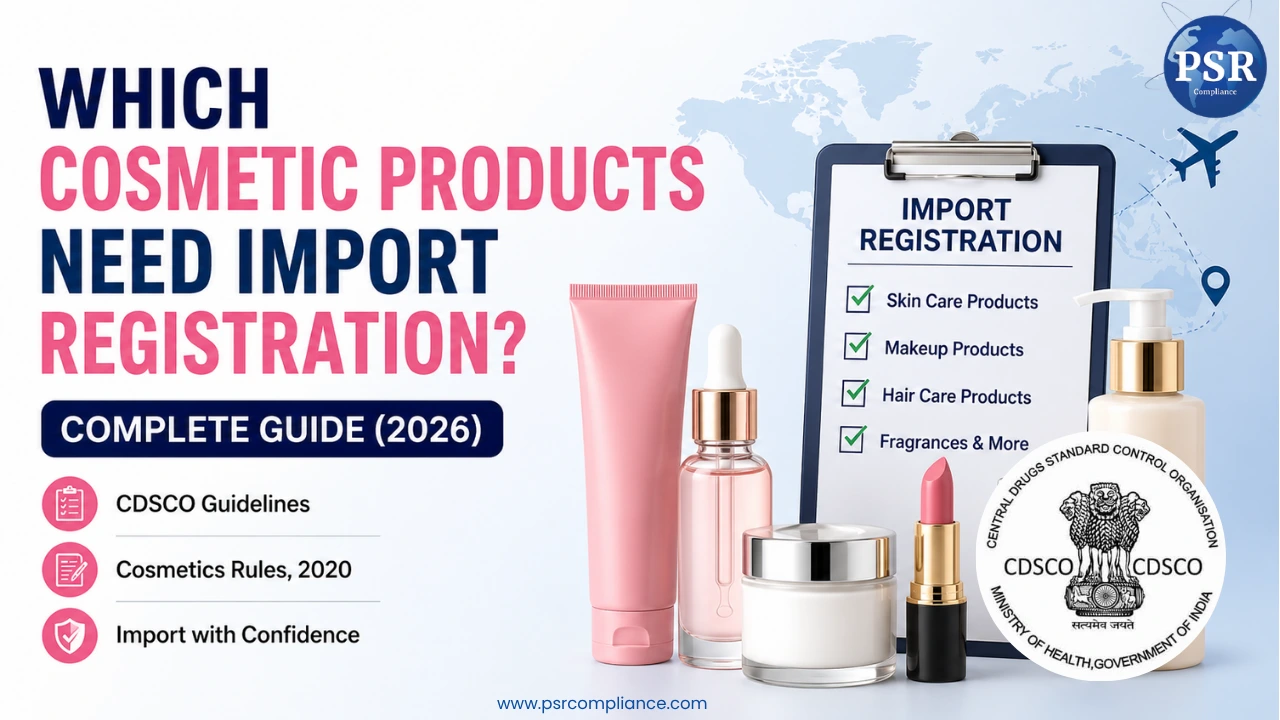
Which Cosmetic Products Need Import Registration?
| Category | Examples of Cosmetic Products |
|---|---|
| Skin Care Products | Face cream, moisturizer, night/day cream, anti-ageing cream, face serum, face mask, sunscreen, skin brightening cream, toner, cleanser, facial scrub |
| Makeup Products | Lipstick, lip balm, lip gloss, foundation, compact/loose powder, concealer, blush, highlighter, eye shadow, mascara, eyeliner, kajal, makeup primer, makeup fixer |
| Hair Care Products | Shampoo, conditioner, hair oil, hair serum, hair cream, styling gel, hair spray, hair wax, hair mousse, hair colour, hair dye |
| Personal Care Products | Body lotion, body butter, body wash, shower gel, hand cream, foot cream, talcum powder, deodorant, roll-on deodorant, perfumed body mist |
| Fragrances and Perfumes | Perfumes, Eau de Parfum, Eau de Toilette, body sprays, fragrance mists, cologne |
| Nail Care Products | Nail polish, nail polish remover, nail strengthener, nail treatment products, cuticle oil |
| Men's Grooming Products | Shaving cream, after-shave lotion, beard oil, beard balm, beard shampoo, beard conditioner, grooming cream |
| Baby Care Cosmetics | Baby lotion, baby shampoo, baby oil, baby cream, baby powder, baby body wash (subject to additional regulatory scrutiny) |
Restricted Ingredients and Testing Requirements
Even if your product is approved for sale elsewhere, it may not qualify for import into India. Two restrictions catch importers off guard most often:
- No animal testing. Cosmetics tested on animals cannot be imported into India — this applies regardless of where the testing happened or whether it's required in the country of origin.
- Restricted ingredients. Products containing hexachlorophene or heavy metals such as arsenic, lead, or mercury are prohibited.
Both of these should be checked against your product's formulation early — reformulating after a shipment is stopped at customs is far more expensive than checking upfront.
Why a Foreign Manufacturer Usually Needs an Indian Point of Contact
If you manufacture cosmetics outside India, you generally can't just ship and register directly — the application must be filed by one of the following:
- The manufacturer themselves (less common in practice)
- An authorized agent appointed in India
- An India-based importer
- An authorized Indian subsidiary of the manufacturer
This Indian entity is the one CDSCO corresponds with, and it's responsible for maintaining accurate registration details (including its own registered address — CDSCO does verify this; see the enforcement example below). Getting this structure right at the start avoids delays and future compliance headaches.
How to Identify Whether Your Product Needs Registration
Ask these four questions:
- Is the product manufactured outside India?
- Does it fall under the legal definition of a "cosmetic"?
- Is it being imported for commercial sale or distribution?
- Will it reach the market through retailers, distributors, or online marketplaces?
If the answer to all four is yes, you should assume registration applies and confirm the specifics before shipping. Products imported strictly for personal use, testing, or research may be treated differently — but if there's any commercial intent, don't assume an exemption without checking.
Who Should Apply for Cosmetic Import Registration?
- Cosmetic importers and trading companies
- International cosmetic brands entering India
- Indian distributors and authorized agents
- E-commerce businesses importing cosmetics for online sale
- Beauty product wholesalers and retail chains carrying foreign brands
If you're planning to bring imported cosmetics into India, registration should be part of your launch planning — not something you deal with after the shipment is already at port.
Why It Matters
- Legal import — you're operating within the actual regulatory framework, not around it
- Smoother customs clearance — registered products move through port checks faster
- Consumer trust — Indian buyers increasingly recognize and expect compliance
- Lower compliance risk — avoids the cost and disruption of enforcement action later
- Stronger brand reputation — compliance signals a serious, long-term market presence
What Happens If You Skip It
Importing or selling unregistered cosmetics is an offense under the Drugs and Cosmetics Act, 1940. Consequences can include consignment seizure or destruction at port, monetary penalties, and suspension or cancellation of any existing registration. CDSCO has also shown it will act on address and identity discrepancies, not just missing paperwork — in January 2026, CDSCO cancelled an import registration certificate for a hair-colour cosmetics importer after a complaint led to verification showing the registered firm wasn't actually operating from its declared address. Enforcement isn't hypothetical; keeping your registration details accurate and current matters as much as getting registered in the first place.
Common Mistakes Cosmetic Importers Should Avoid
- Assuming foreign approval is enough — approval elsewhere doesn't carry over to India
- Importing before checking registration requirements — placing orders first and figuring out compliance later
- Incorrect product classification — misclassifying a product delays the whole application
- Incomplete documentation — the single biggest cause of processing delays
- Ignoring regulatory updates — CDSCO issues new circulars and advisories regularly; what applied last year may have changed
- Letting registered details go stale — not updating CDSCO on changes to address, ownership, or manufacturing site
Documents Generally Required
- Details of the foreign manufacturer and manufacturing site
- Product information and specifications
- Product label artwork
- Manufacturing licence
- Power of Attorney (authorizing the Indian agent/importer to act on the manufacturer's behalf)
- Importer details
- Ingredient information
- Free Sale Certificate from the country of origin (typically notarized/apostilled or attested by the Indian Embassy)
- Declaration of compliance
- Other supporting documents as required by the Central Licensing Authority
Step-by-Step Cosmetic Import Registration Process
- Review your products — confirm which items in your catalog actually require registration.
- Collect documentation — assemble all technical and regulatory documents listed above.
- File Form COS-1 on CDSCO's SUGAM portal, through the manufacturer, an authorized agent, an importer, or an authorized Indian subsidiary.
- Regulatory review — CDSCO's Central Licensing Authority examines the application and supporting documents.
- Respond to queries — if CDSCO asks for clarification or additional documents, respond promptly to avoid delays.
- Receive Form COS-2 — the Import Registration Certificate, valid for 5 years, allowing the registered product(s) to be legally imported.
Registration Validity, Fees, and Timeline
These are the three questions every importer asks first — and the ones worth planning around before you commit to an order:
| Details | |
|---|---|
| Validity | The Import Registration Certificate (COS-2) is generally valid for 5 years from the date of issue, unless suspended or cancelled. Some CDSCO guidance also allows continued validity beyond that through a periodic retention fee — confirm the current position for your product on CDSCO's portal, since this detail is applied case by case. |
| Fees | Indicative CDSCO fees run around USD 1,000 per product category, USD 50 per additional variant, and USD 500 per manufacturing site. Fees are revised periodically, so treat this as a planning estimate, not a quote. |
| Timeline | Approval can take up to 180 working days under the current Cosmetics Rules framework, though actual time depends heavily on documentation completeness and how quickly you respond to CDSCO queries. |
Why Choose PSR Compliance?
Cosmetic import regulation gets complicated fast, especially for businesses handling multiple product categories or working with manufacturers who've never dealt with Indian compliance before. PSR Compliance provides end-to-end support with:
- Imported Cosmetics Registration Certificate (COS-1/COS-2) filing
- CDSCO documentation and dossier preparation
- Product and ingredient compliance review
- Regulatory consultation and application strategy
- Registration renewal and retention support
Get Expert Help with Cosmetic Import Registration
Importing beauty or personal care products into India? PSR Compliance provides complete assistance with Cosmetic Import Registration, CDSCO Registration, COS-1 & COS-2 filing, product dossier preparation, ingredient compliance review, Free Sale Certificate attestation support, and registration renewal — across Noida and India.
📞 Call: +91 8796104190
📧 Email: support@psrcompliance.com
Frequently Asked Questions
Q1. Which cosmetic products require import registration in India?
Most cosmetics manufactured outside India and imported for commercial sale, distribution, or marketing require Cosmetic Import Registration under the Cosmetics Rules, 2020. This includes skincare products, makeup, hair care products, personal care items, fragrances, nail care products, men's grooming products, and baby cosmetics.
Q2. Is import registration mandatory for all imported cosmetics?
Yes, import registration is mandatory for cosmetics imported into India for commercial sale or distribution. There are no general exemptions based on the product category or brand. However, cosmetics imported solely for personal use, testing, or research may be subject to different regulatory provisions. Businesses should always verify the applicable requirements before importing products.
Q3. Who issues the Cosmetic Import Registration Certificate?
The Central Licensing Authority (CLA) under the Central Drugs Standard Control Organization (CDSCO), headed by the Drugs Controller General of India (DCGI), issues the Cosmetic Import Registration Certificate in Form COS-2. Applications must be submitted online in Form COS-1 through the CDSCO SUGAM Portal.
Q4. How long is the Cosmetic Import Registration valid?
The Cosmetic Import Registration Certificate is generally valid for five years from the date of issue, provided the importer continues to comply with the applicable regulations. In some cases, payment of a retention fee may also be required to keep the registration active.
Q5. How much does Cosmetic Import Registration cost?
As a general estimate, the government fee is approximately USD 1,000 per product category, USD 50 for each product variant, and USD 500 for each manufacturing site. Since the fee structure may be revised from time to time, applicants should verify the latest fees before submitting their application.
Q6. How long does the registration process take?
The registration process can take up to 180 working days under the current regulations. However, the actual timeline depends on the completeness of the submitted documents and how quickly the applicant responds to any queries raised by CDSCO.
Q7. Are there any banned ingredients or testing practices?
Yes. India prohibits the import of cosmetics that have been tested on animals. In addition, cosmetics containing hexachlorophene or excessive levels of arsenic, lead, mercury, or other prohibited heavy metals are not permitted for import or sale in India.
Q8. Does shampoo or hair oil require import registration?
Yes. Imported shampoo, hair oil, conditioner, hair serum, hair colour, and other hair care products require Cosmetic Import Registration if they are intended for commercial sale or distribution in India.
Q9. Can online sellers import foreign cosmetics without registration?
No. Selling cosmetics through e-commerce platforms does not exempt products from registration requirements. Imported cosmetics must obtain the required CDSCO registration before they are listed or sold online in India.
Q10. What happens if I sell unregistered imported cosmetics?
Selling unregistered imported cosmetics may lead to regulatory action by CDSCO, including seizure or destruction of the products, financial penalties, suspension or cancellation of registrations, and other legal consequences. Authorities may also take action if registration details are inaccurate or misleading.
Q11. Can PSR Compliance help with Cosmetic Import Registration?
Yes. PSR Compliance assists businesses throughout the Cosmetic Import Registration process, including product eligibility assessment, preparation of documents, filing Form COS-1, coordination with CDSCO, responding to regulatory queries, obtaining the registration certificate, and supporting renewals and ongoing compliance.