
Just send us your questions or concerns by starting a new case &
we will give you the help you need. Start Here...
Trademark Registration
Sat, Aug 29 2026
Raju Karn
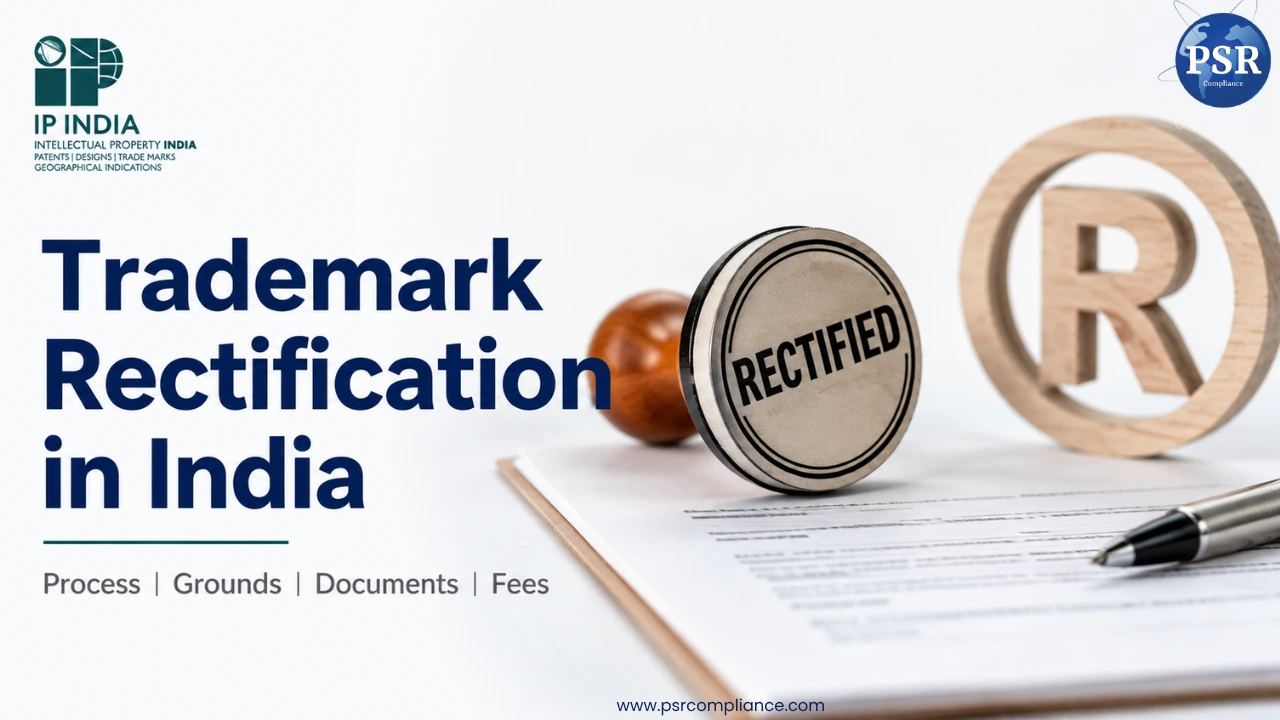
Trademark Rectification in India: Process, Grounds, Documents & Fees
A registered trademark is one of the assets for a business, but merely because it is registered, it does not automatically mean that the entry in the Register is correct or is legally valid. Mistakes, incorrect entries, lack of use, or non-compliance with statutory requirements may lead to difficulties for the registered proprietor or any other interested party. In such cases, rectification of trademarks is available as an option to correct, vary or cancel an entry made in the Register of Trade Marks.
The importance of accurate trademark records has increased due to the rapidly growing intellectual property system in India. As per the Office of the Controller General of Patents, Designs & Trade Marks (CGPDTM), 5,52,190 trademark applications were filed during 2024-25, compared to 4,76,089 during 2023-24. In addition, 3,82,834 trademarks have been registered during 2024-25.
This article discusses trademark rectification in India, its meaning, procedure, grounds, documentation, and government fees related to rectification of trademarks in India.
What Is Trademark Rectification in India?
Trademark Rectification is a process through which an entry in the Register of Trade Marks is altered or deleted. The process derives its primary authority from Section 57 of the Trade Marks Act, 1999.
Section 57 of the Act provides that a person aggrieved by any erroneous or unnecessary entry or defect in law relating to an entry may make an application to the Registrar or the concerned High Court.
The provision covers entries made without sufficient cause, entries that wrongly remain on the Register, and errors or defects in an entry. The remedy is different from a normal trademark registration process.
Registration protects the brand, whereas rectification concerns the issue of the correctness of the existing record.
Why Is Rectification Important?
A wrong record of a trademark will affect businesses in many ways. It could create confusion within the market, infringe on the rightful brand owner, or make it impossible to register a similar trademark.
Trademark Rectification in India can become relevant when:
- A registered mark was entered without sufficient legal basis.
- A trademark remains registered despite circumstances that justify its removal.
- Information in the Register contains an error or defect.
- A condition attached to registration has been breached.
- A registered trademark has not been genuinely used as required by law.
- The registration should be varied or cancelled under the applicable provisions.
Because the Register is a public record, maintaining accurate entries is important for the wider trademark system.
Grounds for Trademark Rectification in India
A registered trademark in India can be rectified, modified, or canceled on several distinct legal grounds:
1. Entry Made Without Sufficient Cause
Section 57 allows an aggrieved person to challenge an entry made without sufficient cause. This can apply where the registration should not have been granted because of legal or factual circumstances that undermine its validity.
2. Wrongful Continuation of a Trademark
A mark may be challenged if it wrongly remains on the Register. This ground can become particularly relevant where statutory requirements for continued registration are no longer satisfied.
3. Error or Defect in the Register
A rectification application can seek correction where there is an error or defect in an entry. This is important because incorrect proprietor details, specifications or other material information can create practical and legal difficulties.
4. Non-Use of a Registered Trademark
The problem of non-use is yet another significant matter concerning trademarks. The topic of non-use is covered by section 47, which speaks about the de-registration of the trademark from the Register due to its non-use. A rectification claim can thus be linked with the matter of the non-use of the trademark. This is one reason why businesses should maintain proper records of commercial use, invoices, advertisements and other evidence relating to their brands.
5. Breach of a Condition
Section 57 also permits Trademark cancellation or variation where there has been a contravention or failure to observe a condition entered on the Register in relation to the trademark.
Who Can File a Trademark Rectification Application?
The law generally requires the applicant to be a person aggrieved. This means the applicant must have a genuine interest affected by the continued presence, absence or incorrect form of the trademark entry.
A person considering the proceeding should therefore establish a clear connection between the challenged registration and the rights or commercial interests being affected. The Registrar or High Court can decide questions that are necessary or relevant to the rectification of the Register.
Trademark Rectification Process in India
The procedure is governed by the Trade Marks Act, 1999 and the Trade Marks Rules, 2017.
Step 1: Identify the Legal Ground
The first step is to identify why the trademark entry should be corrected, varied or removed. The application should not rely on general objections. The facts must correspond to a recognised legal ground. A review of the registration record, trademark history and available evidence can help establish the appropriate basis.
Step 2: Collect Supporting Evidence
The applicant should collect documents that demonstrate the facts behind the claim. Evidence can include registration records, commercial documents, correspondence, marketplace evidence, search results and proof relating to use or non-use. The strength of the evidence can have a major impact on the proceeding.
Step 3: File Form TM-O
According to Rule 97 of the Trade Marks Rules, 2017, a request for rectification or cancellation of a trade mark under applicable laws such as Section 57 would be filed using Form TM-O. It shall be accompanied by a statement detailing the interest of the applicant, the facts and the reliefs sought.
Step 4: Notice to the Registered Proprietor
The Registry ordinarily transmits a copy of the application and statement to the registered proprietor and relevant registered users or other interested persons shown on the Register.
Step 5: Counterstatement
Under Rule 98, the registered proprietor generally has two months from receipt of the application to submit a counterstatement. A further period of up to one month may be available in aggregate, subject to the rule. If no counterstatement is filed within the applicable period, the rectification applicant may proceed with evidence in support.
Step 6: Evidence and Hearing
The parties may submit evidence according to the prescribed procedure. Depending on the matter, the Registrar may provide an opportunity for a hearing before deciding the case.
The evidence should directly support the pleaded grounds rather than simply repeat the allegations made in the application.
Step 7: Decision and Rectification
Following consideration of the pleadings, evidence, and arguments, the competent body may allow or disallow the application. Where rectification is allowed, the appropriate entry can be either deleted, amended, or modified.
Where the High Court orders rectification, Section 57 requires notice of the rectification to be served on the Registrar, who then rectifies the Register accordingly.
Documents Required for Trademark Rectification
The exact documents depend on the facts and grounds of the case. Common documents include:
- Form TM-O and the statement of case.
- Details and copy of the challenged trademark registration.
- Applicant's identity and address documents.
- Proof establishing the applicant's interest in the matter.
- Trademark search or Registry records.
- Registration certificate or available registration details.
- Evidence of use or non-use, where relevant.
- Invoices, purchase orders and sales records.
- Advertisements, catalogues and promotional material.
- Website and social media evidence.
- Affidavits and supporting statements.
- Correspondence or legal notices relevant to the dispute.
- Authorisation or power of attorney, where an agent represents the applicant.
The documents should be consistent with the facts pleaded in the statement of case.
Trademark Rectification Fees in India
Government Fee shall be as per Trade Marks Rules, 2017. As per the present official fee schedule by IP India, the Application for rectification of the Register under Sections 47 to 57, 68 or 77 is made in Form TM-O.
The prescribed fee is currently:
| Filing method | Government fee |
| Physical filing | Rs. 3000 |
| E-filing | Rs. 2700 |
The fee is applicable for each class involved, as specified by the official fee schedule. Professional fees for legal or trademark assistance are separate from the government fee and depend on factors such as the complexity of the dispute, evidence required, and whether hearings or additional proceedings are involved.
Since official fees and procedural requirements can change, applicants should verify the latest information on the IP India official fee page before filing.
Trademark Rectification vs Trademark Opposition
Trademark rectification and opposition are often confused, but they occur at different stages.
A trademark opposition generally challenges a pending application after publication in the Trade Marks Journal. Under Rule 42, an opposition is filed in Form TM-O within four months from publication or republication.
Rectification, on the other hand, generally concerns an entry already appearing on the Register. Its purpose is to correct, vary or remove that entry based on legally recognised grounds.
Common Mistakes to Avoid
To ensure a smooth process and protect your interests, steer clear of these frequent pitfalls:
Filing Without Establishing Locus
A rectification applicant should clearly explain why they are an aggrieved person. A vague commercial interest may not be sufficient.
Using Weak Evidence
Claims of non-use, prior rights or incorrect registration should be supported with relevant documents and credible evidence.
Choosing the Wrong Legal Remedy
Rectification, opposition, review, cancellation and infringement proceedings serve different purposes. Selecting the wrong route can result in unnecessary delay and expense.
Ignoring Procedural Deadlines
Trademark proceedings involve prescribed timelines for counterstatements, evidence, and other filings. Missing a deadline can adversely affect the case.
Conclusion
Trademarks are not only protected during the application process but require monitoring by companies to ensure that they have accurate and legitimate trademarks. This becomes essential for any business in light of the fact that there are over 5.5 lakh trademark applications received in 2024-25 alone. A well-prepared rectification request should mention the statutory basis, the interest of the applicant, and the required evidence and procedural steps.
In case of any doubt about the registration of a trademark, early review may also help companies prevent future problems regarding their brands. Companies requiring help in filing trademarks and regulatory requirements in general can avail themselves of services offered by PSR Compliance.
Need Help With Trademark Rectification?
Facing an issue with a registered trademark or need assistance with Form TM-O, trademark rectification, cancellation, or removal? Our experts can help you understand the process and documentation.
Call us: (+91) 8796104190
Email us: support@psrcompliance.com
Get in touch with PSR Compliance for professional trademark assistance.
Frequently Asked Questions
1. What is the primary objective of Trademark Rectification?
The primary objective of Trademark Rectification is to rectify, modify, or delete the entry made in the register of trade marks if it is legally deficient, wrongly exists in the Register, contains an error, or falls within any other statutory ground.
2. What form should be used for filing an application for Trademark Rectification?
Form TM-O shall be used in connection with the application to rectify or delete the entry in respect of the trademark from the register as per Section 57. Rule 97 of the Trade Marks Rules, 2017 deals with this procedure.
3. What is the cost involved in trademark rectification?
The government fee at present stands at ₹2,700 for online filing and ₹3,000 for offline filing, wherein the fee is applicable for every class as per the official schedule. Fees charged by professionals are different from the government fees.
4. Can trademark registration be revoked due to non-use?
Yes. The Trade Marks Act has provisions for revocation based on non-use. Section 47 pertains to the provisions regarding revocation due to non-use.
5. Is trademark rectification the same as trademark infringement?
No. Rectification concerns the status or accuracy of a trademark entry on the Register. Trademark infringement concerns unauthorised use of a protected trademark and involves different legal considerations.