


Just send us your questions or concerns by starting a new case &
we will give you the help you need. Start Here...
Company Registration
Wed, Aug 19 2026
Raju Karn
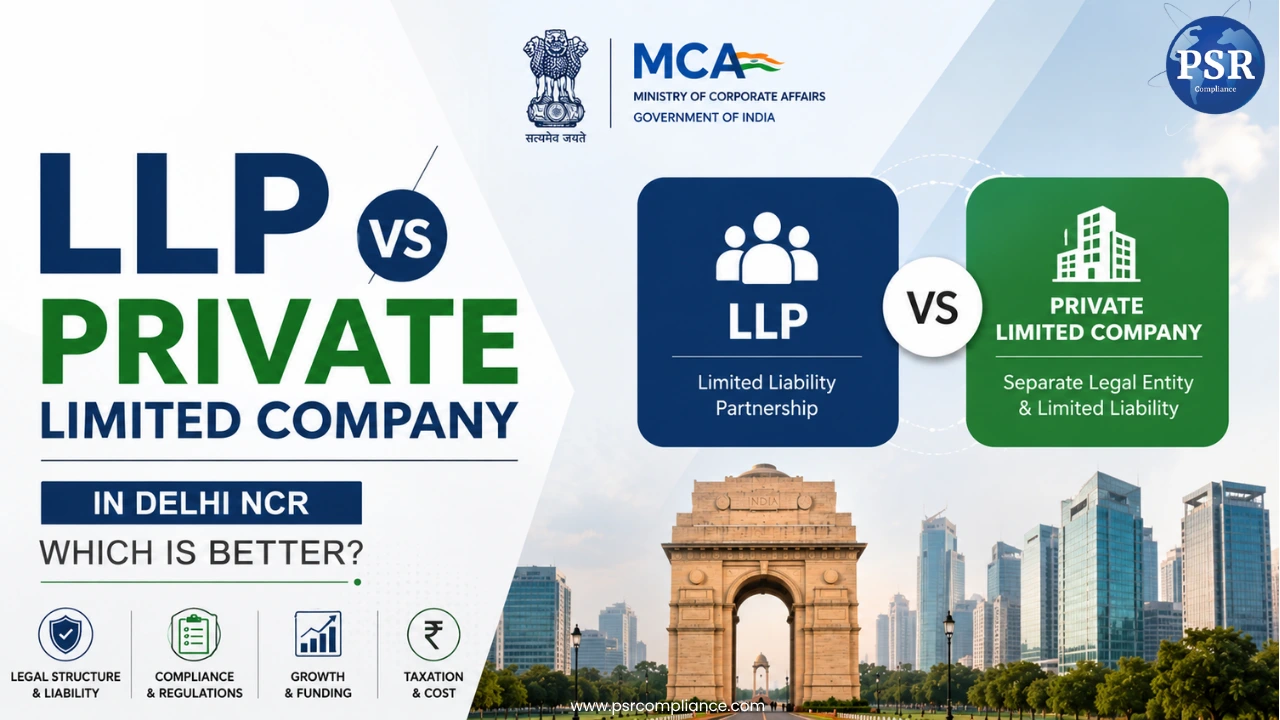
LLP vs Private Limited Company in Delhi NCR – Which Is Better?
Starting a business in Delhi, Noida, or Gurugram can be exciting, but choosing the right legal structure is one of the first major decisions you need to make. Two of the most common options for entrepreneurs are a Limited Liability Partnership (LLP) and a Private Limited Company.
Although both provide limited liability protection, their ownership structure, compliance requirements, taxation, funding options, and long-term suitability are different. This guide explains LLP vs Private Limited Company in simple terms so you can choose the structure that matches your business goals in Delhi NCR.
What Is an LLP?
LLP stands for Limited Liability Partnership. It combines features of a traditional partnership with the benefit of limited liability. An LLP is a separate legal entity from its partners, while the partners can directly participate in managing the business.
An LLP is often suitable for professional firms, consultancies, agencies, and other businesses where the founders want operational flexibility without the relatively higher compliance requirements associated with a Private Limited Company.
What Is a Private Limited Company?
A Private Limited Company is a separate legal entity owned by shareholders and managed by directors. The company has its own legal identity, separate from its members, and ownership is represented through shares.
This structure is widely used by startups and growing businesses because it provides a structured ownership model and is generally more suitable when founders plan to bring in investors, issue shares, create ESOPs, or scale the business significantly.
Private Limited Company vs LLP: Key Differences
The right choice depends on your business model, funding plans, number of founders, expected growth, and willingness to manage ongoing compliance. Here are the major differences you should consider before registration.
Ownership and Structure
An LLP is owned by its partners, who can also participate directly in managing the business. It does not have shareholders or share capital in the same way as a company.
A Private Limited Company has shareholders and directors, creating a more formal ownership and management structure. Since ownership is represented through shares, bringing in new investors or transferring ownership can generally be structured more easily. This makes a Private Limited Company attractive for startups planning to raise angel, venture capital, or other institutional investment.
Compliance Requirements
LLPs generally have fewer ongoing compliance requirements than Private Limited Companies. An LLP must meet applicable annual filing requirements and maintain its statutory records, while audit requirements depend on the applicable statutory thresholds and conditions.
Private Limited Companies have broader ongoing compliance obligations, which can include annual filings with the Registrar of Companies, maintenance of statutory records, financial statements, board-related compliance, and statutory audit requirements. Therefore, founders should consider not only the registration cost but also the recurring compliance workload before selecting the structure.
Taxation
Both LLPs and Private Limited Companies are subject to applicable income-tax rules, but their taxation mechanisms are different. An LLP is generally taxed on its income as an LLP, while a company is taxed according to the tax provisions applicable to companies.
Tax rates, deductions, exemptions, and startup-related benefits can change over time. Therefore, taxation should not be the only factor behind your decision. If tax treatment is a major concern, it is advisable to compare the structures based on your expected turnover, profitability, partner remuneration, dividend plans, and other business circumstances.
Funding and Investment
Funding is one of the biggest differences between an LLP and a Private Limited Company. A Private Limited Company can issue shares and is therefore generally preferred by angel investors, venture capital firms, and other institutional investors.
An LLP does not issue equity shares in the same manner as a company. While an LLP can receive investment subject to applicable laws and conditions, its structure may not be as convenient for businesses planning repeated equity fundraising. If raising external investment is part of your long-term business plan, a Private Limited Company is usually the more practical structure.
Liability Protection
Both LLPs and Private Limited Companies provide limited liability protection, meaning the business is legally separate from its owners or partners in accordance with applicable law.
However, limited liability is not an absolute shield. Personal guarantees, fraud, wrongful acts, statutory violations, or other circumstances can result in personal liability. Therefore, founders should maintain proper legal and financial separation between their personal and business activities.
Which One Should You Choose in Delhi NCR?
Delhi NCR includes a wide range of businesses, from small consulting firms and professional services in Delhi to technology startups in Gurugram and manufacturing businesses in Noida. The location itself should not determine whether you choose an LLP or Private Limited Company. Your business model and future plans should be the main deciding factors.
Choose LLP If...
An LLP may be suitable if:
- Your business is primarily service-based.
- You have two or more partners who will actively manage the business.
- You want comparatively lower ongoing compliance.
- You do not expect to raise significant equity funding.
- You prefer flexibility in managing the partnership.
- You want a separate legal entity with limited liability protection.
Choose Private Limited Company If...
A Private Limited Company may be more suitable if:
- You plan to raise funds from angel investors or venture capitalists.
- You want to issue shares to investors or co-founders.
- You plan to introduce ESOPs for employees.
- You want a structured corporate ownership model.
- You expect rapid business expansion.
- You want to build a business that may eventually pursue larger institutional opportunities.
For businesses with strong growth and fundraising ambitions, a Private Limited Company can be a more suitable structure for startup registration in India.
LLP vs Private Limited Company: Quick Comparison
| Factor | LLP | Private Limited Company |
|---|---|---|
| Ownership | Partners | Shareholders |
| Management | Partners | Directors |
| Minimum members | 2 partners | 2 shareholders and 2 directors |
| Equity shares | Not applicable like a company | Yes |
| Fundraising | Comparatively limited | More suitable for equity funding |
| Compliance | Generally lower | Generally higher |
| Statutory audit | Depends on applicable conditions/thresholds | Generally required annually |
| Suitable for | Service firms and professional businesses | Startups and growth-focused businesses |
| ESOPs | Not structured like a company | Can be structured |
| Scalability | Suitable for many small and medium businesses | Strong option for high-growth businesses |
Registration Process Overview
Both LLP and Private Limited Company registration can be completed through the Ministry of Corporate Affairs (MCA) online system. The exact process and timeline depend on document readiness, name availability, government processing, and whether any clarification or resubmission is required.
The broad process generally includes:
- Obtain Digital Signature Certificates (DSCs) for the required individuals.
- Obtain or apply for the applicable DIN/DPIN.
- Select and reserve an appropriate business name.
- Prepare and submit the incorporation application and supporting documents.
- Submit the LLP Agreement for an LLP or the MOA and AOA for a Private Limited Company, as applicable.
- Receive the Certificate of Incorporation after approval.
- Complete applicable PAN and TAN formalities.
- Open a current bank account and complete other post-incorporation compliances.
Most of the process can be handled online. Common causes of delays include incorrect documents, name objections, mismatched information, incomplete forms, and failure to respond to MCA queries within the required period.
Cost Comparison: LLP vs Private Limited Company
The overall cost of forming and maintaining an LLP or Private Limited Company depends on factors such as government fees, professional fees, state-specific stamp duty, authorized capital, number of partners or directors, and ongoing compliance requirements.
An LLP can generally have a lower recurring compliance burden, particularly for smaller businesses that do not fall under applicable audit requirements. A Private Limited Company usually involves more ongoing statutory compliance, including annual filings and audit-related requirements.
However, the cheapest structure is not always the best structure. If you expect to raise funding, add investors, issue ESOPs, or scale rapidly, the additional compliance associated with a Private Limited Company may be justified by the flexibility it provides for future growth.
LLP vs Private Limited Company for Startups
For a startup in Delhi NCR, the decision should be based on the next three to five years of business plans, not only the current stage.
If you are starting a small consultancy with a few partners and do not expect external investment, an LLP may provide the flexibility you need. On the other hand, if you are building a technology startup, consumer brand, SaaS business, or other scalable venture where external investment is expected, a Private Limited Company may be more appropriate.
Choosing the right structure at the beginning can reduce the need for restructuring later.
Can You Convert an LLP Into a Private Limited Company?
In certain circumstances, an LLP may be converted or restructured into another business structure subject to the applicable legal provisions and eligibility requirements.
Businesses sometimes start with an LLP because of its relatively flexible structure and later consider a company structure when they require equity investment or a more formal ownership arrangement. However, conversion is not something that should be assumed to be automatic. The applicable MCA rules, eligibility conditions, documents, and tax implications should be reviewed before proceeding.
Common Mistakes When Choosing Between LLP and Private Limited Company
Choosing Only on Registration Cost
Many founders select an LLP simply because the initial or recurring compliance cost may be lower. However, if the business later needs institutional funding, ESOPs, or a structured shareholding model, changing the structure can create additional work.
Ignoring Future Funding Plans
If you already know that you will approach angel investors or venture capital firms, consider the investment structure before registration. A Private Limited Company is generally better suited to equity-based fundraising.
Assuming LLP Has No Compliance
An LLP is not a compliance-free business structure. It has its own annual filings, accounting requirements, agreement-related obligations, and other statutory requirements.
Choosing a Private Limited Company Without Considering Compliance
A company can provide excellent scalability, but it also comes with greater ongoing compliance responsibilities. Founders should be prepared for annual filings, financial reporting, statutory audit requirements, and other applicable corporate compliances.
Conclusion
Choosing between an LLP and Private Limited Company in Delhi NCR is not about deciding which structure is universally better. It depends on your business model, number of founders, funding requirements, expected growth, compliance capacity, and long-term plans.
An LLP can be a practical choice for many service-based and partner-driven businesses that want flexibility and comparatively lower compliance. A Private Limited Company can be a stronger option for startups and businesses planning to raise investment, issue shares, create ESOPs, and scale significantly.
Before registering your business, evaluate where you want the business to be in the next few years—not just where it is today.
Get Professional Help With Company or LLP Registration
Confused about whether LLP or Private Limited Company registration is right for your business in Delhi NCR?
PSR Compliance can help you understand the applicable registration requirements, prepare the necessary documents, and complete the incorporation process correctly.
📞 Call: 8796104190
📧 Email: support@psrcompliance.com
Frequently Asked Questions
1. Is a Private Limited Company better than an LLP for a startup in Delhi NCR?
A Private Limited Company can be more suitable when a startup plans to raise equity funding, issue shares, offer ESOPs, or scale rapidly. An LLP may be more suitable for smaller or service-based businesses that do not expect institutional investment.
2. Can an LLP be converted into a Private Limited Company?
Conversion or restructuring may be possible subject to applicable laws, eligibility conditions, MCA requirements, and the specific circumstances of the LLP. Professional and legal advice should be taken before proceeding.
3. Which has less compliance: LLP or Private Limited Company?
An LLP generally has fewer ongoing compliance requirements than a Private Limited Company. However, an LLP still has mandatory statutory filings and other compliance obligations.
4. Can an LLP receive foreign investment?
Foreign investment in LLPs can be permitted subject to applicable foreign exchange regulations, sectoral conditions, eligibility requirements, and other applicable rules. The route and conditions should be checked for the specific business.
5. How many people are required to form an LLP?
An LLP requires at least two partners. There is no maximum limit on the number of partners, subject to applicable legal requirements.
6. How many people are required to form a Private Limited Company?
A Private Limited Company generally requires at least two members/shareholders and two directors. A private company can have up to 200 members, subject to the Companies Act and applicable conditions.
7. Which is cheaper: LLP or Private Limited Company?
An LLP may have a comparatively lower compliance burden and cost for many small businesses. However, the actual cost depends on government fees, stamp duty, professional fees, audit requirements, turnover, and other factors.
8. Can I raise funding through an LLP?
An LLP can receive certain forms of investment subject to applicable laws, but it does not issue equity shares in the same way as a Private Limited Company. Businesses specifically targeting equity-based angel or venture capital funding generally consider a Private Limited Company more suitable.