

Just send us your questions or concerns by starting a new case &
we will give you the help you need. Start Here...
LLP Registration
Wed, Aug 26 2026
Raju Karn
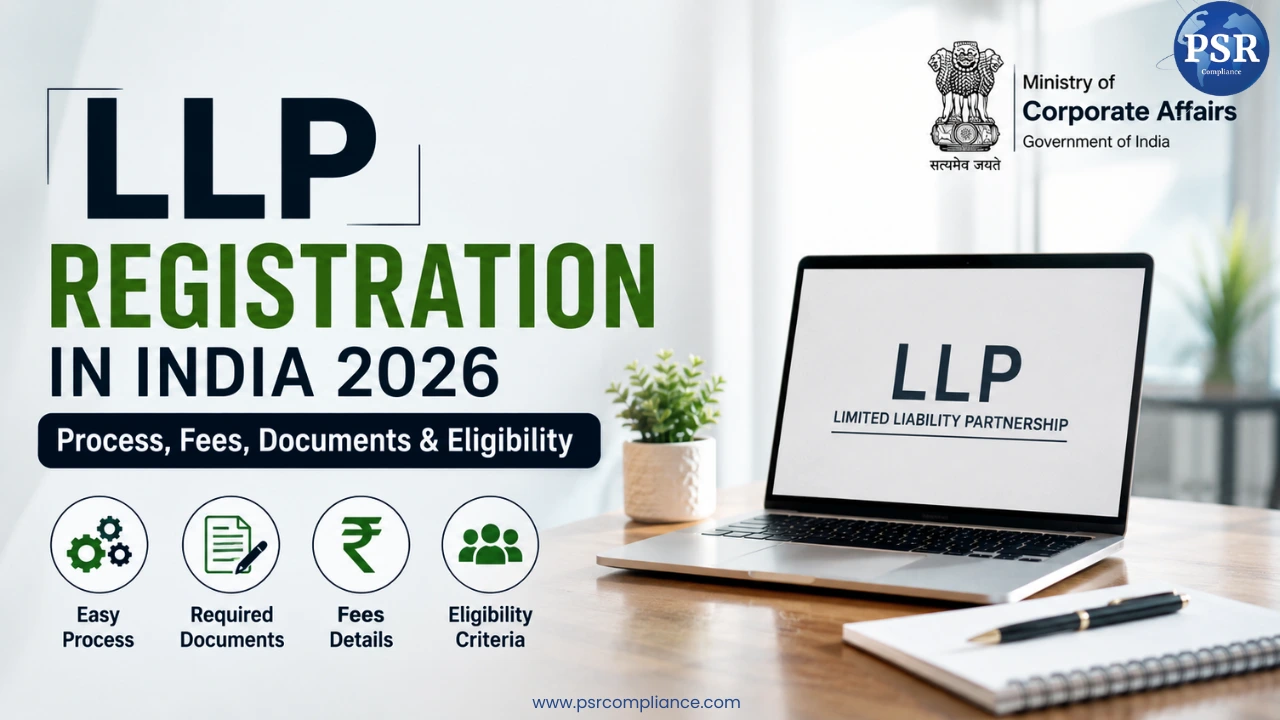
LLP Registration in India 2026: Process, Fees, Documents & Eligibility
Starting a business in India implies deciding on the legal structure of your firm to be able to provide yourself with liability protection, compliance, tax-related and other advantages. If you are starting a business and want to get limited liability but do not want to establish a private limited company, then a Limited Liability Partnership (LLP) will suit you.
LLP Registration in India is carried out through the Ministry of Corporate Affairs (MCA). The legal regulation of an LLP is mainly based on the Limited Liability Partnership Act, 2008, and LLP Rules, 2009. The process of incorporation of LLPs in India in 2026 is conducted mostly online through the MCA website, using the FiLLiP form for incorporation and name reservation.
This guide covers the LLP registration procedure, its eligibility criteria, required documents, fees, cost estimates, and other requirements after registration.
What Is an LLP?
A Limited Liability Partnership combines features of a traditional partnership and a company. It is a separate legal entity, while its partners generally receive limited liability protection.
As opposed to a normal partnership firm, an LLP can insulate the personal property of the partners from the business liabilities of the LLP firm. In addition, LLPs are more flexible when managing the business compared to a company.
An LLP does not have a prescribed minimum capital contribution. The partners can decide the contribution according to the requirements of the business. Invest India also confirms that there is no minimum capital requirement for forming an LLP.
Who Is Eligible to Register an LLP in India?
The basic LLP registration eligibility requirements are straightforward.
Minimum Two Partners
At least two partners are required to form an LLP. There is no prescribed maximum limit on the number of partners.
Designated Partners
An LLP must have at least two designated partners. At least one designated partner must be a resident in India. MCA guidance specifically requires details of a minimum of two designated partners, with at least one being resident in India.
Individuals and Body Corporates
Individuals can become partners or designated partners, subject to the applicable requirements. A body corporate can also participate as a partner through an authorised nominee.
Valid Business Purpose
The proposed LLP should be formed for a lawful business or professional purpose. The proposed name must also satisfy MCA naming requirements and should not conflict with an existing company, LLP, or registered trademark.
Documents Required for LLP Registration
Preparing accurate documents before filing can reduce delays and objections. The documents required for LLP registration generally include the following:
Documents of Partners
- PAN card of each partner
- Aadhaar card or another acceptable identity document
- Address proof
- Passport-size photograph
- Email address and mobile number
- Digital Signature Certificate (DSC), where required
PAN verification is particularly important during the MCA filing process. The FiLLiP instruction kit provides for PAN verification and allows certain information to be fetched through DigiLocker.
Registered Office Documents
The proposed registered office generally requires:
- Address proof of the premises
- Recent utility bill
- Lease agreement
- No objection certificate (NOC) issued by the property owner, if any
The specific documents may differ depending upon whether the premises are owned, rented, or any other type of arrangement.
Other Information
The incorporation application may also require details about the proposed LLP, business activity, contribution of partners, and proposed profit-sharing ration. Foreign nationals and NRIs may have additional documentation and authentication requirements.
LLP Registration Process in India
The LLP registration process is completed through the MCA portal. The process can broadly be divided into the following stages.
1. Obtain Digital Signature Certificates
Designated partners who are required to sign electronic MCA forms need valid Digital Signature Certificates. DSCs authenticate documents filed electronically.
2. Select and Check the LLP Name
The proposed name should be distinctive and compliant with MCA naming rules. An applicant can use the MCA name reservation mechanism where required. MCA's guidance also provides a facility for searching existing company and LLP names to identify similar names before submission.
3. File FiLLiP
FiLLiP is the MCA form used for the name reservation and incorporation of an LLP. It captures information about the proposed LLP and its designated partners. For individuals who do not already have a DIN/DPIN, the relevant details can be provided through the incorporation process. MCA's FiLLiP instruction kit specifically includes fields for designated partners who do not have an existing DIN/DPIN.
4. Submit the Required Documents
The required identity, address, registered-office and incorporation documents are attached to the application. Where applicable, professional certification and digital signatures must also be provided.
5. Pay MCA Government Fees
The government filing fee depends mainly on the total contribution proposed by the partners. The MCA fee schedule provides different slabs based on contribution.
6. Receive the Certificate of Incorporation
Once the Registrar is satisfied that the requirements have been met, the LLP is registered and the Certificate of Incorporation is issued. MCA's incorporation guidance states that, after submission of complete documents, the Registrar can register the LLP within the prescribed period and issue the incorporation certificate.
7. Execute and File the LLP Agreement
After incorporation, the partners should execute the LLP Agreement. The agreement establishes important commercial terms, including contribution, profit-sharing, partner responsibilities and management rights.
The agreement must be filed with the MCA in the prescribed form within the applicable time limit. Current 2026 guidance continues to identify Form 3 as the filing used for the LLP Agreement.
LLP Registration Fees in India in 2026
One of the most important considerations for founders is the LLP registration fees. The final cost is not limited to the MCA incorporation fee. According to the MCA fee schedule, the basic incorporation fee is linked to the partners' contribution. The principal slabs include:
| Total contribution | Basic incorporation fee |
| Up to ₹1 lakh | ₹500 |
| Above ₹1 lakh to ₹5 lakh | ₹2,000 |
| Above ₹5 lakh to ₹10 lakh | ₹4,000 |
| Above ₹10 lakh | ₹5,000 |
The total setup cost can also include name reservation charges, DSC charges, stamp duty on the LLP Agreement and professional fees. The MCA fee schedule lists ₹200 for an application for reservation of an LLP name.
What Determines the Total Cost?
The final LLP registration cost in India can vary because of:
- Number of designated partners
- DSC charges
- Partner contribution
- State-specific stamp duty
- Professional or consultant fees
- Additional registrations required for the business
Therefore, a quoted package price should not be confused with the statutory MCA fee. Current professional estimates commonly place the overall cost for a small LLP in the range of several thousand rupees, but the actual amount depends on the state and services selected.
How Long Does LLP Registration in India Take?
The timeline for LLP Registration in India depends on name approval, document accuracy, DSC issuance, MCA processing and whether an application receives an objection or resubmission request.
Recent 2026 professional guidance estimates that straightforward applications can often be completed within approximately one to three weeks, although the actual MCA processing period can vary.
Incorrect names, mismatched KYC information, unclear office documents or incomplete attachments can extend the timeline.
What Happens After LLP Incorporation?
LLP Registration in India is only the beginning of an LLP's legal compliance responsibilities.
Annual Return
Every LLP is required to file an annual return in Form 11. MCA's Form 11 instruction kit confirms that every LLP must file its annual return with the Registrar within the prescribed period.
Statement of Account and Solvency
The LLP must also meet the applicable requirements relating to its Statement of Account and Solvency.
Income Tax Return
An LLP must file its income tax return even when it has no income or has incurred a loss. The Income Tax Department states that LLPs file their income tax return using ITR-5.
GST and Other Registrations
GST registration may be required depending on turnover, business activity and applicable rules. Other registrations or licences may also apply depending on the nature of the business.
Why Is LLP a Suitable Business Structure?
An LLP can be particularly useful when the founders want a combination of flexibility and liability protection.
Key advantages include:
- Separate legal identity
- Limited liability protection
- No prescribed minimum capital
- Flexible internal management
- Lower structural complexity than many company forms
- Suitable for professional and service-based businesses
However, an LLP may not be ideal for every startup. Businesses planning substantial equity investment or venture capital funding may prefer a private limited company because of its share-based ownership structure.
Common Mistakes to Avoid During LLP Registration in India
Several avoidable mistakes can delay incorporation. Below are the common mistakes to avoid during LLP registration in India.
Choosing a Similar Name
A proposed name that resembles an existing company, LLP or trademark can create objections.
Incorrect Partner Details
PAN, Aadhaar and other KYC details should match the information available in official records.
Ignoring Registered Office Requirements
An incomplete address proof or missing NOC can result in queries during processing.
Delaying the LLP Agreement
The LLP Agreement is a crucial document because it defines the relationship between partners. It should be prepared carefully and filed within the applicable period.
Treating Registration as Complete Compliance
Incorporation does not remove ongoing filing obligations. Annual returns, financial statements and income tax compliance remain important after LLP Registration in India.
Conclusion
An LLP can be considered a viable option for those companies who are looking for limited liability along with flexible management as well as simple registration. Nevertheless, registration goes beyond merely filling out an application. Partner KYC, selecting a name, registered office documentation, contribution, LLP Agreement and other statutory compliances must all be considered carefully.
For business firms interested in LLP Registration in India, a firm that is capable of handling compliance issues would be able to avoid filing errors and ensure compliance even after the business has been incorporated. Businesses can benefit from PSR Compliance.
FAQs
1. What is the minimum number of partners required for an LLP?
A minimum of two partners is required. An LLP must also have at least two designated partners, with at least one designated partner being resident in India.
2. Is there any minimum capital requirement for an LLP?
No prescribed minimum capital contribution is required to form an LLP. The partners can decide the contribution based on their business requirements.
3. How much does it cost to register an LLP in India?
The MCA incorporation fee starts at ₹500 for contribution up to ₹1 lakh. However, the total cost can be higher after adding name reservation, DSC, state stamp duty and professional charges.
4. Is an LLP required to file an income tax return?
Yes. The Income Tax Department states that every LLP must file its income tax return, irrespective of the amount of income or loss. LLPs generally use ITR-5 for this purpose.
5. What is the main incorporation form for an LLP?
FiLLiP is the MCA incorporation form used for LLP name reservation and incorporation. It captures key details of the proposed LLP and its designated partners.