
Just send us your questions or concerns by starting a new case &
we will give you the help you need. Start Here...
GACC Registration
Thu, May 28 2026
Raju Karn
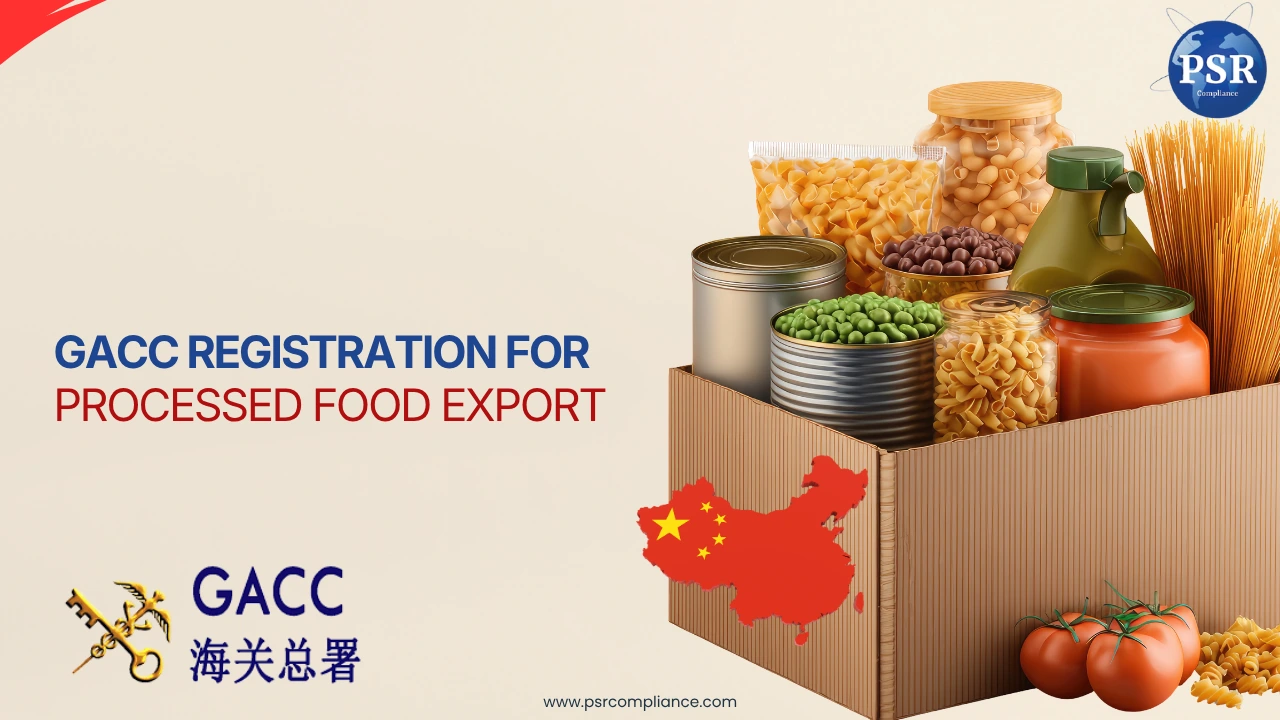
GACC Registration for Processed Food Export- Step by Step Guide (2026)
What is GACC Registration?
GACC stands for the General Administration of the People's Republic of China. It is China's main authority that controls what products can enter the country through customs. If you are a food manufacturer, processor, or storage facility outside China and you want to export food products to China, you must register with GACC. This is called GACC Registration or GACC Certification.
Without this registration, your shipment can be stopped at the Chinese border, returned, or even destroyed. So, getting your GACC registration done correctly and on time is extremely important for your business.
Important Update, New Rules from June 1, 2026
China has replaced the old registration rule (Decree No. 248) with a new regulation called GAC Decree No. 280, effective from June 1, 2026. This new rule brings several key changes for food exporters worldwide. If you are already registered under the old rule, your registration stays valid , but how you renew it and file customs declarations is now different.
Who Needs GACC Registration?
You need GACC registration if you are any of the following:
- A food manufacturer or processor exporting to China
- An agricultural or animal product producer
- A packaged food exporter (biscuits, snacks, chocolates, etc.)
- A seafood, dairy, meat, spices, or health food manufacturer
- A cold storage facility that stores land-animal-sourced foods or aquatic products before export
Food Categories Covered Under GACC Registration
| Category Type | Products Included | Registration Requirement |
|---|---|---|
| Meat Products | Meat and meat products | Official government recommendation required |
| Casings | Animal casings | Official government recommendation required |
| Bird’s Nest | Edible bird's nests and products | Official government recommendation required |
| Bee Products | Honey and bee-related products | Official government recommendation required |
| Egg Products | Eggs and egg products | Official government recommendation required |
| Edible Oils | Edible oils and fats | Official government recommendation required |
| Processed Foods | Stuffed pasta (like dumplings) | Official government recommendation required |
| Grains | Edible grains | Official government recommendation required |
| Grain Products | Grain milling products and malt | Official government recommendation required |
| Vegetables | Dehydrated vegetables | Official government recommendation required |
| Seasonings | Seasoning powders | Official government recommendation required |
| Nuts & Seeds | Nuts and seeds | Official government recommendation required |
| Dry Fruits | Dried fruits | Official government recommendation required |
| Special Foods | Foods for special dietary uses (like infant formula) | Official government recommendation required |
| Health Foods | Health foods | Official government recommendation required |
| Dairy Products | Milk and dairy products | Official government recommendation required |
| Seafood | Aquatic products (seafood) | Official government recommendation required |
| Other Processed Foods | Chocolates, packaged snacks, tea, candies, biscuits | Self-application through CIFER portal |
Three Registration Pathways , Which One Applies to You?
Under the new Decree No. 280, there are three ways to register with GACC:
Official Recommendation (For High-Risk Products)
This is for producers of the 17 high-risk categories listed above.
- You must first get an inspection by your home country's food safety authority (in India, this is FSSAI, EIA, MPEDA, or APEDA depending on your product)
- Get a recommendation letter from that authority
- Then apply directly to GACC yourself through the CIFER portal
Under the old rule, the government authority had to submit the application for you. Now you can submit it yourself after getting the recommendation , this saves time.
Self-Application (For Non-High-Risk Products)
This is for processed food exporters whose product does not fall in the 17 high-risk categories.
- Apply directly on the CIFER portal (https://cifer.singlewindow.cn)
- Submit the application form, your business identity documents, and a compliance declaration
- GACC may ask for additional details about your food safety systems and production capacity
This is simpler, faster, and used widely by mid-sized manufacturers of packaged food, snacks, chocolates, tea, and similar items.
List Registration (New in 2026)
This is a brand-new option only for countries that have a formal food safety agreement with China.
- The home country's government submits a batch list of companies to GACC
- Companies do not need to apply individually
- This makes the process much faster and lighter
Whether your country qualifies depends on bilateral agreements with China. Check with your national food safety authority to find out if this is available for you.
Eligibility Requirements for Indian Exporters
Before applying, make sure you have:
➜ A registered business entity (company, LLP, or partnership)
➜ A valid Import Export Code (IEC) from DGFT
➜ A FSSAI License (state or central , not just registration)
➜ Food safety certifications like HACCP, ISO 22000, FSSC 22000, or BRC
➜ A food traceability system in place (tracking raw materials to final product)
➜ Compliance with Chinese rules for pesticide residues, heavy metals, and microbiological limits
For seafood, dairy, and meat: an EIA or MPEDA permit
For grains, spices, or nuts: APEDA registration
Documents Required for GACC Registration
Gather these documents before starting your application:
Company & Legal Documents:
→ Certificate of Incorporation or Business Registration
→ Factory license or manufacturing registration
→ GST Registration Certificate
Product & Compliance Documents:
→ List of all products with HS Codes
→ Manufacturing process flowchart
→ Quality control procedures and safety management documents (HACCP/ISO 22000)
→ Product labels and packaging designs (must follow Chinese standards)
→ Lab test reports (pesticide residues, heavy metals, microbiological testing)
Facility Documents:
→ Factory layout/plant diagram
→ Production capacity details
→ Storage and hygiene control records
→ Pest control management plan and records
→ Inspection report from competent authority (for Pathway 1)
→ Phytosanitary certificate (for grains, nuts, dry fruits)
→ Veterinary health certificate (if required for your product)
For Pathway 1 High-Risk Products:
- → Recommendation letter from FSSAI/EIA/APEDA/MPEDA
- → Authority inspection report
GACC Registration Process (Step-by-Step Guide)
Step 1: Check Your Product Category
The first step in the GACC registration process is to identify your product category. You must check whether your product falls under the 17 high-risk categories or non-high-risk categories, as this decides your registration pathway under GACC rules.
Step 2: Prepare Your Compliance
Next, you must ensure your manufacturing unit complies with Chinese food safety requirements. This includes maintaining proper hygiene standards, HACCP or ISO 22000 systems, traceability mechanisms, pest control systems, and laboratory testing compliance.
Step 3: Gather Your Documents
In this step, collect all required documents such as company registration certificates, IEC, GST, product lists with HS codes, quality control records, lab test reports, factory layout, and other compliance-related documents needed for verification.
Step 4: Create an Account on the CIFER Portal
After preparing documents, you must create an account on the official CIFER portal (https://cifer.singlewindow.cn). This is the official GACC system where all foreign food manufacturers must register for exporting to China.
Step 5: Submit Your Application
Once the account is created, fill out the application form carefully and upload all required documents. If your product falls under the high-risk category, you must also upload recommendation letters and inspection reports from the concerned authority.
Step 6: GACC Review
After submission, GACC authorities will review your application. They may ask for additional information, clarifications, or even conduct a virtual or physical inspection depending on the product category and risk level.
Step 7: Get Your GACC Registration Number
Once your application is approved, GACC will issue a unique registration number. This number must be used on product packaging, customs documentation, and shared with your Chinese importer for smooth clearance of goods.
Registration Timeline and Validity
- Processing Time : 20 to 45 working days for most products; high-risk products may take 2 to 3 months
- Validity : 5 years from date of approval
- Renewal must be done before expiry to avoid suspension
Renewal Rules Under New Decree No. 280 (Important!)
Most food categories:
- Registration now auto-renews at the end of 5 years. You don't need to do anything.
Two categories require active renewal:
- Meat and meat products
- Edible bird's nests and products
For these two, you must apply for renewal between 3 and 12 months before your registration expires. If you miss this window, your registration lapses and you cannot export until you re-register , which could take months.
Auto-renewal might not happen if:
- Your company is currently under a rectification period due to food safety violations
- China has suspended imports from your country for that food category
- Your registration has been previously suspended, revoked, or cancelled
New Customs Declaration Requirements from June 1, 2026
- Registration Number , Enter your GACC registration number under "Product qualifications" using license category code: 519
- Purpose , Enter 食用 (meaning "edible / for human consumption") in the "Purpose" field under commodity filing
If either of these fields is missing or wrong, your shipment will be blocked at Chinese customs. Make sure your customs broker knows about these new requirements before June
Why Does GACC Registration Matters for Your Business?
Getting GACC registered is not just a legal requirement , it is a business opportunity. Here's why it matters:
✓ Access to 1.4 billion consumers , one of the world's biggest food markets
✓ No customs rejection or shipment destruction
✓ Build long-term relationships with Chinese importers, distributors, and retail chains
✓ Better brand reputation in the global market
✓ Eligibility for government incentives under APEDA, MPEDA, Tea Board, and Spices Board schemes
✓ Avoid penalties of up to ₹50 lakhs or more per non-compliant shipment
Common Reasons for GACC Rejection
⚠ Wrong or incorrect HS Code for your product
⚠ Incomplete manufacturing process details
⚠ Product labels not following Chinese standards
⚠ Missing quality control or food safety documents
⚠ Mismatch between factory details and application data
⚠ Poor formatting or translation errors in submitted documents
GACC Registration Fee
- FSSAI/EIA/APEDA inspection and processing fees (approx. ₹5,000 - ₹50,000)
- Lab testing costs for pesticide, heavy metals, and microbiological testing (approx. ₹10,000 - ₹1,00,000)
- Professional consultant fees if you hire an agency
Note : There is no official fee from GACC itself. Any website or agent charging you directly for the "registration" (not for their service fee) should be treated with caution.
Quick Checklist Before You Export to China
- Confirm if your product needs GACC registration
- Identify your pathway (Pathway 1, 2, or 3)
- Check if your existing registration is still valid and note the expiry date
- If you export meat or bird's nest products , calendar your renewal window now
- Ensure your product labels meet Chinese standards
- Gather all required documents and certifications
- Register on the CIFER portal: https://cifer.singlewindow.cn
- Update your customs declaration templates with the new code 519 and "食用" fields
- Brief your customs broker on the June 1, 2026 changes
Conclusion
GACC Registration is the gateway to one of the world's biggest food markets. Whether you export processed snacks, spices, grains, dairy, or seafood , you need to be registered with China's General Administration of Customs before your products can legally enter the country.
With the new rules under Decree No. 280 effective June 1, 2026, it is more important than ever to understand which pathway applies to you, keep your documents in order, and meet the new customs declaration requirements. The process is manageable if you plan ahead and prepare your paperwork carefully.
Start early, get your FSSAI/EIA/APEDA certifications in place, and make sure your factory meets food safety standards , and you will be well on your way to successfully exporting to China.
Need Help with GACC Registration 2026 Updated Step by Step?
Get expert assistance for GACC registration to export food products to China with complete compliance support. Our specialists handle the entire 2026 updated step-by-step process—from CIFER application to document preparation and approval—so your business stays fully compliant with China import requirements.
📞 Call: 8796104190
📧 Email: support@psrcompliance.com
Fast, accurate, and compliant support for smooth China food export approvals.
FAQs on GACC Registration for Processed Food Exports to China
1. Who needs GACC registration for exporting food to China?
GACC registration is mandatory for overseas food manufacturers, processors, and storage facilities that export food products to China. Trading companies or brand owners alone cannot register unless they are also the actual manufacturer. If production is outsourced, the contract manufacturing facility must complete the registration.
2. Is GACC registration required for both manufacturers and exporters?
Yes, but the responsibility lies with the manufacturer, processor, or cold storage facility. Exporters and traders can facilitate shipments, but the registered entity must be the actual production or storage unit involved in handling the food product.
3. What is the difference between high-risk and low-risk GACC food categories?
GACC divides food products into specified (high/medium-risk) and unspecified (low-risk) categories. High-risk products such as meat, dairy, seafood, and edible oils require government recommendation from the exporting country authority. Low-risk products like biscuits, beverages, and certain processed foods can be registered directly through the CIFER portal.
4. Which platform is used for GACC registration?
All applications must be submitted through the CIFER system under the China International Trade Single Window portal. This is the official online platform used by GACC for foreign food manufacturer registration and approval.
5. Is there any official government fee for GACC registration?
No, GACC does not charge any official fee for registration. The CIFER application process is free of cost. However, businesses may incur costs for documentation, certification, lab testing, or consultancy services if they hire third-party assistance.
6. What documents are required for GACC (CIFER) registration?
Applicants generally need to submit business registration documents, food safety certifications such as FSSAI, HACCP, or ISO 22000, factory layout and process flow charts, water testing reports, pest control records, and product-related compliance documents depending on the category.
7. How long does GACC registration take to complete?
The standard processing time for GACC registration is approximately 20 to 45 working days. However, for high-risk food categories requiring additional inspection or recommendation, the process may take longer depending on regulatory checks.
8. How long is GACC registration valid and when should it be renewed?
GACC registration is valid for 5 years from the date of approval. Renewal applications should be submitted between 3 to 12 months before expiry to avoid suspension or delays in export clearance.
9. How is the GACC registration number used after approval?
Once approved, a unique GACC registration number is issued to the manufacturer. This number must be printed on both inner and outer packaging and must also be included in customs documentation. Missing or incorrect usage can result in shipment delays or rejection.
10. How can I track or manage my GACC application status?
Applicants can log into the CIFER portal to track real-time application status, updates, or queries raised by GACC authorities. Any required corrections or additional information must be submitted through the same system.