Fri, Aug 21 2026
Raju Karn
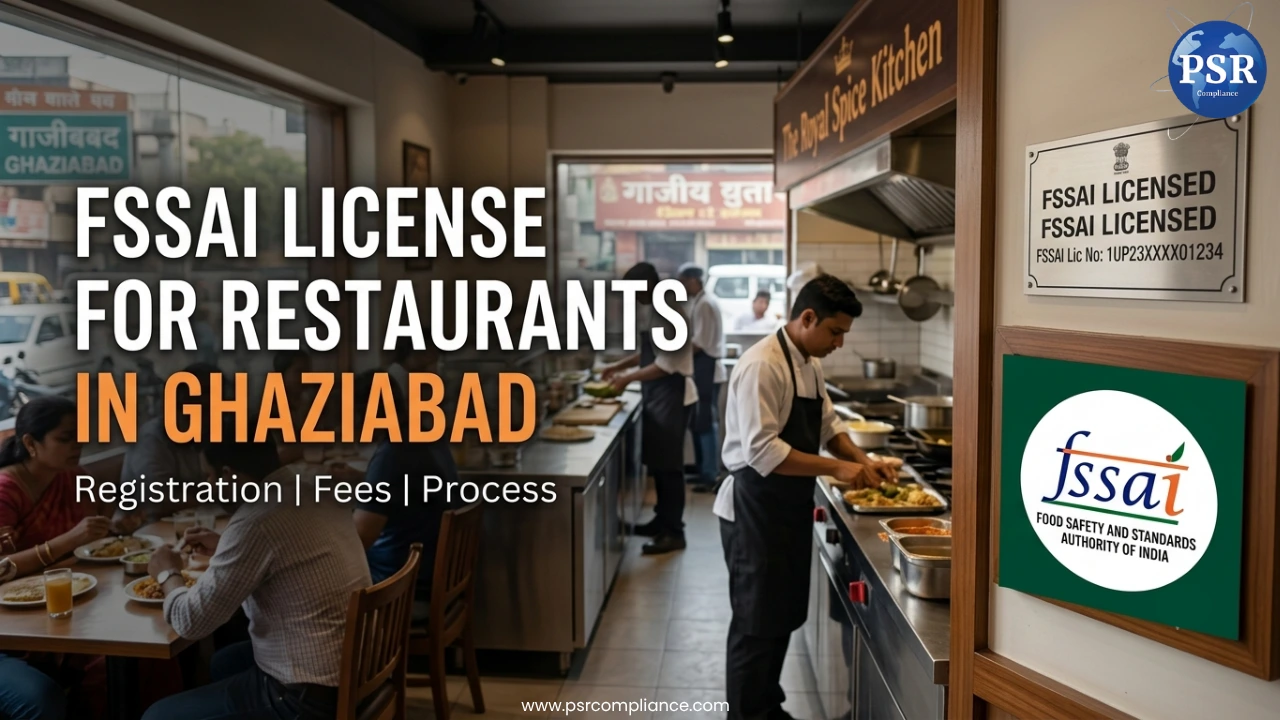
FSSAI License for Restaurants in Ghaziabad: Registration, Fees & Process
Running a restaurant in Ghaziabad means not only selecting an appropriate place, creating a menu, and attracting clients but also making sure your food safety complies with the law. All restaurants serving, storing, preparing, and selling food should comply with relevant provisions of the Food Safety and Standards Authority of India (FSSAI).
However, for the owners of restaurants, knowing the FSSAI License procedure may help to avoid problems connected with the process of compliance and will make management of the business much easier. Now the application for the license is processed through the Food Safety Compliance System (FoSCoS), which is the official website for food business registration and licensing.
This article will clarify how one can apply to obtain the license, what documents are usually needed, what the government fee can be, and what food safety requirements should be taken into consideration after licensing of the restaurant in Ghaziabad.
What Is an FSSAI License?
FSSAI License is an approval obtained by food business operators in India who qualify for this license as per certain criteria. This license is issued according to the Food Safety and Standards Act, 2006, and related regulations. This approval will facilitate the process of validating that the food business is functioning within the scope of India’s food safety regime. Restaurants, cafes, cloud kitchens, caterers, and other food service businesses fall into the purview of the FSSAI regime. The correct category of license for restaurants is dependent upon the turnover and the criteria for eligibility.
Why Is FSSAI Compliance Important for a Restaurant?
A restaurant handles food at several stages. These include receiving ingredients, storing raw materials, preparing dishes, cooking, serving, and sometimes delivering food.
Poor hygiene at any stage can create food safety risks. FSSAI requirements therefore cover more than simply obtaining a certificate. Restaurants also need to maintain appropriate hygiene and sanitation practices.
According to FSSAI, any food business seeking a license needs to have a documented FSMS (Food Safety Management System). The Food Safety Standards Authority of India (FSSAI) provides various hygiene and sanitation requirements for catering services under Schedule 4 of FSSAI.
What Type of FSSAI Approval Does a Restaurant in Ghaziabad Need?
The first step is determining the correct category. The revised turnover framework applicable from 1 April 2026 is:
| Category | Annual turnover | Applicable approval |
|---|---|---|
| Registration | Up to ₹1.5 crore | FSSAI Registration |
| State License | Above ₹1.5 crore and up to ₹50 crore | State FSSAI License |
| Central License | Above ₹50 crore | Central FSSAI License |
These revised limits apply to new applications submitted from 1 April 2026. Existing businesses are being given time to migrate through FoSCoS where required. The importance of this move lies in the fact that the old system, where registration was required if the turnover exceeded ₹12 lakh, has now been changed to ₹1.5 crore.
According to FSSAI's own announcement from March 2026, this new system will make compliance easier for micro and small food businesses.
Documents Required for a Restaurant Application
The exact documents depend on the type and scale of the restaurant. Commonly required information and FSSAI registration documents may include:
- Proof of identity of the applicant or authorised person
- Proof of possession of the restaurant premises
- Business constitution documents, where applicable
- Partnership deed or company-related documents, where applicable
- Photograph of the applicant
- Details of the restaurant and food business activity
- Details of the food products or food categories handled
- Layout or premises-related information where applicable
- Food Safety Management System or hygiene-related documents where applicable
- Details of the person responsible for food safety
- Supporting documents requested by the licensing authority
Step-by-Step Process for Getting an FSSAI License in Ghaziabad
Below is the detailed FSSAI registration process to get an FSSAI license in Ghaziabad.
Step 1: Identify the Correct Business Category
Start by identifying the restaurant's annual turnover and the nature of the food business. Use the eligibility section on FoSCoS to determine whether the restaurant falls under registration, State License, or Central License. This is a crucial initial step because applying under the incorrect classification can cause delays or even require amendment.
Step 2: Visit the Official FoSCoS Portal
The application process will be completed through the official FoSCoS website. The website offers the facility to apply for a new license or registration and also to check your eligibility and other compliance services. For restaurant owners seeking an FSSAI license online, it is better to visit the official FoSCoS website rather than other sites.
Step 3: Select the State and Food Business Activity
After entering the application process, select Uttar Pradesh and choose the relevant food business activity. For a conventional restaurant, the applicable category is generally the restaurant/food service activity. The exact classification should be confirmed through the current FoSCoS eligibility tool. Providing the correct activity is important because licensing requirements and documentation can vary according to the nature of the food business.
Step 4: Enter Restaurant and Applicant Details
The application requires information such as:
- Restaurant name
- Complete business address
- District and sub-district
- PIN code
- Applicant details
- Business structure
- Annual turnover
- Nature of food activity
- Relevant food categories
Step 5: Upload the Required Documents
Upload the documents requested for the selected category. Scanned copies should be clear and readable. Names, addresses and business details should remain consistent across the documents.
A restaurant should also keep its food safety and hygiene documentation organised. This can help if further information is requested during the processing stage or during later compliance checks.
Step 6: Pay the Applicable Government Fee
The government fee depends on the type of approval. FSSAI's current fee structure lists different fees for Registration, State License and Central License. The official eligibility system should be checked before payment because the applicable amount depends on the category and business activity.
For example, the current FoSCoS eligibility information lists ₹7,500 per year for a Central License and ₹2,000 per year for a State License for the relevant restaurant category. The registration fee is ₹100 per year where registration applies.
Step 7: Submit the Application
Once all the documents have been verified and uploaded by the candidate, he should submit the application. The application will receive an application number, through which its status can be tracked via the application tracking facility provided by FoSCoS.
Step 8: Respond to Any Query or Inspection Requirement
A restaurant should keep its supporting records ready. FSSAI's 2026 reforms have introduced a greater focus on risk-based inspection and food safety audits. The updated framework also provides for perpetual validity of licenses and registrations, subject to continued compliance and the applicable regulatory conditions.
How Much Does an FSSAI License Cost in Ghaziabad?
The FSSAI license cost depends on the category applicable to the restaurant.
Under the current framework, the broad government fee structure includes:
- Registration: ₹100 per year where applicable
- State License: ₹2,000 per year for the relevant restaurant category
- Central License: ₹7,500 per year for the relevant restaurant category
These are government fees. Professional consultation or documentation services, if used, may involve separate charges.
Since FSSAI changed the definition of turnover in 2026, old sources will contain obsolete eligibility criteria. It is thus better to consult newer sources of FoSCoS eligibility criteria for restaurant owners.
What Food Safety Rules Must a Restaurant Follow After Approval?
Obtaining the certificate is only one requirement for compliance. Apart from that, restaurants need to have appropriate sanitation standards in place for all of their operations. FSSAI's Schedule 4 framework outlines GHP and GMP, with Part 5 dealing with catering operations.
Important areas include:
Clean Food Preparation Areas
Kitchen floors, walls, work surfaces and equipment should be maintained in a clean and hygienic condition.
Safe Storage of Ingredients
Raw materials should be stored appropriately. Perishable products require suitable temperature control and protection from contamination.
Personal Hygiene
Food handlers should follow proper hygiene practices. Handwashing, clean protective clothing and appropriate health and hygiene procedures are important parts of food safety.
Pest Control
The premises should be protected against pests. Signs of infestation should be addressed quickly.
Safe Water
Water used for food preparation, cleaning and other relevant activities should meet applicable safety requirements.
Waste Management
Food waste and other waste should be collected and disposed of properly to prevent contamination and pest problems.
Food Safety Supervision
FSSAI's guidance recommends appointing trained Food Safety Supervisors. Its hygiene guidance states that there should be one Food Safety Supervisor for every 25 food handlers.
Common Mistakes to Avoid When Applying
Several simple mistakes can make the application process more difficult.
Choosing the Wrong Category
Using outdated turnover limits is a common issue. Since the thresholds changed from 1 April 2026, the current ₹1.5 crore and ₹50 crore limits should be considered.
Entering an Incorrect Address
The premises address should match the supporting proof of possession.
Uploading Unclear Documents
Blurry or incomplete documents can create unnecessary queries.
Ignoring Food Safety Requirements
Compliance does not end when approval is received. Hygiene, sanitation, food handling and documentation must continue to be maintained.
Relying on Outdated Information
Many online articles still refer to the earlier ₹12 lakh registration threshold. FSSAI officially changed the thresholds from 1 April 2026, making current government information especially important.
Conclusion
Obtaining the appropriate food license for restaurant is an important step for every restaurant operating in Ghaziabad. The process starts with identifying the correct category, preparing the documents, applying through FoSCoS, and maintaining food safety standards after approval.
The changes in regulations in 2026 have made it particularly necessary for this process to be reviewed owing to the fact that the threshold limits of turnover have been altered. The registration is for turnover up to ₹1.5 crore, while state licensing is for turnover up to ₹50 crore, and central licensing is above ₹50 crore.
For those restaurants that seek to stay compliant, they can seek professional help in order to simplify this process. PSR Compliance will be able to provide assistance to businesses with regard to their regulatory compliance, documentation, and other needs.
Get Your FSSAI License for Your Restaurant in Ghaziabad
Start your restaurant with the right food safety approval. PSR Compliance helps you with FSSAI registration, documentation, online application, and compliance support.
📞 Call: (+91) 8796104190
📧 Email: support@psrcompliance.com
Frequently Asked Questions
1. Is an FSSAI License mandatory for a restaurant in Ghaziabad?
Food businesses must obtain the applicable FSSAI registration or license based on their business category and eligibility. A restaurant should check its current turnover and activity on FoSCoS before applying.
2. What is the new turnover limit for FSSAI Registration?
From 1 April 2026, registration shall be for food businesses that have turnover of up to ₹1.5 crore per annum. Food businesses between ₹1.5 crore and ₹50 crore will come under State License, and food businesses above ₹50 crore need a Central License.
3. Is it possible to make FSSAI registration online?
Yes. One can apply for FSSAI registration online via FoSCoS Portal.
4. Does an FSSAI approval need to be renewed every year?
The FSSAI license and registration changes for 2026 included perpetual validity of the licenses and registrations, provided that compliance requirements were fulfilled and the approval was not revoked. Companies were required to maintain compliance with food safety, hygiene, and other regulatory requirements.
5. What happens if the restaurant changes its business details?
Modification of the relevant business details should be done through the proper modification procedures in FoSCoS. The restaurant owners should modify their details rather than working with wrong information.