

Just send us your questions or concerns by starting a new case &
we will give you the help you need. Start Here...
NGO Registration
Thu, Sep 10 2026
Raju Karn
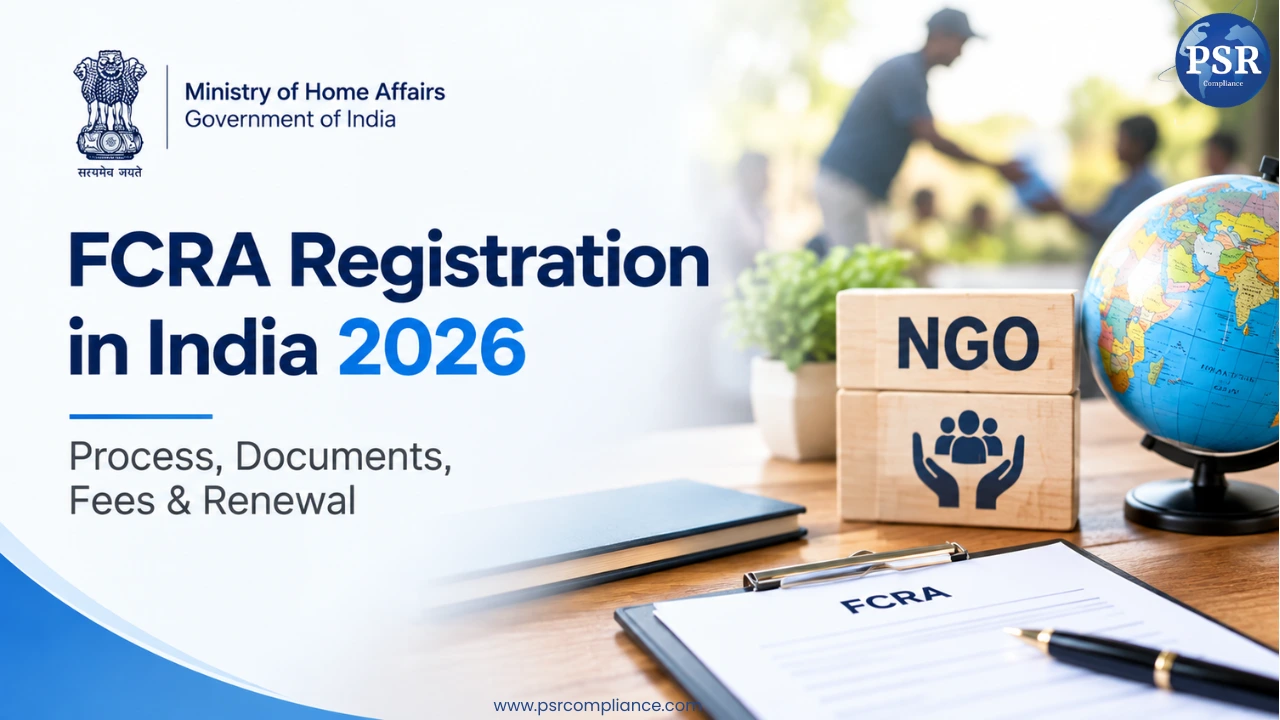
FCRA Registration India 2026 – Get 50% OFF
The Foreign Contribution (Regulation) Act, 2010 (FCRA) provides the legal framework governing the acceptance and utilisation of foreign contributions in India. Charitable trusts, societies and Section 8 companies that intend to receive foreign contributions must comply with the applicable FCRA requirements before accepting such funds.
If you are a trustee of a charitable trust, a member of a society or a director of a Section 8 company, understanding the FCRA registration process is important before your organisation receives foreign donations. This guide explains FCRA Registration in India, including eligibility, registration process, required documents, government fees, FCRA bank account requirements, validity, renewal and prior permission.
What is FCRA Registration?
FCRA Registration is the approval required by eligible organisations to receive foreign contributions in accordance with the Foreign Contribution (Regulation) Act, 2010.
The Ministry of Home Affairs (MHA), Government of India, administers the FCRA framework. Organisations receiving foreign contributions must use the funds only for permitted purposes and comply with the applicable reporting, accounting and utilisation requirements.
Foreign contribution may be received for activities falling within the permitted cultural, economic, educational, religious or social purposes, subject to the FCRA Act and Rules.
Who Can Apply for FCRA Registration in India?
The following types of non-profit organisations can generally seek FCRA registration if they satisfy the applicable eligibility requirements:
- Charitable Trusts
- Societies
- Section 8 Companies
An organisation applying for regular FCRA registration generally needs to have been in existence for at least three years and must have spent a minimum of ₹15 lakh on its core activities for the benefit of society during the last three financial years, subject to the applicable rules and conditions.
A newly established organisation that does not meet the requirements for regular registration may consider the Prior Permission (PP) route when it has a specific foreign donor, a specific amount and a specific project or activity.
FCRA Registration vs Prior Permission
There are two important routes for an organisation that wants to receive foreign contribution:
FCRA Registration
Regular registration is generally suitable for an organisation that has an established track record and satisfies the prescribed eligibility conditions.
FCRA Prior Permission
Prior Permission is generally used where an organisation is still in its formative stage and wants to receive a specified amount from a specified donor for a specified project or activity.
The applicant needs to provide the required donor commitment and project-related information. The FCRA framework provides separate online application forms for registration and prior permission.
Eligibility for FCRA Registration in India
Before applying, an organisation should check whether it satisfies the applicable FCRA requirements.
Key considerations include:
- The organisation should generally have been in existence for at least three years.
- It should have spent at least ₹15 lakh on core activities for the benefit of society during the last three financial years, subject to applicable rules.
- The organisation should have a definite cultural, economic, educational, religious or social programme.
- Its activities and proposed use of foreign contribution should comply with the FCRA framework.
- The organisation and its key functionaries must satisfy the applicable legal and eligibility requirements.
- The organisation should maintain the required FCRA banking and accounting arrangements.
The Ministry of Home Affairs also requires applicants to comply with the prescribed application and documentation requirements.
FCRA Registration Process in India
The FCRA application process is completed online through the FCRA portal.
Step 1: Check FCRA Eligibility
First, determine whether your Trust, Society or Section 8 Company meets the requirements for regular registration or whether Prior Permission is more appropriate.
Step 2: Obtain the Required Details
Prepare the organisation's registration details, governing documents, activity information, financial records, office-bearer details and other information required in the applicable form.
Step 3: Maintain the Required FCRA Bank Account
The FCRA framework requires the designated FCRA account for receipt of foreign contribution. The official FCRA FAQ states that foreign contribution is to be received through the designated SBI FCRA account at the State Bank of India, New Delhi Main Branch.
Step 4: Complete the Online Application
Regular FCRA registration is applied for through Form FC-3A, while Prior Permission is applied for through Form FC-3B.
Step 5: Upload the Required Documents
Upload the prescribed documents and supporting information in the required format.
Step 6: Pay the Government Fee
The applicable government fee is paid online through the FCRA application process. The official FCRA FAQ currently states:
- Registration: ₹10,000
- Prior Permission: ₹5,000
- Renewal: ₹5,000
Step 7: Government Scrutiny
The Ministry of Home Affairs examines the application and may seek additional information, clarification or supporting documents where required.
Step 8: FCRA Approval
If the application is approved, the organisation receives its FCRA registration certificate and can receive foreign contribution in accordance with the applicable FCRA requirements.
Documents Required for FCRA Registration
The exact document requirement can vary depending on the organisation and application. Common documents and information include:
- Registration Certificate or Trust Deed
- Memorandum of Association
- Articles of Association, where applicable
- Activity Report for the required period
- Audited financial statements
- Income and Expenditure Statements
- Balance Sheets
- Details of the organisation's office bearers or governing body
- Details of key functionaries
- Organisation bank account details
- FCRA bank account details
- Details of activities and projects
- Information relating to the organisation's objectives
- NITI Aayog Darpan ID, where applicable
- Identity and other prescribed details of key functionaries
- Supporting documents and declarations required under the applicable FCRA forms
The application forms and requirements may be updated by the Ministry from time to time, so the current FCRA portal requirements should be checked before filing.
New FCRA Form Requirements and 2026 Updates
FCRA compliance requirements continue to evolve. A June 2026 Gazette notification amended the FCRA Rules and introduced additional information requirements in the application forms.
For example, Form FC-3A now includes fields relating to:
- Social media accounts of the association
- Scope of FCRA registration
- Selected activities for which registration is sought
- Geographical area of operation
- Details of activities undertaken during the last three financial years
The amendment also added further information requirements concerning certain government-related characteristics and bank/utilisation account details.
Therefore, organisations should use the latest applicable forms and document requirements rather than relying on older FCRA application checklists.
FCRA Registration Fees
The government fee for regular FCRA registration is currently ₹10,000.
For comparison:
| FCRA Application | Government Fee |
|---|---|
| FCRA Registration | ₹10,000 |
| Prior Permission | ₹5,000 |
| FCRA Renewal | ₹5,000 |
The official FCRA FAQ confirms these applicable fees and states that payment is made through the online payment gateway.
Professional consultancy charges, documentation charges or other service charges are separate from the government fee.
Benefits of FCRA Registration
1. Legal Acceptance of Foreign Contribution
FCRA registration enables an eligible organisation to receive foreign contribution in accordance with the law.
2. Greater Donor Confidence
Having the required FCRA approval can provide greater confidence to eligible international donors and funding organisations.
3. Access to International Funding
Eligible NGOs can receive foreign contributions for permitted activities and projects after complying with the applicable FCRA requirements.
4. Better Financial Compliance
FCRA registration requires organisations to maintain proper records and follow prescribed requirements relating to receipt and utilisation of foreign contribution.
5. Structured Foreign Funding
An organisation can receive foreign contribution through the prescribed banking system and utilise it for permitted objectives in accordance with the FCRA framework.
FCRA Bank Account Requirement
An organisation receiving foreign contribution must comply with the FCRA banking requirements.
The official FCRA FAQ states that an FCRA-registered organisation must have an FCRA account with the State Bank of India, New Delhi Main Branch, for receipt of foreign contribution. The organisation can open and maintain the designated account without physically visiting New Delhi.
Foreign contribution should not be accepted through an ordinary bank account in violation of the applicable FCRA requirements.
Validity of FCRA Registration
FCRA registration is generally valid for five years from the date of grant.
The FCRA Rules provide for renewal after the five-year validity period.
Organisations should monitor their certificate expiry date and start the renewal process within the prescribed period to avoid compliance problems.
What Happens If FCRA Registration Expires?
An organisation should not assume that it can continue receiving foreign contribution after its FCRA registration has expired.
The organisation should monitor the certificate validity and complete renewal within the prescribed period. The FCRA Rules provide for a five-year validity period and renewal requirements.
Timely renewal is therefore an important part of FCRA compliance.
FCRA Annual Compliance
FCRA registration is not a one-time compliance exercise.
An FCRA-registered organisation must maintain appropriate records and comply with applicable reporting and utilisation requirements. This includes maintaining records of foreign contributions received and utilised and filing the applicable annual return within the prescribed period.
Organisations should also ensure that foreign contributions are used only for permitted purposes and that required changes in organisational details are reported through the prescribed forms.
For example, the official FCRA FAQ provides online procedures for reporting changes relating to name, address, objectives, bank accounts and governing-body members.
How to Check FCRA Registration Status?
You can check the status of an FCRA application through the official FCRA online system.
The general process is:
- Visit the FCRA online portal.
- Log in using the relevant credentials.
- Access the application status section.
- Enter the required application details.
- Submit the search.
- Review the current application status.
The official FCRA FAQ confirms that the status of pending registration, Prior Permission and renewal applications can be checked online through the FCRA services portal.
Why Choose PSR Compliance for FCRA Registration?
FCRA applications require accurate documentation and careful compliance with the prescribed requirements.
PSR Compliance can assist organisations with:
- FCRA eligibility assessment
- Registration documentation
- FC-3A application support
- Prior Permission documentation
- FCRA bank account guidance
- Financial and activity document review
- Application filing assistance
- Clarification and compliance support
- FCRA renewal assistance
- Ongoing FCRA compliance guidance
Our team can help you understand the applicable requirements and prepare your application with a structured documentation process.
Conclusion
FCRA Registration is an important compliance requirement for eligible organisations intending to receive foreign contributions in India. Trusts, Societies and Section 8 Companies should carefully assess their eligibility, prepare the required documents and use the latest FCRA forms and requirements before submitting an application.
The current FCRA framework also requires organisations to pay attention to banking, reporting, annual compliance and renewal requirements. Recent amendments to the FCRA Rules have introduced additional information requirements in the application forms, making it even more important to use updated information while filing.
If you are planning to apply for FCRA Registration, Prior Permission or FCRA renewal, PSR Compliance can assist with documentation, application filing and compliance guidance.
Contact PSR Compliance today for professional FCRA Registration assistance.
Frequently Asked Questions
Q1. What is FCRA Registration?
FCRA Registration is the approval required by eligible organisations to receive foreign contributions in accordance with the Foreign Contribution (Regulation) Act, 2010.
Q2. Who is eligible for FCRA Registration?
Charitable Trusts, Societies and Section 8 Companies can apply for FCRA Registration if they satisfy the applicable eligibility conditions, including the prescribed track record and expenditure requirements.
Q3. How many years should an NGO exist before applying for FCRA Registration?
An organisation generally needs to have been in existence for at least three years and satisfy the prescribed eligibility requirements for regular FCRA registration.
Q4. What is the minimum expenditure required for FCRA Registration?
The current eligibility requirement generally includes spending at least ₹15 lakh on core activities for the benefit of society during the last three financial years, subject to the applicable rules and conditions.
Q5. What is the FCRA Registration fee?
The government fee for FCRA Registration is currently ₹10,000. Prior Permission costs ₹5,000 and renewal costs ₹5,000.
Q6. How long is FCRA Registration valid?
FCRA Registration is generally valid for five years from the date of grant.
Q7. When should FCRA Registration be renewed?
The renewal application should be submitted within six months before the expiry of the existing FCRA registration certificate.
Q8. Which form is used for FCRA Registration?
Regular FCRA Registration is applied for through Form FC-3A. Prior Permission is applied for through Form FC-3B, while renewal is filed through Form FC-3C.
Q9. Can a new NGO apply for FCRA Registration?
A newly established organisation that does not satisfy the eligibility conditions for regular registration may consider applying for Prior Permission for a specific amount from a specific donor for a specific project or activity.
Q10. Is an FCRA bank account mandatory?
Yes. Organisations receiving foreign contribution must comply with the prescribed FCRA banking requirements. The designated FCRA account for receipt of foreign contribution is maintained with SBI's New Delhi Main Branch as prescribed under the FCRA framework.
Q11. How can I check my FCRA application status?
The status of pending FCRA Registration, Prior Permission and renewal applications can be checked online through the FCRA services portal using the relevant login details.
Q12. Can PSR Compliance help with FCRA Registration?
Yes. PSR Compliance provides professional assistance with FCRA eligibility assessment, documentation, FC-3A filing, Prior Permission, renewal and related compliance requirements.