

Just send us your questions or concerns by starting a new case &
we will give you the help you need. Start Here...
CPCB Update
Wed, Sep 02 2026
Raju Karn
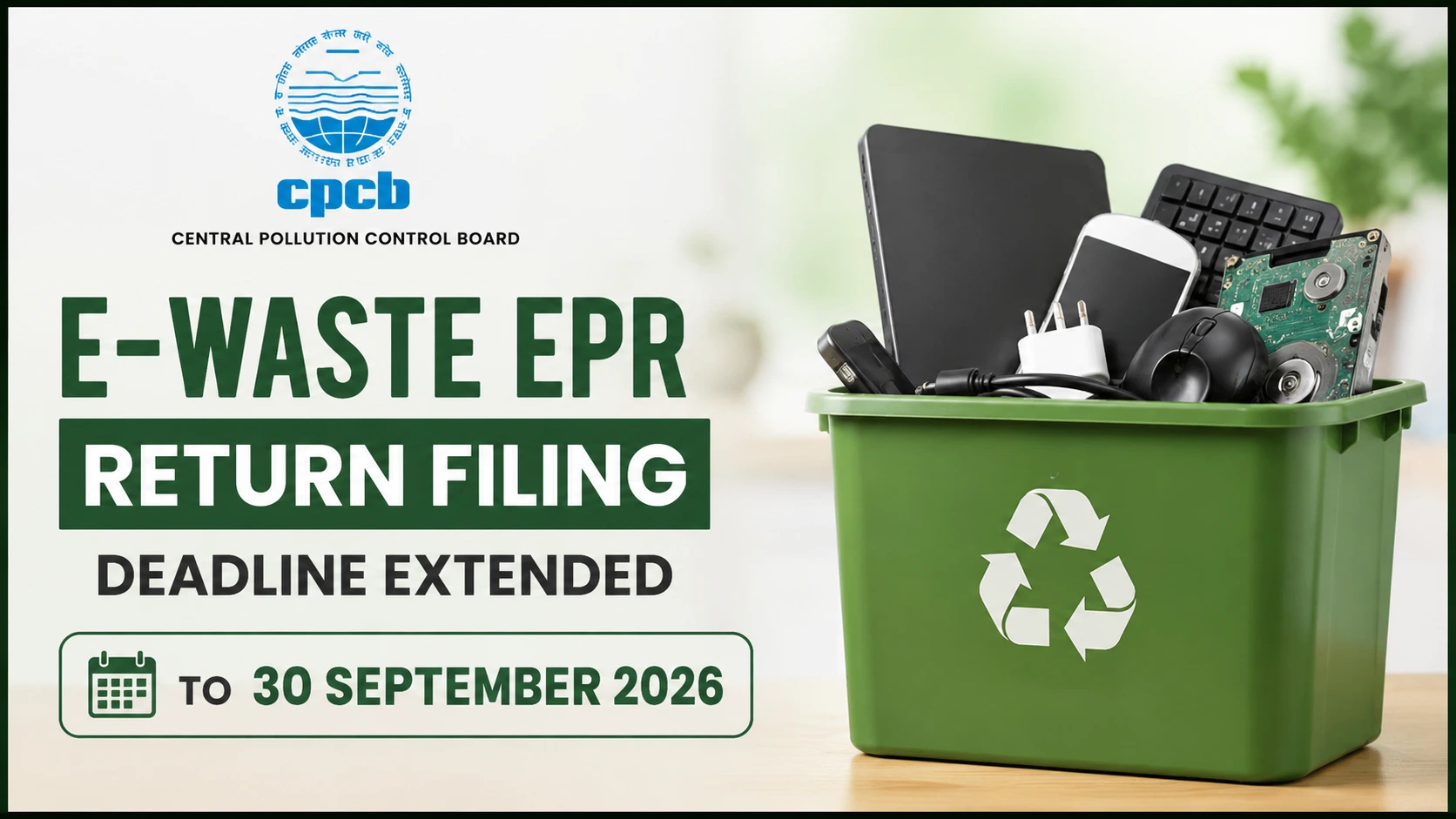
Final Week: E-Waste EPR Return Filing Deadline Closes 30 September 2026
Only a few days are left before the deadline. The E-Waste Extended Producer Responsibility (EPR) return filing deadline for FY 2025–26 was already extended once, from 30 April 2026 to 30 September 2026, and that revised deadline is now days away.
Businesses registered under the E-Waste (Management) Rules, 2022 that have not yet filed their applicable Quarterly and Annual Returns on the E-Waste EPR Portal need to act now, not later this week. There is no indication of a further extension, so treat 30 September 2026 as final: reconcile your E-Waste data, verify your compliance records, and complete the filing before the window closes.
E-Waste EPR Filing Deadline 2026: What Has Changed?
The key change is the extension of the filing deadline for FY 2025–26.
| Particular | Earlier | Extended |
|---|---|---|
| Financial Year | FY 2025–26 | FY 2025–26 |
| Earlier filing deadline | 30 April 2026 | — |
| Extended filing deadline | — | 30 September 2026 |
| Return type | Quarterly & Annual Returns | Quarterly & Annual Returns |
| Filing platform | E-Waste EPR Portal | E-Waste EPR Portal |
| Applicability | Registered E-Waste EPR entities | Registered E-Waste EPR entities |
The extension was issued following concerns relating to operational and technical difficulties in compiling and reconciling compliance information. A regulatory update published on 28 August 2026 also records the CPCB extension and identifies the relevant notification as Notification No. CP/14/2024-WM-III-HO-CPCB-HO.
What Is E-Waste EPR?
Extended Producer Responsibility (EPR) is a regulatory framework under which producers and other covered entities have responsibilities for the environmentally sound management of waste generated from products placed on the Indian market.
For electronic and electrical products, these obligations are governed by the E-Waste (Management) Rules, 2022.
The framework places compliance responsibilities on relevant manufacturers, producers, refurbishers and recyclers and uses the CPCB's online EPR system for registration and reporting.
E-Waste EPR is therefore not simply a one-time registration. Registered entities may also have continuing obligations relating to targets, recycling, documentation, transactions and return filing.
Why Is the 30 September 2026 Deadline Important?
The extension gives businesses additional time, but it should not be treated as a reason to postpone compliance until the last few days.
E-Waste return filing may require businesses to collect and reconcile information from several internal and external sources, including:
- Product and EEE quantities
- Sales and production records
- Import data, where applicable
- E-Waste generation data
- Recycling information
- EPR certificates or related compliance records
- Recycler transaction details
- Previous quarterly records
- Annual compliance information
- Portal registration details
Any mismatch between these records can create problems during filing.
Businesses should therefore use the extended deadline to review their data rather than simply waiting for September.
Who Needs to Pay Attention to This Update?
The extension is particularly relevant to entities that are already registered under the E-Waste EPR framework and are required to submit returns for FY 2025–26.
Depending on the activity and applicable provisions, this can include:
| Entity | E-Waste EPR Relevance |
|---|---|
| Manufacturers | May have EPR obligations for covered electrical and electronic equipment |
| Producers | Responsible for applicable EPR obligations relating to products placed on the market |
| Importers | May have obligations for covered electronic and electrical products imported into India |
| Recyclers | Required to maintain applicable recycling and reporting records |
| Refurbishers | May have specific registration and reporting responsibilities |
Applicability should be assessed based on the entity's actual business activity and the products covered under the E-Waste Rules.
What Returns Are Covered by the Extension?
The reported extension covers the filing of Quarterly and Annual Returns for FY 2025–26 by entities registered on the E-Waste EPR Portal.
The important point for businesses is that the extension does not remove the underlying compliance obligation. It provides additional time for completing the applicable filing.
Therefore, if an entity was required to file a return for FY 2025–26, it should not assume that the extension means the return is no longer required.
Instead, the applicable return should be prepared and submitted within the revised timeline.
What Should Businesses Do Before Filing?
Before submitting the return, businesses should conduct an internal compliance check.
1. Verify E-Waste EPR Registration
Check whether the organisation's EPR registration details are correct and active on the applicable portal.
Review details such as:
- Legal entity name
- PAN
- GST details
- Registered address
- Authorised person
- Product categories
- EEE details
- Contact information
2. Reconcile Product and E-Waste Data
Businesses should compare their E-Waste information with their internal records.
- Relevant data may include:
- Manufacturing quantities
- Sales quantities
- Import quantities
- Product categories
- EEE placed on the market
- Applicable EPR targets
- Recycling quantities
The figures submitted on the portal should be supported by appropriate business records.
3. Check Recycling Records
Review the records relating to recycling and EPR compliance.
Where applicable, businesses should verify:
- Recycler details
- Recycling quantities
- Certificates
- Transaction records
- Dates of transactions
- Category-wise quantities
4. Reconcile Quarterly Data
If quarterly returns have been maintained during FY 2025–26, compare each quarter with the annual figures.
This can help identify:
- Missing entries
- Duplicate entries
- Incorrect quantities
- Category mismatches
- Data-entry errors
- Unreconciled transactions
5. Prepare the Annual Return
Once the data has been reconciled, the applicable annual return should be prepared using the information required by the E-Waste EPR Portal.
6. File Before 30 September 2026
Do not wait until the final day.
A portal-related technical issue, missing document, incorrect data or reconciliation problem close to the deadline can create unnecessary compliance pressure.
Common Problems Businesses Face During E-Waste EPR Return Filing
EPR return filing can become difficult when the data maintained by different departments does not match.
Some common issues include:
Incorrect Product Classification
Electronic and electrical equipment must be reported under the applicable categories. Incorrect classification can affect the compliance calculation.
Mismatch Between Sales and EPR Data
Sales, production and import records may not always match the figures maintained for EPR reporting.
Missing Recycler Information
Businesses may have difficulty reconciling recycling transactions where records are incomplete or maintained separately.
Incorrect Quarterly Data
Errors in one or more quarterly submissions can affect the annual reconciliation.
Portal-Related Technical Issues
Online compliance systems can sometimes create technical or operational difficulties during data entry, reconciliation or submission.
The current deadline extension itself was reported in the context of operational and technical challenges associated with compiling and reconciling compliance data.
What Happens If an E-Waste EPR Return Is Not Filed?
Businesses should not assume that missing the filing deadline is harmless.
Failure to meet applicable E-Waste EPR obligations can expose an entity to regulatory action under the applicable environmental framework.
Depending on the nature and severity of non-compliance, consequences can include:
- Regulatory notices or queries
- Requirement to provide additional information
- Environmental compensation, where applicable
- Suspension or other action affecting registration
- Additional compliance scrutiny
- Difficulty in maintaining ongoing EPR compliance
The exact consequence depends on the nature of the violation and the applicable CPCB rules, guidelines and directions.
For this reason, businesses should complete their FY 2025–26 filing within the extended deadline rather than relying on another extension.
E-Waste EPR Return Filing: Important Checklist
Before submitting your return, check the following:
| Compliance Check | Status to Verify |
|---|---|
| E-Waste EPR registration | Active and correct |
| Entity details | Verified |
| Product/EEE categories | Correct |
| FY 2025–26 data | Reconciled |
| Quarterly records | Checked |
| Annual figures | Reconciled |
| Recycling records | Verified |
| EPR certificates/transactions | Checked, where applicable |
| Supporting documents | Available |
| Portal data | Reviewed |
| Return | Submitted before 30 September 2026 |
What Does the Extension Mean for E-Waste EPR Compliance?
The extension should be viewed as an opportunity to correct and reconcile compliance data.
For businesses that have already prepared their records, the additional time can be used for a final review.
For businesses that have not started their return preparation, the remaining period should be used to:
- Review EPR registration.
- Collect FY 2025–26 data.
- Reconcile quarterly records.
- Verify recycling and certificate records.
- Identify discrepancies.
- Correct eligible information.
- Prepare the applicable return.
Submit it on the E-Waste EPR Portal before 30 September 2026.
Why Proper E-Waste EPR Data Reconciliation Matters
EPR compliance is increasingly dependent on accurate digital records.
A business may have information available in different systems-for example, accounting software, ERP records, GST data, import documents, sales reports and recycler documentation.
If these records are not reconciled before filing, the return may contain inconsistent information.
A proper reconciliation exercise helps businesses identify errors before submission and maintain supporting records for future compliance requirements.
E-Waste EPR Compliance Assistance from PSR Compliance
Managing E-Waste EPR registration and return filing can be challenging when product data, recycling information and portal records need to be reconciled.
PSR Compliance assists businesses with E-Waste EPR compliance, including:
- E-Waste EPR registration assistance
- EPR documentation
- Product/category assessment
- EPR compliance data review
- Quarterly return assistance
- Annual return filing assistance
- Data reconciliation support
- Portal filing support
- Compliance documentation
If your organisation is registered on the E-Waste EPR Portal for FY 2025–26, now is the time to review your records and complete the applicable returns.
🚨 E-Waste EPR Return Filing Deadline: 30 September 2026
Do not wait until the last week to prepare your return.
Need help with E-Waste EPR return filing?
📞 Call: +91 8796104190
📧 Email: support@psrcompliance.com
Get professional assistance with your E-Waste EPR compliance and return filing.
Conclusion
The extension of the E-Waste EPR return filing deadline from 30 April 2026 to 30 September 2026 gives registered entities additional time to complete their FY 2025–26 compliance.
However, the extension does not remove the underlying EPR obligations.
Businesses should use the additional time to verify their registration, reconcile product and recycling data, review quarterly records and submit the applicable annual and quarterly returns through the E-Waste EPR Portal.
With the revised deadline approaching, completing the filing early can help avoid last-minute data issues and compliance delays.
E-Waste EPR Deadline: 30 September 2026.
Stay informed. Stay compliant.
Frequently Asked Questions
1. What is the new E-Waste EPR return filing deadline for FY 2025–26?
The deadline for filing the applicable Quarterly and Annual E-Waste EPR Returns for FY 2025–26 has been extended to 30 September 2026, from the earlier deadline of 30 April 2026.
2. Who is covered by the E-Waste EPR deadline extension?
The extension applies to entities registered on the E-Waste EPR Portal for FY 2025–26 and required to file the applicable quarterly and annual returns.
3. Is the E-Waste EPR registration deadline also extended?
The reported update concerns the filing timeline for the applicable Quarterly and Annual Returns for FY 2025–26. It should not automatically be interpreted as an extension of the EPR registration requirement.
4. What is E-Waste EPR?
E-Waste EPR is the Extended Producer Responsibility framework for managing waste arising from covered electrical and electronic equipment under the E-Waste (Management) Rules, 2022.
5. Do I still need to file if I have already registered for E-Waste EPR?
If your entity is required to file the applicable FY 2025–26 return, registration does not eliminate the return-filing obligation. The relevant return should be submitted within the applicable timeline.
6. What documents are needed for E-Waste EPR return filing?
The required information depends on the entity and applicable return. Businesses should generally maintain their EEE/product data, sales or import records, recycling information, EPR transactions/certificates where applicable and supporting compliance records.
7. What happens if there is a mismatch in E-Waste EPR data?
A mismatch should be identified and reconciled before filing wherever possible. Businesses should verify their source records and ensure that the information submitted on the portal is accurate and supported by appropriate documentation.
8. Can PSR Compliance help with E-Waste EPR return filing?
Yes. PSR Compliance can assist businesses with E-Waste EPR registration, documentation, compliance data review, reconciliation and applicable quarterly and annual return filing.
9. What should I do if I have not filed my FY 2025–26 E-Waste return yet?
Start preparing immediately. Review your EPR registration, collect FY 2025–26 data, reconcile quarterly and recycling records and submit the applicable return before 30 September 2026.
10. Is 30 September 2026 the final deadline?
Based on the current extension, 30 September 2026 is the extended deadline for the applicable FY 2025–26 quarterly and annual E-Waste returns. Businesses should not assume that another extension will be granted and should complete filing within the revised deadline.