
Just send us your questions or concerns by starting a new case &
we will give you the help you need. Start Here...
BIS
Sat, Jul 18 2026
Raju Karn
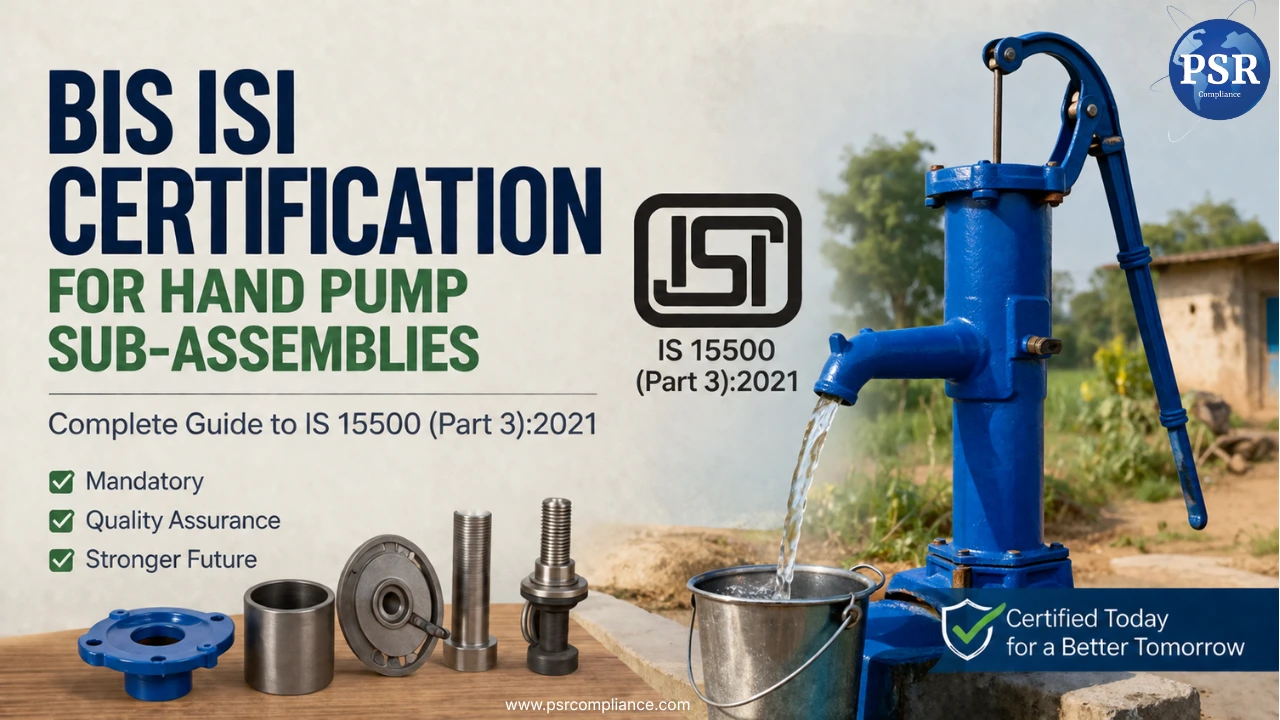
BIS ISI Certification for Hand Pump Sub-Assemblies: Complete Guide (2026)
A hand pump may look like a simple mechanical product, but for millions of people across rural India, it is a primary source of drinking water. Whether installed in villages, farms, schools, or public places, a hand pump is expected to deliver clean water consistently for years. Because these products operate under continuous mechanical stress and harsh environmental conditions, even a small defect in a sub-assembly can affect performance, durability, and user safety. This is why the Government of India has made BIS ISI Certification mandatory for specified hand pump sub-assemblies under IS 15500 (Part 3):2021.
Unfortunately, many manufacturers become aware of this requirement only after facing compliance issues during inspections or while participating in government tenders. A product that has been selling successfully for years may suddenly become ineligible for sale if it does not carry the required ISI Mark. Understanding the certification requirements before manufacturing or marketing your products can save your business from penalties, rejected orders, and unnecessary financial losses.
Why Do Hand Pumps Need BIS Certification?
Although a hand pump appears to be a simple product, its reliability directly affects people's daily lives. In many rural and remote areas where piped water supply is unavailable, hand pumps remain the most dependable source of drinking water. If critical components such as the cylinder, valve, or handle assembly fail due to poor manufacturing quality, communities may lose access to clean water until repairs are completed. Since many installations are located far from service centres, durability and performance become essential rather than optional.
To ensure consistent product quality across manufacturers, the Bureau of Indian Standards (BIS) developed IS 15500 (Part 3):2021, which specifies quality, design, material, testing, and performance requirements for deep well hand pump sub-assemblies. Products carrying the ISI Mark demonstrate that they have been tested against nationally accepted standards and are manufactured under a controlled quality management system. This not only protects consumers but also improves confidence among government departments, NGOs, distributors, and institutional buyers.
Why BIS Certification Matters
- Ensures consistent product quality and durability.
- Verifies compliance with Indian safety and performance standards.
- Reduces the risk of product failures in the field.
- Improves customer confidence and market credibility.
- Supports participation in government procurement and public water supply projects.
Which Products Require ISI Certification?
The mandatory certification requirement primarily applies to sub-assemblies of deep well hand pumps covered under IS 15500 (Part 3):2021. Many manufacturers mistakenly believe that certifying the complete hand pump is sufficient, whereas BIS evaluates each notified sub-assembly separately. If a manufacturer produces multiple variants of these assemblies, each applicable product must comply with the prescribed standard before being marketed.
Manufacturers should carefully identify every product covered under the applicable Quality Control Order to ensure complete compliance. Producing even one uncertified notified sub-assembly may result in regulatory action, regardless of whether the remaining products are certified.
Hand Pump Sub-Assemblies Covered Under IS 15500 (Part 3):2021
| Product | BIS Certification Required |
|---|---|
| Head Assembly | ✔ Yes |
| Handle Assembly | ✔ Yes |
| Cylinder Assembly | ✔ Yes |
| Valve Assembly | ✔ Yes |
Important: Each notified sub-assembly is assessed individually during the BIS certification process. Manufacturers producing multiple variants may be required to submit separate samples and supporting documentation depending on the product configuration.
What Gets Tested Under IS 15500 (Part 3):2021?
Many manufacturers believe BIS certification is simply about submitting a product sample and receiving an approval after basic inspection. In reality, the certification process is much more comprehensive. BIS evaluates whether every critical component of the hand pump sub-assembly complies with the technical requirements prescribed under IS 15500 (Part 3):2021. The objective is to ensure that every certified product delivers consistent performance, long service life, and reliable operation under real working conditions.
The testing process begins with the verification of raw materials and continues through dimensional inspection, workmanship evaluation, functional performance testing, and quality assessment of individual sub-assemblies. Manufacturers are also expected to maintain proper production controls so that every unit manufactured after certification continues to meet the same quality standards as the tested sample.
Major Areas Covered During Testing
| Test Category | Purpose |
|---|---|
| Raw Material Verification | Confirms the quality of steel, cast iron, stainless steel, brass, bronze, rubber, paint, welding electrodes, and other materials used. |
| Dimensional Inspection | Verifies that all components conform to the dimensions specified in IS 15500 (Part 3):2021. |
| Workmanship Check | Examines welding quality, finishing, alignment, assembly accuracy, and overall manufacturing quality. |
| Functional Performance Testing | Ensures that each sub-assembly performs efficiently during actual operation. |
| Quality Control Verification | Reviews manufacturing practices and quality assurance procedures followed by the manufacturer. |
Sub-Assembly Specific Tests
Each hand pump sub-assembly performs a different function, so BIS evaluates them individually instead of treating the complete pump as a single product. Manufacturers producing multiple variants should understand that each notified sub-assembly may require separate testing before certification is granted. This helps ensure that every component functions correctly and meets the performance requirements defined in the Indian Standard.
The testing procedures focus on the operational characteristics of each assembly. For example, the head assembly is examined for smooth movement and alignment, while the cylinder assembly undergoes performance testing to verify its pumping efficiency. These evaluations help ensure that the complete hand pump operates reliably once installed in the field.
Testing Requirements for Individual Sub-Assemblies
| Sub-Assembly | Important Tests |
|---|---|
| Head Assembly | Stroke length, chain alignment, workmanship, dimensional accuracy |
| Handle Assembly | Handle movement, lateral play, clearance between handle and bracket |
| Cylinder Assembly | Water discharge, pumping efficiency, performance testing |
| Valve Assembly | Valve operation, sealing performance, functional reliability |
Important: Every applicable sub-assembly is tested individually. Certification of one assembly does not automatically approve other assemblies manufactured by the same company.
Quality Assurance Is an Ongoing Requirement
Obtaining the BIS licence is only the beginning of the compliance journey. Manufacturers are expected to maintain a documented Quality Assurance Plan (QAP) that ensures every product manufactured after certification continues to meet the prescribed BIS standard. Routine inspections, batch testing, process monitoring, equipment calibration, and record maintenance form an important part of this system. During surveillance activities, BIS may review these records to verify continued compliance.
A well-maintained quality control system not only helps manufacturers retain their BIS licence but also minimizes production defects, customer complaints, and warranty claims. Businesses that consistently follow quality procedures are generally better positioned to meet market expectations and participate in large institutional procurement projects.
Manufacturers Should Maintain
- Raw material inspection records.
- Batch-wise production records.
- Routine testing reports.
- Equipment calibration records.
- Internal quality inspection reports.
- Corrective and preventive action records.
- Product traceability documents.
In-House Laboratory Requirements
One aspect of BIS certification that many manufacturers overlook is the requirement for testing infrastructure. Large-scale manufacturers are generally expected to establish an in-house testing laboratory capable of performing routine quality tests specified under the Quality Assurance Plan. This enables continuous monitoring of product quality during regular production instead of relying only on external laboratories at the time of certification.
However, BIS also recognizes that establishing a complete laboratory may not be practical for every manufacturer, particularly smaller businesses. Therefore, the certification framework provides certain relaxations for eligible Micro, Small, and Medium Enterprises (MSMEs) while still ensuring that product quality is maintained.
What Happens If You Skip BIS Certification?
Some manufacturers assume that BIS certification can be completed later, especially if their products are already selling in local markets. However, this approach can expose the business to significant legal and commercial risks. Since BIS ISI Certification under IS 15500 (Part 3):2021 is mandatory for the notified hand pump sub-assemblies, manufacturing or selling uncertified products may violate the applicable Quality Control Order (QCO). Regulatory authorities may initiate action against non-compliant manufacturers, affecting not only product sales but also long-term business credibility.
The consequences extend far beyond regulatory penalties. Large distributors, government departments, NGOs, and institutional buyers generally procure only certified products. A manufacturer without a valid BIS licence may lose access to these valuable markets, making it difficult to compete with certified brands. Investing in certification at the right time is often far less expensive than dealing with rejected orders, seized inventory, or legal proceedings later.
Possible Consequences of Non-Compliance
- Seizure of uncertified products.
- Financial penalties under applicable BIS provisions.
- Restriction on manufacturing, storage, sale, or distribution.
- Loss of government and institutional business opportunities.
- Rejection from public procurement and rural water supply projects.
- Damage to brand reputation and customer trust.
- Increased costs due to delayed certification and business interruption.
Why BIS Certification Is Good for Business
Many businesses view certification only as a legal obligation, but the ISI Mark also provides significant commercial advantages. In a competitive market where buyers often compare products based on price, the ISI Mark acts as an independent assurance of quality. It demonstrates that the product has been manufactured according to nationally recognized standards and has successfully passed the required testing and quality evaluation.
Certification also creates new business opportunities. Government departments, public sector organizations, NGOs, and institutional buyers frequently specify BIS-certified products in their procurement requirements. Manufacturers with valid BIS licences can participate in these projects with greater confidence while strengthening their reputation among distributors and end users.
Business Benefits of BIS ISI Certification
| Benefit | Business Advantage |
|---|---|
| Higher Customer Trust | Buyers recognize the ISI Mark as a symbol of quality and reliability. |
| Government Tender Eligibility | Enables participation in public procurement and rural water supply projects. |
| Stronger Market Reputation | Differentiates certified products from uncertified alternatives. |
| Better Dealer Confidence | Dealers prefer products with recognized quality certification. |
| Reduced Product Complaints | Standardized manufacturing improves consistency and product performance. |
| Long-Term Business Growth | Compliance supports sustainable expansion into larger markets. |
Rather than viewing BIS certification as an expense, successful manufacturers often consider it an investment in product quality, customer confidence, and long-term business growth.
Step-by-Step BIS Certification Process for Hand Pump Sub-Assemblies
Although the BIS certification process involves several technical evaluations, it becomes much easier when approached systematically. Manufacturers should begin by ensuring that their products comply with the requirements of IS 15500 (Part 3):2021, followed by preparing the necessary documentation and arranging testing through the prescribed procedures. Once the product successfully completes evaluation and the manufacturing facility satisfies BIS requirements, the licence is granted, allowing the manufacturer to use the ISI Standard Mark.
Maintaining compliance after obtaining the licence is equally important. Manufacturers are expected to continue following the approved Quality Assurance Plan, conduct routine testing, and maintain records for future BIS surveillance inspections.
BIS Certification Process
| Step | Activity |
|---|---|
| Step 1 | Identify the applicable hand pump sub-assembly and relevant BIS standard. |
| Step 2 | Prepare technical documents and manufacturing details. |
| Step 3 | Submit the BIS application with the required information. |
| Step 4 | Product testing as per IS 15500 (Part 3):2021. |
| Step 5 | Factory assessment and verification of quality control arrangements. |
| Step 6 | Review of test reports and Quality Assurance Plan. |
| Step 7 | Grant of BIS Licence (CM/L Number) and permission to use the ISI Mark. |
Expected Certification Timeline
The actual approval timeline depends on the completeness of documentation, laboratory testing schedules, factory readiness, and BIS processing. Manufacturers who prepare technical documents, testing arrangements, and quality control systems in advance generally experience a smoother certification process. Delays often occur due to incomplete documentation or corrective actions identified during testing or inspection.
Approximate Timeline
| Manufacturer Type | Estimated Processing Time |
|---|---|
| Domestic Manufacturer | Around 30 Days (subject to successful testing and BIS approval) |
| Foreign Manufacturer | Around 180 Days (depending on inspection, documentation, and logistics) |
Final Takeaway
A hand pump may appear to be a simple product, but its reliability directly affects the daily lives of millions of people who depend on it for access to clean water. Components such as the head assembly, handle assembly, cylinder assembly, and valve assembly must withstand continuous use under demanding conditions. By making BIS ISI Certification under IS 15500 (Part 3):2021 mandatory, the Government of India aims to ensure that only products meeting prescribed quality and performance standards reach the market.
For manufacturers, certification is far more than a legal requirement. It improves product credibility, strengthens customer confidence, opens access to government procurement opportunities, and supports long-term business growth. Manufacturers who invest in compliance today are better positioned to compete in a market where quality, reliability, and regulatory compliance increasingly influence purchasing decisions.
Need BIS ISI Certification for Hand Pump Sub-Assemblies?
PSR Compliance assists manufacturers with BIS ISI Certification, documentation, application filing, testing coordination, factory inspection support, and end-to-end regulatory consultancy for hand pump sub-assemblies.
📞 Call: +91 8796104190
📧 Email: support@psrcompliance.com
Frequently Asked Questions (FAQs)
1. Is BIS certification mandatory for hand pump sub-assemblies?
Yes. Notified hand pump sub-assemblies covered under IS 15500 (Part 3):2021 require mandatory BIS ISI Certification before they can be legally manufactured or sold in India.
2. Which hand pump components require BIS certification?
The certification applies to notified Head Assembly, Handle Assembly, Cylinder Assembly, and Valve Assembly used in deep well hand pumps.
3. What is IS 15500 (Part 3):2021?
It is the Indian Standard that specifies the quality, material, performance, and testing requirements for deep well hand pump sub-assemblies.
4. Do MSME manufacturers need an in-house laboratory?
Not necessarily. Eligible MSMEs may use shared testing facilities or BIS-recognized/NABL-accredited laboratories as permitted under BIS guidelines.
5. How long does BIS certification take?
The certification process generally takes around 30 days for domestic manufacturers and approximately 180 days for foreign manufacturers, depending on documentation and successful completion of the evaluation process.
6. What happens if a manufacturer sells uncertified hand pump sub-assemblies?
Manufacturers may face product seizure, financial penalties, legal action, and loss of business opportunities, including eligibility for government tenders.
7. How can PSR Compliance help?
PSR Compliance provides complete assistance with BIS ISI Certification, documentation, application filing, testing coordination, factory inspection support, and post-certification compliance for hand pump manufacturers.