
Just send us your questions or concerns by starting a new case &
we will give you the help you need. Start Here...
BIS Certification
Fri, Jul 17 2026
Raju Karn
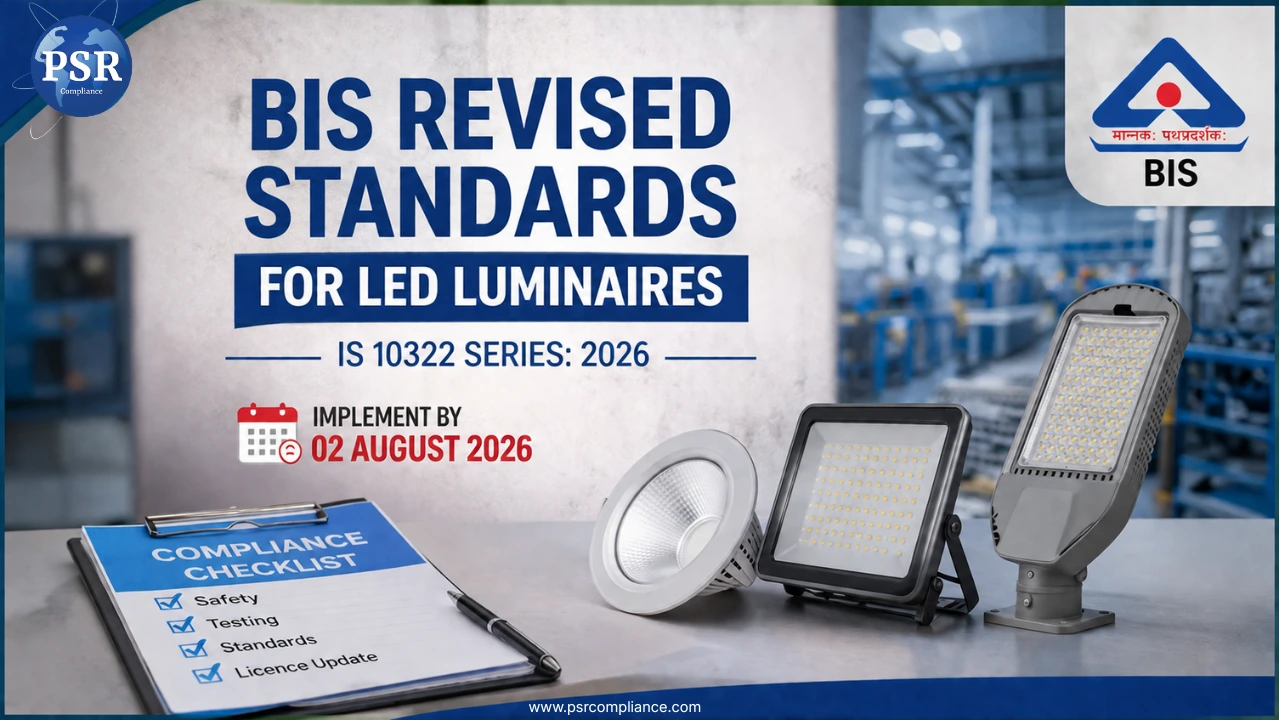
Guidelines for Implementation of Revised Standards for LED Luminaires: What Manufacturers Must Do Before 02 August 2026
For most LED lighting manufacturers, business planning usually revolves around production schedules, dealer orders, project deliveries, and government tenders. However, one important deadline is approaching that could directly affect your BIS licence, approved product models, and market access.
The Bureau of Indian Standards (BIS) has issued new Guidelines for Implementation of Revised Standards for LED Luminaires under the IS 10322 series. These guidelines were released by the Registration Department on 20 March 2026 (Reference No. Reg./IS 10322 Series/Guidelines/01) to help manufacturers transition from older standards to the revised versions.
The most important date in these guidelines is 02 August 2026. This marks the end of the concurrent running period for the old standards. After this date, manufacturers can no longer rely on the previous version of the standards for obtaining or maintaining BIS licences. Existing licence holders, new applicants, importers, and brand owners must ensure that their LED luminaires comply with the revised IS 10322 series before the deadline.
Why These Revised Standards Matter Beyond Compliance
Many businesses assume that revisions to Indian Standards only concern quality or testing departments. In reality, this update has a much broader commercial impact. A delay in adopting the revised standards can interrupt product approvals, slow down new product launches, and even affect participation in government projects or institutional tenders.
The revised standards influence several key business activities, including:
- Existing BIS licence validity
- Product model approvals
- Scope extension applications
- Laboratory testing schedules
- Government procurement eligibility
- Dealer and distributor confidence
- Marketplace listings
- Import planning
- Commercial project supplies
If manufacturers fail to transition to the revised standards within the prescribed timeline, BIS may initiate cancellation of licences or remove product models from the approved scope. Such actions can significantly affect business continuity, making early preparation essential.
Existing BIS Licence Holders Must Update Their Compliance
Manufacturers already holding a BIS licence for LED luminaires should not assume that their approval automatically continues under the revised standards. BIS requires every existing licensee to actively demonstrate compliance with the updated IS 10322 series before 02 August 2026.
To continue operating under the revised standards, manufacturers must submit fresh test reports for all lead models covered under their licence. These reports must be issued by a BIS-recognized laboratory and confirm compliance with the applicable revised standard.
Along with the laboratory reports, businesses are also required to submit an undertaking confirming that all other series models covered under the licence have been updated to comply with the revised requirements.
This means manufacturers should begin reviewing their complete product portfolio immediately rather than waiting until the final months before implementation.
New Applicants Should Plan Carefully During the Transition Period
The revised guidelines also affect businesses applying for BIS certification for the first time. During the transition period, certain applications may still be processed under the older version of the standard, but only under specific conditions.
Applications where product samples have already been submitted for testing, or where laboratory test reports have already been generated before the deadline, may continue under the previous standards. Similarly, new applications filed before 02 August 2026 may be accepted under either the old or revised standards.
However, applicants choosing the earlier version must provide a written declaration confirming that they will adopt the revised standard before the concurrent running period ends.
From a practical business perspective, manufacturers should carefully evaluate whether applying under the old standard actually saves time. Since every licence must eventually shift to the revised standard, many companies may find it more efficient to complete certification directly under the updated requirements.
Planning New Product Models Requires Better Timing
LED lighting manufacturers regularly introduce new products such as flood lights, street lights, recessed luminaires, decorative lighting, emergency lighting systems, and industrial luminaires. Under the revised guidelines, the timing of these product launches becomes much more important.
Requests for Change in Scope (CIS) under the old standards will only be accepted until the manufacturer adopts the revised standard or until 02 August 2026, whichever occurs earlier.
For companies planning multiple product launches, this creates an important strategic decision. Launching products under the previous standard may appear quicker initially but could require additional testing, documentation, and administrative work shortly afterwards when migrating to the revised standard.
Businesses should therefore evaluate whether launching directly under the revised IS 10322 series offers greater long-term efficiency.
What Has Changed in IS 10322 Part 1:2026?
The revised IS 10322 Part 1:2026 introduces several important technical updates that reflect the changing design and safety requirements of modern LED luminaires. These revisions go beyond routine editorial changes and introduce additional protection measures for users, installers, and maintenance personnel.
Some of the key technical updates include:
- Introduction of IPX9 protection requirements
- Addition of Electromagnetic Field (EMF) safety requirements
- Revised marking and labelling provisions
- New marking requirements for mains socket outlets
- Protection against fast rotating parts, including moving fan blades
- Introduction of PELV (Protective Extra-Low Voltage) systems
- Additional requirements for luminaires using controllable control gear with SELV outputs
- Updated testing methods for touch voltage and touch current limits
- Improved protection against electric shock from conductive parts
These revisions indicate that BIS is placing greater emphasis on electrical safety, user protection, energy-efficient lighting technologies, smart control systems, and modern luminaire designs. Manufacturers should carefully review these technical changes before submitting products for testing under the revised standards.
Common Mistakes That Can Delay Compliance
One of the biggest mistakes manufacturers make during standard revisions is assuming that they have enough time to complete the transition. In reality, testing laboratories become busier as the implementation deadline approaches, and documentation reviews often take longer than expected.
Several common issues can delay compliance, including:
- Waiting until the final months before scheduling laboratory testing
- Not identifying lead models that require fresh testing
- Incomplete technical documentation
- Incorrect or outdated product labels
- Delays in preparing undertakings for series models
- Failure to review revised marking requirements
- Lack of coordination between compliance and production teams
Even a minor non-conformity discovered during testing can require product modifications and additional testing, making early planning the safest approach.
How Manufacturers Should Prepare Before 02 August 2026
Rather than treating the revised standards as a last-minute compliance exercise, manufacturers should develop a structured implementation plan across all departments. A coordinated approach helps avoid unnecessary testing delays and ensures uninterrupted business operations.
A practical preparation plan includes:
- Preparing a complete list of all LED luminaire models covered under the BIS licence
- Identifying lead models and associated series models
- Mapping every product to the applicable revised IS 10322 standard
- Scheduling testing through BIS-recognized laboratories
- Reviewing product markings and labels
- Updating technical drawings and product documentation
- Preparing required undertakings for existing series models
- Monitoring the implementation timeline internally
Compliance should not remain solely the responsibility of the quality department. Product design, production, procurement, regulatory affairs, sales, and senior management should all understand the importance of the 02 August 2026 deadline.
Early Compliance Can Become a Competitive Advantage
Many businesses view compliance only as a legal requirement. However, companies that complete the transition early often gain significant commercial advantages.
Government departments, infrastructure developers, builders, electrical contractors, and institutional buyers increasingly prefer suppliers whose products already comply with the latest BIS standards. Updated certification provides confidence that products meet current safety and performance expectations.
Early implementation can strengthen business opportunities in:
- Government procurement projects
- Smart city developments
- Commercial building projects
- Industrial lighting installations
- Infrastructure contracts
- Retail lighting networks
- Electrical distribution channels
- Online marketplaces
- Corporate and institutional procurement
Instead of explaining why certification is still under process, manufacturers with updated licences can demonstrate immediate compliance and strengthen buyer confidence.
How a BIS Consultant Can Help
Transitioning to revised standards often involves more than laboratory testing. Manufacturers must review technical files, identify applicable standards, update labels, coordinate with testing laboratories, prepare documentation, and respond to BIS observations within specified timelines.
A professional BIS consultant can assist with:
- Applicability assessment of revised IS 10322 standards
- Model mapping and lead model identification
- Documentation review and preparation
- Coordination with BIS-recognized laboratories
- Product label and marking verification
- Technical file review
- BIS application and scope modification support
- Query handling during licence transition
- Compliance planning for future product launches
For manufacturers with multiple product categories, structured consultancy support can significantly reduce delays and simplify the transition process.
Final Takeaway
The Guidelines for Implementation of Revised Standards for LED Luminaires represent one of the most significant compliance updates for India's lighting industry. The transition deadline of 02 August 2026 is not merely an administrative milestone—it determines whether existing BIS licences remain valid under the revised IS 10322 series.
Existing licensees must complete testing of lead models and submit the required undertakings for series models before the deadline. New applicants should carefully evaluate whether applying under the previous standards is worthwhile, as every licence must eventually transition to the revised requirements.
The revised standards introduce important updates covering IP protection, EMF safety, marking requirements, PELV systems, SELV control gear, touch voltage limits, and protection against moving parts, making them highly relevant for today's LED lighting technologies.
Manufacturers who begin preparation early will be better positioned to maintain uninterrupted sales, participate in government tenders, expand product portfolios, and build stronger confidence among distributors and institutional buyers.
The transition to the revised IS 10322 series is more than a regulatory requirement—it is an opportunity to strengthen product quality, improve market credibility, and stay competitive in India's evolving LED lighting industry.
Need Assistance with BIS Certification for LED Luminaires?
PSR Compliance provides complete assistance for BIS certification and transition to revised IS 10322 standards, including:
- BIS Registration & Certification
- Standard Applicability Assessment
- Product Testing Coordination
- Technical Documentation Preparation
- Scope Extension Support
- Label & Marking Review
- BIS Application Filing
- Query Resolution
- End-to-End Compliance Consultancy
Contact PSR Compliance
📞 +91-8796104190
Frequently Asked Questions (FAQs)
1. What is the implementation deadline for the revised IS 10322 standards?
The concurrent running period ends on 02 August 2026. After this date, BIS licences under the older standards will no longer be granted or continued.
2. Do existing BIS licence holders need fresh testing?
Yes. Existing licensees must submit fresh test reports for lead models issued by BIS-recognized laboratories and provide undertakings for the remaining series models.
3. Can new applicants still apply under the old standards?
Applications may be processed under the old standards only during the transition period and subject to BIS guidelines. Applicants must also declare that they will implement the revised standards before 02 August 2026.
4. What are the major changes introduced in IS 10322 Part 1:2026?
The revised standard introduces IPX9 protection, EMF safety requirements, updated marking provisions, protection against rotating parts, PELV systems, additional SELV control gear requirements, and revised touch voltage and touch current testing.
5. Why should manufacturers begin compliance early?
Early preparation helps avoid laboratory delays, prevents disruption of BIS licences, supports uninterrupted product sales, and strengthens eligibility for government tenders and commercial projects.
6. How can PSR Compliance help with revised IS 10322 implementation?
PSR Compliance assists manufacturers with product applicability assessment, documentation, laboratory coordination, BIS applications, licence transition, scope extension, and complete regulatory compliance support.