Wed, Jun 17 2026
Raju Karn
UPPCB : Which Category Does Your Business Fall Under?
If you run a factory, a hotel, a hospital, or even a small workshop in Uttar Pradesh, there is one important question you must answer before you start operations :
Which pollution category does your business fall under?
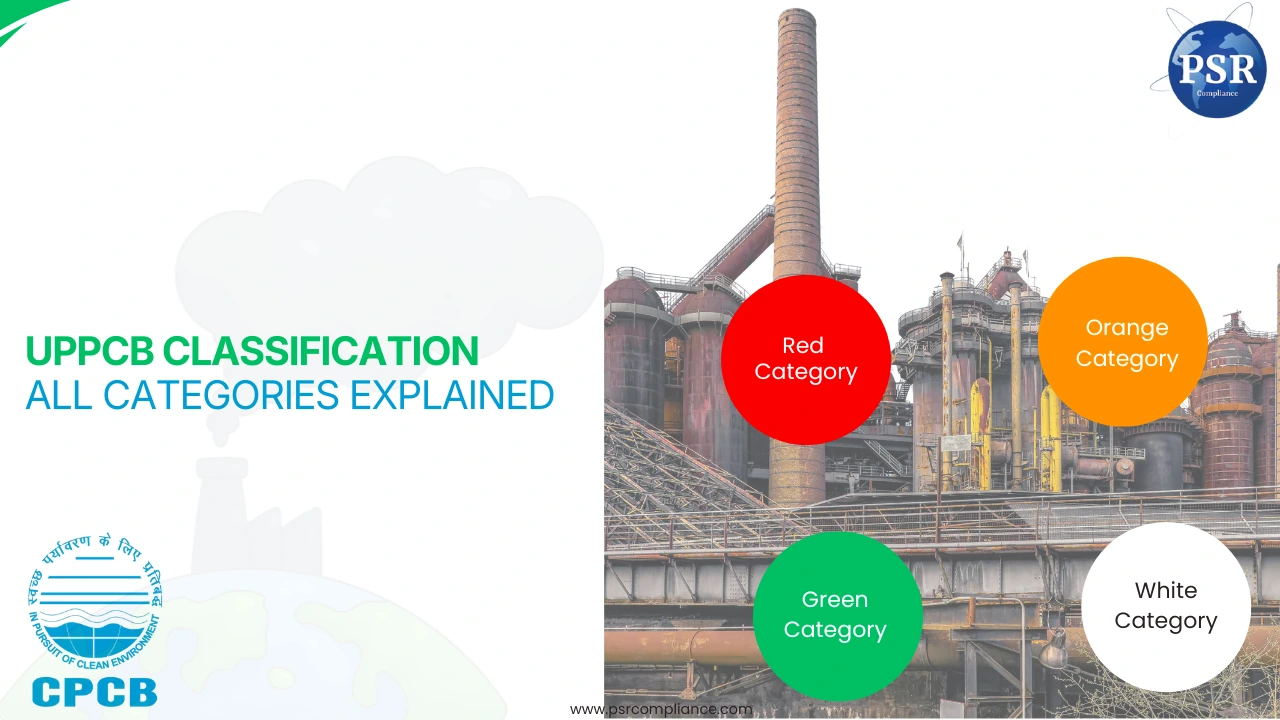
The Uttar Pradesh Pollution Control Board (UPPCB) classifies every industry and business into four color-coded categories, Red, Orange, Green, and White based on how much pollution they are likely to generate. This classification decides whether you need a pollution clearance certificate, how often your unit will be inspected, and what legal responsibilities you carry.
This guide breaks it all down in simple language so that whether you are a business owner, a student, or just someone curious about environmental rules in India, you will walk away with a clear understanding.
What Is the UPPCB Industry Classification System?
The UPPCB follows the directions of the Central Pollution Control Board (CPCB), which created a national system to rank industries based on their Pollution Index (PI). This index looks at three main things :
Water pollution : How much dirty water or effluent the industry produces
Air pollution : How much smoke, dust, or harmful gas is released
Hazardous waste : How much toxic or dangerous waste is generated
Based on the total Pollution Index score, every business is placed into one of four categories:
| Category | Pollution Index Score | Pollution Level |
|---|---|---|
| Red | 60 and above | High |
| Orange | 41 to 59 | Moderate |
| Green | 21 to 40 | Low |
| White | Up to 20 | Negligible |
This system was last significantly updated in 2020, when UPPCB issued an official office order adopting the CPCB's revised categorization, which also added new sectors like scrapping centers, used cooking oil collection centers, bio-gas plants, and railway stations.
Red Category: High Pollution Industries
Who Falls Under the Red Category?
Red category industries are those that pose the highest risk to the environment. These are units with a Pollution Index of 60 or above. There are currently 89 Red category sectors under UPPCB's list.
Examples include :
• Sugar mills and distilleries
• Cement plants
• Thermal power plants and DG sets of 5 MVA or more
• Pharmaceuticals manufacturing
• Tanneries (leather processing)
• Dyes and dye intermediates
• Oil refineries and petrochemicals
• Pulp and paper mills
• Fertilizer plants (basic)
• Slaughterhouses and meat processing
• Airports with wastewater generation of 100 KLD (kilolitres per day) or more
• Hospitals with incinerators or generating more than 100 KLD wastewater
• Hotels with 100 or more rooms or generating 100 KLD or more wastewater
• Common treatment and disposal facilities like TSDF, CETP for red industries, and sanitary landfill sites
Key Rules for Red Category :
➝ Must obtain Consent to Establish (CTE) and Consent to Operate (CTO) from UPPCB
➝ CTO is valid for up to 5 years
➝ Inspected at least once every 6 months
➝ Must maintain effluent treatment, air pollution control systems, and hazardous waste management records
Orange Category : Moderate Pollution Industries
Who Falls Under Orange Category?
Orange category industries generate a moderate level of pollution, with a Pollution Index score between 41 and 59. UPPCB currently lists 104 Orange category sectors.
Examples include :
• Automobile servicing, repairing, and painting (excluding fuel dispensing only)
• Building and construction projects over 20,000 sq.m
• Stone crushers
• Printing presses and gravure printing
• Food and food processing units
• Brickfields
• Hot mix plants (used in road construction)
• New highway construction projects
• Hotels with more than 20 rooms but less than 100 rooms
• Small dairy and dairy products units
• Foam manufacturing
• Reprocessing of waste plastic including PVC
• Scrapping centers for end-of-life vehicles (including dismantling and shredding)
• Compressed/Refined Bio-Gas production from biodegradable wastes (where wastewater is discharged)
• Railway locomotive workshops with wastewater generation under 100 KLD
Key Rules for Orange Category :
➝ Must obtain CTE and CTO
➝ CTO is valid for up to 10 years
➝ Inspected at least once every year
Green Category: Low Pollution Industries
Who Falls Under Green Category?
Green category businesses have a Pollution Index between 21 and 40. There are 70 Green category sectors recognized by UPPCB.
Examples include :
• Rice mills (hullers only, below 10 TPD capacity)
• Dal mills
• Flour mills (dry process)
• Cold storage and chilling plants
• Sawmills
• Carpentry and wooden furniture units (with electric machines)
• Poultry, hatchery, and piggery
• Cotton spinning and weaving (small scale)
• Fly ash export and transport facilities
• Mineral stack yards and railway sidings
• Oil and gas transportation pipelines with small power plants up to 5 MW
• Hotels with up to 20 rooms, no boiler, and less than 10 KLD wastewater generation
• Small railway stations with less than 10 KLD wastewater generation
• DG sets of capacity more than 10 KVA (standalone, without other industrial activity)
Key Rules for Green Category :
➝ Must obtain CTE and CTO
➝ CTO is valid for up to 15 years
➝ Inspected at least once every 2 years
White Category : Negligible Pollution Industries
Who Falls Under White Category?
White category businesses are considered nearly non-polluting with a Pollution Index of 20 or below. UPPCB lists 137 White category sectors. This category was introduced for the first time in 2016 by the CPCB.
Examples include :
• Tailoring shops
• Beauty parlors
• Small restaurants, tea stalls, and snack bars
• Handloom and carpet weaving (without dyeing)
• Garment manufacturing without wet process
• Assembly of computers and electronics
• Book binding
• Candle making
• Solar panel manufacturing
• Bee keeping
• Diesel generator sets under 10 KVA
• Typing centers and xerox shops
• Bindi making units
• Seed processing units
• Mushroom cultivation
• Used Cooking Oil (UCO) collection centers (Pollution Index = 0)
• IT companies (as defined by UPPCB's board order)
Key Rules for White Category :
➝ No Consent required, only an intimation (notification) to UPPCB is sufficient
But this exemption applies only if the unit is located in a designated industrial area, has an investment of not more than Rs. 1 Crore in plant and machinery, does not discharge any trade effluent or toxic waste, and generates no significant air, water, or noise pollution
If any pollution issue arises, UPPCB can take legal action even against white category units
Why Does This Classification Matter to You?
1. Legal Compliance
Without the correct pollution clearance (Consent to Establish and Consent to Operate), your business can be sealed or fined. Red and Orange category industries especially cannot legally operate without valid UPPCB consent.
2. Site Selection
Before you build or start a factory, the category tells you where you are allowed to set it up. Red category industries generally cannot be located near residential areas, water bodies, or ecologically sensitive zones.
3. Inspection Readiness
Depending on your category, you may be inspected every 6 months, every year, or every 2 years. Knowing your category helps you stay inspection-ready.
4. Financial Planning
Consent fees, compliance costs, treatment plant installation, and renewal expenses vary by category. Knowing your category upfront helps you budget accurately.
Benefits of Getting Your Pollution Clearance in Order
✓ Legal protection from closure notices, penalties, or court action
✓ Business continuity without fear of sudden shutdowns
✓ Better reputation with buyers, banks, and partners who check compliance status
✓ Access to bank loans and government schemes that require a valid CTO
✓ Eligibility for export orders where environmental certifications are checked
Penalties for Non-Compliance
Ignoring UPPCB's classification rules can result in serious consequences :
⚠ Closure notice issued under Section 33A of the Water (Prevention & Control of Pollution) Act, 1974
⚠ Criminal prosecution for the owner and directors
⚠ Fines and environmental compensation based on the Pollution Index of your sector
⚠ Bank loan rejection if clearance certificates are not in order
⚠ Public interest litigation filed by residents or NGOs, which can lead to court-ordered shutdowns
UPPCB has the authority under both the Water Act (1974) and the Air Act (1981) to stop operations, seal premises, and initiate prosecution of offenders.
How to Check Your Category and Apply for Consent
- Visit the official UPPCB website or the CPCB's categorization document
- Search for your industry sector in the Red, Orange, Green, or White list
- If your sector is not listed, UPPCB's Member Secretary-led committee will assess and categorize it
- Apply for CTE before construction and CTO before starting production through the UPPCB online portal
Final Thoughts
The UPPCB category system is not just a bureaucratic requirement, it is a practical tool that tells you exactly how your business affects the environment and what responsibilities you carry. Whether you run a large factory, a mid-size hotel, or a small tailoring unit, knowing your category puts you ahead of legal trouble and helps you run your business with confidence.
When in doubt, always consult an environmental consultant or contact UPPCB directly to confirm your classification before you invest in a new venture. Staying compliant from day one is far cheaper and easier than trying to fix violations after the fact.
Get Expert Help with UPPCB Consent & Pollution Clearance
Not sure whether your business falls under the Red, Orange, Green, or White category? PSR Compliance provides end-to-end assistance with industry categorization, Consent to Establish (CTE), Consent to Operate (CTO), Pollution NOC approvals, documentation, and UPPCB compliance requirements.
👉 Ensure smooth approvals and stay compliant with UPPCB regulations from day one
📞 +91 8796104190
📧 support@psrcompliance.com
Common Queries Businesses Have
Q: My small hotel has 15 rooms and no boiler. Which category do I fall under?
You would fall under the Green category if your wastewater generation is less than 10 KLD and you generate no hazardous waste.
Q: I run an automobile repair shop. Do I need UPPCB consent?
Yes. Automobile servicing and painting falls under the Orange category (if wastewater is less than 100 KLD) or Red category (if wastewater exceeds 100 KLD). You need UPPCB consent.
Q: My factory generates no liquid waste. Does it still need consent?
It depends on air pollution and hazardous waste. Even dry process units may need consent if they generate dust emissions or use chemicals.
Q: Can my category change over time?
Yes. Under the 2023 revised CPCB methodology, businesses that adopt cleaner fuels or technologies can apply for reclassification into a lower category, which means fewer compliance requirements.