


Just send us your questions or concerns by starting a new case &
we will give you the help you need. Start Here...
Trademark Registration
Sat, Aug 22 2026
Raju Karn
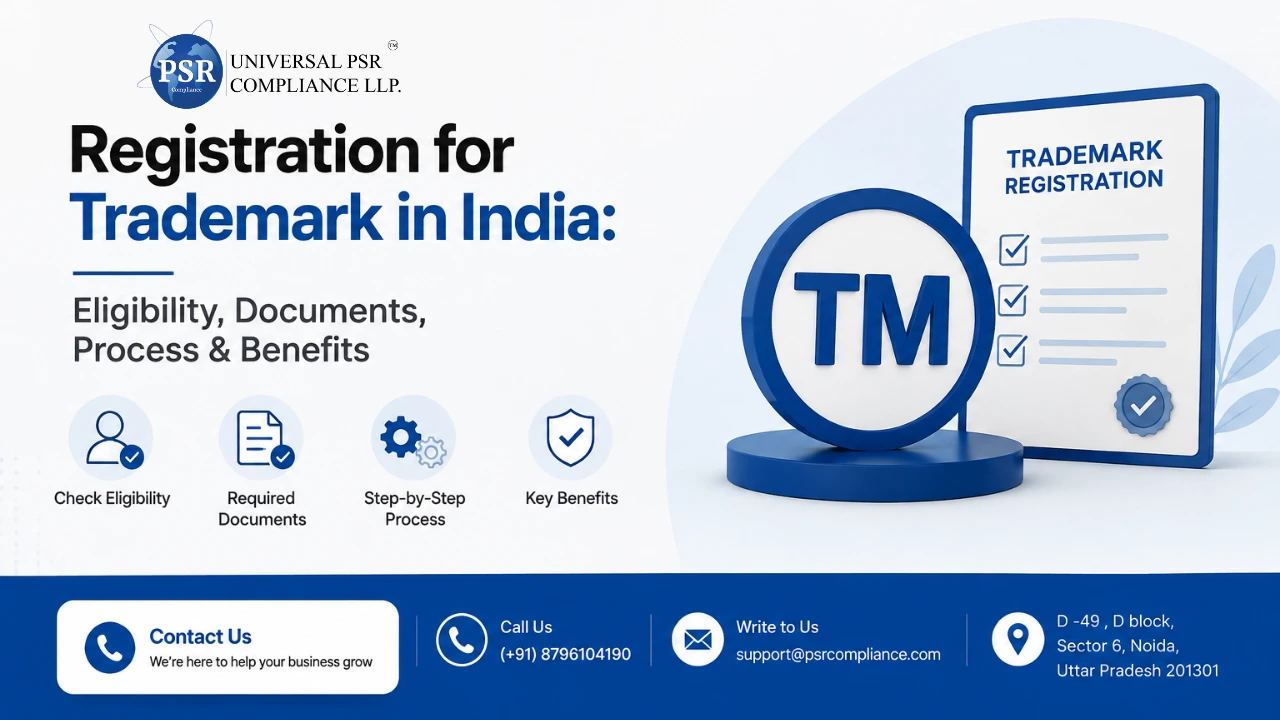
Registration for Trademark in India: Eligibility, Documents, Process & Benefits
The brand name, logo, or tagline is among the most important business assets that you may have. However, many entrepreneurs in India neglect the registration of their brands till a competing company makes use of the same brand name, and the damage is done already. Trademark registration in India is the only legal tool that will help you secure your brand identity from misuse by others.
You will get complete information in this article regarding who is eligible to register, documents required, trademark registration process, cost of trademark registration in India, and benefits of registering a trademark.
What Is a Trademark and Why Does It Matter?
A trademark refers to any form of intellectual property that includes names, symbols, sounds, or other features that allow consumers to recognize the origin of their goods or services. They can be anything from a brand name, company logo, or slogan to unique package designs.
After being registered according to the provisions of the Trade Marks Act, 1999, trademarks provide an individual with the legal right to use their mark exclusively for their goods/services and allow the person to take legal action against any form of infringement.
There has been an increase in the filing of trademarks in India since the last decade, which is due to the influx of startups, D2C companies, and MSMEs realising the importance of branding early on. The ease of filing trademarks online by the Indian government through the IP India E-filing portal is evident in the same.
Who Can Apply? Eligibility for Trademark Registration in India
One of the most positive aspects of Indian trademark laws is the wide scope of eligibility. You do not have to be a big company to obtain trademark protection.
Individuals and Sole Proprietors
An individual, be it a freelancer, consultant, or sole proprietor can apply for a trademark in his or her own name, even before registering a formal business entity.
Startups and MSMEs
Recognized by DPIIT, startups and registered MSMEs are eligible for trademark application, and they have a reduced government fee.
Companies, LLPs, and Partnership Firms
Limited liability companies, LLPs, partnerships, and other types of business entities can file a trademark application under the name of the company, having the required proof of registration.
Foreign Applicants
Even foreign individuals and companies can apply for trademark registration in India. They usually use a trademark agent or attorney from India for correspondence with relevant authorities.
There are no limitations related to the business size or revenue; it matters only that the mark is distinctive, not offensive, and not identical with an existing trademark.
Documents Required for Trademark Registration
Correct documentation from the start will save any trouble in the future. The following is the required Trademark Registration Documents list:
For Individuals and Sole Proprietors
PAN Card & Aadhaar Card (Proof of Identity)
Proof of address (Utility Bill, Passport, or Voter ID)
A distinct image or logo of the trademark you want to register
Power of attorney signed by you (TM-48 Form) if filing through an agent
For Companies and LLPs
Incorporation Certificate/Limited Liability Partnership Registration Certificate
PAN Card of the entity
Udyam/MSME Registration Certificate (if required to avail the fee concession)
Startup recognition certificate from DPIIT (if applicable)
Board Resolution/Authority Letter
Image of Logo/Wordmark
For Claiming Prior Use
In case you have been using the trade mark for business purposes before, having a user affidavit along with invoices and promotional material would be helpful for claiming prior use.
Step-by-Step Trademark Registration Process in India
Let me explain to you what happens in reality during the registration process of the trademark.
Step 1: Conduct a Trademark Search
Before applying for registration, perform a trademark search of the public database on the IP India website to find out if there is an identical or similar mark registered in your class. Not performing this step is one of the main reasons why the application may be objected to or opposed in the future.
Step 2: Choose the Right Trademark Class
India follows the Nice Classification system with 45 trademark classes, where 34 classes are related to goods, and 11 are related to services. If your brand works in different areas, then you will need to apply for registration in different classes, paying separate fees for each. For example, your restaurant brand providing food services (Class 43) and also selling sauces (Class 30) should submit an application in both classes. (IP India – Search Goods & Services Classification)
Step 3: File Form TM-A
The application is submitted electronically using the IP India e-filing service and Form TM-A.
Step 4: Examination by the Registrar
Distinctiveness and conflicts with other trademarks are assessed at this stage by the Registrar. In case there is an objection, you will be allowed to answer it and present evidence within 30 days.
Step 5: Publication in the Trademark Journal
Following this, the mark is published in the Trademark Journal to undergo a four-month opposition period, where third parties can oppose the mark if they feel it violates their trademark rights.
Step 6: Registration Certificate
In case no opposition is raised against the mark or in case of favourable resolution of opposition, the Registrar will issue the trademark registration certificate.
How Long Does It Take?
According to Registry practice in present times, trademark registration in India usually requires about 12 to 18 months for unopposed applications, although opposed applications may take more time (source). It is legal to use the ™ mark immediately after filing of the application, even before issuance of the certificate.
Trademark Registration Fees in India
Government fees are fixed under the Trade Marks Rules, 2017 and are charged per class, per application.
| Applicant Type | Government Fee (E-filing) |
|---|---|
| Individuals, DPIIT Startups, MSMEs | Rs 4,500 per class |
| Companies and LLPs | Rs 9,000 per class |
| Renewal (every 10 years) | Rs 9,000 per class |
"All government charges for trademark registration in India can be found in the First Schedule of the Trade Marks Rules, 2017, framed by the Office of the Controller General of Patents, Designs & Trade Marks (CGPDTM)." The updated fee structure can be verified on the official IP India website.
In addition to the government fee, applicants usually have to pay the professional fee to a trademark lawyer or agent for performing searches, drafting objections, and other related tasks.
Benefits of Registering a Trademark
Beyond securing legal ownership, registering a trademark unlocks several strategic advantages that protect and scale your brand.
Exclusive Legal Ownership
Your trademark registration ensures you have exclusive rights to use your brand name or logo on your specified products and services in India.
Legal Actions for Infringement
In case your brand is replicated, you can seek legal help in the form of a cease and desist order or infringement lawsuit with the help of your registration certificate as proof.
Creation of Brand Value and Credibility
Your trademark registration increases the value of your brand and shows its credibility to investors and consumers. It is a non-tangible asset that can be evaluated, licensed, and even sold.
Nationwide Usage of a Trademark
Unlike your business registration, which is limited to one state only, trademark registration provides you with nationwide rights.
International Protection of Your Trademark
Your registered Indian trademark will act as the base for filing international trademarks under the Madrid Protocol in the future.
Common Mistakes to Avoid
Even with the right strategy in place, steering clear of these frequent pitfalls will save you the most time and effort.
Bypassing the searching stage – Filing without considering other marks that could conflict may trigger opposition or refusal.
Choosing the wrong classification – A wrong classification would mean that the application does not cover the goods or services that matter.
Generic and Descriptive Marks – A mark that describes a product (example, "Fresh Bread" for a baker) makes it difficult to register under Section 9 of the Act.
Not attending to the objections – Not answering the examination report within 30 days could mean that the application is considered abandoned.
Failure to renew – A trademark is in force for 10 years and needs to be renewed promptly, or it gets removed from the registry.
Conclusion
The process of registering a trademark is not only a procedural formality but also an investment in the identity and worth of your brand. There are many stages involved in the process at which one needs to be careful, where small mistakes can delay the process by months or even deny trademark registration.
This is where the importance of compliance assistance comes into play. PSR Compliance offers compliance services for individuals, startups, and businesses in India that include trademark searching, trademark registration, answering objections, and renewals.
Frequently Asked Questions
1. Who qualifies for filing a trademark application in India?
Any individual, sole proprietorship, partnership, LLP, company, or any other foreign applicant qualifies for filing an application provided that the trademark is distinctive and is not registered under someone else within the same class.
2. What is the trademark registration cost in India?
The online e-filing government trademark registration cost charged per class is ₹4,500 for individuals, sole proprietors, MSMEs, and start-ups, and ₹9,000 for other corporate applicants per class (source), besides any professional charges, if you choose to hire a professional agent.
3. How long does it take to register a trademark in India?
It usually takes 12 to 18 months to register a trademark application if there are no objections against it, and one can use the trademark ™ symbol from the date of filing the application.
4. Is it compulsory to register a trademark in India?
No, it is not compulsory by law; however, an unregistered trademark provides only narrow protection under common law.
5. For how many years is a registered trademark valid, and can it be extended further?
A trademark is valid for 10 years from the date of its registration and can be extended forever at 10-year intervals.