
Just send us your questions or concerns by starting a new case &
we will give you the help you need. Start Here...
Company Registration
Fri, Apr 10 2026
Raju Karn
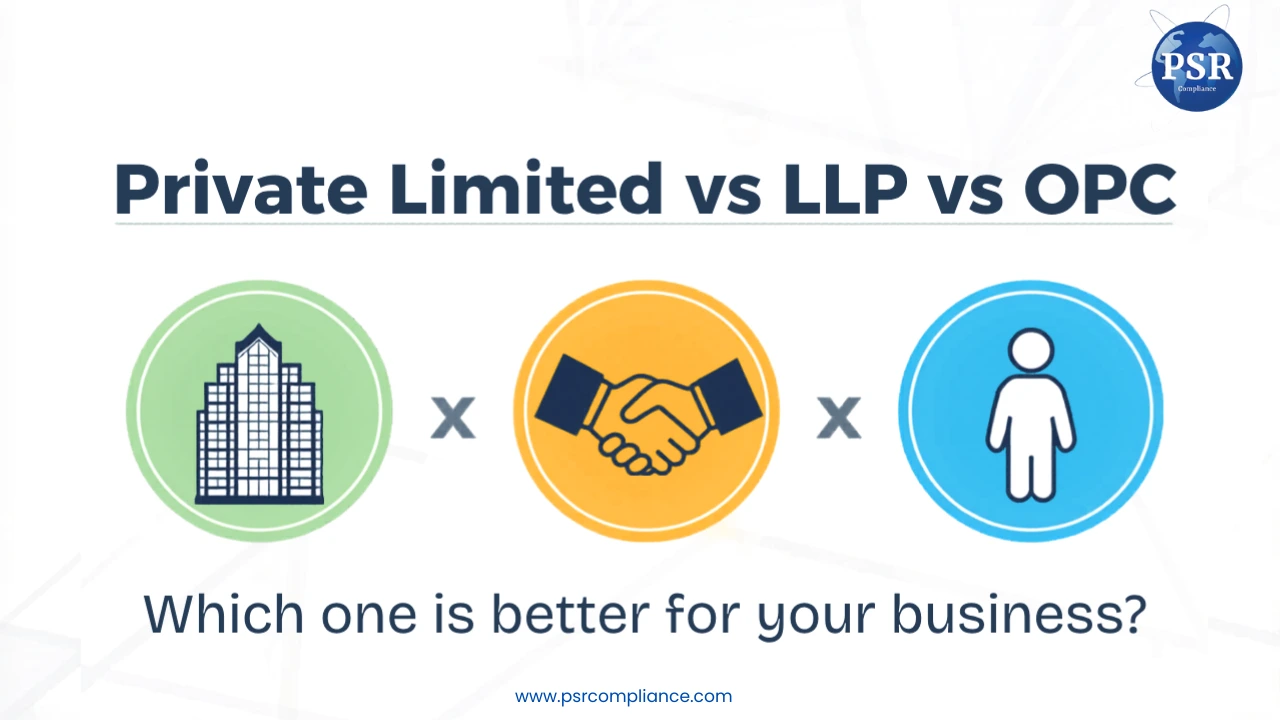
Private Limited Company Registration vs LLP vs OPC – Which is Better in 2026?
Starting a business in 2026 is easier than before, but choosing the right company structure is still one of the most confusing decisions for many people. Most beginners are unsure about which option to choose and often get stuck between different types of companies.
Many common questions come up, like whether to start a Private Limited Company, whether LLP is better for a small or service-based business, or if OPC is the right choice for someone starting alone. The truth is, there is no one perfect option for everyone. The right choice depends on your business goals, how you plan to grow, whether you need funding, and how much compliance you can manage. In this guide, we will clearly compare Private Limited Company, LLP, and OPC in the simplest way, so you can easily decide which structure is best for you in 2026.
Why Choosing the Right Business Structure Matters in 2026
Before you register your company in India, it is very important to choose the right business structure. Many people ignore this step and choose any option quickly, but this decision affects your business for a long time.
Once your company is registered, changing the structure later is possible, but it takes time, effort, and extra cost. Different company types also have different rules. Some have more legal work (compliance), some have different tax systems, and some are better for getting funding from investors or banks. So, your choice will directly affect how your business runs daily and how easily it can grow.
In 2026, this decision has become even more important. Investors, banks, and government departments now check whether your business is properly structured and compliant. Most of this is managed through the MCA (Ministry of Corporate Affairs) system, where all company records are maintained. If your structure is right from the beginning, it becomes easier to build trust, get approvals, and grow your business smoothly in the future.
What is a Private Limited Company?
A Private Limited Company is one of the most popular business structures in India, especially for startups and growing businesses. It is registered under the Companies Act, 2013 through the MCA (Ministry of Corporate Affairs) portal. In this type of company, the business is treated as a separate legal entity, which means it has its own identity apart from the owners.
This structure is preferred because it provides safety, trust, and better growth opportunities. It allows businesses to raise funds easily and protects the personal assets of the owners if the company faces any loss or debt.
Key Features:
● Minimum 2 Directors are required to manage the company
● Minimum 2 Shareholders are needed to own the company
● Limited liability protection keeps personal assets safe
● Separate legal identity allows the company to operate in its own name
- Suitable for startups and businesses planning to raise funding or scale in the future
What is an LLP (Limited Liability Partnership)?
An LLP, or Limited Liability Partnership, is a type of business structure that combines the flexibility of a partnership with the safety of a company. In simple words, it allows two or more people to run a business together while also protecting their personal assets. It is registered under the LLP Act and is commonly used by professionals and small service-based businesses.
This structure is popular because it is easier to manage and has fewer legal formalities compared to a Private Limited Company. At the same time, it still gives protection to partners, which makes it a safe and practical option for many small and medium businesses.
Key Features:
➤ Minimum 2 partners are required to start an LLP
➤ Lower compliance and fewer legal rules compared to Private Limited Company
➤ Limited liability protection, so personal assets are generally safe
➤ Flexible profit-sharing among partners based on mutual agreement
What is an OPC (One Person Company)?
An OPC, or One Person Company, is a type of business structure made for people who want to start a company on their own. It allows a single person to run a business while still getting the benefits of a company, like legal protection and a separate identity. This concept became popular after government reforms that encouraged startups and small entrepreneurs.
In simple words, OPC is perfect for individuals who do not have partners but still want a proper company setup instead of running an informal business. It gives a more professional image and helps in building trust with customers and banks.
Key Features:
➔ Only 1 director is required to start the company
➔ Limited liability, so personal assets are protected
➔ Separate legal identity, meaning the company works in its own name
Ideal for solo founders and small business owners
Private Limited vs LLP vs OPC – Comparison Table (2026)
| Feature | Private Limited Company | LLP | OPC |
|---|---|---|---|
| Minimum Members | 2 | 2 | 1 |
| Maximum Members | 200 | No Limit | 1 |
| Legal Identity | Separate | Separate | Separate |
| Liability | Limited | Limited | Limited |
| Compliance | High | Moderate | Moderate |
| Annual Filing | Mandatory | Mandatory | Mandatory |
| Taxation | 22%–25% approx. | 30% approx. | Same as Pvt Ltd |
| Fundraising | Easy | Limited | Very Limited |
| Investor Friendly | Yes | No | Limited |
| Ownership Transfer | Easy | Difficult | Limited |
| Management | Directors | Partners | Single Owner |
| Credibility | High | Medium | Medium |
| Scalability | High | Medium | Low |
| Audit Requirement | Required | Conditional | Conditional |
| Setup Cost | High | Medium | Low |
| Best For | Startups | Professionals | Solo Founders |
Private Limited Company – Advantages in 2026
Many startups and growing businesses prefer Private Limited Company registration because it offers strong support for funding, growth, and trust-building. It is considered one of the most reliable business structures in India for long-term success.
Major Benefits:
1. Easy Funding Opportunities
Private Limited Companies are the first choice for investors like angel investors, venture capitalists, and banks. This is because shares can be issued easily, which helps in raising funds for business expansion.
2. Strong Brand Credibility
Having “Private Limited” in your company name creates a professional image. It builds trust among customers, suppliers, and financial institutions, making your business look more reliable and established.
3. Simple Ownership Transfer
In a Private Limited Company, ownership can be transferred through shares. This makes it easier to bring in new partners or exit the business without much legal complexity.
4. Best for Business Growth
This structure is designed for scalability. If you plan to expand your business, hire more people, or enter new markets, a Private Limited Company supports long-term growth and stability.
Private Limited Company – Disadvantages
Every business structure has some limitations, and a Private Limited Company is no exception. While it offers many benefits, it also comes with certain responsibilities and challenges that business owners must manage properly.
Challenges Include:
1. Higher Compliance Requirements
A Private Limited Company must follow strict legal rules. This includes maintaining records, holding meetings, and following proper corporate governance under MCA guidelines.
2. Mandatory Audits
In most cases, the company accounts must be audited by a Chartered Accountant every year, even if the business is small. This adds extra responsibility and professional involvement.
3. Annual Filings with MCA
Companies are required to file annual returns and financial statements with the Ministry of Corporate Affairs (MCA). Missing deadlines can lead to penalties.
4. Slightly Higher Cost
Compared to LLP or sole proprietorship, a Private Limited Company has higher setup and maintenance costs due to compliance, accounting, and audit requirements.
LLP – Advantages in 2026
A Limited Liability Partnership (LLP) is a popular choice among professionals and service-based businesses because it offers a balance of flexibility and legal protection. It is easier to manage compared to a Private Limited Company and is suitable for small to medium-sized businesses.
Key Benefits:
1. Lower Compliance Burden
LLPs have fewer legal requirements compared to Private Limited Companies. There are fewer filings, less paperwork, and simpler annual compliance, making it easier to manage.
2. Flexible Management Structure
Partners can manage the business freely based on mutual agreement. There are no strict corporate rules like board meetings or complex decision-making structures.
3. Cost-Effective Structure
The overall cost of starting and maintaining an LLP is generally lower. This makes it a good option for small businesses that want to reduce expenses.
4. Best for Professional Businesses
LLPs are especially suitable for service-based and professional firms such as:
- Chartered Accountant (CA) firms
- Legal firms
- Consultants
- Marketing and service agencies
LLP – Disadvantages
Although LLP is simple and flexible to run, it also has some limitations. It is more suitable for small and medium service-based businesses, but not always ideal for fast-growing or funded startups.
Common Issues:
1. Harder to Raise Funding
LLPs are not preferred by investors like venture capitalists or angel investors. This makes it difficult to raise large-scale funding for expansion.
2. Low Investor Interest
Most investors prefer Private Limited Companies because they can invest through shares. LLPs do not offer equity shares, so investment opportunities are limited.
3. Difficult Ownership Transfer
Changing or adding partners in an LLP is more complex compared to transferring shares in a company. It usually requires changes in the LLP agreement.
4. Limited Growth Flexibility
LLPs are better for stable businesses. They are not ideal for aggressive scaling, rapid expansion, or businesses planning to go global or raise funds.
OPC – Advantages in 2026
One Person Company (OPC) is a great option for individuals who want to start a business alone but still enjoy the benefits of a registered company. It gives a proper legal structure without needing any business partner.
Key Benefits:
1. Single Ownership
OPC allows one person to fully own and control the business. You don’t need any partners to start or manage the company.
2. Limited Liability Protection
Your personal assets like savings, house, or property are protected. If the business faces loss or debt, it does not directly affect your personal wealth.
3. Better Credibility than Sole Proprietorship
An OPC is a registered company, so it looks more professional and trustworthy compared to a normal sole proprietorship business.
4. Ideal for Freelancers and Solo Entrepreneurs
OPC is perfect for individuals such as:
- Designers
- Developers
- Consultants
- Small business owners
OPC – Disadvantages
One Person Company (OPC) is a good option for solo entrepreneurs, but it also comes with certain rules and limitations. It is not designed for large-scale or fast-growing businesses.
Limitations Include:
1. Only One Shareholder Allowed
In OPC, only one person can own the company. You cannot add partners or co-founders as shareholders.
2. Limited Funding Opportunities
It is difficult to raise funds in an OPC because investors prefer companies with multiple shareholders and equity structure, like a Private Limited Company.
3. Limited Growth Scope
OPC is suitable for small businesses. It may not support aggressive expansion or large-scale operations easily.
4. Mandatory Conversion Rule
If the OPC crosses certain turnover or capital limits, it must be converted into a Private Limited Company as per government rules.
Which Structure is Best for Startup Funding in 2026?
If funding is your goal:
Choose Private Limited Company.
Why?
Because:
- Venture capitalists invest in Pvt Ltd
- Angel investors prefer share-based structure
- ESOP (Employee Stock Option Plans) possible
Funding is almost impossible in LLP or OPC structures.
Which Structure is Best for Small Businesses?
If you are starting small:
LLP is often the best choice.
Especially if:
- You run service-based business
- You have 2 partners
- Funding is not required
- LLP keeps compliance manageable.
Which Structure is Best for Solo Entrepreneurs?
If you are starting alone:
OPC is usually the best option.
Ideal for:
- ▪ Freelancers
- ▪ Online businesses
- ▪ Independent professionals
▪ It gives legal identity without needing partners.
Compliance Comparison in 2026
Compliance is a major factor in structure selection.
| Compliance | Private Limited | LLP | OPC |
|---|---|---|---|
| Annual Filing | Mandatory | Mandatory | Mandatory |
| Audit | Mandatory | Limited | Mandatory |
| Board Meetings | Required | Not Required | Limited |
| MCA Filings | Frequent | Moderate | Moderate |
Compliance Comparison in 2026
Compliance is a major factor in structure selection.
| Compliance | Private Limited | LLP | OPC |
|---|---|---|---|
| Annual Filing | Mandatory | Mandatory | Mandatory |
| Audit | Mandatory | Limited | Mandatory |
| Board Meetings | Required | Not Required | Limited |
| MCA Filings | Frequent | Moderate | Moderate |
Taxation Difference in 2026
Taxation rules vary depending on structure.
Private Limited Company:
Corporate tax applies.
LLP:
Taxed like partnership firm.
OPC:
Taxed like company.
Consulting a professional helps reduce tax mistakes.
Real-Life Decision Guide (2026)
| Business Type | Choose This Structure | Reason |
|---|---|---|
| You want investors | Private Limited Company | Investors prefer equity-based structure for funding |
| You want to scale your business | Private Limited Company | Best for long-term growth and expansion |
| You want strong branding & trust | Private Limited Company | High credibility in market and with clients |
| You are planning long-term business growth | Private Limited Company | Supports fundraising, hiring, and expansion |
| You run a service-based business | LLP | Flexible structure with lower compliance |
| You want fewer compliance rules | LLP | Easier legal and filing requirements |
| You do not need investors | LLP | Suitable for self-funded or stable businesses |
| You are a solo founder | OPC | Designed for single-owner businesses |
| You are starting small | OPC | Simple structure for small-scale operations |
| You want limited risk | OPC | Limited liability protects personal assets |
Common Mistakes While Choosing Business Structure
Many founders make avoidable mistakes.
Mistake 1: Choosing Structure Without Growth Planning
Always think long-term.
Mistake 2: Ignoring Compliance Requirements
Some structures require strict filings.
Mistake 3: Copying Others
Your business needs may differ.
Mistake 4: Choosing Only Based on Cost
Low cost today may cost more later.
MCA Registration Process Overview (2026)
In India, all company registrations are done through the MCA (Ministry of Corporate Affairs) portal. This is an online system where you can legally register your business and get official approval from the government.
The process is simple but must be followed step by step to avoid rejection or delay.
Basic Steps:
- Choose Company Name
First, you need to select a unique name for your business that is not already registered or too similar to existing companies. - Obtain DSC and DIN
Digital Signature Certificate (DSC) is used to sign documents online, and Director Identification Number (DIN) is required for all directors. - File Incorporation Form
Submit the official incorporation application with all required details of the company, directors, and shareholders. - Submit Required Documents
Upload identity proof, address proof, and business-related documents on the MCA portal. - Receive Certificate of Incorporation
Once approved, you receive the Certificate of Incorporation, which means your company is officially registered.
Client Experience
"We were confused between LLP and Private Limited while starting our IT company. The PSR Compliance team helped us understand future funding needs and guided us to register a Private Limited Company. The process was smooth and fast."
— Startup Founder, Noida
Need Help Choosing the Right Company Structure?
Contact PSR Compliance for expert support in company registration and structure selection.
📞 7065883416 | 📧 support@psrcompliance.com
FAQs
- Which company type is best for startup funding in India?
👉 Private Limited Company is best for startup funding in India. - Which business structure has the lowest compliance in India?
👉 LLP has the lowest compliance among all business structures in India. - Can a solo founder register a Private Limited Company in India?
👉 Yes, a solo founder can start a Private Limited Company with one nominee. - Which is better for small business in India, LLP or Pvt Ltd?
👉 LLP is better for small service businesses, while Pvt Ltd is better for growth. - Which company structure is easiest to start in India?
👉 OPC is the easiest structure for single-person businesses in India. - Which business type is most trusted by investors in India?
👉 Private Limited Company is most trusted by investors in India. - Can OPC be converted into Private Limited Company later?
👉 Yes, OPC must be converted into a Private Limited Company after certain limits. - Which company type is best for freelancers in India?
👉 OPC or LLP is best for freelancers depending on growth needs.