

Just send us your questions or concerns by starting a new case &
we will give you the help you need. Start Here...
IEC Registration
Fri, Aug 21 2026
Raju Karn
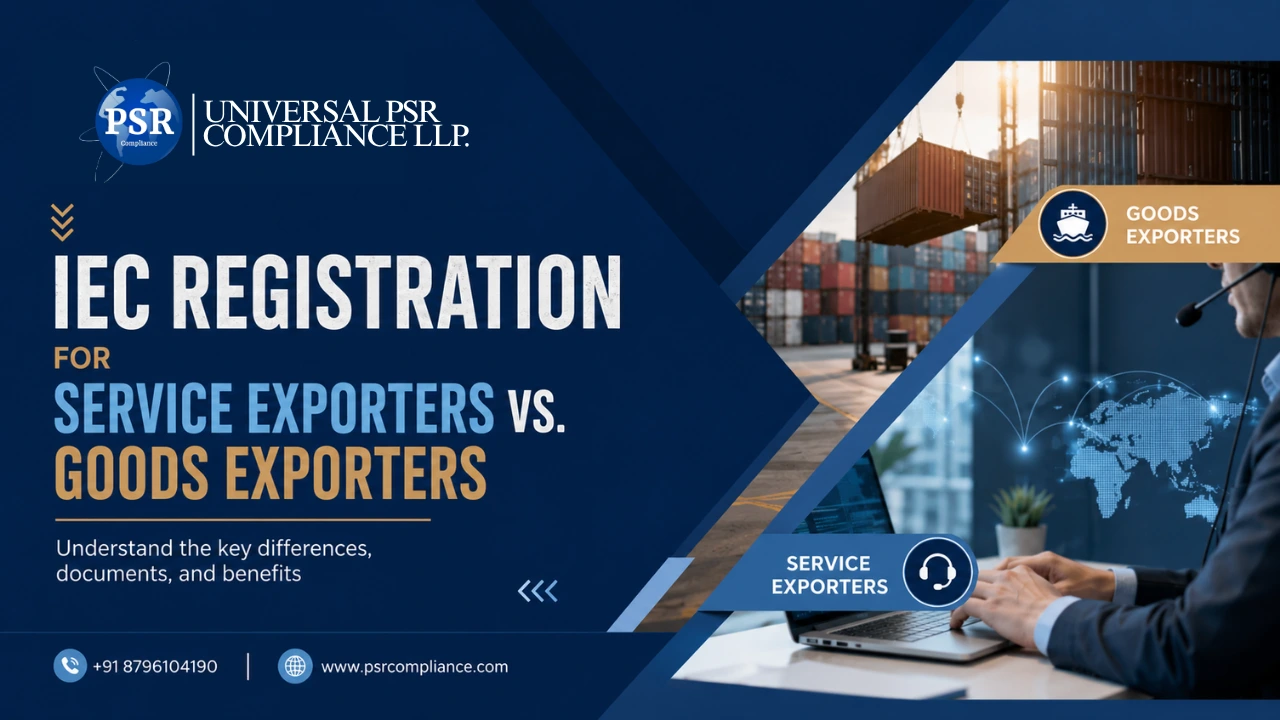
IEC Registration for Service vs Goods Exporters in India (2026)
If you are an Indian freelancer, SaaS startup, consultant, software company, or business exporting products to foreign customers, you may have heard conflicting information about whether an IEC Code is mandatory. The answer depends largely on whether you are exporting goods or services. Goods exporters generally require IEC for cross-border shipments, while service exporters can have different requirements depending on their activities, export benefits, banking requirements, and business model.
This guide explains the difference between IEC registration for service exporters and goods exporters, when freelancers and SaaS companies may need an IEC, what FEMA compliance involves for service exports, and how to apply for IEC registration online through DGFT.
What is an IEC Code?
IEC stands for Importer Exporter Code. It is a unique identification number issued by the Directorate General of Foreign Trade (DGFT), Ministry of Commerce and Industry, for businesses and eligible individuals involved in international trade.
For goods exporters, IEC plays an important role in customs and export documentation. DGFT's official guidance describes IEC as a 10-digit code based on PAN and confirms that the application process is completed online through the DGFT portal.
The important point is that goods and service exporters do not always have identical IEC requirements. Your requirement should be determined by the nature of your export activity and whether you need IEC-linked benefits or other business purposes.
IEC Requirements: Goods Exporters vs. Service Exporters
The biggest confusion around IEC registration comes from treating goods and services exports as the same. They are not.
| Export Type | IEC Position | Key Compliance Requirements |
|---|---|---|
| Goods Exporters | Generally required for export transactions | Customs documentation, shipping documents, foreign exchange realization |
| Service Exporters | IEC may not be mandatory in every case | FEMA, banking, invoices, foreign exchange realization and applicable reporting |
| Freelancers Exporting Services | Generally may operate without IEC in certain cases | Export invoices, banking records, purpose codes and payment documentation |
| SaaS & Software Exporters | Depends on business activity and applicable requirements | Foreign payment records, GST documentation and applicable software export reporting |
| Service Exporters Claiming Applicable DGFT Benefits | IEC becomes important/required for the relevant benefit | IEC and scheme-specific documentation |
| Businesses Exporting Goods + Services | IEC becomes relevant for goods exports | Goods export and applicable service-export compliance |
Your uploaded source specifically highlights that a freelancer or SaaS company exporting services may not automatically need an IEC merely because it receives payments from overseas clients. However, IEC can become important when claiming applicable Foreign Trade Policy benefits, meeting client requirements, joining export councils, or starting physical goods exports.
Is IEC Mandatory for Goods Exporters?
For businesses exporting physical goods from India, IEC is generally a fundamental requirement. Goods exporters need to use the IEC in the applicable customs and export documentation so that the transaction can be identified and processed through the relevant systems.
Without the required IEC, an exporter can face difficulties with customs clearance and international shipment processing. DGFT's guidance also describes IEC as a key requirement for import and export transactions and confirms that IEC applications are submitted online.
Do Service Exporters Need an IEC?
Service exporters have a different position. According to the supplied source, IEC is generally not required solely for exporting services, unless the service provider needs it for a specific purpose such as claiming applicable Foreign Trade Policy benefits or meeting a commercial requirement.
For example, an Indian freelancer providing software development to a US client or a SaaS company receiving subscription payments from UK customers may not automatically require IEC merely because the customer is located outside India. However, that does not mean service exporters are exempt from foreign exchange, tax, banking, documentation, or other applicable compliance requirements.
Why "No Mandatory IEC" Does Not Mean "No Compliance"
Even where IEC is not required for a particular service-export transaction, the exporter still needs to comply with applicable FEMA and RBI requirements relating to foreign exchange receipts.
Service exporters may need to:
- Receive foreign earnings through authorised banking channels.
- Use the appropriate RBI purpose code for the nature of the service.
- Ensure export proceeds are realised and repatriated within the applicable regulatory timeline.
- Complete applicable software-export reporting such as SOFTEX where required.
- Maintain invoices, contracts, bank records, e-FIRA and reconciled payment records.
The supplied blog specifically highlights purpose codes, e-FIRA, SOFTEX and documentation as important elements of the compliance framework for service exporters.
When Does IEC Become Important for Service Exporters?
Even if IEC is not mandatory for your basic service-export activity, obtaining one can still make commercial sense in several situations.
1. Claiming Applicable Government Export Benefits
Service exporters seeking benefits available under India's Foreign Trade Policy may need an IEC. The IEC becomes part of the documentation required for the relevant scheme or benefit.
2. When Your Bank Requires IEC Details
Banks may request IEC information while processing or settling certain international transactions, particularly for specific business structures or larger transactions. Having the appropriate registration and documentation ready can reduce unnecessary payment delays.
3. When an International Client Requires IEC
Large overseas companies may have detailed vendor onboarding procedures. Their compliance or procurement teams may ask Indian service providers for IEC and other business documentation before entering into a contract.
4. Joining Export Promotion Councils
IEC may also be required for membership in relevant export promotion councils. Such memberships can provide exporters with access to trade events, market-development opportunities and international business networks.
5. Starting Physical Goods Exports
If a freelancer, consultant, SaaS company or service business starts exporting physical products, samples, hardware or other goods, the compliance position changes. Goods-export requirements then become relevant and IEC becomes an important part of the export process.
IEC Registration for SaaS Companies
SaaS businesses often receive recurring payments from customers located in countries such as the USA, UK, EU member states and other international markets. Since the product is delivered digitally rather than through a physical shipment, SaaS exporters need to understand the distinction between service exports and goods exports.
IEC may still be commercially useful for SaaS companies because of enterprise client requirements, applicable export benefits, export council memberships and broader documentation requirements. The supplied source also highlights software-export compliance, foreign payment records and applicable SOFTEX requirements as part of the compliance framework.
IEC Code for Freelancers: What You Should Know
For an Indian freelancer providing services to overseas clients, IEC is not automatically required in every situation. The freelancer may need to maintain proper export invoices, receive payments through appropriate banking channels, use the applicable RBI purpose code and maintain payment evidence such as e-FIRA.
However, an IEC may become necessary or commercially useful if the freelancer begins exporting physical goods, wants to claim applicable DGFT benefits, joins an export promotion council, or has a foreign client or platform that specifically requires IEC details.
Documents Required for IEC Registration
The exact documents can vary according to the applicant's business structure. Common requirements include:
| Document | Purpose |
|---|---|
| PAN Card | Identity and entity verification |
| Aadhaar/Identity Proof | Applicable for individual or proprietor applicants |
| Business Address Proof | Verification of business premises |
| Bank Account Details | Verification of the applicant's bank account |
| Cancelled Cheque or Bank Certificate | Bank verification |
| Incorporation/Partnership Documents | Applicable to companies and firms |
| Mobile Number & Email ID | DGFT portal registration and communication |
DGFT's published guidance confirms requirements such as valid PAN, mobile number, email ID, address details and a valid bank account in the IEC holder's name.
How to Apply for IEC Registration Online
IEC registration is completed online through the DGFT portal.
Step 1: Register on the DGFT Portal
Create your user account on the DGFT website using the required mobile number and email ID.
Step 2: Select IEC Application
After logging in, navigate to the IEC application section and start a new IEC application. DGFT's official FAQ describes the route through the dashboard for applying for a new IEC.
Step 3: Enter Applicant and Business Details
Provide PAN, address, business constitution, bank details and other information requested in the application.
Step 4: Upload Required Documents
Upload the applicable identity, address, business and bank documents.
Step 5: Pay the Government Fee
The supplied source states that the government application fee is ₹500. DGFT's published material also confirms the ₹500 application fee.
Step 6: Submit the Application
Review the information carefully and submit the application through the DGFT portal.
Step 7: Receive the IEC
Once the application is processed successfully, the IEC is issued digitally through the DGFT system.
IEC Maintenance and Annual Update
Obtaining IEC is not the end of the compliance process. IEC holders should keep their details updated on the DGFT portal and complete applicable annual confirmation or update requirements within the prescribed period.
The supplied source specifically warns that failure to complete the required annual update can result in IEC deactivation, potentially affecting shipments and international payment processing.
Therefore, businesses should periodically verify their IEC profile, bank details, address, contact information and other registered particulars.
Common Mistakes Service and Goods Exporters Should Avoid
1. Assuming every service exporter automatically needs IEC
The IEC requirement for service exporters is different from the requirement for goods exporters. Businesses should first identify the exact nature of their export activity.
2. Assuming service exporters have no compliance obligations
Not requiring IEC for a particular service export does not remove FEMA, RBI, banking, GST or documentation responsibilities.
3. Using the wrong RBI purpose code
Incorrect purpose-code selection can create difficulties in correctly classifying and reconciling foreign inward remittances.
4. Not maintaining e-FIRA and payment records
Freelancers and service exporters should maintain proper documentation linking invoices with foreign payments and bank records.
5. Forgetting IEC annual updates
An IEC can become inactive if applicable update requirements are missed. Keeping the DGFT profile updated helps avoid unnecessary disruption.
6. Applying for IEC only after starting goods exports
Businesses planning to add physical products to their existing service business should arrange the required export compliance before beginning goods shipments.
Why Working With an IEC Consultant Makes Business Sense
Correct Registration Scope
An experienced consultant can assess whether your business requires IEC and identify the additional compliance requirements relevant to your export model.
Complete Export Compliance Support
For service exporters, IEC is only one part of the compliance framework. Purpose codes, e-FIRA, applicable software-export reporting, GST documentation and foreign payment records may also need attention.
Proactive IEC Update Management
Keeping track of DGFT profile requirements and applicable annual updates helps prevent accidental IEC deactivation.
Better Export Planning
If your business plans to expand from services into physical goods or intends to access applicable export benefits, early compliance planning can prevent last-minute registration issues.
Key Takeaways
The difference between IEC requirements for goods exporters and service exporters is important for Indian businesses dealing with international customers. Goods exporters generally need IEC for their cross-border shipments, while service exporters may not automatically need IEC solely because they receive foreign payments.
However, service exporters still need to maintain appropriate FEMA, RBI, banking, tax and documentation compliance. IEC can also become commercially important when claiming applicable export benefits, satisfying client requirements, joining export councils or expanding into physical goods exports.
Need Help With IEC Registration?
Planning to export goods or services from India? Get expert assistance with IEC registration, DGFT application, document preparation, and export compliance.
📞 Call us: (+91) 8796104190
📧 Email: support@psrcompliance.com
Frequently Asked Questions
1. Is IEC mandatory for goods exporters in India?
Yes. Businesses exporting physical goods from India generally need a valid Importer Exporter Code (IEC) issued by DGFT.
2. Is IEC mandatory for service exporters?
Not necessarily. Service exporters may not need IEC solely for exporting services, although IEC can be required for certain export benefits, client requirements, or other business purposes.
3. Do freelancers need IEC to receive foreign payments?
Not automatically. Freelancers providing services to overseas clients may be able to receive foreign payments without IEC, subject to applicable FEMA, RBI, banking and tax requirements.
4. Do SaaS companies need IEC in India?
A SaaS company does not necessarily need IEC merely because it provides services to overseas customers. However, IEC may be useful or required for certain export benefits, client requirements, export council membership or other applicable purposes.
5. What is the government fee for IEC registration?
The IEC application fee is ₹500, subject to the applicable DGFT fee structure.
6. What documents are required for IEC registration?
Common documents include PAN, identity proof, business address proof, bank account details and applicable incorporation or business constitution documents.
7. How can I apply for IEC online?
You can apply online through the DGFT portal by registering your account, completing the IEC application, uploading the required documents, paying the applicable fee and submitting the application.
8. Do service exporters have to follow FEMA compliance?
Yes. Even where IEC is not mandatory, service exporters must comply with applicable FEMA, RBI, banking and foreign exchange requirements, including proper documentation of export payments.
9. Is IEC renewal required every year?
IEC itself does not work like a traditional yearly licence renewal, but IEC holders must complete the applicable annual update/confirmation requirements on the DGFT portal to keep their IEC active.
10. Can a service exporter get IEC voluntarily?
Yes. A service exporter may obtain IEC where it is commercially useful or required for a particular purpose, such as applicable export benefits, client requirements or export council membership.