
Just send us your questions or concerns by starting a new case &
we will give you the help you need. Start Here...
FSSAI License
Mon, Aug 17 2026
Raju Karn
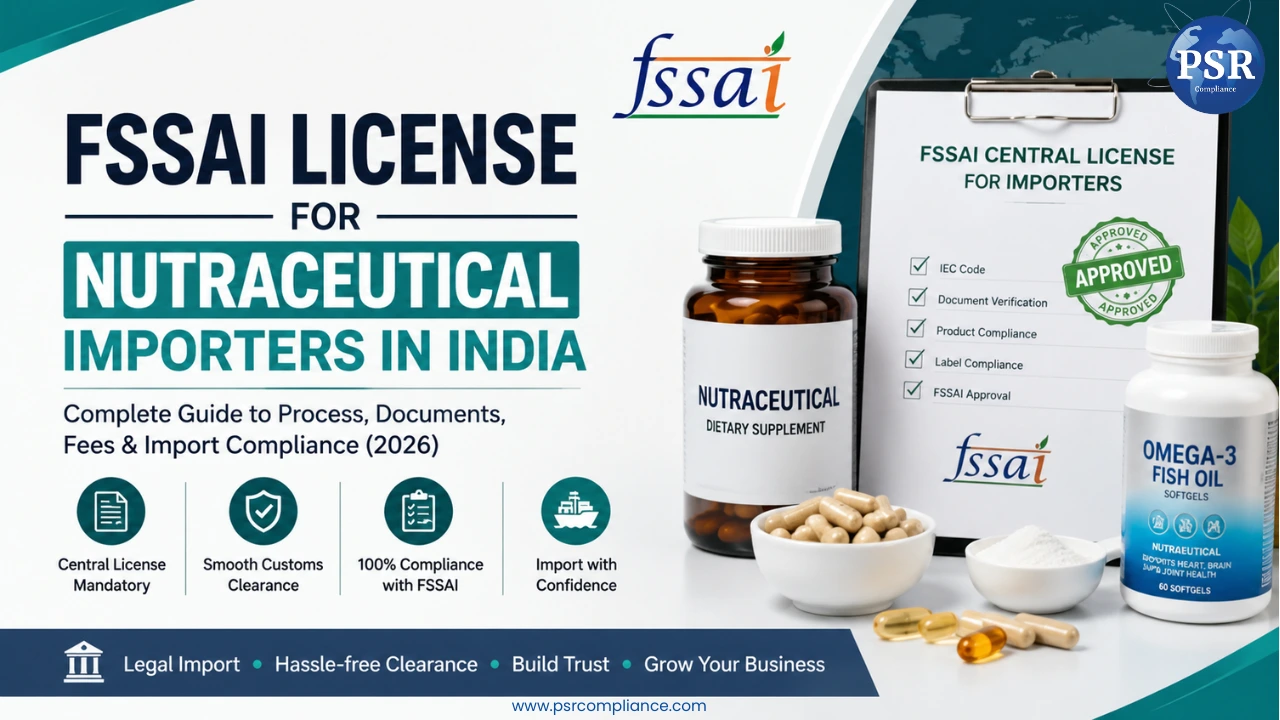
FSSAI License for Nutraceutical Importers in India (2026)
Importing nutraceuticals, health supplements, vitamins, minerals, and other food products into India requires careful compliance with FSSAI requirements. Before shipping products, importers generally need an FSSAI Central License for import activities, along with an active IEC and compliant product documentation. Understanding the FSSAI import license process, fees, labeling requirements, and nutraceutical regulations can help prevent customs delays and product clearance issues.
Importers may face holds at ports such as JNPT or Chennai when products contain ingredients that are not permitted in India, documentation is incomplete, or labeling does not meet Indian requirements. This guide explains the key requirements and process for obtaining an FSSAI license for nutraceutical imports in India.
What Is Nutraceutical Import Compliance?
Nutraceuticals generally include health supplements, vitamins, minerals, botanical ingredients, and other products intended for human consumption. Commonly imported products include whey protein isolates and amino acids, multivitamin capsules and gummies, omega-3 fish oil softgels, botanical extracts, and dietary enzymes.
Because these products enter the human food chain, importers must comply with applicable FSSAI requirements relating to ingredients, safety, labeling, documentation, and import clearance. Products may also require additional regulatory assessment depending on their formulation and ingredient status.
FSSAI Central Import License Rules for Nutraceuticals
Food importers in India generally require an FSSAI Central License for their import business. The applicable license and product requirements depend on the nature of the food business, products being imported, and the relevant FSSAI regulations.
| Feature | FSSAI Central Import License |
|---|---|
| Applicable Business | Food and nutraceutical importers |
| Issuing Authority | Food Safety and Standards Authority of India |
| Application System | FoSCoS |
| Import Clearance | Linked with applicable food import clearance processes |
| Validity | 1 to 5 years, as selected |
| Key Requirement | Active IEC and applicable food business documents |
Importing food or nutraceutical products without the required FSSAI authorization can result in clearance problems, regulatory action, or other business consequences.
Who Needs an FSSAI Import License?
An FSSAI Central License may be required if you are:
- Importing foreign health supplement or nutraceutical brands into India.
- A merchant trader distributing imported nutraceutical products.
- An e-commerce business importing supplements for direct-to-consumer sales.
- A bulk ingredient importer supplying raw extracts or ingredients to Indian supplement manufacturers.
- Importing vitamins, minerals, botanical ingredients, protein products, or other regulated food products.
The exact regulatory requirements can vary according to the product category, formulation, ingredients, and intended use.
Why Is FSSAI Import Compliance Important?
Non-compliance can create significant commercial problems for importers. A shipment may be held during food import clearance if the product documentation, ingredients, labeling, or other regulatory requirements are not satisfactory. Extended holds can also result in additional storage and demurrage costs.
Products containing ingredients that are not permitted or appropriately approved in India may face rejection, re-export, or destruction depending on the circumstances. On the other hand, maintaining the required FSSAI license and ensuring that products comply with applicable Indian requirements can help support smoother import clearance and lawful sale in India.
Benefits of Maintaining FSSAI Import Compliance
- Supports food import clearance: Proper documentation helps facilitate the applicable FSSAI import clearance process.
- Allows lawful food business operations: An appropriate FSSAI license supports the legal sale and distribution of food products in India.
- Builds buyer confidence: Proper compliance can improve trust among distributors, retailers, pharmacies, and online marketplaces.
- Reduces regulatory risks: Checking ingredients and labels before shipment can help avoid preventable compliance issues.
Basic Requirements Before Applying for an FSSAI Import License
Before applying, importers should prepare the key regulatory and business requirements.
1. Import Export Code (IEC)
An active IEC issued by DGFT is an important prerequisite for businesses involved in importing products into India.
2. Ingredient and Product Compliance
Importers should verify that the ingredients used in their nutraceutical products comply with applicable FSSAI regulations. Ingredients or formulations falling under specific approval requirements may require additional regulatory action before import.
3. Compliant Product Labeling
The product label should comply with applicable Indian food labeling requirements, including relevant importer details, FSSAI license information, declarations, and other mandatory particulars.
Documents Required for FSSAI Import License
The exact documents depend on the nature of the business and application, but importers may typically need:
- Active Import Export Code (IEC) issued by DGFT.
- Company incorporation certificate, partnership deed, or applicable business constitution document.
- List of directors or partners along with applicable identity documents.
- Proof of business premises such as a lease deed or utility bill.
- Nominee or authorized person declaration, wherever applicable.
- Product list and relevant product specifications.
- Certificate of Analysis (CoA) or other technical documents, where applicable.
- Product label or proposed label artwork.
- Ingredient and formulation details for nutraceutical products.
- Other documents requested by the licensing authority based on the product category.
Step-by-Step Process to Obtain an FSSAI Central Import License
Step 1: Create an Account on the FoSCoS Portal
Start by creating or accessing your account on the FoSCoS portal and selecting the appropriate Central License category for the food import business.
Step 2: Identify the Correct Product Category
Identify the applicable food category and verify the ingredients and formulation of the nutraceutical products. This step is particularly important because certain ingredients or formulations may have additional regulatory requirements.
Step 3: Prepare and Upload Documents
Prepare the business documents, IEC, product information, label artwork, and other applicable documents. Ensure that the information provided in the application matches the supporting documents and product details.
Step 4: Pay the Applicable Government Fee
Pay the applicable FSSAI government fee through the online application system. The final fee depends on the license category and validity selected.
Step 5: Application Review
The licensing authority reviews the application and supporting documents. If clarification or additional information is required, the applicant may receive a query that needs to be addressed within the prescribed timeframe.
Step 6: License Grant
Once the application satisfies the applicable requirements, FSSAI issues the license containing the 14-digit FSSAI license number. The importer can then use the license for applicable food business and import compliance activities.
FSSAI Import License Fees and Approval Timeline
The government fee and processing timeline can vary depending on the applicable license category, validity, application details, and whether additional scrutiny or clarification is required.
| Particular | Typical Information |
|---|---|
| License Type | Central FSSAI License |
| Validity | 1–5 years |
| Government Fee | Depends on applicable license category and validity |
| Application Platform | FoSCoS |
| Processing Time | Depends on application and regulatory scrutiny |
Important: Do not rely on a fixed fee or approval timeline without checking the applicable category at the time of application, as FSSAI requirements and government charges can change.
Common Mistakes Nutraceutical Importers Should Avoid
Importers should carefully review their products before placing an overseas order. Common mistakes include:
- Importing a formulation containing ingredients that are not permitted or appropriately approved in India.
- Failing to verify whether an ingredient or formulation requires additional FSSAI approval.
- Using labels that do not meet applicable Indian requirements.
- Applying under an inappropriate food business category.
- Providing different product names or specifications across the FSSAI application, invoice, label, and customs documents.
- Importing products before completing the necessary regulatory checks.
- Assuming approval by a foreign authority automatically means the product can be imported into India.
A product being permitted in the US, EU, or another international market does not automatically mean that the same formulation is permitted for sale in India.
Practical Case Study: Nutraceutical Shipment Held During Import Clearance
Consider an Indian importer preparing to bring a shipment of health supplements from Southeast Asia. The company had its IEC and business documents but had not properly reviewed the ingredients and Indian labeling requirements before shipment.
During the import clearance process, the product documentation and formulation required additional scrutiny. The shipment could not proceed normally until the regulatory concerns were addressed, resulting in additional storage costs and delays in the planned distribution schedule.
The importer subsequently worked with a compliance consultant to review the formulation, product documents, labeling, and applicable FSSAI requirements. The exercise helped identify the compliance gaps and prepare the required documentation before subsequent shipments.
Key Lesson for Importers
The most effective approach is to conduct a regulatory review before placing the overseas purchase order, rather than discovering an ingredient or labeling problem after the shipment reaches an Indian port.
📞 Apply for FSSAI Import License Today
Need help with your nutraceutical import license? Talk to our compliance experts today.
📱 Call: +91 87961 04190
📧 Email: support@psrcompliance.com
Frequently Asked Questions
Q1. Is an FSSAI Central License mandatory for nutraceutical importers?
Food importers generally require an FSSAI Central License for their import activities. The exact requirements depend on the nature and category of the food products being imported.
Q2. What is the FSSAI license fee for food importers?
The applicable government fee depends on the license category and validity selected. Importers should verify the current fee applicable to their business before submitting the application.
Q3. Can I import supplements if their ingredients exceed the recommended limits?
Not necessarily. The formulation must comply with applicable FSSAI requirements, and certain ingredients or formulations may require additional approval or regulatory assessment.
Q4. How are imported nutraceuticals cleared at Indian ports?
Imported food products are subject to the applicable food import clearance process. FSSAI authorities may examine documents and draw samples for testing where required before clearance.
Q5. Do I need a separate FSSAI license for every port of entry?
Generally, an importer does not need a separate Central License simply because goods enter through different Indian ports. However, the applicable import and food clearance requirements must still be followed at each entry point.
Q6. Can FSSAI labeling corrections be made after the product reaches India?
Certain labeling deficiencies may be rectifiable in permitted circumstances, but importers should not assume that every labeling issue can be corrected after arrival. It is safer to ensure compliance before shipment.
Q7. How long is an FSSAI Central License valid?
An FSSAI license can generally be obtained for a validity period selected within the permitted range, commonly 1 to 5 years, subject to the applicable rules.
Q8. What happens if a nutraceutical shipment fails FSSAI requirements?
Depending on the nature of the non-compliance, the consignment may be detained, rejected, re-exported, or otherwise dealt with under the applicable food safety and customs procedures.
Q9. Is IEC required for an FSSAI import business?
Yes. An active Import Export Code (IEC) issued by DGFT is generally required for businesses importing goods into India.
Q10. How can I verify an FSSAI license?
An FSSAI license number can be checked through the official FSSAI/FoSCoS system to verify the license details.