
Just send us your questions or concerns by starting a new case &
we will give you the help you need. Start Here...
BIS License
Mon, Aug 17 2026
Raju Karn
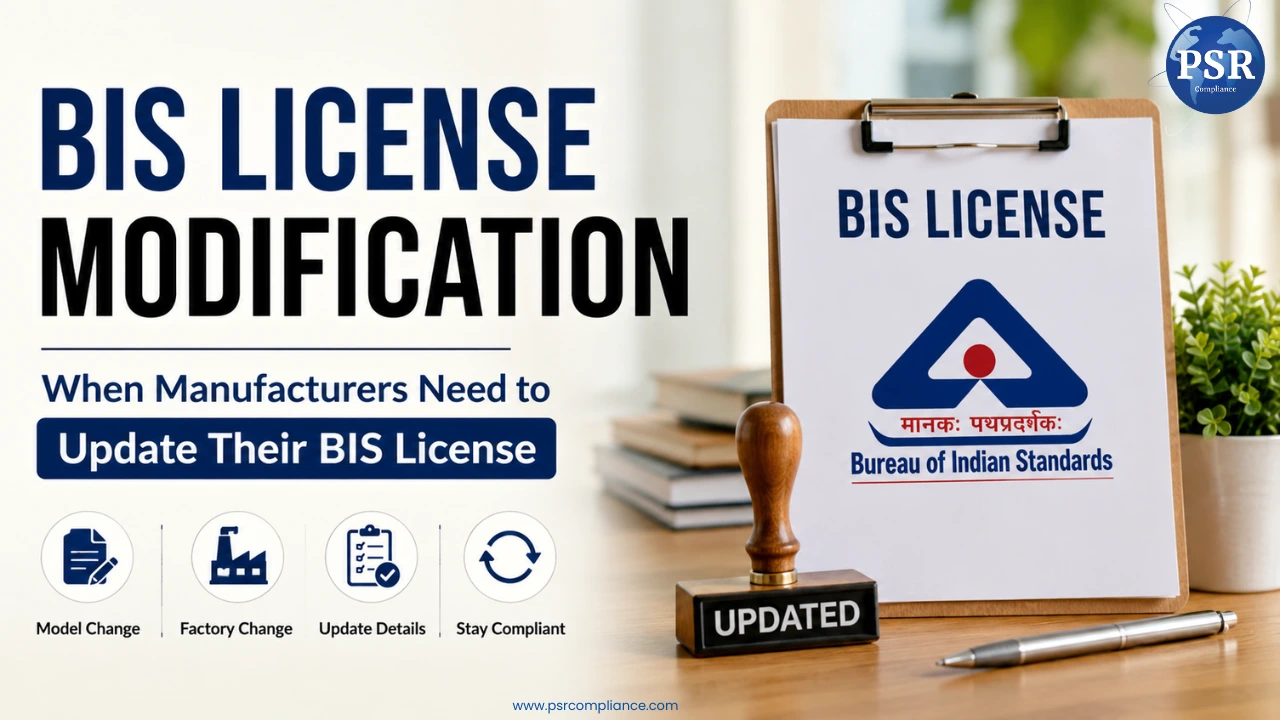
BIS License Modification: When Manufacturers Need to Update Their BIS License
You worked hard to obtain your BIS certification. You completed product testing, prepared the required documents, submitted the application, and finally received your BIS license. However, getting the license is not always the end of the compliance process.
A BIS license must reflect the current product, manufacturing facility, brand, and business details of the license holder. If any important information changes, manufacturers may need to apply for a BIS license modification or amendment. Continuing to sell products when the actual details no longer match the BIS license can create compliance issues, including market surveillance action, e-commerce delisting, customs problems, or other regulatory consequences.
This guide explains when BIS license modification is required, the common types of changes, the difference between renewal and modification, the application process, and the risks of ignoring required updates.
What Is BIS License Modification?
A BIS license modification, also called a BIS license amendment, is the process of officially updating an existing BIS license when there is a change in the product, manufacturing facility, brand, company details, or other information covered by the certification.
For example, a BIS license may contain details such as the manufacturer's name, factory address, brand name, certified product models, applicable Indian Standard, and scope of certification. If these details change, the manufacturer may need to inform BIS and obtain the applicable modification before selling the changed product or operating under the updated business details.
In simple terms, your BIS license should accurately represent the product and manufacturing setup that BIS has approved. A valid license with outdated information does not automatically cover every subsequent change.
When Do You Need BIS License Modification?
Different changes can trigger a BIS modification requirement. The exact procedure and documentation depend on the applicable BIS scheme and the nature of the change.
| Change | Possible BIS Modification Requirement |
|---|---|
| New product model | Model inclusion or applicable scope modification |
| Factory address change | Change/update of manufacturing premises |
| New manufacturing unit | Addition of applicable manufacturing location |
| Product/component change | Technical evaluation or modification, depending on the change |
| Brand name change | Update of brand/trademark details |
| Company name change | Update of legal entity information |
| Product scope expansion | Scope modification or inclusion |
| AIR change | Update of Authorized Indian Representative details for applicable foreign manufacturers |
1. Adding a New Product Model
One of the most common reasons for BIS license modification is the introduction of a new product model or variant.
For example, suppose a manufacturer has BIS CRS registration for a 10,000 mAh power bank and wants to launch a 20,000 mAh model. The new model cannot automatically be sold under the existing registration merely because the products belong to the same category. Depending on the applicable requirements, the new model may require testing and formal inclusion in the BIS certification scope.
Manufacturers should therefore evaluate new models before production and commercial launch rather than assuming that an existing BIS registration automatically covers them.
2. Change in Factory Address
If a manufacturer moves its production facility to another location, the BIS license may need to be updated to reflect the new manufacturing address.
This is particularly important where certification is directly connected to the manufacturing premises and factory inspection. Opening an additional manufacturing facility may also require a separate addition or modification, depending on the applicable BIS scheme.
Manufacturers should not simply start production at a new facility using the BIS license issued for the original factory without checking the applicable BIS requirements.
3. Changes in Product Specifications or Critical Components
Changes to critical components, materials, design, or technical specifications can be an important compliance trigger.
For example, a power bank manufacturer may change the lithium-ion cell supplier, protection circuit, BMS, PCB configuration, or another critical component. Even if the finished product looks identical, the change may affect the basis on which the product was originally tested.
Before making such changes commercially, manufacturers should determine whether BIS approval, additional testing, model inclusion, or another form of modification is required.
4. Change in Brand Name or Trademark
If a manufacturer changes the brand name or trademark under which a certified product is sold, the BIS records may also need to be updated.
This is especially important for businesses selling through e-commerce platforms, distributors, and retailers. The brand information appearing on the product, packaging, marketplace listing, and BIS documentation should remain consistent with the applicable certification requirements.
5. Change in Company Name or Legal Entity Details
A change in the company's legal name due to restructuring, merger, acquisition, or another corporate change may require an update to the BIS license.
Manufacturers should ensure that their BIS records reflect the correct legal entity and supporting documents. A change in corporate structure should therefore be reviewed from a BIS compliance perspective before continuing business under the updated entity.
6. Expansion of the BIS License Scope
Manufacturers may also need modification when they want to expand the scope of their existing BIS certification.
For example, a manufacturer certified for one applicable product category may later introduce another product covered under a different Indian Standard. The existing license does not automatically cover every related product.
The manufacturer should identify the applicable standard, testing requirements, and BIS modification route before adding the new product to commercial production.
7. Change in Authorized Indian Representative (AIR)
Foreign manufacturers using an Authorized Indian Representative (AIR) may need to update their BIS records when the appointed representative changes.
If an existing AIR is replaced, the manufacturer should complete the applicable BIS update rather than continuing with outdated representative information in the certification records.
What Happens If You Don't Update Your BIS License?
Failing to update a BIS license when a modification is required can create both regulatory and commercial problems.
1. E-Commerce Delisting
E-commerce platforms may request BIS documentation while reviewing product listings. A mismatch between the product information and certification details can create compliance issues and potentially affect the listing.
2. Customs Clearance Issues
For imported products, inconsistencies between the shipment, manufacturer information, product details, and BIS certification can create additional scrutiny or delays during customs clearance.
3. BIS Market Surveillance Action
BIS conducts market surveillance to verify whether certified products continue to comply with applicable requirements. If the product or manufacturing details do not match the certification, the manufacturer may face regulatory action.
4. Suspension or Cancellation Risk
Depending on the nature and seriousness of the non-compliance, BIS may take action against the license, which can include suspension or cancellation under the applicable rules and scheme.
5. Financial and Legal Consequences
Selling or manufacturing products in violation of applicable BIS requirements can expose a business to penalties and other enforcement measures under the BIS Act, 2016 and applicable regulations. The exact consequences depend on the nature of the violation.
BIS License Renewal vs. BIS License Modification
Manufacturers often confuse BIS license renewal with BIS license modification, but they serve different purposes.
| BIS Renewal | BIS Modification |
|---|---|
| Extends the validity of an existing certification | Updates information or scope covered by the certification |
| Generally associated with expiry of the license/registration | Triggered by a change during the validity period |
| Does not simply replace the need for modification | Does not automatically extend the license validity |
| Helps maintain certification after expiry | Keeps certification details aligned with current circumstances |
For example, if your BIS license is approaching its expiry date, you may need to apply for renewal. If you have introduced a new model or changed relevant manufacturing details during the license period, you may need modification.
In some situations, a manufacturer may need to manage both processes separately.
Practical Example: How a Product Change Created a BIS Compliance Issue
Consider a Pune-based electronics manufacturer with a valid BIS CRS registration for a Bluetooth speaker. During production, the company changed the speaker driver because of supply-chain issues. The new component appeared to provide similar performance, so the manufacturer continued production without first reviewing the BIS implications.
Later, during a compliance review, the manufacturer discovered that the internal component configuration no longer matched the technical information associated with the certified product. The company then had to evaluate the change, arrange the required testing and take the appropriate BIS modification steps before continuing with the updated configuration.
The situation could have been avoided by reviewing the component change with a BIS compliance professional before introducing it into commercial production.
How to Apply for BIS License Modification
The exact process varies according to the BIS certification scheme and type of modification. However, the general process usually involves the following steps:
Step 1: Identify the Required Modification
First, determine what has changed. It could be a new model, factory address, component, brand, company information, product scope, or AIR.
Step 2: Review the Applicable BIS Requirements
Check whether the proposed change requires additional testing, technical evaluation, factory inspection, supporting documents, or another approval before implementation.
Step 3: Prepare the Required Documents
Prepare documents relevant to the modification. These may include updated technical documents, test reports, factory documents, legal entity documents, trademark information, or other supporting records.
Step 4: Submit the Modification Application
Submit the applicable modification request through the relevant BIS online system/portal and provide the required information and documents.
Step 5: Respond to BIS Queries
BIS may review the application and raise technical or documentary queries. Responding accurately and promptly can help avoid unnecessary delays.
Step 6: Obtain the Updated License
Once the modification is approved, the BIS certification records are updated according to the approved change. Manufacturers should use the updated certification details for future production, labeling, listings, and compliance documentation where applicable.
Common BIS License Modification Mistakes
Manufacturers should avoid these common mistakes:
- Assuming a valid BIS license covers every new model.
- Changing critical components without checking BIS requirements.
- Moving production to another factory without reviewing the certification implications.
- Changing the brand name without updating certification records.
- Treating BIS renewal and modification as the same process.
- Submitting incomplete supporting documents.
- Waiting until an audit, customs issue, or marketplace compliance check to discover the mismatch.
- Assuming that a minor technical change automatically requires no BIS action.
The safest approach is to review the proposed change before implementing it commercially.
Why Work With a BIS Consultant for License Modification?
BIS modification can become complicated when the proposed change affects the product's technical specifications, testing basis, factory, or certification scope.
A BIS consultant can help you:
- Identify whether a modification is required.
- Determine the appropriate BIS modification route.
- Review technical and supporting documents.
- Coordinate additional testing where applicable.
- Prepare and submit the modification application.
- Respond to BIS queries.
- Help maintain consistency between your product, factory, packaging, marketplace listing, and BIS certification.
This proactive approach can help manufacturers avoid unnecessary compliance interruptions and costly rework.
Key Takeaways
- A BIS license should accurately reflect the current certified product and manufacturing details.
- New models, factory changes, critical component changes, brand changes, company changes, and scope expansions may require BIS modification.
- BIS renewal and BIS modification are different processes.
- Manufacturers should review proposed product or manufacturing changes before commercial implementation.
- The exact modification requirements depend on the applicable BIS scheme and nature of the change.
- Professional BIS compliance support can help identify the correct modification route and reduce avoidable delays.
Get Expert Help With BIS License Modification
Has your product model, factory address, brand name, company details, critical components, or certification scope changed after receiving your BIS license? Don't risk selling products that no longer match your certification. Get professional assistance with BIS license modification, model inclusion, scope changes, document preparation, technical evaluation, testing coordination, and BIS application support.
📞 Call: +91 8796104190
📧 Email: support@psrcompliance.com
Frequently Asked Questions
Q1. What is BIS license modification?
BIS license modification is the process of updating an existing BIS license when relevant product, manufacturing, business, brand, or certification details change.
Q2. When is BIS license modification required?
It may be required when adding new models, changing the manufacturing location, modifying critical product specifications, changing the brand or company name, expanding certification scope, or making other changes covered by the applicable BIS scheme.
Q3. Can I add a new product model to my existing BIS license?
In many cases, a new model requires formal inclusion or another applicable BIS approval. The exact requirement depends on the product, standard, and certification scheme.
Q4. Is BIS license renewal the same as modification?
No. Renewal primarily deals with continuing the certification after its validity period, while modification deals with updating relevant certification details during the license period.
Q5. Do component changes require BIS license modification?
They can. Changes to critical components or technical specifications may affect the basis of the original certification. Manufacturers should review the change before commercial production.
Q6. Does changing the factory address require a BIS update?
A change in manufacturing premises can require an update or modification, particularly where the BIS certification is linked to a specific manufacturing location. The applicable scheme requirements should be checked before production at the new location.
Q7. Can a foreign manufacturer change its Authorized Indian Representative?
Yes, but the applicable BIS records and certification details should be updated when the AIR changes.
Q8. How long does BIS license modification take?
The timeline varies depending on the type of modification, documentation, testing requirements, BIS queries, and applicable certification scheme. Simple administrative changes may differ significantly from technical scope changes requiring testing.
Q9. Can I sell a modified product while my BIS license is still valid?
Not necessarily. A license being valid does not automatically mean that every modified product is covered. If the modification changes the certified product or other relevant details, the applicable BIS requirements should be addressed before commercial sale.
Q10. Can PSR Compliance help with BIS license modification?
Yes. PSR Compliance can assist with reviewing the proposed change, identifying the applicable BIS modification route, preparing documents, coordinating testing where required, submitting the application, and supporting the manufacturer through the BIS process.