Wed, Jul 15 2026
Raju Karn
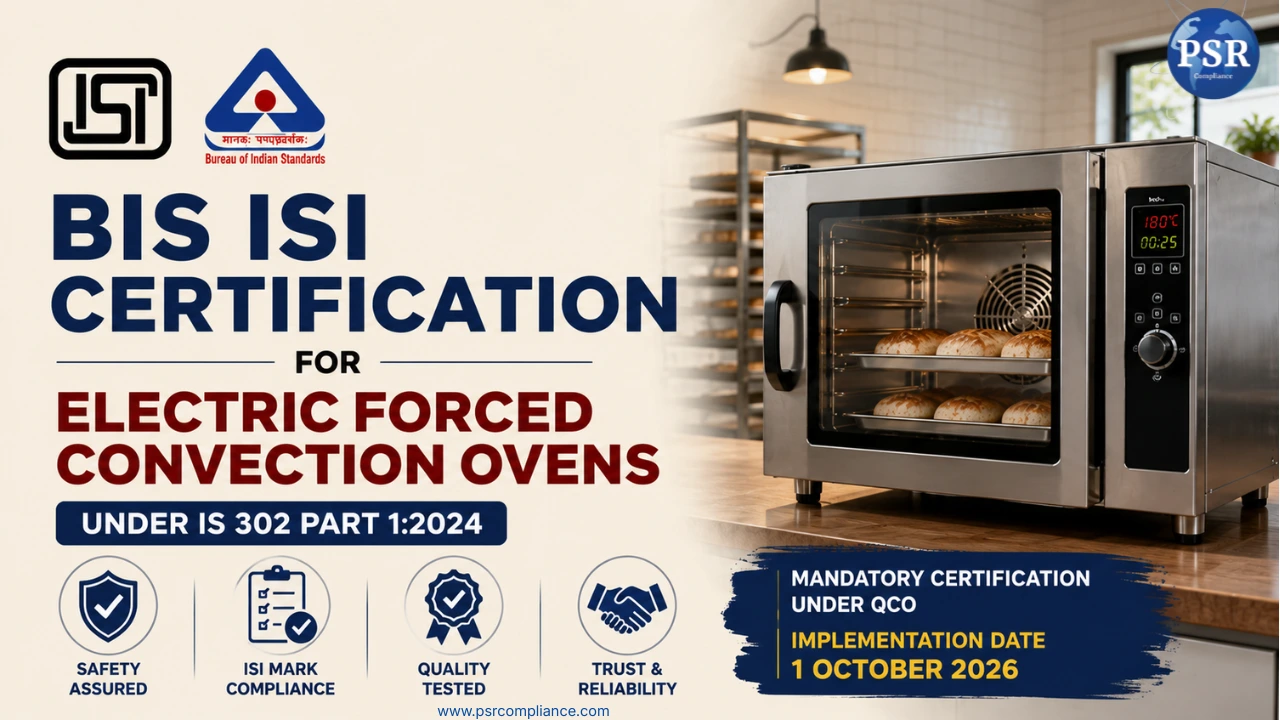
BIS ISI Certification for Electric Forced Convection Ovens under IS 302 (Part 1):2024
India's food service industry is expanding rapidly, creating strong demand for reliable commercial kitchen equipment. Restaurants, hotel chains, bakeries, cloud kitchens, hospitals, institutional canteens, and catering companies are investing in modern cooking appliances that improve efficiency and maintain consistent food quality. Among these appliances, Electric Forced Convection Ovens, Steam Cookers, and Steam-Convection Ovens have become essential because they offer faster cooking, uniform heating, and high production capacity. As the market grows, buyers are paying greater attention not only to performance but also to product safety and regulatory compliance.
To ensure electrical safety, the Government of India has included Commercial Electric Forced Convection Ovens, Steam Cookers, and Steam-Convection Ovens under the Safety of Household, Commercial and Similar Electrical Appliances (Quality Control) Order (QCO). Covered products must comply with IS 302 (Part 1):2024 and obtain a valid BIS ISI Certification before they can be manufactured, imported, or sold in India. For general enterprises, the mandatory implementation date is 1 October 2026, while small and micro enterprises receive additional time for compliance. Manufacturers, importers, and kitchen equipment suppliers should begin the certification process early to avoid disruptions in production, imports, and commercial supply.
Why BIS Certification Matters for Electric Forced Convection Ovens
A commercial electric forced convection oven is much more than a simple cooking appliance. It combines powerful heating elements, high-speed circulation fans, electrical wiring, thermostats, timers, insulation materials, motors, control panels, and temperature sensors to deliver uniform heat throughout the cooking chamber. Steam cookers and steam-convection ovens operate under equally demanding conditions, using steam, hot air, or a combination of both to prepare food quickly and consistently. Since these appliances generate high temperatures for extended periods, even a small defect can create serious electrical and fire hazards.
Commercial kitchens operate continuously throughout the day, especially in hotels, restaurants, bakeries, airline kitchens, hospitals, and cloud kitchens. Poor insulation, inadequate earthing, faulty wiring, weak temperature control, or fan motor failure can lead to overheating, electric shock, inconsistent cooking temperatures, short circuits, equipment breakdown, or even fire. Such failures not only affect kitchen safety but can also interrupt business operations, delay customer service, and cause significant financial losses. This is why commercial buyers consider the ISI Mark an important indicator of product safety and quality before making large procurement decisions.
A Practical Business Scenario
Imagine a company importing commercial electric forced convection ovens just before the festive season when restaurants and bakeries are preparing for increased customer demand. The products arrive on time, distributors are ready, and buyers have already placed advance orders. However, the importer has not completed the BIS certification process. As a result, customs authorities, distributors, online marketplaces, and commercial buyers request compliance documents before accepting delivery.
Although the products are technically ready for sale, the lack of BIS certification delays shipments, affects seasonal demand, and causes businesses to lose valuable sales opportunities. This example shows why certification should never be treated as a last-minute requirement. Completing the BIS process before import or production helps businesses avoid unnecessary delays and maintain customer confidence.
Who Needs BIS ISI Certification?
The Quality Control Order applies to various businesses involved in manufacturing, importing, supplying, or selling these appliances. Companies should carefully review their product portfolio to determine whether certification is required before launching products in the Indian market.
This certification is important for:
- Indian manufacturers of electric forced convection ovens
- Foreign manufacturers exporting ovens to India
- Importers of bakery and commercial kitchen ovens
- Commercial kitchen equipment suppliers
- Bakery equipment dealers
- Hotel and restaurant equipment vendors
- Cloud kitchen setup companies
- Private-label appliance brands
- E-commerce sellers
- Retail kitchen appliance stores
- Food processing equipment suppliers
Even if the oven is supplied as part of a complete commercial kitchen solution, BIS certification requirements should still be verified before production, import, or installation.
Products Covered Under the QCO
Businesses should carefully review each product model because different electrical ratings, heating systems, and construction designs may require separate certification planning.
| Products to Review | Examples |
|---|---|
| Electric Forced Convection Ovens | Commercial baking ovens with fan-assisted heating |
| Bakery Convection Ovens | Bakery production ovens |
| Countertop Convection Ovens | Compact commercial ovens |
| Commercial Convection Ovens | Heavy-duty food service ovens |
| Food Service Electric Ovens | Institutional kitchen ovens |
| Steam Cookers | Commercial electric steam cooking equipment |
| Steam-Convection Ovens | Combination steam and convection ovens |
| Imported Electric Ovens | Imported commercial cooking appliances |
| Private-Label Convection Ovens | OEM and branded oven models |
Every model should be evaluated individually because differences in capacity, heating elements, control systems, electrical ratings, or airflow design may affect BIS certification planning.
Key Facts: BIS Certification for Electric Forced Convection Ovens
The following table provides a quick overview of the certification requirements for commercial electric forced convection ovens, steam cookers, and steam-convection ovens. Manufacturers, importers, distributors, and commercial kitchen equipment suppliers should use this as a reference before starting the BIS certification process.
| Detail | Information |
|---|---|
| Product | Commercial Electric Forced Convection Ovens, Steam Cookers & Steam-Convection Ovens |
| Applicable Standard | IS 302 (Part 1):2024 |
| Certification Scheme | Product Certification Scheme (Scheme-I) |
| Certification Mark | BIS Standard Mark (ISI Mark) |
| Compliance Status | Mandatory |
| Regulating Authority | Bureau of Indian Standards (BIS) |
| Governing Ministry | Ministry of Commerce and Industry |
| Implementation Date (General Enterprises) | 1 October 2026 |
| Major Import Sources | China, Germany, United States |
Why BIS Certification Helps Your Business
BIS certification is much more than a legal requirement. In today's commercial kitchen industry, buyers want equipment that delivers consistent performance while meeting recognized safety standards. Hotels, restaurant chains, bakeries, cloud kitchens, institutional kitchens, and catering companies invest heavily in equipment that operates continuously under demanding conditions. Before placing large orders, procurement teams increasingly verify whether the products comply with Indian safety regulations. A BIS-certified oven immediately creates confidence because it demonstrates that the appliance has undergone independent testing and meets prescribed safety requirements.
Certification also provides a significant competitive advantage. Dealers, distributors, online marketplaces, and institutional buyers prefer certified products because they reduce operational risks and simplify purchasing decisions. Businesses with BIS-certified products often find it easier to enter government tenders, large hospitality projects, and premium commercial kitchen installations. Rather than competing only on price, manufacturers can position themselves as trusted suppliers offering safe, reliable, and regulation-compliant equipment.
Major Business Benefits
- Legal permission to manufacture, import, and sell products in India.
- Increased trust among hotels, restaurants, bakeries, and cloud kitchens.
- Better opportunities in government and institutional procurement.
- Stronger dealer and distributor confidence.
- Easier acceptance on e-commerce platforms and marketplaces.
- Improved brand reputation and market credibility.
- Competitive advantage over uncertified products.
- Higher customer confidence and repeat business.
Common Mistakes That Delay BIS Certification
Many businesses assume that certification begins only after submitting the BIS application. In reality, most delays occur because important technical and documentation requirements have not been completed beforehand. Missing documents, inconsistent product information, or incorrect model planning can significantly increase approval timelines and delay product launches. For importers, these issues may also affect customs clearance and project deliveries.
Some of the most common mistakes include:
- Model numbers not finalized.
- Electrical ratings missing or inconsistent.
- Product labels not matching technical documents.
- User manuals without complete safety instructions.
- Missing factory registration documents.
- Imported products lacking technical drawings.
- Incorrect grouping of similar oven models.
- Packaging printed before BIS marking approval.
- Weak quality control documentation.
- Incomplete manufacturing records.
Preparing these items before filing the application helps businesses avoid repeated BIS queries and speeds up the certification process.
Documents Required for BIS ISI Certification
Manufacturers and importers should begin collecting all technical and business documents before initiating the certification process. Proper documentation enables BIS officials and testing laboratories to verify that the product complies with Indian safety requirements and is manufactured under a controlled quality management system. Well-prepared documents also reduce approval time and minimize the chances of application rejection.
The commonly required documents include:
- Company registration certificate
- Factory address proof
- Product specification sheet
- Complete model list
- Electrical rating details
- Brand or trademark registration documents
- Manufacturing process flow chart
- Quality control plan
- List of testing equipment
- Machinery details
- Product label artwork
- User manual
- Installation instructions
- Safety warning labels
For electric forced convection ovens, installation manuals should clearly explain ventilation requirements, electrical connections, operating temperatures, cleaning procedures, maintenance instructions, and safety precautions. Clear documentation not only supports BIS approval but also helps end users operate the appliance safely.
How Long Does BIS Certification Take?
The time required to obtain BIS ISI Certification depends on whether the applicant is an Indian manufacturer or a foreign manufacturer. Indian manufacturers generally complete the certification process in around 30 days, provided all documents are accurate, product testing is successful, and the factory inspection is completed without major observations. Foreign manufacturers exporting commercial electric forced convection ovens to India should plan for a longer timeline of approximately 180 days, as the process involves additional documentation, overseas factory inspection, and coordination under the Foreign Manufacturers Certification Scheme (FMCS).
Businesses supplying equipment to hotels, restaurant chains, cloud kitchens, hospitals, or institutional projects should plan certification well in advance. Waiting until purchase orders are received may lead to shipment delays, postponed installations, and missed business opportunities. Early certification planning helps manufacturers and importers meet project deadlines while ensuring uninterrupted market access.
How a BIS Consultant Helps
Obtaining BIS certification involves much more than completing an application form. Businesses must determine product applicability, prepare technical documentation, coordinate product testing, undergo factory inspections, and respond to BIS queries before receiving the licence. Managing these activities without proper experience can increase approval timelines and create avoidable compliance issues.
A professional BIS consultant simplifies the entire certification process by providing end-to-end guidance. Services typically include product applicability assessment, document preparation, technical file verification, model grouping, laboratory testing coordination, factory inspection readiness, product label review, user manual verification, BIS application filing, and query management. For importers, consultants also coordinate with overseas manufacturers to ensure that technical documents, quality records, and compliance files meet Indian BIS requirements before shipment planning begins.
Final Takeaway
Commercial electric forced convection ovens, steam cookers, and steam-convection ovens are essential appliances for bakeries, restaurants, hotels, cloud kitchens, hospitals, institutional kitchens, and food processing businesses. Since these appliances operate continuously at high temperatures using electrical heating systems, motors, fans, and control circuits, ensuring their safety is just as important as ensuring their performance. This is why the Government of India has made BIS ISI Certification under IS 302 (Part 1):2024 mandatory for products covered under the Quality Control Order.
Manufacturers, importers, distributors, OEM suppliers, and private-label brands should begin compliance planning well before the implementation deadline. Early preparation provides sufficient time for product testing, factory inspection, documentation, and BIS approval while avoiding production delays and supply chain disruptions. Businesses that obtain certification early not only meet legal requirements but also strengthen buyer confidence, improve brand credibility, and gain a competitive advantage in India's rapidly growing commercial kitchen equipment market.
Get Expert Help with BIS ISI Certification for Electric Forced Convection Ovens
Need assistance with BIS ISI Certification under IS 302 (Part 1):2024 for Electric Forced Convection Ovens, Steam Cookers, and Steam-Convection Ovens? PSR Compliance provides complete end-to-end support—from documentation and application filing to product testing, factory inspection, BIS query handling, and final licence approval.
👉 Get faster approvals with expert guidance and hassle-free compliance support.
📞 +91 8796104190
Frequently Asked Questions (FAQs)
1. Is BIS certification mandatory for Electric Forced Convection Ovens?
Yes. Electric Forced Convection Ovens, Steam Cookers, and Steam-Convection Ovens covered under the Quality Control Order must comply with IS 302 (Part 1):2024 and obtain a valid BIS ISI licence before they can be manufactured, imported, or sold in India.
2. Which BIS standard applies to Electric Forced Convection Ovens?
These appliances are covered under IS 302 (Part 1):2024, which specifies safety requirements for household, commercial, and similar electrical appliances.
3. Who requires BIS certification for these products?
Indian manufacturers, foreign manufacturers exporting to India, importers, commercial kitchen equipment suppliers, OEM manufacturers, private-label brands, distributors, and e-commerce sellers dealing with these appliances require BIS certification.
4. What documents are required for BIS certification?
The application generally requires company registration documents, factory address proof, product specifications, model list, electrical ratings, trademark documents, manufacturing process details, quality control plan, machinery details, testing equipment list, product labels, user manuals, installation instructions, and safety warnings.
5. How long does BIS certification take?
Indian manufacturers generally require around 30 days, while foreign manufacturers exporting to India should plan for approximately 180 days, depending on documentation, testing, factory inspection, and BIS approval.
6. Why should manufacturers start the BIS certification process early?
Starting early allows sufficient time for testing, documentation, factory inspection, and licence approval, helping businesses avoid shipment delays, project interruptions, and lost sales opportunities while ensuring timely compliance with the Quality Control Order.