Wed, Jun 24 2026
Raju Karn
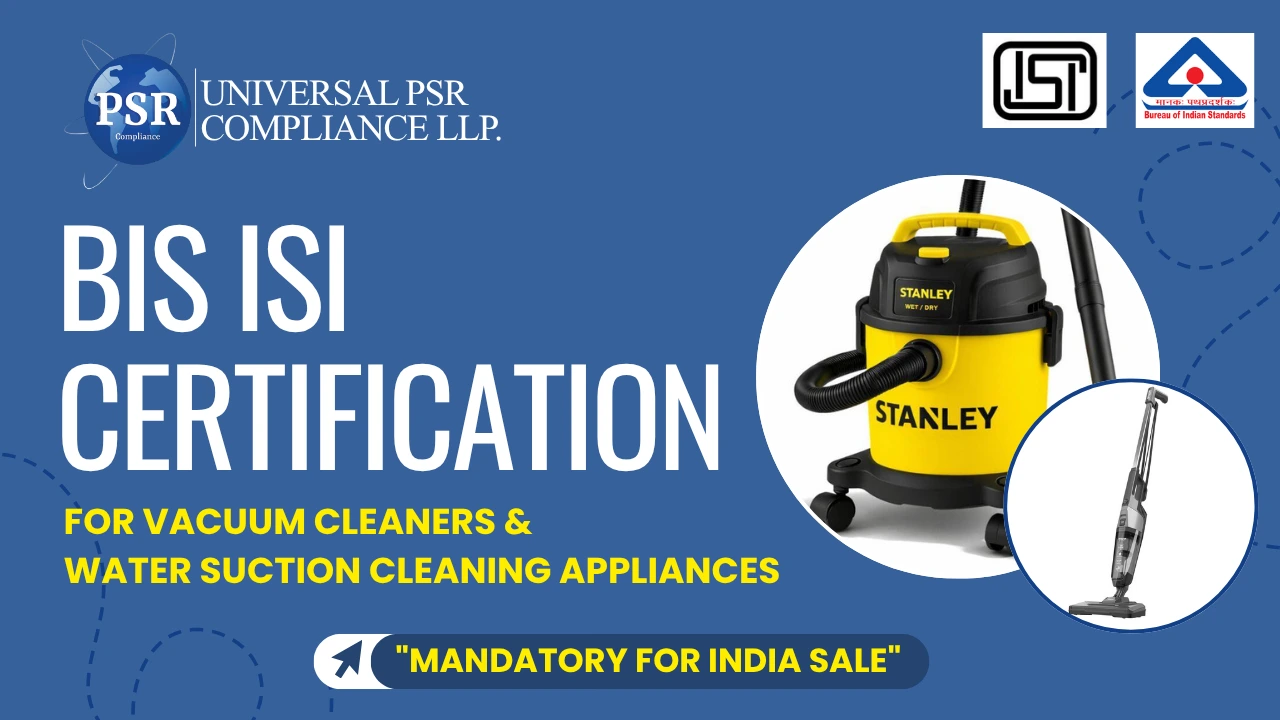
BIS ISI Certification for Vacuum Cleaners and Water Suction Cleaning Appliances Under IS 302 Part 1
Vacuum cleaners are no longer luxury products in India. They are now used in homes, offices, hotels, hospitals, airports, malls, factories, schools, car cleaning stations, and housekeeping businesses. Along with dry vacuum cleaners, many brands also sell water suction cleaning appliances for deep cleaning, wet cleaning, upholstery cleaning, and industrial floor maintenance.
But after the new QCO implementation date, selling these appliances will not be only about suction power, motor wattage, price, design, or online ratings. Vacuum cleaners and water suction cleaning appliances are part of the listed products under the Safety of Household, Commercial and Similar Electrical Appliances QCO. As per the supplied document, these appliances must conform to IS 302 Part 1: 2024 and carry the BIS Standard Mark under a valid BIS licence.
For general enterprises, the mandatory implementation date is 1 October 2026. Small enterprises and micro enterprises have later timelines, but waiting until the last moment is risky.
For manufacturers, importers, distributors, and sellers, BIS ISI certification is now a business requirement.
Why vacuum cleaners need BIS ISI certification
A vacuum cleaner looks like a simple cleaning machine. But inside, it includes a motor, cord, plug, switch, wiring, filters, suction parts, plastic body, insulation, and moving electrical parts. Water suction appliances also work around moisture, which increases safety risk.
If the product is poorly designed, it can create problems like electric shock, overheating, weak insulation, motor failure, unsafe wiring, sparks, burning smell, or short circuit.
In a home, this can put families at risk. In a hotel or hospital, it can affect staff safety. In a commercial cleaning business, it can damage customer trust. In a factory or mall, equipment failure can disturb daily operations.
BIS ISI certification helps prove that the appliance has been tested according to Indian safety requirements. It also shows that the manufacturer has a proper system to produce safe products again and again.
This is why BIS certification is not just paperwork. It is product safety, legal permission, and business trust in one process.
Who needs BIS certification for vacuum cleaners?
You should prepare for BIS ISI certification if you are :
• An Indian manufacturer of vacuum cleaners
• A manufacturer of water suction cleaning appliances
• A foreign manufacturer exporting these products to India
• An importer bringing cleaning appliances into India
• A private-label brand selling vacuum cleaners under its own name
• A distributor supplying cleaning machines to dealers
• An e-commerce seller listing vacuum cleaners online
• A housekeeping equipment supplier
• A commercial cleaning machine supplier
• A hotel, hospital, mall, or airport equipment vendor
• A car detailing equipment seller
• An institutional procurement supplier
Many sellers think BIS certification is only the manufacturer’s responsibility. But if your product is sold in India under your brand or through your sales channel, your business will be affected.
Dealers may ask for BIS proof. Marketplaces may ask for compliance documents. Institutional buyers may ask for licence details. Import shipments may require better planning. If you cannot provide certification details, buyers may shift to another brand.
Which sectors are affected?
Vacuum cleaners and water suction cleaning appliances are used across many sectors. The QCO can affect businesses in :
• Home appliance manufacturing
• Commercial cleaning equipment
• Facility management services
• Hotel and hospitality supply
• Hospital and healthcare maintenance
• Office and corporate housekeeping
• Industrial cleaning equipment
• Mall and airport maintenance
• Car wash and detailing equipment
• E-commerce appliance sales
• Retail appliance distribution
• Import and trading businesses
This wide usage makes compliance more important. A single uncertified product model can create problems across several sales channels.
For example, a housekeeping company may need 200 vacuum cleaners for a new contract. If the supplier cannot show BIS compliance, the buyer may reject the product. A hospital may avoid uncertified cleaning equipment because safety risk is higher in healthcare environments. An online marketplace may pause product listing if documents are not ready.
That is why BIS certification can directly affect revenue.
Which related products should cleaning appliance brands check?
The supplied QCO document includes vacuum cleaners and water suction cleaning appliances. Businesses in this category may also deal with other related products, such as :
→ Floor treatment machines
→ Wet scrubbing machines
→ Surface-cleaning appliances
→ Air-cleaning appliances
→ Commercial cleaning machines
→ Handheld cleaning appliances
→ Water-based cleaning equipment
→ Cleaning appliances used in hotels and offices
If your company sells a full cleaning appliance range, do not check only one model. Create a product compliance list. Mention every product name, model number, brand, factory, voltage rating, certification status, and target BIS timeline.
This simple step can prevent major confusion later.
Why early BIS certification is a commercial advantage
Many businesses wait for the deadline before taking action. That can be expensive.
BIS certification takes time because it may involve product review, testing, factory inspection, document preparation, application filing, queries, and approval. If a sample fails testing, the manufacturer may need to correct design or components. If factory records are weak, inspection may get delayed. If the product label has incorrect details, marking approval can slow down.
Late preparation can create :
⚠ Import delays
⚠ Product launch delay
⚠ Marketplace listing issues
⚠ Dealer order cancellation
⚠ Unsold inventory
⚠ Packaging rework
⚠ Failed testing pressure
⚠ Distributor hesitation
⚠ Loss of bulk orders
Early certification gives you a sales advantage. You can tell buyers that your product is BIS ready. This matters in B2B sales, especially for hotels, hospitals, cleaning contractors, and government or institutional buyers.
When two products have similar prices and features, the certified product looks safer and more reliable.
What documents should be prepared?
The exact document list depends on the applicant and product type, but generally businesses should prepare :
▪ Company registration documents
▪ Factory address proof
▪ Product specification sheet
▪ Model list
▪ Electrical rating details
▪ Manufacturing process flow
▪ Quality control plan
▪ Testing equipment details
▪ Machinery list
▪ Brand or trademark documents
▪ Product label and rating plate draft
▪ User manual and safety instructions
▪ Authorized signatory details
Indian representative details for foreign manufacturers, if applicable
Document accuracy is very important. Even a small mismatch in model number, brand name, voltage, address, or company name can delay the process.
How a BIS certification consultant helps
A BIS consultant helps businesses avoid common mistakes. For vacuum cleaners and water suction cleaning appliances, a consultant can support with:
✓ Product coverage checking
✓ Applicable standard confirmation
✓ Model grouping guidance
✓ Document preparation
✓ Application filing
✓ Testing coordination
✓ Factory inspection preparation
✓ Label and marking review
✓ BIS query handling
✓ Post-licence compliance support
For foreign manufacturers and importers, this support becomes even more important. The Indian importer may not control the overseas factory directly, but the product still needs Indian compliance. A consultant can help coordinate between the foreign manufacturer, Indian representative, testing process, and BIS requirements.
Final word
Vacuum cleaners and water suction cleaning appliances are no longer just cleaning products. Under the QCO for household, commercial, and similar electrical appliances, they are regulated BIS products.
For manufacturers, importers, brand owners, distributors, and online sellers, BIS ISI certification under IS 302 Part 1: 2024 can decide whether the product continues to sell smoothly in India after the applicable date. The businesses that prepare early will protect their product launches, dealer network, online listings, and bulk sales. The businesses that delay may face testing pressure, documentation issues, and lost orders.
If vacuum cleaners or water suction cleaning appliances are part of your business, start your BIS certification planning now. Compliance is not only about avoiding penalties. It is about keeping your product trusted, legal, and ready for the Indian market.
Get Expert Help with BIS ISI Certification for Vacuum Cleaners
Need assistance with BIS ISI Certification under IS 302 (Part 1): 2024 for vacuum cleaners and water suction cleaning appliances? PSR Compliance provides complete end-to-end support—from documentation and application filing to testing coordination and final approval—ensuring a smooth and hassle-free certification process.
👉 Avoid delays, product rejection, and compliance risks with expert guidance.
📞 8796104190
📧 support@psrcompliance.com
Frequently Asked Questions (FAQs) on BIS ISI Certification for Vacuum Cleaners
1. Is BIS ISI certification mandatory for all types of vacuum cleaners in India?
Yes, BIS ISI certification is mandatory for all types of vacuum cleaners under the applicable QCO. This includes standard dry vacuum cleaners, wet and dry cleaners, robotic vacuum cleaners, battery-operated and cordless models, as well as commercial vacuum and water suction cleaning appliances.
2. What is the applicable IS standard for vacuum cleaners?
The applicable Indian Standard is IS 302 (Part 1): 2024, which covers general safety requirements for household, commercial, and similar electrical appliances. It is used along with IS 302 Part 2 Section 2, which specifies requirements specific to vacuum cleaners.
3. What happens if vacuum cleaners are sold without BIS certification in India?
Selling, importing, or distributing non-certified vacuum cleaners in India is a violation of the BIS Act. Businesses may face serious penalties, including customs seizure of imported goods, removal from e-commerce platforms like Amazon and Flipkart, fines up to ₹5 lakh, and possible imprisonment.
4. How much time does it take to get BIS ISI certification for vacuum cleaners?
The certification timeline depends on the type of manufacturer. Indian manufacturers typically receive certification within 30 to 45 working days, while foreign manufacturers applying under the Foreign Manufacturers Certification Scheme (FMCS) may take 120 to 180 working days due to factory inspections and audit requirements.
5. What is the cost of BIS ISI certification for vacuum cleaners?
The cost varies based on product type, testing, and factory location. For Indian manufacturers, the estimated cost ranges from ₹58,000 to ₹1,65,000. For foreign manufacturers, the cost is higher due to inspection travel expenses. The total cost includes BIS application fees, lab testing charges, and marking fees.
6. Can an importer apply for BIS ISI certification for vacuum cleaners?
No, BIS certification is issued only to the manufacturer and is factory-specific. Importers cannot directly apply for the license. However, foreign manufacturers must appoint an Authorized Indian Representative (AIR) to manage the application and compliance process in India.
7. What tests are required for BIS certification of vacuum cleaners?
Vacuum cleaners must be tested in BIS-recognized laboratories. Key tests include protection against electric shock, temperature rise testing, mechanical strength testing, and abnormal operation testing to ensure safety during overload or blockage conditions.
8. What are the key steps in the BIS ISI certification process?
The certification process involves multiple stages, including documentation preparation, product sample testing in a BIS-approved lab, factory inspection by BIS officials, and final approval with issuance of the ISI license number (CM/L).
9. Is BIS certification required for imported vacuum cleaners?
Yes, imported vacuum cleaners must also comply with BIS requirements. Foreign manufacturers must obtain certification under FMCS before exporting products to India.
10. Why is BIS certification important for vacuum cleaner businesses?
BIS certification ensures product safety, legal compliance, and market trust. It helps avoid penalties, improves brand credibility, and is often required by distributors, e-commerce platforms, and institutional buyers.