Tue, Jun 30 2026
Raju Karn
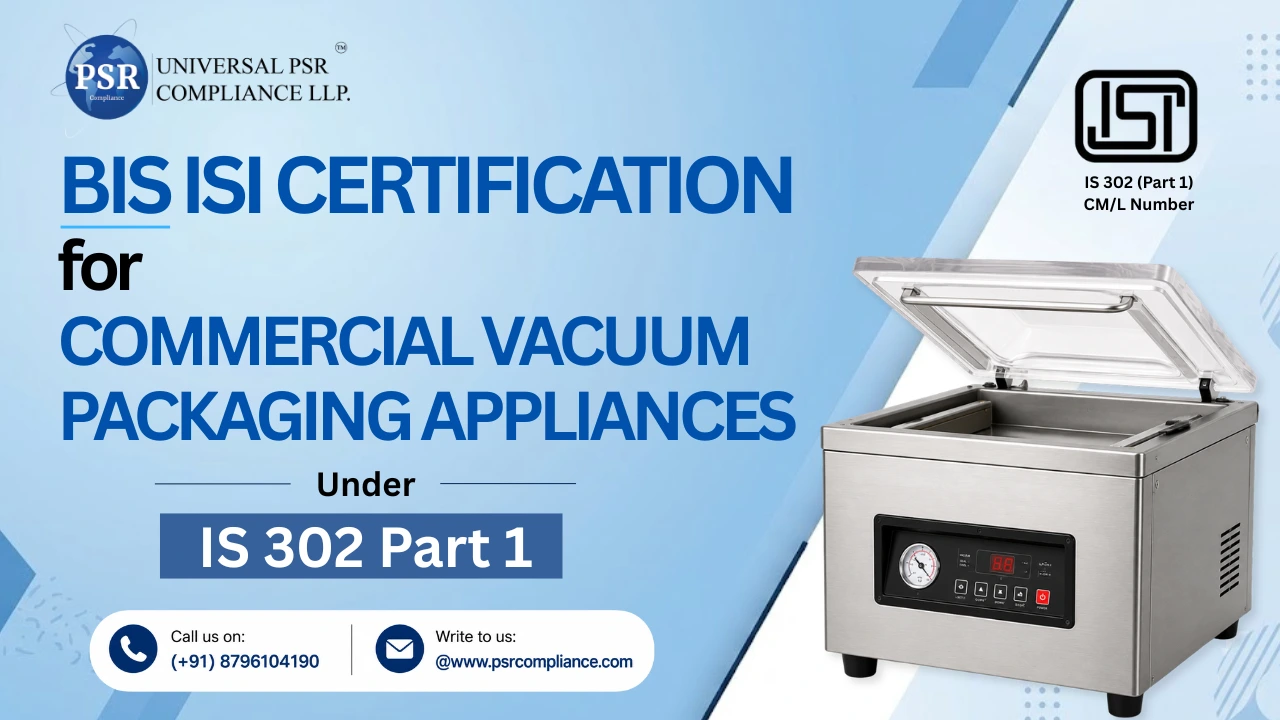
BIS ISI Certification for Commercial Vacuum Packaging Appliances under IS 302 (Part 1): 2024
Commercial vacuum packaging appliances usually work behind the scenes in restaurant kitchens, cloud kitchens, food processing units, supermarkets, butcher shops, seafood processing units, bakeries, hotels, and central kitchens. While the end customer may never see these machines, businesses rely on them every day to preserve food quality, extend shelf life, reduce air exposure, improve hygiene, and prepare products for storage or dispatch.
Under the Quality Control Order (QCO) for household, commercial, and similar electrical appliances, commercial vacuum packaging appliances are covered products. These appliances must comply with IS 302 (Part 1): 2024 and bear the BIS Standard Mark (ISI Mark) under a valid BIS licence before they can be manufactured, imported, or sold in India. For general enterprises, the implementation date is 1 October 2026. For manufacturers, importers, and commercial equipment suppliers, this requirement can directly impact product launches, dealer sales, hotel procurement, food industry contracts, and online marketplace listings.
Why Commercial Vacuum Packaging Appliances Need BIS Certification
A commercial vacuum packaging appliance is far more than a simple sealing machine. It contains several electrical and mechanical components such as a vacuum pump, sealing bar, heating element, control panel, chamber, motor, electrical wiring, insulation system, pressure control parts, and power plug. Because these machines operate continuously in demanding commercial environments, electrical safety and product reliability are critical.
If the appliance is poorly designed or manufactured, it can result in electric shock, overheating, sealing failures, motor malfunction, short circuits, fire hazards, or unexpected operational downtime. In a restaurant, this may delay food preparation. In a food processing facility, it can interrupt production, while supermarkets and cloud kitchens may face packaging delays that affect product freshness and customer service. BIS ISI Certification helps ensure that the appliance complies with Indian safety standards and is suitable for long-term commercial use.
Commercial Buyers Expect More Than Just Features
Commercial buyers evaluate equipment based on reliability, safety, documentation, and long-term performance rather than appearance alone. Before purchasing a vacuum packaging appliance, they commonly ask whether the machine is reliable, whether service support is available, whether it is safe for continuous operation, whether technical documentation is available, whether the supplier is dependable, and whether the product complies with Indian regulatory requirements.
BIS ISI Certification answers one of the most important questions for buyers—it demonstrates that the product has been assessed against Indian electrical safety standards. This not only improves buyer confidence but also makes the sales process easier for manufacturers, distributors, and suppliers.
Who Should Obtain BIS ISI Certification?
This certification is important for businesses involved in manufacturing, importing, branding, or supplying commercial vacuum packaging appliances, including:
- Indian manufacturers of commercial vacuum packaging machines
- Foreign manufacturers exporting to India
- Importers of food packaging equipment
- Hotel and restaurant equipment suppliers
- Cloud kitchen equipment vendors
- Food processing equipment distributors
- Meat and seafood packaging suppliers
- Supermarket equipment suppliers
- Commercial kitchen consultants
- E-commerce sellers of packaging machines
- Private-label equipment brands
Even when the product is supplied only to commercial customers, BIS compliance remains mandatory if the appliance falls under the notified Quality Control Order.
Commercial Vacuum Packaging Appliances Covered Under the QCO
Businesses should carefully review every vacuum packaging appliance included in their product catalogue before beginning the BIS certification process. Different models may have different electrical ratings, construction designs, and technical specifications, requiring separate documentation and certification planning.
Common products include:
➜ Chamber vacuum packaging machines
➜ Tabletop vacuum packing machines
➜ Commercial food vacuum sealers
➜ Industrial vacuum packaging appliances
➜ Sealing and vacuum combination machines
➜ Hotel kitchen vacuum machines
➜ Food factory vacuum packing appliances
➜ Imported commercial packing machines
➜ Private-label packaging machines
A compact tabletop vacuum sealer and a heavy-duty commercial chamber machine should never be assumed to fall under identical certification planning.
Why Early BIS Certification Can Improve Sales
Many businesses consider BIS Certification only as a legal requirement, but it also provides a significant commercial advantage. Certified equipment is easier to sell to hotels, restaurant chains, food processing units, cloud kitchens, supermarkets, and institutional buyers because these organizations prefer suppliers who are already prepared for compliance requirements.
Early certification also supports dealer confidence, B2B tender participation, smoother import planning, and easier online marketplace listings. When buyers compare two suppliers, the one with an active certification strategy often appears more reliable and professionally prepared.
Common Reasons for Certification Delays
Commercial equipment manufacturers and importers frequently experience delays because of avoidable documentation and planning mistakes. Common issues include:
⚠ Foreign suppliers delaying technical documents
⚠ Unfinalized model numbers
⚠ Product labels not matching application documents
⚠ Incomplete technical specifications
⚠ Poor factory inspection preparation
⚠ Product testing failures
⚠ User manuals unsuitable for Indian requirements
⚠ Packaging printed before BIS approval
⚠ Import planning without compliance verification
Most of these problems can be avoided through proper planning before the certification process begins.
A Practical 9-Step Action Plan
Businesses can simplify the certification process by following a structured approach:
Step 1: List every commercial vacuum packaging appliance model.
Step 2: Identify the actual manufacturer and factory location.
Step 3: Confirm whether each model falls under the applicable QCO.
Step 4: Review electrical ratings, labels, and user manuals.
Step 5: Collect complete technical documentation from the manufacturing facility.
Step 6: Verify quality control systems and testing readiness.
Step 7: Plan product testing and BIS application filing.
Step 8: Prepare the factory for BIS inspection.
Step 9: Update dealers, distributors, sales teams, and buyers regarding certification progress.
Following these steps helps businesses stay organized and reduces the likelihood of unexpected compliance delays.
Documents Required for BIS ISI Certification
To complete the BIS ISI Certification process smoothly, businesses should prepare all required documentation before filing the application. Commonly required documents include company registration documents, factory address proof, detailed product specification sheets, model lists, electrical rating details, brand or trademark documents, manufacturing process flow, quality control plans, testing equipment details, machinery information, and product label drafts.
Preparing these documents correctly helps minimize application delays, testing issues, and BIS clarification requests. Since commercial vacuum packaging machines are commonly operated in busy kitchens and food processing environments, installation manuals and operating instructions should also be clear, practical, and easy for users to understand.
How a BIS Consultant Can Help
A professional BIS consultant can manage the certification process efficiently by assisting with product applicability assessment, Indian Standard verification, documentation, model grouping, testing coordination, factory inspection preparation, label verification, user manual review, application filing, BIS query handling, Standard Mark guidance, licence renewal, and ongoing compliance support.
For importers, a consultant also coordinates with overseas manufacturers to obtain the technical documents required for Indian certification. This reduces delays caused by communication gaps and helps businesses complete the certification process more efficiently.
Final Thoughts
Commercial vacuum packaging appliances play an essential role in restaurants, hotels, food factories, supermarkets, cloud kitchens, and packaging businesses. Although they operate behind the scenes, these machines directly influence food quality, operational efficiency, and business continuity. Under the applicable Quality Control Order, these appliances require BIS ISI Certification under IS 302 (Part 1): 2024 before they can be legally supplied in India.
If commercial vacuum packaging machines are part of your product portfolio, begin the certification process well before the compliance deadline. Reviewing product models, preparing technical documentation, verifying labels, ensuring factory readiness, and planning the BIS application early will help your business avoid delays while strengthening buyer confidence and market credibility.
Get Expert Help with BIS ISI Certification for Commercial Vacuum Packaging Appliances
Need assistance with BIS ISI Certification under IS 302 (Part 1): 2024 for commercial vacuum packaging appliances? PSR Compliance provides complete end-to-end support—from documentation and application filing to testing coordination, factory inspection, and final BIS licence approval.
👉 Avoid certification delays, compliance issues, and market-entry risks with expert guidance.
📞 +91 8796104190
📧 support@psrcompliance.com
Frequently Asked Questions (FAQs)
1. Is BIS ISI Certification mandatory for commercial vacuum packaging appliances?
Yes. Commercial vacuum packaging appliances covered under the applicable Quality Control Order (QCO) must comply with IS 302 (Part 1): 2024 and obtain a valid BIS ISI Certification before they can be manufactured, imported, or sold in India.
2. Which standard applies to commercial vacuum packaging appliances?
These appliances are required to conform to IS 302 (Part 1): 2024, which specifies the general safety requirements for household, commercial, and similar electrical appliances.
3. Who needs BIS Certification for commercial vacuum packaging machines?
Indian manufacturers, foreign manufacturers, importers, private-label brands, hotel equipment suppliers, food processing equipment distributors, and commercial kitchen equipment sellers dealing in covered products must ensure BIS compliance.
4. Which types of vacuum packaging appliances are covered?
Products such as chamber vacuum packaging machines, tabletop vacuum sealers, commercial food vacuum sealers, industrial vacuum packaging machines, and other covered commercial vacuum packaging appliances may require BIS Certification.
5. What documents are required for BIS ISI Certification?
Generally, businesses need company registration documents, factory details, product specifications, model list, electrical ratings, quality control documents, testing equipment details, manufacturing process information, product labels, and other BIS-required documents.
6. What happens if a commercial vacuum packaging appliance is sold without BIS Certification?
Selling covered products without a valid BIS licence and ISI Mark may result in regulatory action, product sale restrictions, marketplace issues, import delays, and legal penalties under applicable BIS regulations.
7. How can PSR Compliance help with BIS ISI Certification?
PSR Compliance offers complete assistance with product applicability review, documentation, testing coordination, BIS application filing, factory inspection preparation, query handling, marking guidance, licence approval, and post-certification compliance support.