Wed, Jul 29 2026
Raju Karn
BIS FAQs on Migration to IS/IEC 62368-1:2023: Complete Guide for CRS License Holders (2026)
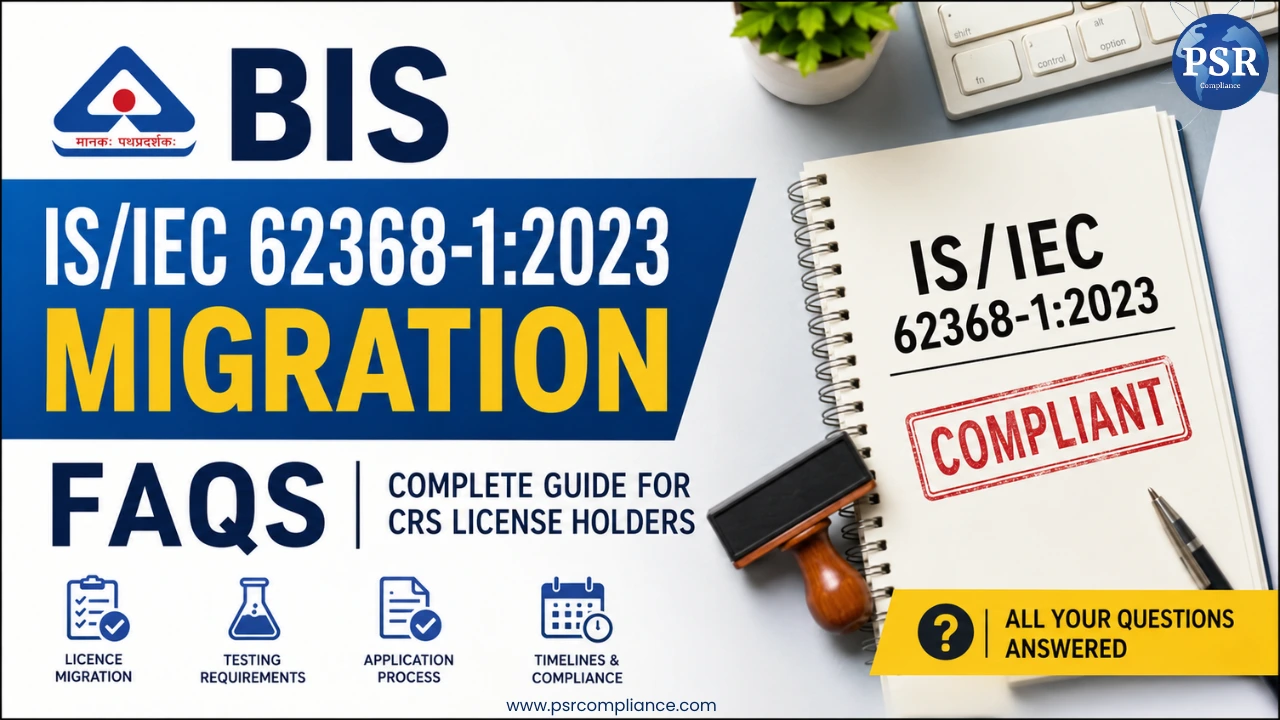
Manufacturers holding a valid BIS Compulsory Registration Scheme (CRS) licence are currently preparing for the migration from IS 13252 (Part 1):2010 and IS 616:2017 to the new safety standard IS/IEC 62368-1:2023. To address common concerns raised by manufacturers and existing licensees, the Bureau of Indian Standards (BIS) published an official Frequently Asked Questions (FAQs) document on 22 July 2026. The document explains important points such as licence migration, testing requirements, renewal, addition of new models, laboratory testing, critical components, and migration procedures.
Many businesses are still confused about how the migration will affect their existing BIS licences, whether new testing is required, and what happens if they fail to migrate before the implementation deadline. In this guide, we simplify the official BIS FAQs in easy-to-understand language so manufacturers, importers, and BIS CRS licence holders can understand the migration process without reading the complete official document.
Why Has BIS Released These FAQs?
The migration to IS/IEC 62368-1:2023 is one of the biggest changes under the BIS Compulsory Registration Scheme for electronic and IT equipment. Since thousands of manufacturers hold licences under IS 13252 (Part 1):2010 and IS 616:2017, BIS released the FAQ document to clarify common doubts regarding migration, licence validity, testing requirements, implementation timelines, and compliance procedures.
The FAQs are intended to help existing licence holders understand the transition process. However, BIS has also clarified that in case of any inconsistency, the provisions of the BIS Act, 2016, BIS Conformity Assessment Regulations, 2018, applicable Quality Control Orders, and the official implementation guidelines will prevail.
Frequently Asked Questions on BIS Migration to IS/IEC 62368-1:2023
Will my existing BIS Licence Number (R-number) change after migration?
No. BIS has confirmed that after successful migration to IS/IEC 62368-1:2023, the existing Licence Number (R-number) will remain the same. Manufacturers do not need to obtain a completely new licence simply because of the standard revision.
I have separate licences under IS 13252 and IS 616. What happens after migration?
If a manufacturer already holds separate licences for different product categories, those licences will continue separately after migration. For example, power adapters registered under different standards will continue to retain separate licences even after successful migration to the new standard. Each licence must be migrated individually according to the implementation guidelines.
What should the BIS Standard Mark look like after migration?
Products complying with IS/IEC 62368-1:2023 must continue to display the BIS Standard Mark in accordance with the BIS Conformity Assessment Regulations, 2018. The Indian Standard printed below the Standard Mark will now be IS/IEC 62368-1, along with the applicable R-number.
Are BIS-recognized laboratories available for testing under IS/IEC 62368-1:2023?
Yes. BIS has confirmed that recognized laboratories are available for testing products according to IS/IEC 62368-1:2023. Manufacturers can search for approved laboratories through the BIS Laboratory Information Management System (LIMS) portal using the applicable Indian Standard number.
Can I renew my existing licence under the old standards?
Yes, but only during the permitted transition period. BIS has clarified that licences may still be renewed under IS 13252 (Part 1):2010 and IS 616:2017 until the last date of concurrent implementation notified under the migration timeline. Manufacturers should nevertheless plan their migration early to avoid future compliance issues.
Should all new applications be filed under IS/IEC 62368-1:2023?
BIS encourages applicants to submit new applications under IS/IEC 62368-1:2023. During the concurrent implementation period, applications under the older standards may still be accepted subject to the conditions specified in the migration guidelines. After the transition period ends, all new applications must be submitted under the new standard. Existing licensees who fail to migrate may face licence cancellation or deletion of models from the scope of the licence.
Can I add new models tested under IS/IEC 62368-1:2023 to my existing licence?
Yes. BIS has permitted manufacturers to include new models tested according to IS/IEC 62368-1:2023 under an existing licence issued under the previous standards, provided all applicable BIS requirements are fulfilled. Manufacturers should also ensure timely migration before the last date of concurrent implementation.
Can one representative sample be submitted for migration testing?
No. BIS has clarified that manufacturers cannot submit only one representative sample for the entire licence during migration. Instead, complete test reports must be submitted for all applicable lead models identified according to the revised Series Guidelines. This ensures every product covered under the licence complies with IS/IEC 62368-1:2023.
What if my lead model has reached End-of-Life (EOL)?
If the lead model has become End-of-Life (EOL), manufacturers may withdraw that model from the licence. They can then select another suitable lead model from the same product series according to the revised Series Guidelines to demonstrate compliance with the new standard.
Are separate test reports required for different manufacturing locations?
Yes. BIS has confirmed that products manufactured at different manufacturing locations require separate test reports because separate BIS CRS licences are issued for each manufacturing location. Even if the products are identical, testing and licensing requirements apply independently for each facility.
What if migration affects compliance with other applicable standards?
If migration to IS/IEC 62368-1:2023 affects compliance with other applicable standards or essential requirements, manufacturers should follow the relevant provisions mentioned in the official implementation guidelines issued by BIS. Depending on the situation, additional testing or documentation may be required.
Can components and end products be tested simultaneously?
Yes. BIS allows parallel testing of components and end products during migration, provided the testing follows the applicable BIS Parallel Testing Guidelines. This can help manufacturers reduce overall project timelines and complete migration more efficiently.
Is there any migration fee payable to BIS?
No. BIS has clearly stated that no fee is charged for migrating already registered models covered under the existing licence, provided the application is submitted through the Standard Revision facility available in the BIS CRS portal.
Can existing critical components continue after migration?
No. Critical components that comply only with IS 13252 (Part 1):2010 or IS 616:2017 cannot be accepted after migration if they function as safety safeguards. Such components must comply with the requirements of IS/IEC 62368-1:2023. Manufacturers may register critical components and end products simultaneously using the BIS Parallel Testing provisions.
Can registered products with the BIS Standard Mark be submitted for testing?
Yes. Models that are already registered may continue to bear the BIS Standard Mark while being submitted for testing under IS/IEC 62368-1:2023. However, manufacturers must declare to the BIS-recognized laboratory that the submitted models are already registered, and the laboratory will record this information in the test report.
Can manufacturers begin testing before applying for migration?
Yes. BIS permits manufacturers to start product testing according to IS/IEC 62368-1:2023 even before submitting the migration application. Early testing can help businesses complete the migration process within the prescribed implementation timeline and avoid last-minute delays.
How should existing licence holders apply for migration?
Existing BIS CRS licence holders must submit complete test reports for all applicable lead models through the Standard Revision/Amendment/Essential Requirement option available in their BIS CRS login portal. The migration application should strictly follow the official implementation guidelines issued by BIS for IS/IEC 62368-1:2023.
Key Takeaways for Manufacturers
Before initiating migration, manufacturers should keep the following points in mind:
- Existing BIS Licence Numbers (R-numbers) will remain unchanged after successful migration.
- Separate licences for different product categories will continue after migration.
- Manufacturers should plan migration well before the end of the concurrent implementation period.
- Every applicable lead model must be tested according to the revised Series Guidelines.
- Critical safety components must comply with IS/IEC 62368-1:2023.
- No migration fee is payable for already registered models submitted through the Standard Revision provision.
- Parallel testing is permitted for eligible products and components.
- Manufacturers can begin testing before submitting the migration application.
How PSR Compliance Can Help
Migrating to IS/IEC 62368-1:2023 involves understanding revised testing requirements, updated series guidelines, critical component compliance, and BIS CRS migration procedures. Even small documentation errors or delays can affect the migration timeline.
PSR Compliance provides complete assistance with:
- BIS CRS migration planning
- IS/IEC 62368-1:2023 compliance guidance
- Documentation review and preparation
- Coordination with BIS-recognized laboratories
- Application filing and migration support
- New model inclusion and licence management
Our team helps manufacturers complete the migration process accurately and within the prescribed timeline.
Conclusion
The official BIS FAQs issued on 22 July 2026 provide important clarification for manufacturers migrating from IS 13252 (Part 1):2010 and IS 616:2017 to IS/IEC 62368-1:2023. Understanding these FAQs can help manufacturers avoid common mistakes related to testing, licence renewal, model inclusion, critical components, and migration procedures.
Businesses should begin planning their migration early, complete testing through BIS-recognized laboratories, and follow the official implementation guidelines to ensure uninterrupted compliance under the BIS Compulsory Registration Scheme. For complex migration cases or expert assistance, seeking professional regulatory guidance can help ensure a smooth transition to the new standard.
Need help planning your IS/IEC 62368-1:2023 migration?
Planning to migrate your BIS CRS licence to IS/IEC 62368-1:2023? PSR Compliance provides complete assistance with migration planning, documentation, testing coordination, BIS portal application filing, standard revision, and compliance support to help you complete the migration smoothly and on time.
📞 +91 8796104190
📧 support@psrcompliance.com