Mon, Aug 24 2026
Raju Karn
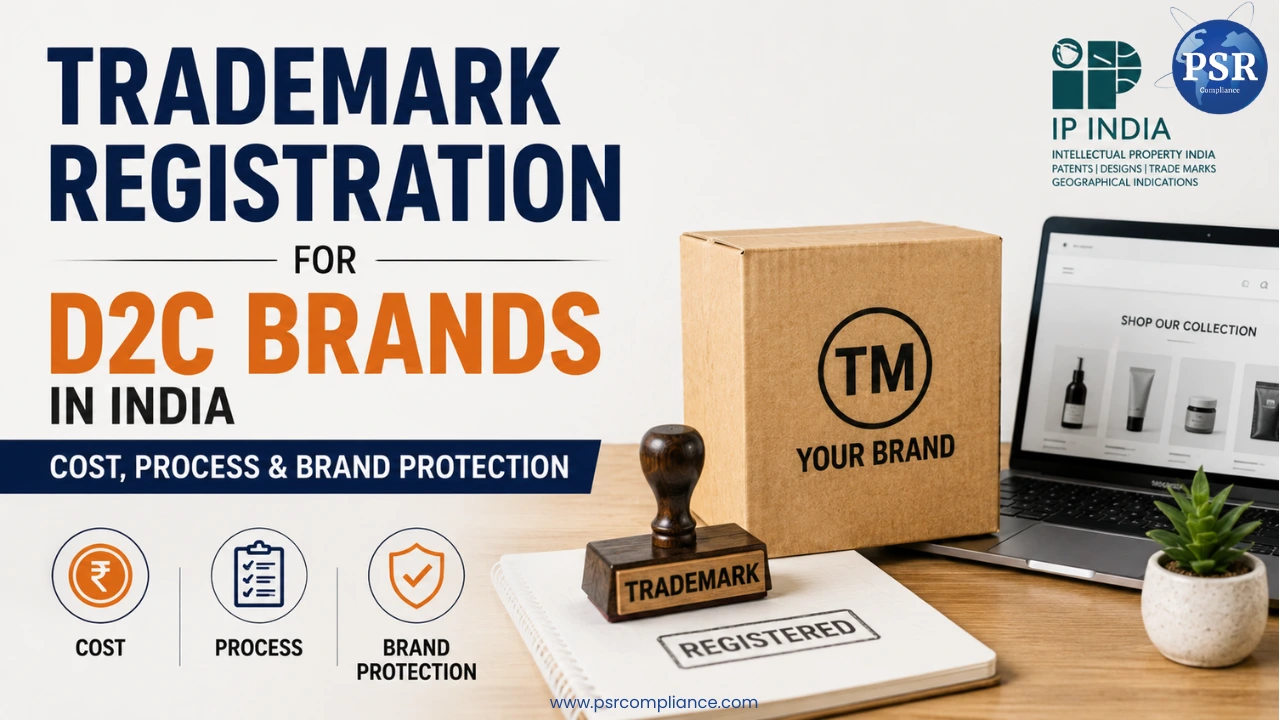
Trademark Registration for D2C Brands in India: Cost, Process & Brand Protection
Building a D2C brand today is exciting, but also risky. You spend months designing your logo, choosing your brand name, building a website, and running ads and just when the orders start coming in, someone else opens a store on Amazon or Flipkart using a name that sounds exactly like yours. Customers get confused. Some of them even end up buying from the copycat by mistake. This is one of the most common and painful problems D2C founders face in India today, and the only real solution is Trademark Registration For D2C Brands.
Many young business owners think trademark registration is something only big companies need. But in a Direct-to-Consumer business, your brand name is your entire company. Unlike a traditional retailer who sells many different brands, a D2C business builds its whole identity website, packaging, social media, and marketplace listings around one single name. If that name isn't legally protected, everything you've built is sitting on shaky ground.
Why D2C Brands Specifically Need Trademark Protection
For a D2C business, a trademark isn't just a legal formality it's a survival tool. Unlike a retailer selling fifty different brands, your entire business identity rests on one name, one logo, and one colour palette. If someone else registers your brand name as a trademark before you do, the consequences range from a forced rebrand to litigation that can burn through your marketing budget.
That's the real risk: someone else registering your name first. Trademark law in India works on a "first come, first served" basis in most disputes, so waiting too long to file isn't just risky, it can mean losing the name entirely, even if you were the one who built the brand from scratch.
How to Register Brand Name in India: The Process
Here's how the process works, step by step, explained simply.
Step 1: Search Your Brand Name
Before anything else, search the IP India portal to check if your name, or something very close to it, is already registered. Skipping this step is the number one reason applications later get objected to.
Step 2: Pick the Right Trademark Classes
This step matters more for D2C brands than almost anyone else. If you run a D2C consumer brand, you likely need at least two goods classes for full protection, one for your actual product, and often one more for how you sell it. Trademark protection is class-specific: a D2C fashion brand registering only in Class 25 (clothing) has no legal standing to stop a competitor from selling bags in Class 18 or fragrances in Class 3 under the same name.
Step 3: File Form TM-A Online
This is your official application, submitted through the IP India portal along with your logo, brand details, and selected classes.
Step 4: Examination and Response
The Registrar reviews your application and may raise objections. You get 30 days to reply if this happens.
Step 5: Publication and Registration
If there's no objection or opposition, your mark gets published in the Trademark Journal, and after the four-month opposition window closes, you receive your registration certificate.
Why Class 35 Is a Must for D2C and E-commerce Sellers
Here's something most first-time founders miss completely. Class 35 specifically covers "bringing together goods for customers to view and purchase" which is precisely what every Amazon, Flipkart, Meesho, and D2C website storefront does. Filing Class 35 alongside your product class protects your brand name as a retail identity on marketplaces, not just on the physical product itself. D2C brands that file only their product class often discover this gap the hard way, when a competitor opens a marketplace storefront under a similar name.
Trademark for E-commerce Business: Marketplace Requirements
If you're selling on Amazon, Flipkart, or Meesho, trademark registration isn't optional in practice, it's the gateway to real brand protection tools. Major marketplace enforcement programmes, including Amazon Brand Registry, Flipkart Brand Protection, and Meta Brand Rights Protection, expect trademark registration or equivalent proof of brand rights before granting access to stronger enforcement tools such as counterfeit listing removal and brand impersonation reporting. An unregistered brand cannot typically access these mechanisms.
This is a big deal. With a registered trademark, marketplace complaints against infringers are typically resolved in 24 to 72 hours instead of dragging on for weeks, because Amazon, Flipkart, and other platforms prioritize trademark-backed complaints with dedicated IP protection teams. Without one, you're stuck sending emails and hoping someone reads them while the copycat keeps selling.
Real growth trend: According to the IP India Annual Report, trademark registrations grew from about 431,213 in FY 2020-21 to roughly 552,190 in FY 2024-25 and a significant portion of this increase is being driven by D2C brands and e-commerce sellers who need a legal basis to apply for programs like Amazon Brand Registry. This isn't a niche legal step anymore it's becoming standard practice across India's online selling economy.
Brand Protection Trademark India: What You Actually Get
Once registered, your trademark gives you real, enforceable protection:
Nationwide exclusivity no one else can use your name in your registered classes anywhere in India
Faster marketplace action against copycats and listing hijackers
A real business asset that can be valued, licensed, or sold later
Investor confidence most investors specifically check for trademark protection before funding a D2C brand
Legal standing to send cease-and-desist notices or file infringement suits
Trademark Registration Cost for Startup D2C Brands
Government filing fees start at ₹4,500 for individuals, startups, and small enterprises per class, and ₹4,500 per class for Startup India recognised entities, versus ₹9,000 per class for others. Including professional charges, most D2C brands end up spending somewhere between ₹5,000 and ₹15,000 total for a straightforward filing, a genuinely small price compared to the risk of losing your brand name later.
For most D2C brands, filing in two classes (your product category plus Class 35 for retail) is the smart baseline, which means budgeting roughly ₹9,000 – ₹18,000 in government fees alone if filing as a recognised startup.
A Word of Caution on Shortcuts
Some sellers, in a rush to unlock Amazon or Flipkart Brand Registry quickly, are tempted by shortcuts like buying an already-registered trademark from someone else. While this can unlock instant Brand Registry access, a new trademark application filed properly can take three to six months, and sometimes longer if objections occur so the smarter move for most founders is simply to file early, correctly, and in the right classes from day one, rather than scrambling for a workaround later.
Get Your Brand Legally Yours
Your brand name is the single most valuable thing your D2C business owns. Everything else - your website, your ad campaigns, your customer relationships is built on top of it. Registering it properly, in the right classes, protects the business you're building before a competitor, a copycat, or even an unrelated stranger claims it first. Talk to a trademark professional today and make sure your brand name legally belongs to you.
Protect Your D2C Brand Before Someone Else Does
Your brand name, logo, website and marketplace presence are valuable business assets. PSR Compliance can help you with trademark search, class selection, application filing and complete trademark registration support for D2C and e-commerce brands.
Secure your brand before the copycats do.
📞 Call us: (+91) 8796104190
📧 Write to us: support@psrcompliance.com
Frequently Asked Questions
Why do D2C brands need trademark registration?
Trademark registration helps D2C brands protect their brand name and identity from unauthorised use. It can also strengthen the brand's position when dealing with marketplace infringement and brand protection issues.
How do I register a trademark for a D2C brand in India?
The process generally involves conducting a trademark search, selecting the appropriate trademark classes, preparing the application, filing Form TM-A, responding to examination objections if required, and completing the registration process.
Which trademark classes are important for D2C brands?
The appropriate classes depend on the products and services offered by the brand. A D2C business should identify the classes that accurately cover its products and relevant services before filing.
Is Class 35 required for every D2C brand?
Not necessarily. Class 35 covers specific retail and business-related services, so whether it is appropriate depends on the activities and business model of the D2C brand. The correct classes should be selected based on the actual goods and services.
How much does trademark registration cost for a D2C brand in India?
The government trademark filing fee depends on the applicant category and number of classes. Professional fees are additional and can vary depending on the scope of services and complexity of the application.
Can a startup register a trademark for its D2C brand?
Yes. Startups can apply for trademark registration for their D2C brand. Eligible startups may also receive applicable benefits under the trademark fee structure.
Can I register my D2C brand before launching?
Yes. Filing a trademark application before launching can help establish an early claim to the proposed brand and reduce the risk of investing heavily in a name that later faces trademark conflicts.
Can trademark registration protect my brand on Amazon and Flipkart?
A registered trademark can strengthen your ability to use platform-specific brand protection and enforcement programmes, subject to each marketplace's eligibility and verification requirements.
How long does D2C trademark registration take in India?
The timeline varies depending on examination, objections, opposition and other factors. A straightforward application can progress faster, while applications facing objections or opposition may take considerably longer.
What happens if someone copies my D2C brand name?
A registered trademark gives the owner stronger legal rights to take action against unauthorised use within the relevant scope of protection. Depending on the situation, this may include marketplace complaints, cease-and-desist notices or legal proceedings.