Thu, Jul 02 2026
Raju Karn
ITR Filing 2026: The Deadlines Have Changed — Here's Your New Calendar
For many years, one date ruled everything: July 31. Every year, salaried people, freelancers, small shop owners, and business consultants all rushed to file their Income Tax Return (ITR) by this same date. It didn't matter if your tax situation was simple or complicated - the deadline was the same for everyone.
That is not true anymore.
Starting this year, for Assessment Year 2026-27 (this covers the income you earned in FY 2025-26, i.e., between April 2025 and March 2026), the government has changed how ITR deadlines work. Now, your deadline depends on which ITR form you need to file - not on what kind of taxpayer you are. So before you assume your due date is July 31, you should stop and check. You might have more time than you think. Or you might have less. It all depends on your form.
Let's break this down in the simplest way possible.
Why Did the Government Change This?
Think about it this way. In the old system, a salaried person with one simple salary slip and a small business owner with GST filings, inventory records, and audited accounts both had to submit their ITR by the same date — July 31. That never made much sense, because the second person clearly has a lot more paperwork to sort through.
The government noticed this problem. So, as part of Budget 2026, they created a new system. Now, deadlines are based on the complexity of your tax return, not just on who you are. The goal is simple:
- Give more time to people who genuinely need it (like businesses with audits)
- Reduce the last-minute rush that causes mistakes
- Cut down the number of people all trying to file on the same day, which used to crash the tax portal every year
This is a fair change, and once you understand your own deadline, it should actually make life easier.
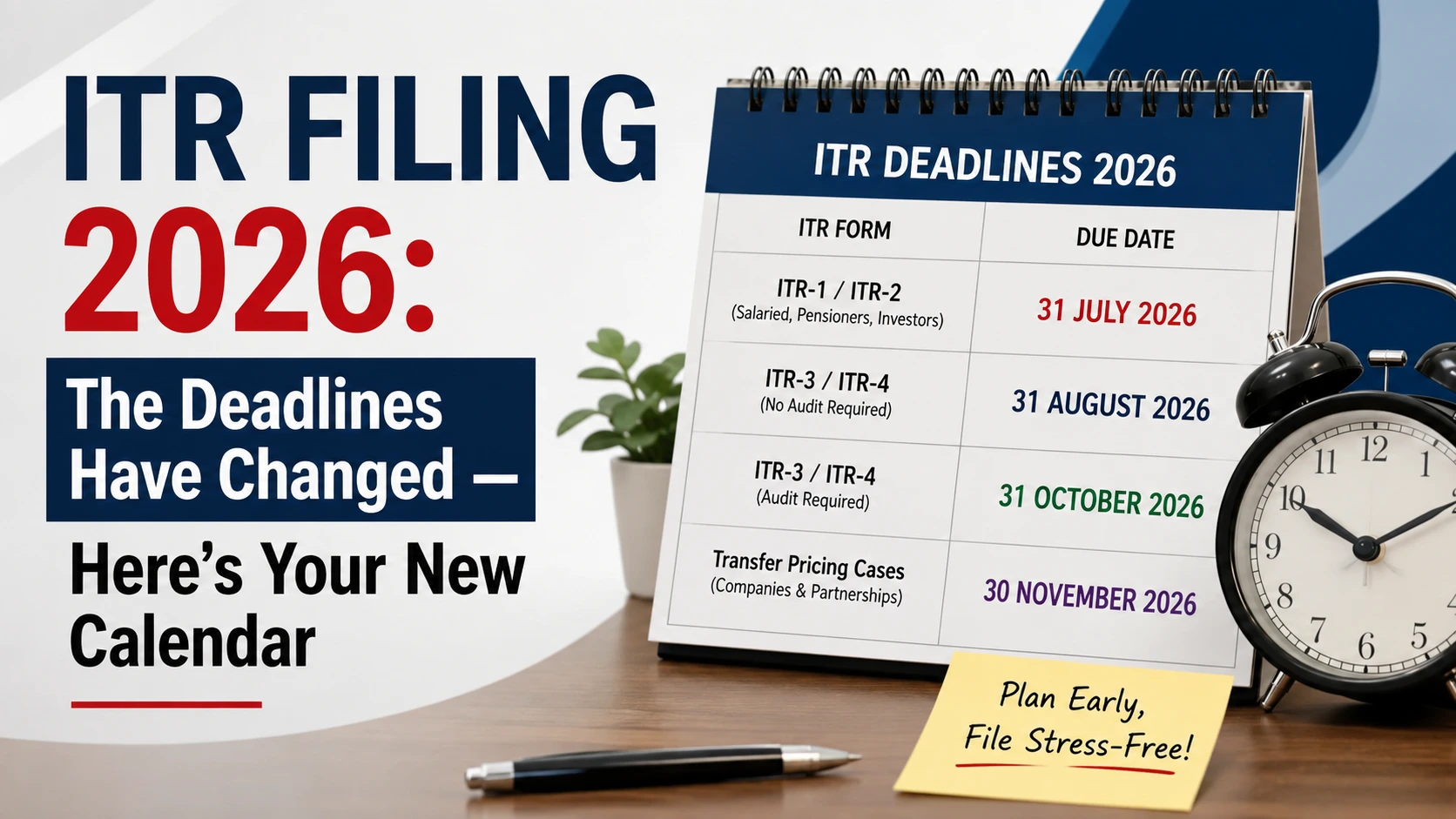
The New ITR Deadlines for 2026 - Simple Table
Here's the full picture. Find where you fit, and mark your calendar.
| Who You Are | Which ITR Form | Your New Deadline |
|---|---|---|
| Salaried employees, pensioners, and investors (salary, interest income, capital gains, dividends, up to 2 house properties) | ITR-1 or ITR-2 | July 31, 2026 — no change |
| Business owners or professionals who do not need a tax audit | ITR-3 or ITR-4 | August 31, 2026 — one extra month |
| Business owners who do need a statutory tax audit | ITR-3 or ITR-4 (audit cases) | October 31, 2026 |
| Companies and partnerships with international dealings needing transfer pricing reports | Corporate/partnership forms | November 30, 2026 |
So here's the simplest way to remember it:
- If you're salaried — nothing has changed. July 31 is still your date.
- If you run a business or work as a professional (like a freelancer or consultant) and don't need an audit — you now get until August 31.
- If your business needs an audit — you get until October 31.
- If your company deals with international transactions — you get until November 30.
It's Really Four Deadlines in a Row, Not Just One
Tax experts have pointed out something interesting about this new system. It's not really "one new deadline" — it's actually four deadlines that happen one after another, from July all the way to October. Each one depends on the one before it.
This creates a small side-effect that businesses and their chartered accountants (CAs) need to know about. In the old system, CAs had almost two full months — from August 1 to September 30 — to finish audit work after the non-audit ITR season ended. Now, because the non-audit deadline has moved to August 31, that window has shrunk to just about one month. So if your business needs an audit, it's smart to get your paperwork moving early — don't wait for your CA to be free in September.
A New Penalty for Late Audit Reports
Here's something new that many people don't know about yet.
If your business needs a tax audit, there are actually two separate documents involved — your ITR, and your Tax Audit Report (TAR). Starting this year, if the Tax Audit Report itself is filed late, it comes with its own separate penalty — starting at ₹75,000 for a delay of up to one month.
The Tax Audit Report is due one month before your ITR deadline:
- September 30, 2026 for regular audit cases
- October 31, 2026 for cases involving transfer pricing
So if you're a business owner who needs an audit, don't just track your ITR date — track your audit report date too. Missing either one now costs you money.
What Happens If You Miss Your Deadline?
Don't panic — missing your deadline doesn't mean you've lost your chance to file. You can still file what's called a belated return (a return filed after the due date) up until December 31, 2026. But it comes with some costs:
- A late filing fee of up to ₹5,000 under Section 234F
- This fee drops to just ₹1,000 if your total income is below ₹5 lakh
- On top of that, if you owe any tax, you'll be charged 1% interest per month on the unpaid amount under Section 234A
There are other downsides too. Filing late can delay your refund, and it may also mean you lose the ability to carry forward certain business losses to future years. It can even affect things like loan approvals, since banks often ask for your latest ITR as proof of income.
Good News: More Time to Fix Mistakes
Here's a change that doesn't get talked about as much, but it's actually really helpful.
In the past, if you filed your ITR and later realized you'd made a mistake — maybe you forgot to claim a deduction, or you entered the wrong bank account number — you had until December 31 to file a revised return and fix it.
That window has now been extended all the way to March 31, 2027 — the very last day of the assessment year. This gives you a lot more breathing room to catch and correct errors after you've filed.
One important thing to remember: this longer window only applies if your original return was filed on time. If you filed a belated return (meaning you were already late once) and then need to revise it after December 31, you could end up paying two separate penalties — one under Section 234F for filing late, and another under Section 234I. So this extended window is a safety net for people who file on time and later spot a mistake — it's not a reason to delay your original filing.
What About People Who Miss Everything?
There's one more option for people who completely miss the belated return deadline, or who realize months (or even years) later that they forgot to report some income. This is called an Updated Return, filed using Form ITR-U.
For this assessment year, you can file an Updated Return up to four years after the end of the assessment year — which means the final cutoff is March 31, 2031. However, this option comes with extra tax and interest, and you cannot use it to claim new deductions that weren't in your original return. It's meant purely for correcting or disclosing missed income — not for getting a better refund.
The One Thing You Must Do Right Now
With all these different deadlines floating around, the most important step is this: figure out exactly which ITR form applies to you. Don't just go by habit or assume your deadline is the same as last year.
This matters a lot if your income situation is a bit mixed. For example:
- You're salaried, but you also earn some freelance income on the side
- You're an investor, but you also run a small consulting business
In cases like these, you may need to file a different ITR form than you expect — which means a completely different deadline too.
Quick Checklist Before You File
- Check your ITR form — this decides your deadline, not your job title.
- Match your Form 16 with Form 26AS and AIS — make sure the numbers line up before you file.
- Compare the old and new tax regimes — pick whichever saves you more money.
- Don't wait till the last week — the tax portal often slows down when everyone files at once.
- E-verify your return within 30 days — an unverified return is treated as if you never filed at all.
- If you need an audit, start early — remember, the audit window has shrunk this year.
Conclusion
The days of one single tax deadline for everyone in India are over. Whether you have more time or less time now depends entirely on which form you file. Salaried employees can relax — July 31 is still your date. But if you run a business, freelance, or deal with more complex income, you need to check your specific deadline carefully, because assuming it's "the usual July 31" could actually cause you to miss your real due date — or waste time worrying about a deadline that's already passed you by.
Take ten minutes today to check which form applies to you, mark the right date on your calendar, and start collecting your documents early. It's a small step now that saves a lot of stress later.
Need Help With Your ITR Filing?
Our team handles ITR form selection, tax audit coordination, and revised return filing together. This keeps your income tax compliance fully accurate from day one. We also help you avoid the last-minute errors that usually attract penalties and notices.
📞 Call: +91-8796104190
📧 Email: support@psrcompliance.com
Frequently Asked Questions: ITR Filing Deadlines 2026
1. Is July 31 still the ITR deadline for everyone in 2026?
No. July 31, 2026 is only the deadline for taxpayers filing ITR-1 or ITR-2, including most salaried employees, pensioners, and investors. Business owners and professionals filing ITR-3 or ITR-4 have different deadlines depending on whether a tax audit is required.
2. I am a salaried employee. Has my ITR filing deadline changed?
No. If you file ITR-1 or ITR-2, your income tax return filing deadline remains July 31, 2026.
3. I run a small business or work as a freelancer. What is my new ITR deadline?
If you file ITR-3 or ITR-4 and your accounts do not require a statutory tax audit, your deadline is August 31, 2026.
4. My business requires a tax audit. What is my ITR filing deadline?
Businesses and professionals whose accounts require a statutory tax audit must file their Income Tax Return by October 31, 2026.
5. My company has international transactions. What is the due date?
Companies and partnership firms required to submit a Transfer Pricing Report for international or specified domestic transactions must file their ITR by November 30, 2026.
6. How do I know which ITR form is applicable to me?
The correct ITR form depends on your income sources. Salary, pension, interest, dividends, capital gains, and up to two house properties generally require ITR-1 or ITR-2, while business or professional income usually requires ITR-3 or ITR-4. If you have multiple income sources, choose your form carefully.
7. What happens if I miss my ITR filing deadline?
You can still file a Belated Return until December 31, 2026. However, you may have to pay a late filing fee of up to ₹5,000 under Section 234F (₹1,000 if taxable income is below ₹5 lakh), along with 1% monthly interest on unpaid tax under Section 234A.
8. What are the disadvantages of filing an Income Tax Return late?
Late filing may delay your tax refund, prevent you from carrying forward certain losses, restrict tax regime options in some cases, and even affect loan or visa applications where recent ITRs are required.
9. Can I revise my Income Tax Return after filing it?
Yes. If you discover any mistake after filing, you can submit a Revised Return. For AY 2026-27, the revision deadline has been extended until March 31, 2027.
10. Does the extended ITR revision deadline apply to everyone?
The extended revision window primarily benefits taxpayers who filed their original return on time. Revising a belated return after December 31 may attract additional penalties under the Income Tax Act.
11. What if I discover unreported income years later?
You can file an Updated Return (ITR-U). For AY 2026-27, an ITR-U can be filed up to March 31, 2031, subject to additional tax and other applicable conditions.
12. Is the Tax Audit Report (TAR) filing deadline different from the ITR deadline?
Yes. The Tax Audit Report (TAR) must generally be filed one month before the applicable ITR due date. For AY 2026-27, the due dates are September 30, 2026 for regular audit cases and October 31, 2026 for transfer pricing cases.
13. Why has the government changed the ITR filing deadline structure for 2026?
The revised schedule aims to reduce last-minute filing pressure, minimize errors, improve compliance, and distribute portal traffic by assigning deadlines based on the complexity of different taxpayer categories.
14. What should I do before filing my Income Tax Return?
Identify the correct ITR form, reconcile your Form 16, Form 26AS, and Annual Information Statement (AIS), compare the old and new tax regimes, gather all required documents, and file your return well before the due date to avoid last-minute issues.