Thu, Jul 02 2026
Raju Karn
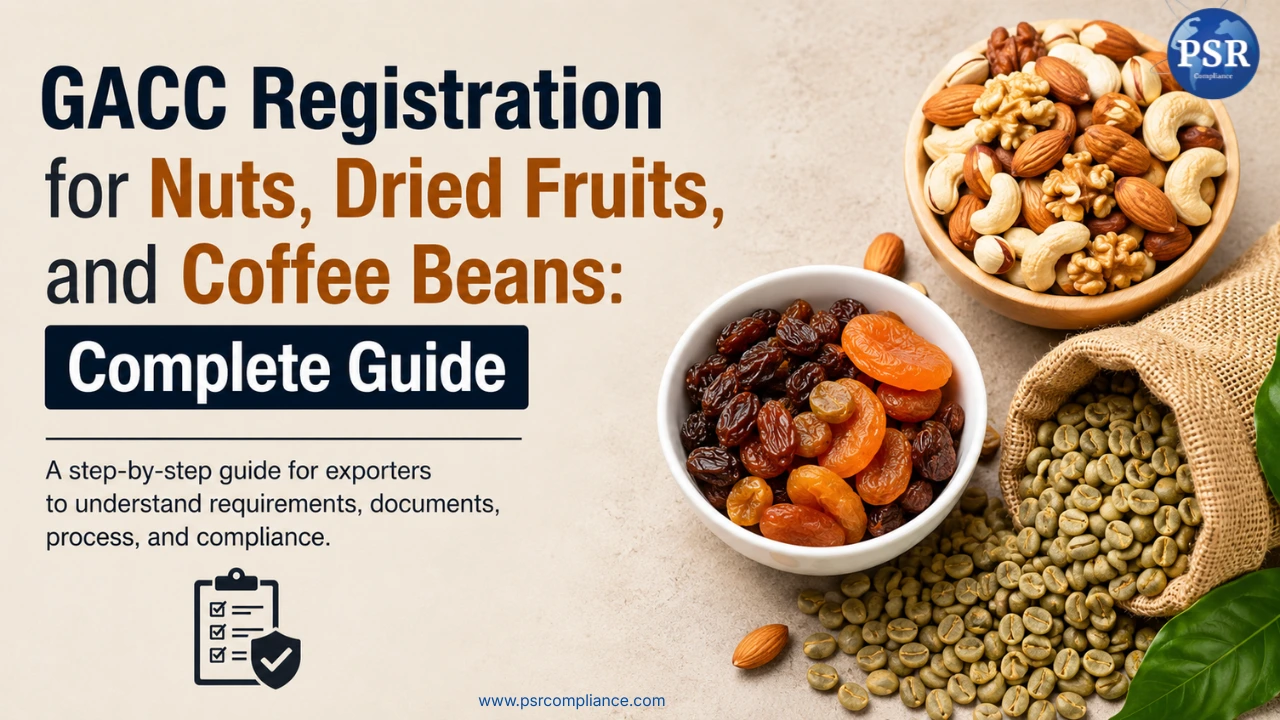
GACC Registration for Nuts, Dried Fruits, and Coffee Beans: Complete Guide
If you export nuts, dried fruits, or unroasted coffee beans to China, you fall under one of the stricter categories of GACC registration. These products are officially classified as high-risk by Chinese customs, which means your facility cannot simply register on its own the way many packaged food companies do. This guide explains exactly what applies to you, in simple and clear terms, so you know what to expect at every stage before you begin.
Why These Products Get Extra Scrutiny
Nuts, dried fruits, and coffee beans might seem like low-risk, shelf-stable products, especially when compared to something like meat or dairy. But China's customs authority, known as GACC, does not see it that way. These products carry certain natural risks that make them a food safety concern during storage and transport.
The biggest concern is aflatoxin. This is a toxin produced by certain molds that can grow on nuts, dried fruits, and beans, especially when they are stored in warm or humid conditions. Aflatoxin is harmful even in very small amounts, and it does not go away with normal cooking or processing. Beyond aflatoxin, these products can also carry pesticide residue from farming, pest contamination during drying, and moisture-related spoilage if packaging or storage is not handled correctly.
Because of these risks, GACC places this entire product group under a stricter registration path, rather than allowing simple, direct self-registration like it does for many packaged snack foods or beverages.
Which Products Exactly Fall Under This Category?
| Product Category | Products Covered | Important Compliance Notes |
|---|---|---|
| Tree Nuts | Almonds, cashews, walnuts, pistachios, hazelnuts, macadamia nuts, and similar nuts | Closely monitored due to the high risk of aflatoxin contamination during storage. |
| Groundnuts & Seeds | Peanuts, sunflower seeds, pumpkin seeds, sesame seeds | Peanuts are particularly scrutinized because improper drying and storage can lead to aflatoxin contamination. |
| Dried Fruits | Raisins, dried apricots, dried figs, dried mango, dried dates, and similar dried fruits | Moisture control during drying, packaging, and storage is essential to maintain food safety. |
| Unroasted Coffee Beans | Green coffee beans (unroasted) | Only unroasted (green) coffee beans fall under this category. Roasted coffee is generally regulated separately. |
| Unroasted Cocoa Beans | Raw cocoa beans before processing | Classified alongside unroasted coffee beans as raw agricultural products. |
| Mixed Products (Blends) | Trail mixes, nut and dried fruit blends, flavored nut mixes | May require registration under multiple product classifications. Exporters should confirm the correct classification with the relevant food safety authority before applying. |
Note: If your product contains ingredients from more than one category (such as nuts, seeds, and dried fruits in a single package), you may need to comply with multiple registration requirements. Always verify the applicable product classification before submitting your application.
The Registration Route: Why Official Recommendation Is Required
This is the single most important thing to understand about this category, so it's worth explaining clearly.
Under China's registration system, food products are split into two paths. Some products can go through self-registration, where the company applies directly through China's online portal without needing any outside approval first. Other products, considered higher risk, must go through official recommendation, meaning your home country's competent food safety authority has to review and formally recommend your facility to GACC before your registration can even be considered.
Nuts, dried fruits, and coffee beans fall into this second, stricter group. You cannot register your facility with GACC by yourself, no matter how strong your documentation is. Your government's food authority must act as a middle step.
For example, if you are exporting from India, your application would typically go through your relevant national food safety authority. If you are exporting from the United States, this step goes through the FDA. Only after this recommendation reaches GACC does the actual registration review begin.
This is very different from many packaged food products, like biscuits, soft drinks, or confectionery, which can usually self-register directly through China's online portal, called CIFER, without this extra government-level step.
What Documents You Will Typically Need
Before applying for GACC Registration, exporters should keep the following documents ready:
→ Business Registration Certificate – Proof that your company is legally registered and authorized to operate.
→ Food Safety or Export License – A valid license issued by your country's food safety or export authority.
→ Production Facility Photographs – Clear images of the manufacturing, processing, storage, and packaging areas.
→ Processing Flow Chart – A step-by-step diagram showing how the product moves from sourcing or harvesting to cleaning, drying, sorting, processing, and final packaging.
→ Laboratory Test Reports – Recent test reports covering:
- Aflatoxin levels
- Pesticide residue
- Heavy metal content
- Other applicable food safety parameters
→ Packaging Samples or Label Designs – Samples showing how the product will be packaged and labeled for export to China, including space for the GACC registration number.
→ Product Information – Details such as product specifications, ingredients (if applicable), and intended export category.
→ Quality Control & Food Safety Documents – Records demonstrating your food safety management and quality assurance procedures (where applicable).
How the Registration Process Works, Step by Step
Step 1: Confirm Your Product Classification
Identify the correct GACC product category for your goods. Tree nuts, dried fruits, groundnuts, seeds, coffee beans, and cocoa beans each have specific product classifications. Choosing the wrong category can lead to delays or rejection of your application.
Step 2: Prepare Documents & Laboratory Test Reports
Gather all required documents, including business registration, food safety certificates, facility details, and recent laboratory reports covering aflatoxin, pesticide residues, heavy metals, and other required food safety parameters.
Step 3: Obtain Recommendation from Your Competent Authority
Before GACC reviews your application, your country's designated food safety authority must recommend your facility. Since this process follows your national authority's timeline, plan sufficient time before your intended export date.
Step 4: Submit the Application Through the CIFER Portal
File your registration through the China Import Food Enterprise Registration (CIFER) portal. As the portal primarily operates in Mandarin, many exporters seek professional assistance to ensure accurate submission and avoid errors.
Step 5: Receive GACC Review & Registration Approval
After reviewing your application, GACC issues an official registration number for your facility upon approval. No physical certificate is provided—the registration number listed in GACC's official database serves as proof of registration.
Step 6: Display the GACC Registration Number on Product Packaging
Once approved, print your GACC registration number on both the inner and outer packaging of your products. The registration number must also be included in customs documentation for every shipment exported to China.
How Long Does This Usually Take?
Because this category requires official recommendation before GACC review even begins, the overall timeline tends to be longer than for self-registered products. Packaged snacks or beverages, which follow the self-registration path, might complete the process in a matter of weeks. Nuts, dried fruits, and coffee beans, on the other hand, often take considerably longer, since your application first has to move through your home country's food authority before it even reaches GACC's desk for review.
Because of this extra step, it is safer to plan several months ahead of your intended export date, rather than assuming a quick turnaround. Businesses that leave this until close to their shipping date often face costly delays.
Renewal Rules Under the New Decree 280
China recently updated its overall registration framework. As of June 1, 2026, a new regulation called Decree 280 has replaced the older Decree 248 that had been in place since 2022. This update introduces an automatic renewal system for many registered facilities. Once your registration validity period ends, it can now renew automatically for another five years, without you needing to reapply from scratch.
However, this automatic renewal benefit does not apply to every product category. GACC has specifically excluded certain high-risk categories from automatic renewal, and it regularly reviews and updates this exclusion list. Since nuts, dried fruits, and coffee beans fall under the recommended registration category, it is important to check your current renewal status directly with GACC's system rather than assuming automatic renewal applies to your product. If your category turns out to be excluded, you will need to submit a manual renewal application, and this should be done between 3 and 12 months before your existing registration expires.
Common Mistakes Exporters Make in This Category
Many exporters in this specific category run into problems that could have been avoided with better preparation. One of the most common mistakes is submitting outdated or incomplete lab reports, especially around aflatoxin testing, which is one of the biggest red flags GACC watches for given the natural risk profile of nuts and dried fruits.
Another frequent issue is misclassifying blended or mixed products, such as trail mixes or flavored nut blends, under the wrong product code. This kind of classification error can delay an application significantly or even lead to outright rejection, forcing the business to start the entire process over again.
Some businesses also mistakenly assume this category follows the same simple, direct self-registration process used for packaged snacks or beverages, only to discover later that their application was submitted through the completely wrong route. This misunderstanding alone can add months to the registration timeline.
Finally, many businesses make the mistake of leaving the entire registration process to their Chinese importer or distributor. This creates a real long-term risk, because the registration number and its login credentials legally belong to the manufacturer, not the buyer. If you ever switch distributors down the line, this arrangement can create serious access and continuity problems, sometimes even blocking your ability to ship at all until the issue is resolved.
Why Getting This Right Matters So Much
For nuts, dried fruits, and coffee bean exporters, a rejected or delayed registration is not just a paperwork inconvenience. It means your shipment gets physically held at Chinese customs while the issue is sorted out. It means pressure on your relationship with your buyer, who is waiting on stock they may have already promised to their own customers. In some cases, it even means your product loses shelf life or quality while sitting in storage, waiting for clearance that should have happened smoothly.
Getting your product classification, documentation, and recommendation process right from your very first application is what separates a smooth, predictable export process from one full of costly delays and last-minute scrambling.
Need Help With Your GACC Registration for Nuts, Dried Fruits, or Coffee Beans?
Our team at PSR Compliance handles your entire GACC registration process, from product classification and lab report coordination to competent authority recommendation and CIFER submission. This keeps your exports to China fully compliant and moving smoothly through customs, without last-minute surprises.
📞 Call: +91-8796104190
📧 Email: support@psrcompliance.com
📍 D-49, D Block, Sector 6, Noida, Uttar Pradesh, 201301
Frequently Asked Questions
Can I register my nut or dried fruit processing facility directly with GACC?
No. For this product category, GACC requires an official recommendation from your country's competent food safety authority before reviewing your application. Direct self-registration is not permitted.
Are laboratory test reports mandatory for GACC registration?
Yes. Exporters must submit recent laboratory test reports covering key food safety parameters such as aflatoxin, pesticide residues, and heavy metals. These reports are essential for demonstrating compliance with GACC's safety requirements.
Does this registration requirement apply to roasted coffee beans?
No. This category specifically covers unroasted (green) coffee beans. Roasted coffee is generally regulated under different Chinese import requirements, so you should verify the correct classification before applying.
What if my GACC registration cannot be renewed automatically?
If your registration is not eligible for automatic renewal under GACC Decree 280, you must submit a manual renewal application between 3 and 12 months before your registration expires. Missing this deadline may interrupt your ability to export to China.
How long before exporting should I begin the GACC registration process?
It is recommended to begin the registration process several months before your planned export date. This allows sufficient time for document preparation, laboratory testing, recommendation by your competent authority, and GACC's review process.
Can mixed products such as trail mixes require multiple product classifications?
Yes. Products containing a combination of nuts, seeds, and dried fruits may fall under more than one GACC product classification. Exporters should confirm the correct classification before submitting their application.
What happens if I submit my application under the wrong product category?
Submitting an incorrect product classification can result in delays, requests for additional information, or rejection of your application. Verifying the correct category before filing helps avoid unnecessary complications.
Is the GACC registration number mandatory on product packaging?
Yes. Once your facility is approved, the GACC registration number must appear on both the inner and outer packaging of exported products and be included in the customs documentation for every shipment to China.