Sat, Jul 25 2026
Raju Karn
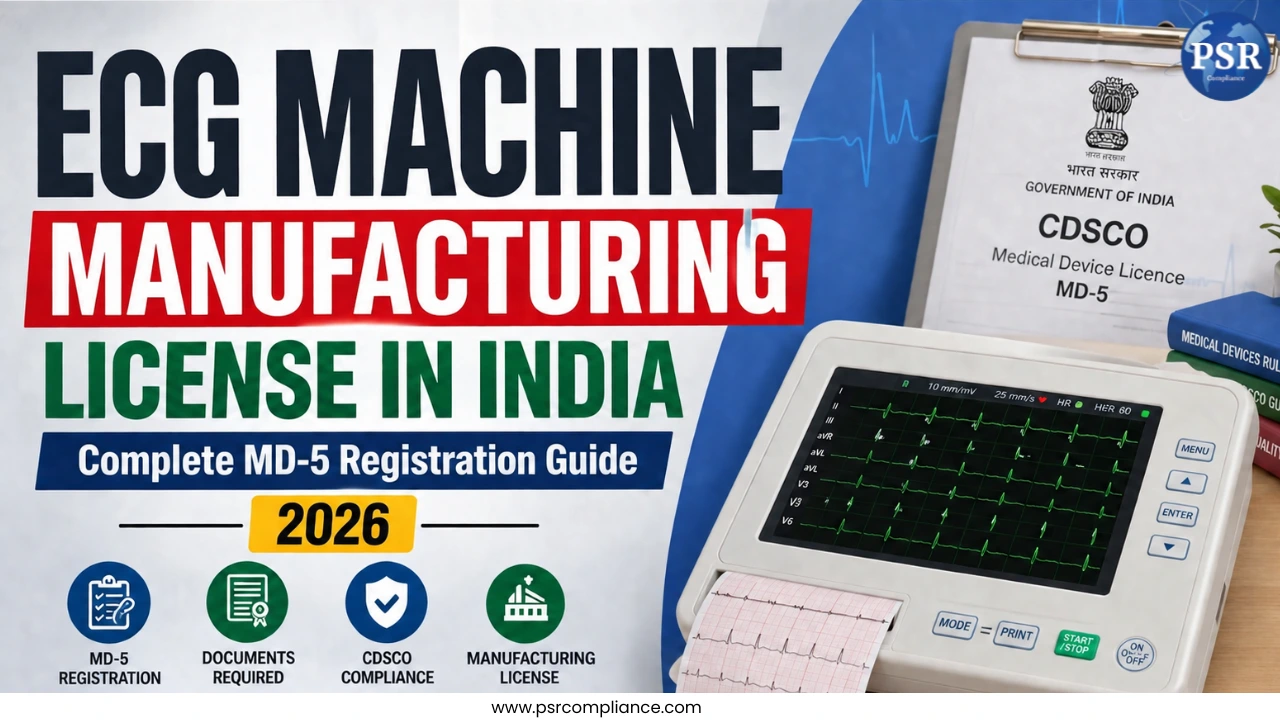
ECG Machine Manufacturing License in India: Complete MD-5 Registration Guide (2026)
An Electrocardiogram (ECG) machine is one of the most widely used medical devices in hospitals, clinics, diagnostic centres, and healthcare facilities. Since it directly helps healthcare professionals diagnose heart-related conditions, its quality, safety, and performance are extremely important. To ensure that only safe and compliant medical devices reach the market, the Government of India regulates the manufacturing of ECG machines under the Medical Device Rules, 2017.
Any business planning to manufacture ECG machines in India must obtain the appropriate ECG Machine Manufacturing License before starting production or selling the device. Manufacturing without the required approval may lead to penalties, product seizure, or suspension of business operations.
In this guide, you'll learn everything about obtaining an ECG Machine Manufacturing License, including the applicable regulations, required documents, licensing process, MD-3, MD-5, MD-7, and MD-9 forms, processing time, and common mistakes to avoid.
What is an ECG Machine Manufacturing License?
An ECG Machine Manufacturing License is an approval issued under the Medical Device Rules, 2017, allowing a company to legally manufacture ECG machines in India.
The license confirms that the manufacturer complies with the required quality management systems, manufacturing standards, and regulatory requirements prescribed by the licensing authority.
Only after receiving this license can a manufacturer legally produce, distribute, and sell ECG machines in the Indian market.
Is an ECG Machine Considered a Medical Device?
Yes.
An ECG (Electrocardiogram) machine is classified as a medical device because it is used to monitor and record the electrical activity of the heart for diagnosis and patient care.
Under the CDSCO's risk-based classification system, ECG machines fall under Class B (low-to-moderate risk). This is because the device is non-invasive and doesn't sustain or support life directly — but if it malfunctions, it can produce incorrect readings that delay or mislead cardiac diagnosis. This Class B status is what determines the entire licensing pathway for ECG manufacturers: it means the applicable forms are MD-3 (application) and MD-5 (license) — not the MD-7/MD-9 route, which applies only to the higher-risk Class C and D devices.
Since ECG machines directly influence medical decisions, they are regulated under India's medical device regulations to ensure patient safety and product quality.
Manufacturers must therefore comply with all applicable regulatory requirements before commercial production.
Which Authority Regulates ECG Machine Manufacturing in India?
The manufacturing of medical devices is regulated under the Medical Device Rules, 2017, framed under the Drugs and Cosmetics Act.
Depending on the risk classification of the device, approvals are granted by two separate bodies:
- State Licensing Authority (SLA) — grants manufacturing licenses for Class A and Class B devices, via Form MD-3 (application) → Form MD-5 (license). Since ECG machines are Class B, this is the authority ECG manufacturers must apply to.
- Central Licensing Authority (CDSCO, at the central level) — grants manufacturing licenses for Class C and Class D devices, via Form MD-7 (application) → Form MD-9 (license).
These authorities evaluate manufacturing facilities, quality systems, technical documentation, and regulatory compliance before granting manufacturing licenses.
Understanding MD-3, MD-5, MD-7 and MD-9
Many applicants get confused about these forms. Here's a simple explanation.
MD-3
MD-3 is the application form used for obtaining a manufacturing license for Class A and Class B medical devices — the category ECG machines fall under. Applications are submitted to the State Licensing Authority.
Manufacturers submit this application before starting production.
MD-5
MD-5 is the manufacturing license issued after approval of the MD-3 application, by the State Licensing Authority.
Once issued, it authorizes the manufacturer to legally manufacture approved Class A and Class B medical devices, including ECG machines.
MD-7
MD-7 is the application form used for obtaining manufacturing permission for Class C and Class D medical devices, which generally carry higher risks. Applications are submitted to the Central Licensing Authority (CDSCO).
MD-9
After successful review of an MD-7 application, CDSCO (as the Central Licensing Authority) issues MD-9, allowing manufacturing of approved Class C and Class D medical devices.
MD-12 and MD-13 (Test License)
Before scaling up to commercial production, manufacturers often need to produce small quantities of an ECG machine for testing, clinical evaluation, demonstration, or training purposes. This requires a separate Test License:
- Form MD-12 is the application for a test license, filed with CDSCO through the SUGAM portal.
- Form MD-13 is the test license granted after review, permitting manufacture of limited quantities strictly for testing, evaluation, demonstration, or training — not for commercial sale. This license is typically valid for three years and must be kept available at the manufacturing premises at all times.
Many manufacturers obtain an MD-13 test license first to generate performance and validation data before filing the full MD-3/MD-5 commercial application.
Difference Between MD-3, MD-5, MD-7 and MD-9
| Form | Purpose | Licensing Authority |
|---|---|---|
| MD-3 | Application for manufacturing license (Class A & B) | State Licensing Authority |
| MD-5 | Manufacturing License issued for Class A & B devices | State Licensing Authority |
| MD-7 | Application for manufacturing license (Class C & D) | Central Licensing Authority (CDSCO) |
| MD-9 | Manufacturing License issued for Class C & D devices | Central Licensing Authority (CDSCO) |
Understanding these forms helps manufacturers choose the correct application process based on the classification of their medical device. For ECG machines specifically, the relevant pathway is always MD-3 → MD-5, filed with the State Licensing Authority.
Who Needs an ECG Machine Manufacturing License?
The license is generally required by businesses involved in manufacturing ECG machines, including:
- Medical device manufacturers
- Medical device company India
- OEM manufacturers
- Healthcare equipment manufacturers
- Startup medical device companies
- Contract manufacturers
- Electronics companies entering the healthcare sector
- Medical equipment production units
Any business intending to commercially manufacture ECG machines must obtain the appropriate regulatory approval before production.
Documents Required for ECG Machine Manufacturing License
The licensing authority carefully verifies technical and legal documents before granting approval.
Commonly required documents include:
- Company Incorporation Certificate
- PAN Card
- GST Registration
- Factory License
- Manufacturing Site Details
- Site Master File
- Device Master File
- ISO 13485 Certificate
- Quality Management System (QMS) Documents
- Manufacturing Process Flow
- Equipment List
- Technical Staff Details
- Qualification Certificates
- Address Proof of Manufacturing Unit
- Electricity Bill
- Rent Agreement or Ownership Proof
- No Objection Certificate (if applicable)
- Product Specifications
- Product Labels
- Risk Management Documents
Preparing complete documentation before filing the application significantly improves approval chances.
Why is ISO 13485 Important?
ISO 13485 is the internationally recognized quality management standard for medical device manufacturing.
It demonstrates that the manufacturer follows consistent quality processes throughout design, production, storage, and distribution.
Although regulatory requirements depend on the device category, implementing ISO 13485 greatly strengthens compliance and simplifies inspections.
Step-by-Step Process to Obtain an ECG Machine Manufacturing License
Obtaining an ECG Machine Manufacturing License involves preparing technical documents, implementing a quality management system, and submitting an application to the appropriate licensing authority. Following the correct process helps avoid unnecessary delays and objections.
Step 1: Determine the Device Classification
The first step is to determine the risk classification of your ECG machine under the Medical Device Rules, 2017.
Medical devices in India are classified into:
- Class A – Low Risk
- Class B – Low to Moderate Risk (ECG machines fall here)
- Class C – Moderate to High Risk
- Class D – High Risk
Since ECG machines are Class B devices, the applicable application form is MD-3, and the license issued will be MD-5, granted by the State Licensing Authority. The applicable application form and licensing authority depend on the device classification, so confirming this at the outset avoids filing under the wrong pathway.
Step 2: Set Up the Manufacturing Facility
Before applying, ensure your manufacturing unit is properly established.
The facility should include:
- Production area
- Quality control area
- Testing equipment
- Storage area
- Clean manufacturing environment
- Qualified technical staff
The manufacturing site must comply with applicable Good Manufacturing Practices (GMP).
Step 3: Implement a Quality Management System
A proper Quality Management System (QMS) is essential for medical device manufacturing.
Manufacturers should establish documented procedures covering:
- Production
- Quality control
- Risk management
- Complaint handling
- Product traceability
- Corrective and preventive actions
Many manufacturers adopt ISO 13485 to strengthen their quality management system and meet regulatory expectations.
Step 4: Prepare the Site Master File (SMF)
The Site Master File provides complete information about the manufacturing facility.
It generally includes:
- Company profile
- Manufacturing layout
- Production process
- Machinery details
- Technical staff
- Utilities
- Quality control procedures
- Storage arrangements
This document helps the licensing authority evaluate the manufacturing site.
Step 5: Prepare the Device Master File (DMF)
The Device Master File contains technical information about the ECG machine.
It usually includes:
- Product description
- Device specifications
- Intended use
- Design information
- Risk analysis
- Performance data
- Testing reports
- Labeling details
- Packaging information
A well-prepared Device Master File improves the chances of faster approval.
Step 6: (Optional) Apply for a Test License
If you need to manufacture limited quantities of the ECG machine for testing, clinical evaluation, demonstration, or training before commercial launch, apply for a Test License using Form MD-12, which results in the grant of Form MD-13 by CDSCO.
Step 7: Submit the Commercial Manufacturing Application
Manufacturers should submit the appropriate application based on the classification of the ECG machine.
- MD-3 for Class A and Class B medical devices, submitted to the State Licensing Authority — this is the pathway ECG machines follow.
- MD-7 for Class C and Class D medical devices, submitted to the Central Licensing Authority (CDSCO).
Applications are submitted along with all supporting documents and prescribed government fees.
Step 8: Document Review and Inspection
After receiving the application, the licensing authority reviews all submitted documents.
Depending on the device category and regulatory requirements, officials may also inspect the manufacturing facility to verify:
- Manufacturing practices
- Quality management system
- Technical infrastructure
- Documentation
- Compliance with Medical Device Rules
Manufacturers should ensure that all records are readily available during inspection.
Step 9: Grant of Manufacturing License
If the application satisfies all regulatory requirements, the licensing authority issues:
- MD-5 for approved Class A and Class B devices (issued by the State Licensing Authority) — this is what an ECG manufacturer ultimately receives.
- MD-9 for approved Class C and Class D devices (issued by the Central Licensing Authority).
The manufacturing license is generally valid for five years from the date of issue, after which it must be renewed to continue manufacturing legally.
After receiving the manufacturing license, the company can legally manufacture and market approved ECG machines in India.
Government Fees for ECG Machine Manufacturing License
The government fee depends on several factors, including:
- Medical device classification
- Number of products
- Manufacturing site
- Applicable regulatory category
Since fee structures may be revised by the regulatory authorities from time to time, manufacturers should verify the latest fee schedule before filing the application.
Processing Time
The approval timeline depends on:
- Completeness of documentation
- Device classification
- Inspection requirements
- Queries raised by the licensing authority
As a Class B device, ECG machine applications generally move faster than Class C or D applications, which require more extensive clinical data review. If all documents are complete and compliant, the manufacturing license is generally processed within a reasonable period as prescribed under the applicable regulations.
Common Reasons for Application Rejection
Many applications are delayed because of avoidable mistakes.
Some common reasons include:
- Incorrect device classification
- Incomplete Site Master File
- Missing Device Master File
- Poor quality management documentation
- Inconsistent technical information
- Incorrect application form
- Missing supporting documents
- Inadequate manufacturing infrastructure
- Incomplete risk management documentation
Carefully reviewing the application before submission helps improve approval chances.
Benefits of Obtaining an ECG Machine Manufacturing License
Having a valid manufacturing license offers several advantages.
Legal Manufacturing
The license allows manufacturers to legally produce and sell ECG machines in India.
Better Market Reputation
Licensed manufacturers are generally trusted more by hospitals, distributors, and healthcare professionals.
Regulatory Compliance
The business remains compliant with Indian medical device regulations.
Business Expansion
A licensed manufacturing facility can explore new business opportunities in domestic and international markets.
Improved Product Quality
Compliance with quality standards helps improve manufacturing consistency and patient safety.
Why Choose PSR Compliance?
Obtaining a medical device manufacturing license requires technical documentation, regulatory knowledge, and proper compliance.
PSR Compliance offers complete assistance with:
- ECG Machine Manufacturing License
- Medical Device Manufacturing Registration
- Device Classification Support
- MD-3 & MD-7 Application Filing
- MD-5 & MD-9 Licensing Assistance
- ISO 13485 Guidance
- Site Master File Preparation
- Device Master File Preparation
- CDSCO Documentation Support
- Post-License Compliance
Our experts guide manufacturers through every stage of the licensing process to help ensure accurate documentation and timely approvals.
Conclusion
Manufacturing ECG machines in India requires compliance with the Medical Device Rules, 2017 and obtaining the appropriate ECG Machine Manufacturing License before commercial production begins. Since ECG machines are classified as Class B devices, manufacturers must file through Form MD-3 with the State Licensing Authority and receive their manufacturing license via Form MD-5. Understanding the licensing process, preparing the required technical documents, implementing a strong quality management system, and selecting the correct application form are all essential steps toward successful registration.
Whether you are a startup entering the healthcare industry or an established medical device company in India, obtaining the correct manufacturing license ensures legal compliance, enhances credibility, and supports long-term business growth. If you need expert guidance throughout the licensing process, PSR Compliance can assist you from documentation to final approval.
Frequently Asked Questions (FAQs)
1. Is an ECG machine considered a medical device in India?
Yes. ECG machines are regulated medical devices under the Medical Device Rules, 2017, classified as Class B (low-to-moderate risk).
2. Which authority issues the ECG Machine Manufacturing License?
Since ECG machines are Class B devices, the State Licensing Authority (SLA) issues the manufacturing license, in Form MD-5, following approval of a Form MD-3 application.
3. What is MD-3?
MD-3 is the application form for obtaining a manufacturing license for Class A and Class B medical devices, filed with the State Licensing Authority. This is the form ECG manufacturers use.
4. What is MD-5?
MD-5 is the manufacturing license issued by the State Licensing Authority after approval of the MD-3 application.
5. What is the difference between MD-7 and MD-9?
MD-7 is the application form for Class C and D medical devices, filed with the Central Licensing Authority (CDSCO), while MD-9 is the manufacturing license issued after approval. These do not apply to ECG machines, which are Class B.
6. Is ISO 13485 required for medical device manufacturing?
ISO 13485 is widely recognized as the quality management standard for medical device manufacturers and helps demonstrate compliance with quality requirements.
7. What documents are required for an ECG Machine Manufacturing License?
Documents generally include company incorporation records, Site Master File, Device Master File, ISO 13485 certificate, QMS documents, factory details, and technical documentation.
8. How long does the approval process take?
The processing time depends on the device classification, document completeness, and inspection requirements. As a Class B device, ECG applications typically process faster than Class C/D applications.
9. Do I need a test license before commercial manufacturing?
Not always, but manufacturers who want to produce small quantities for testing, evaluation, demonstration, or training before commercial launch can apply for a Test License using Form MD-12, which results in Form MD-13.
10. How long is the ECG Machine Manufacturing License valid?
The manufacturing license (MD-5) is generally valid for five years from the date of issue and must be renewed thereafter.
11. Can startups apply for an ECG Machine Manufacturing License?
Yes. Startups that meet the regulatory requirements can apply for the appropriate manufacturing license.
12. Can PSR Compliance help with ECG Machine Manufacturing License registration?
Yes. PSR Compliance provides end-to-end support for documentation, application filing, regulatory guidance, and post-license compliance.